


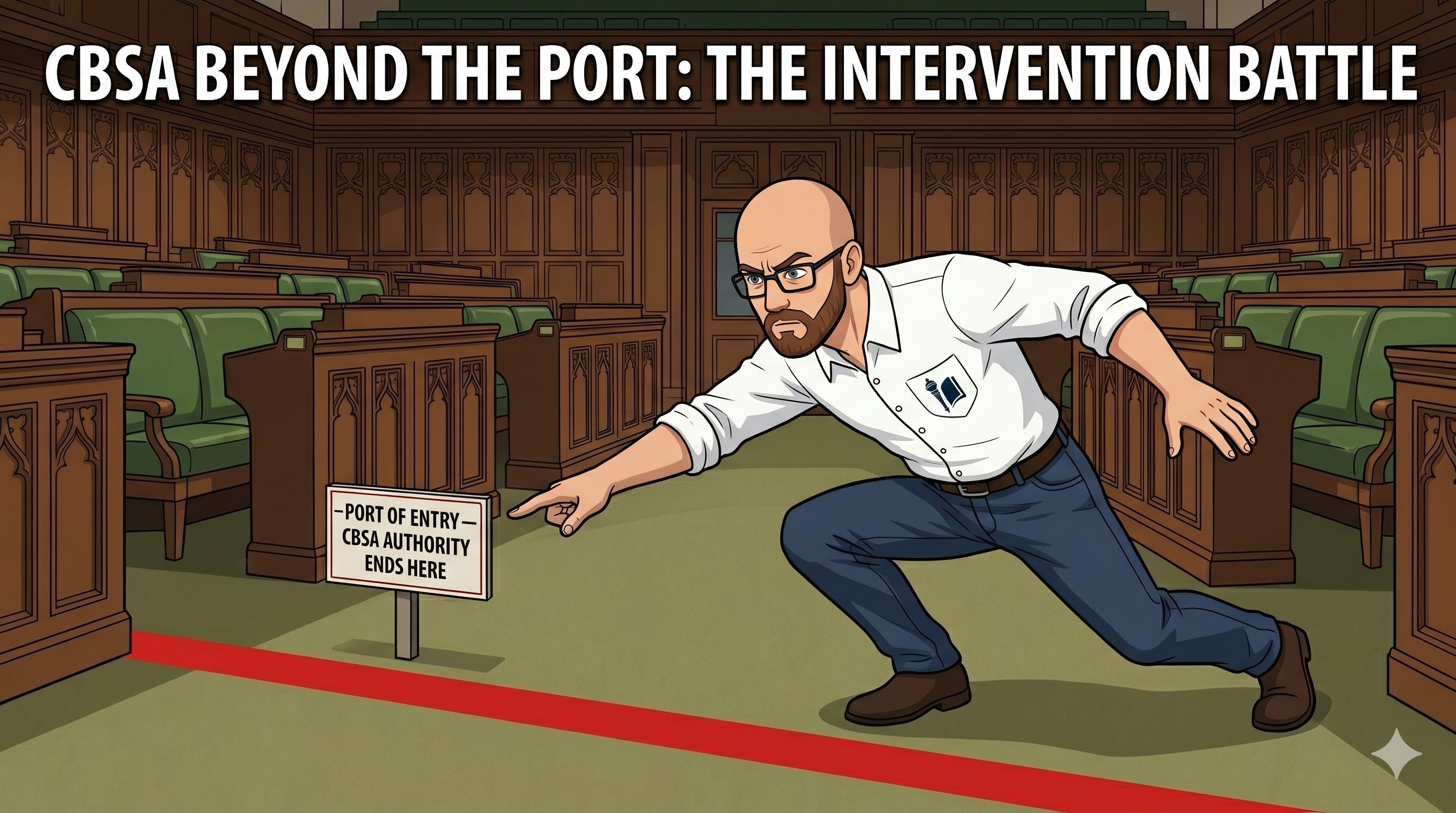
Mark Weber had seen the pattern too often. A Canada Border Services Agency officer posted near an official port of entry would notice movement just beyond the line. The officer would radio for help. Then the wait would begin. Hours could pass before a Royal Canadian Mounted Police unit arrived, if one came at all. In some cases the call went unanswered.
Weber, National President of the Customs and Immigration Union, laid out the scene during testimony before the House of Commons Standing Committee on Public Safety and National Security. The committee’s May 2026 report records his account of irregular crossings observed in rural areas close to official ports. Even when officers witnessed a crossing, they lacked authority to intervene. Only the CBSA and the RCMP hold interception powers under the Immigration and Refugee Protection Act and the Customs Act. Everyone else must escort people to the nearest CBSA port.
The result, Weber told the committee, was a system that created its own delays. He called the situation regrettable and easily fixed by giving CBSA officers the power to act directly outside official ports of entry.
Kenneth Bieger, Chief Executive Officer of the Niagara Falls Bridge Commission, described the same constraint on bridges. CBSA officers are armed yet cannot step in when an incident occurs on the span. They must summon regional police or the RCMP. Bieger pointed to the Whirlpool Bridge, where people have attempted irregular crossings along the railroad tracks despite an advanced security system. Multiple agencies still end up involved, stretching response times.
The committee heard a different view from Brian Sauvé, President of the National Police Federation. He warned against expanding the CBSA mandate. The agency already faces a shortfall of roughly 3,000 officers needed to meet its current responsibilities at ports of entry. Adding duties between ports, he argued, would duplicate roles the RCMP federal policing program is already structured to handle. Sauvé urged Parliament to reinforce the RCMP instead.
Two Agencies, One Border, Divided Powers
The division of labour is written into law. The CBSA controls people and goods at official ports of entry under the Canada Border Services Agency Act, the Customs Act, the Customs Tariff, and the Immigration and Refugee Protection Act. The RCMP holds responsibility for security between those ports under the Royal Canadian Mounted Police Act, the Customs Act, and the IRPA. It investigates irregular entry, human trafficking, drug trafficking, and firearms smuggling.
Sean McGillis, Assistant Deputy Minister of Federal Policing Strategy and Business Management at Public Safety Canada, told the committee the RCMP relies on the Joint Operational Intelligence Cell to share sensitive information with partners. The cell was stood up in March 2025 under the Border Plan. McGillis also described an aerial intelligence force of helicopters, drones, and surveillance towers meant to monitor the spaces between ports and speed up incident response.
Christian Leuprecht, a professor at the Royal Military College of Canada, argued the current split places both agencies on too broad a spectrum. A specialized agency handles the ports while a generalist agency carries an expansive mandate everywhere else. Minor adjustments or added personnel will not close the gaps, he said. Political commitment to restructure the national security posture is required.
Hiring Plans Meet Hard Numbers
The government has committed to hiring 1,000 new CBSA officers and 1,000 new RCMP officers. The first CBSA cohort was scheduled to begin training in November 2025. Erin O’Gorman, President of the CBSA, told the committee the agency’s college in Rigaud can train 250 recruits in each of the first two years and 300 the year after. A pool of 300 qualified candidates already existed who could start within six weeks. Eighty percent of the new positions are designated for armed officers; the remaining 200 will fill specialized operational roles in trade, intelligence, targeting, criminal investigations, and inland enforcement.
Weber countered that the real need sits between 2,000 and 3,000 officers. As of 23 September 2025, no hires under the 1,000-person plan had been made. Aaron McCrorie, Vice-President of Intelligence and Enforcement at the CBSA, confirmed the timeline stretches two to three years.
At major airports the agency already leans heavily on student border officers. They represent nearly 19 percent of the workforce at locations such as Montréal-Trudeau. These students receive three weeks of training before they begin evaluating national security threats and drug smuggling at primary inspection points. Recommendation 8 of the committee report calls on the government to properly resource the CBSA to reduce this reliance.
The Scale of What Remains Unenforced
The committee also examined the removal system. Recommendation 24 calls for immediate additional resources to locate and remove 33,458 individuals who held active deportation warrants as of 29 January 2026 and had not yet been found. The figure sits in the report as a concrete measure of unfinished work inside the immigration enforcement system.
The broader Border Plan, announced 17 December 2024, allocates $1.3 billion over six years. That includes $355.4 million for the CBSA and $667.5 million for the RCMP. Witnesses from Public Safety Canada noted early results: a 99 percent drop in southbound irregular migration since the previous summer. United States data cited in the hearings showed less than 1 percent of fentanyl seized south of the border originates in Canada.
Still, operational frictions persist. Lucas Bédard of the National Police Federation described detachments running short on personnel. At Saint-Jean-sur-Richelieu, only 12 officers might cover a shift built for 24, forcing units into a constant reshuffle that undercuts investigations. He and Sauvé both pressed for sustained investment in technology and human resources.
A Mandate Question That Will Not Go Away
The committee’s first recommendation is direct: give CBSA officers the power to patrol and intervene in urgent situations outside official ports of entry. Other recommendations call for dedicated RCMP border funding, modern surveillance and intelligence tools, expanded training capacity at Rigaud, reduced reliance on automated systems through more frontline officers, and a structural review to rebalance operational and administrative positions inside the CBSA.
Leuprecht told the committee that Canada is not currently structured to counter transnational threats effectively. Minor additions will not suffice. The record shows a border where officers sometimes see what they cannot stop, where hiring targets lag behind stated needs, and where tens of thousands of removal orders remain outstanding. The committee has placed the question of mandate reform squarely before the government.
Hansard Files spends weeks in the archives so you don’t have to. If stories like this matter to you, The archive stays free. A paid membership funds the hours to work the next file.
Related Hansard Files Articles


Source Documents
House of Commons, Standing Committee on Public Safety and National Security. (2026, May). Canada-United States Border Management: Report of the Standing Committee on Public Safety and National Security. 45th Parliament, 1st Session. Ottawa: House of Commons.
I was thinking about the Anglosphere intelligence alliance (FVEY, UKUSA) integration while reading this. A quick search suggested that the CBSA is as integrated as I already knew the RCMP were.
As more Canadians recognize the greatest threat to the sovereignty of Northern North American Nations (Canada and pre-existing/Indigenous nations) isn't from distant Westphalian governments, but the USA and other parts of the Anglosphere, I wonder when that agency integration question will be adequately discussed and addressed.
Problems like this which are so easily defined and relatively simple to solve, should never come around again.