


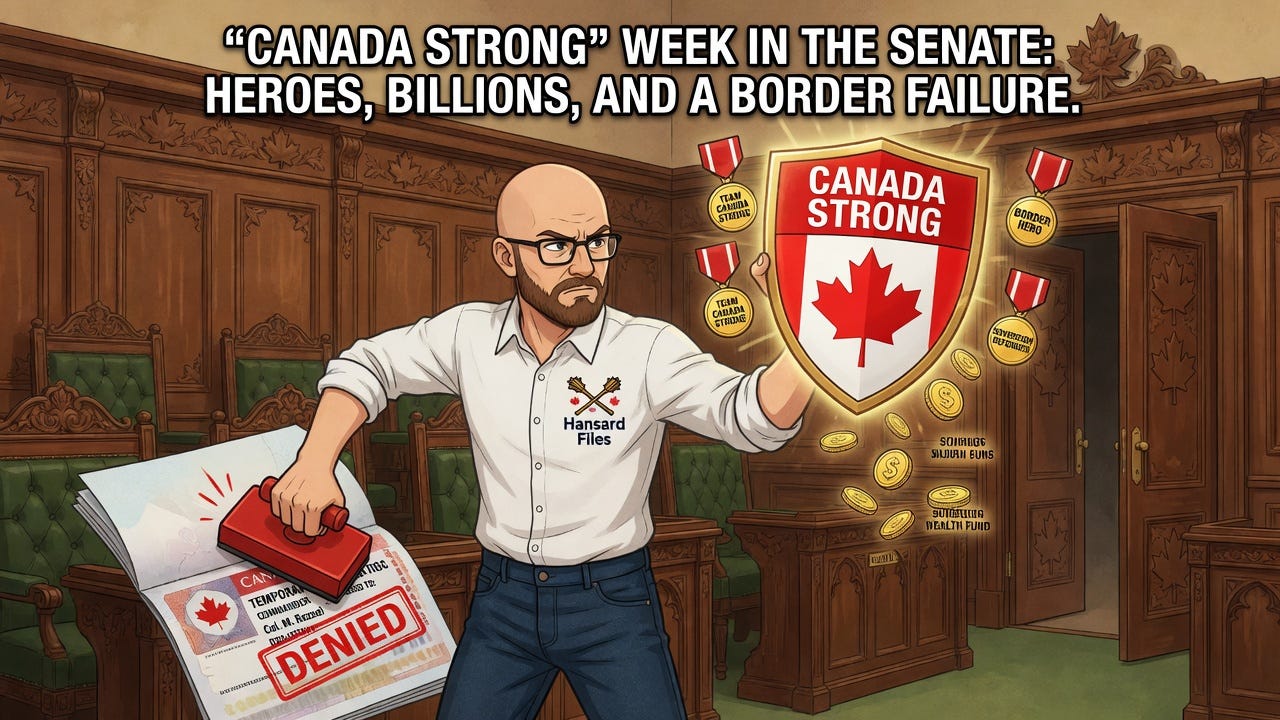
The Senate chamber carries its own quiet weight. On the last Tuesday of April 2026, it began with a minute of silence for workers killed or injured on the job. By Friday, it had heard stories of Canadians who had stared down air-raid sirens in Bucha, met polar bears in their tents on the Arctic ice, and fought for language rights in Ontario courtrooms. It had also been told that an IRGC commander was issued a temporary resident permit, only to be turned away at the border by officers who apparently understood the risk better than the system that granted it.
This was the week the government tabled its Spring Economic Update 2026 and unveiled the Canada Strong Fund, its first national sovereign wealth fund, alongside the $6-billion Team Canada Strong workforce strategy. The Senate’s response was not simple applause. It was a mix of tribute, inquiry, and pointed accountability that revealed what “strong” actually requires.
Tuesday, April 28: Service That Outlasts a Lifetime
The day opened with remembrance. Senators stood for the National Day of Mourning. Then came the human stories that give meaning to national strength.
Senator Baltej Dhillon marked Sikh Heritage Month by recalling the 1984 anti-Sikh riots and the quiet courage of those who chose service over revenge. Senator Rebecca Patterson rose for Canada’s military intelligence professionals, the analysts and collectors who turn raw data into decisions that keep troops alive. Senator Wanda Thomas Bernard spoke of Dalhousie’s new Africentric Bachelor of Social Work cohort, 36 African-Nova Scotian students whose lived experience is now the baseline of their practice, not an add-on. Senator Stan Kutcher reminded colleagues that World Immunization Week was about protecting the vulnerable with science, not slogans.
The most visceral tribute came from Senator David Wells for the late Jim O’Toole. The 46-year-old St. John’s firefighter and union leader had pushed Bill C-224, the PFAS cancer presumption bill, even while battling suspected PFAS-related cancer himself. He left behind a wife and two teenage sons who had watched their father advocate until the end. “His legacy will endure,” Wells said. The chamber answered with a standing ovation that lasted.
Then came the first sharp question of the week. Senator Leo Housakos asked about Mehdi Taj, a commander in the Islamic Revolutionary Guard Corps, a listed terrorist entity. Taj had been granted a temporary resident permit to attend the FIFA Congress. Border officers denied him entry. Housakos noted that only one IRGC-linked person had been removed from Canada, while more than 700 remained. Iranian Canadians, he said, lived under the constant shadow of transnational repression. Senator Pierre Moreau declined to discuss the specific case but assured the chamber that terrorists were not welcome.
Wednesday, April 29: The $37.5-Billion Vision and the Humans Who Embody It
The next afternoon, the Spring Economic Update was tabled. The government framed the Canada Strong Fund as a long-term vehicle for sovereign investment in clean energy, critical minerals, and major projects, open to individual and corporate investors alike. It promised $37.5 billion in new measures over six years, including the Team Canada Strong initiative to recruit and train 80,000 to 100,000 young skilled trades workers.
Opposition Leader Housakos was not impressed. He called it a “sovereign debt fund” financed by more borrowing, not surplus. He asked why any country running deficits should copy Norway or Alberta. Moreau countered that the fund would attract private capital, create jobs, and strengthen sovereignty. The exchange was brisk, technical, and unresolved.
Yet the day’s most memorable moments were not about dollars. Senator Hassan Yussuff rose to congratulate his colleague Stan Kutcher on receiving Ukraine’s Order of Merit, third class. Kutcher, son of Ukrainian immigrants, had traveled at his own expense to Kyiv, Lviv, and Bucha, working under air-raid sirens to strengthen mental-health supports for children and youth traumatized by war. “He doesn’t just speak,” Yussuff said. “He shows up.”
Senator Danièle Henkel honored Geneviève Mottard, the first woman to lead Quebec’s Order of Chartered Professional Accountants, who had transformed the profession into strategic partners for businesses navigating AI. Senator Rebecca Patterson welcomed “Polar Preet,” Captain Harpreet Chandi, MBE, who had crossed Antarctica solo four times and recently completed a 40-day trek across the Canadian Arctic, where a polar bear once tried to investigate her tent for snacks. Chandi’s next goal: ski unsupported to the North Pole, becoming the first woman, first Sikh, and first South Asian to reach both poles alone. The chamber gave her a sustained ovation.
Senator Marty Deacon welcomed the Canada Games Council staff and spoke of the $755-million sports investment that would flow from the update, infrastructure and coaching that could turn young athletes into the next generation of role models. Senator Robert Black celebrated AgScape’s 35 years of bringing agriculture education into Ontario classrooms.
The Senate was painting a picture of Canadian strength that had nothing to do with balance sheets: people who cross continents under fire, who break polar records, who open doors for the next generation in accounting, sport, and farming.
Thursday, April 30: Youth, Inequality, and the Visa That Wouldn’t Go Away
The final day opened with Senator Brian Francis marking Speech and Hearing Month and the barriers still faced by Indigenous children. Senator Rodger Cuzner celebrated the $755-million sports commitment as generational, noting it came on the heels of a Senate inquiry on physical activity. Senator Rosemary Moodie introduced participants in Gen(Z)AI, 100 young Canadians aged 17 to 23 who had spent seven months producing concrete policy recommendations on AI chatbots, data privacy, and age assurance.
Senator Marilou McPhedran hosted the Virus of Inequality Symposium and paid tribute to the “femtors” in their eighties, including the Honourable Jean Augustine, Canada’s first Black woman MP. The room rose for her.
Then the IRGC question returned with new force. Housakos read Minister Anand’s public statement from the previous day: the revocation of Taj’s permission “was unintentional.” He demanded to know which part had been unintentional, the issuance or the reversal, especially since the United States had already barred the same man. Moreau again cited security and said he could not comment on specifics. The chamber heard the same assurances it had heard two days earlier.
Senator Jane MacAdam raised the Auditor General’s report on military housing, noting that National Defence lacked reliable data on its own quarters even as it planned to grow the force. Moreau spoke of a $3.7-billion expansion delivering thousands of new units.
The day closed with committee reports on Russia’s disinformation, the Canada-Indonesia trade agreement, and connected care for Canadians. The Senate had moved from silent tribute to youth policy forums to billion-dollar investments to pointed questions about who gets let in and who gets left out.
What “Canada Strong” Actually Means
Across three sittings, the Senate did not simply debate a funding update. It tested the government’s definition of strength against lived examples. Strength looked like Stan Kutcher under sirens in Bucha. It looked like Harpreet Chandi choosing the harshest environments on earth to prove barriers can be broken. It looked like Jim O’Toole advocating while ill, and like 36 African-Nova Scotian students claiming their place in social work. It looked like young people in Gen(Z)AI demanding accountability from tech platforms.
It also looked like border officers refusing entry to a listed terrorist organization’s commander when the paperwork said otherwise, and like senators refusing to let the matter drop.
The Canada Strong Fund and Team Canada Strong may deliver infrastructure and trades workers. The Senate record from this week suggests that lasting strength will also require the harder work of consistent screening, reliable housing for those who serve, and the courage to name failures when they occur. The chamber adjourned on April 30 knowing the questions about that visa had not been fully answered. They will almost certainly return.
Hansard Files spends weeks in the archives so you don’t have to. If stories like this matter to you, subscribe — it keeps this work independent.
Related Hansard Files Articles


Source Documents
Senate of Canada. (2026, April 28). Debates of the Senate (Hansard), 1st Session, 45th Parliament, Volume 154, Number 68.
Senate of Canada. (2026, April 29). Debates of the Senate (Hansard), 1st Session, 45th Parliament, Volume 154, Number 69.
Senate of Canada. (2026, April 30). Debates of the Senate (Hansard), 1st Session, 45th Parliament, Volume 154, Number 70.
I feel an Ick when I agree with the current Reform party that took over the Conservative brand federally, but we should all be calling it a "Sovereign Debt Fund".
To reduce the ick I will point out that I also consider the ongoing operation of the Athabaska Tar Sands to be deficit increasing our debt -- any alleged Industrial activity that can't as a minimum clean after itself because doing so would be "too expensive" isn't an industry, but externalized debt that should be illegal.
https://r.flora.ca/p/fort-chipewyan
There's a financial maxim which cautions "past performance is not indicative of future results" to warn speculators against being dazzled by spectacular financial gains of the past. Oddly there isn't any similar maxim cauting about shitty performance.
The only difference I can see between the Liberal's past Infrastructure Bank slushfund and the Liberal's current Sovereign Debt slushfund is they're offering us tax slaves the opportunity to throw away our savings in addition to the deficit spending to be money laundered to Liberal friendly firms. What could possibly go right?