


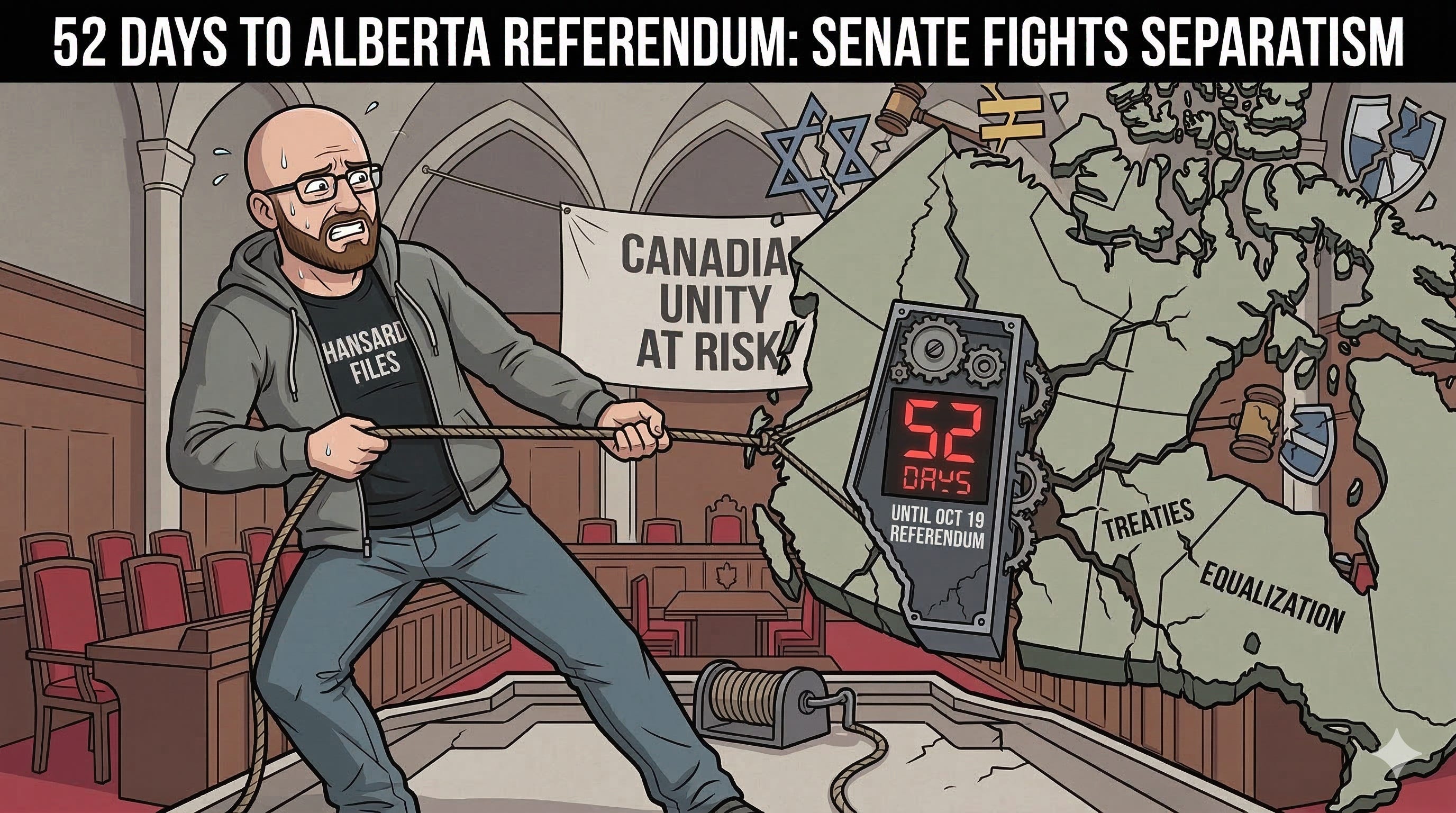
The Senate chamber fell silent on March 11, 2026, as Senator Daryl S. Fridhandler rose to deliver a stark warning. With only 52 days left until the Alberta Prosperity Project’s deadline, Premier Danielle Smith has confirmed that a separation referendum will be held on October 19 if the petition succeeds. Nine additional Smith-initiated referenda, proposing everything from limiting access to provincially funded programs to abolishing the federal Senate, now loom over the federation. Alberta separatism, once dismissed as fringe, has become the central test of Canadian unity in the Red Chamber.
Alberta Separatism: The Referendum Threat and Senate Warning
Senator Fridhandler spoke with urgency under the vaulted ceiling. “Today, we are a mere 52 days until the Alberta Prosperity Project’s May 2 deadline,” he said. Premier Smith has lowered the signature threshold and extended the collection period, moves Fridhandler described as appeasement of hard-line groups now controlling the United Conservative Party. He quoted Conservative insider Ken Boessenkool: “Today, Take Back and Free Albertans control the United Conservative Party of Alberta, and Danielle Smith’s ability to contest the next election.”
The senator contrasted Alberta’s financial grievances — equalization payments and federal-provincial power imbalances, with Quebec’s distinct cultural history. “Quebec governments have played separatism well,” he noted, “and Alberta is attempting to follow their precedent. However, Quebec is unique and distinct in many, many ways.”
First Nations leaders have already drawn a firm line. Chief Sheldon Sunshine of the Sturgeon Lake Cree Nation launched legal action, reminding senators that treaties were signed with Canada and predate Alberta’s 1905 creation as a province. A counter-petition, Forever Canadian, gathered 500,000 signatures, demonstrating that most Albertans want to remain in Canada.
Fridhandler closed with a direct appeal: “I ask you, my Senate colleagues, to be steadfast in your support of a united Canada. I ask our federal government to take action sooner rather than later. Who if not the Prime Minister? October 19 will be upon us soon.” Some honourable senators responded with “Hear, hear.”
The warning echoed through the week. Alberta separatism is not abstract; it threatens the very treaties, institutions and shared prosperity that bind the country.
Hate Crimes and Anti-Semitism: Shots Fired at Synagogues and Consulates
The same week, violence underscored the fragility of social cohesion. On March 10, Senator Leo Housakos confronted Government Representative Senator Pierre Moreau: “Hate crimes and politically motivated violence are running rampant in our communities. Just this past week, three synagogues in Toronto were struck by gunfire. Now even diplomatic buildings are being targeted, with the U.S. consulate in Toronto being shot at this morning.”
Housakos demanded acknowledgment that the government’s “permissiveness towards hateful and discriminatory rhetoric at protests since 2024” had put lives at risk. Moreau replied that the government was “horrified,” that Minister Anandasangaree had stood with the community, and that anti-Semitism has “no place in Canada.” He pointed to increased funding for the Canada Community Security Program and the introduction of the combatting hate act, Bill C-9.
Housakos pressed further, noting attacks on Jewish, Sikh, Hindu and Muslim communities over the past decade. “All eyes are on Canada,” he warned. The exchange revealed deep Senate concern that rhetoric and inaction were allowing division to spiral.
Earlier, on March 9, Senator Charles S. Adler had delivered a powerful statement on combatting hate, recounting personal stories from Holocaust survivors to Black History Month pins, and declaring: “I choose to love the dehumanized… I cannot love Canada without loving every Canadian.”
Foreign Disinformation: Jamestown Report Casts Suspicion on Chinese Canadians
On March 11, Senator Yuen Pau Woo issued a second urgent alert. A Jamestown Foundation report claims to have identified more than 575 Canadian organizations as part of the Chinese Communist Party’s United Front Work Department. Woo noted the list was never made public, yet even Liberal and Conservative Chinese-Canadian political associations were labelled without evidence.
“Based on the evidence presented in the report, activities such as celebrating Chinese culture, promoting Canada-China trade and generally representing Chinese-Canadian communities are treated as evidence of co-optation,” Woo explained. He warned this risked a “modern incarnation of the Chinese Exclusion Act of 1923,” creating systemic discrimination and voter suppression.
Woo urged parliamentarians: “If you have evidence that laws have been broken, report it to the authorities, but if you suspect a Chinese-Canadian organization is a malign foreign agent simply because it celebrates Chinese culture… you are promoting a modern form of Chinese exclusion.” The senator linked the issue to broader foreign interference threats, noting the foreign influence transparency registry appears to exclude the most dangerous non-state actors.
Woo’s March 9 statement had already highlighted inconsistencies in Canada’s international stance, contrasting condemnation of Russian attacks on Ukrainian civilians with defence of strikes in Iran that killed over 135 schoolgirls.
Women’s Safety, Representation and Resilience: Femicides to Paralympic Gaps
International Women’s Day statements wove through the week, revealing parallel fractures. On March 9, Senator Julie Miville-Dechêne listed seven femicides in Quebec in just two months: Sonia Maricela Gonzalez Vasquez, Marie-Kate Ottawa, Véronic Champagne, Susana Rocha Cruz, Mary Tukalak Iquiquq, Tadjan’ah Désir and Danielle Lascelles. She cited disturbing school surveys showing rising misogyny, homophobia and transphobia.
On March 12, Senator Paulette Senior invoked the global theme “Rights. Justice. Action. For ALL Women and Girls,” warning that hard-won gains are fragile. Senator Scott Tannas paid tribute to Georgina Faith Papin, one of Robert Pickton’s victims, recalling her as the smiling child he taught to swim in High River: “These are people we knew and should have known much longer.”
Senator Bernadette Clement, on March 10, celebrated Paralympic athletes while noting zero Black Canadians competing in 2026. “Representation matters,” she said, calling for better access, diverse leadership and exposure. Senator Tracy Muggli highlighted Saskatchewan’s suicide prevention efforts during Social Work Month, noting higher provincial rates and the Pillars for Life plan.
These statements underscored that national unity must include safety for women, girls and racialized communities.
Legislative Progress: Immigration Bill Receives Royal Assent
Amid the debates, the Senate advanced critical legislation. On March 12, the Strengthening Canada’s Immigration System and Borders Bill received royal assent after third reading and amendment debates. The National Strategy for Soil Health Bill advanced through committee. Motions extended studies on veterans’ affairs and Newfoundland and Labrador’s offshore petroleum industry.
Question Period also tackled pipeline projects, Arctic sovereignty, IRGC threats and affordability. Senator Housakos pressed for firm timelines on new pipelines to tidewater, while Moreau emphasized clean-growth criteria and collaboration with Alberta.
Broader Implications: Unity, Action and the October Test
From Alberta separatism to hate crimes, foreign disinformation and women’s safety, the Senate’s March 9–12 sittings painted a nation at a crossroads. Senators repeatedly returned to the same imperative: concrete federal action before October 19. Division, whether provincial, communal or ideological, carries real human cost — from First Nations treaties to Jewish safety, Chinese-Canadian participation and gender equality.
The chamber’s message was unequivocal. Canada’s resilience depends on defending shared institutions, rejecting exclusion and choosing unity over fragmentation. October 19 will test whether Ottawa hears the Senate’s call.
Hansard Files digs through dense parliamentary archives to surface these high-stakes stories. Subscribe today to power independent investigations into Canada’s Senate.
Source Documents
Parliament of Canada. (2026, March 9). Debates of the Senate (Hansard), 1st Session, 45th Parliament, Volume 154, Number 55. Ottawa, ON: Senate of Canada.
Parliament of Canada. (2026, March 10). Debates of the Senate (Hansard), 1st Session, 45th Parliament, Volume 154, Number 56. Ottawa, ON: Senate of Canada.
Parliament of Canada. (2026, March 11). Debates of the Senate (Hansard), 1st Session, 45th Parliament, Volume 154, Number 57. Ottawa, ON: Senate of Canada.
Parliament of Canada. (2026, March 12). Debates of the Senate (Hansard), 1st Session, 45th Parliament, Volume 154, Number 58. Ottawa, ON: Senate of Canada.
Hansard, thank you for this important update. It shows the Senate is unafraid to tackle the nation’s biggest threats.
Senator Yuen Pau Woo is not a voice I would amplify. His connection to the the Chinese Communist Party may be stronger than his connection to Canada.