


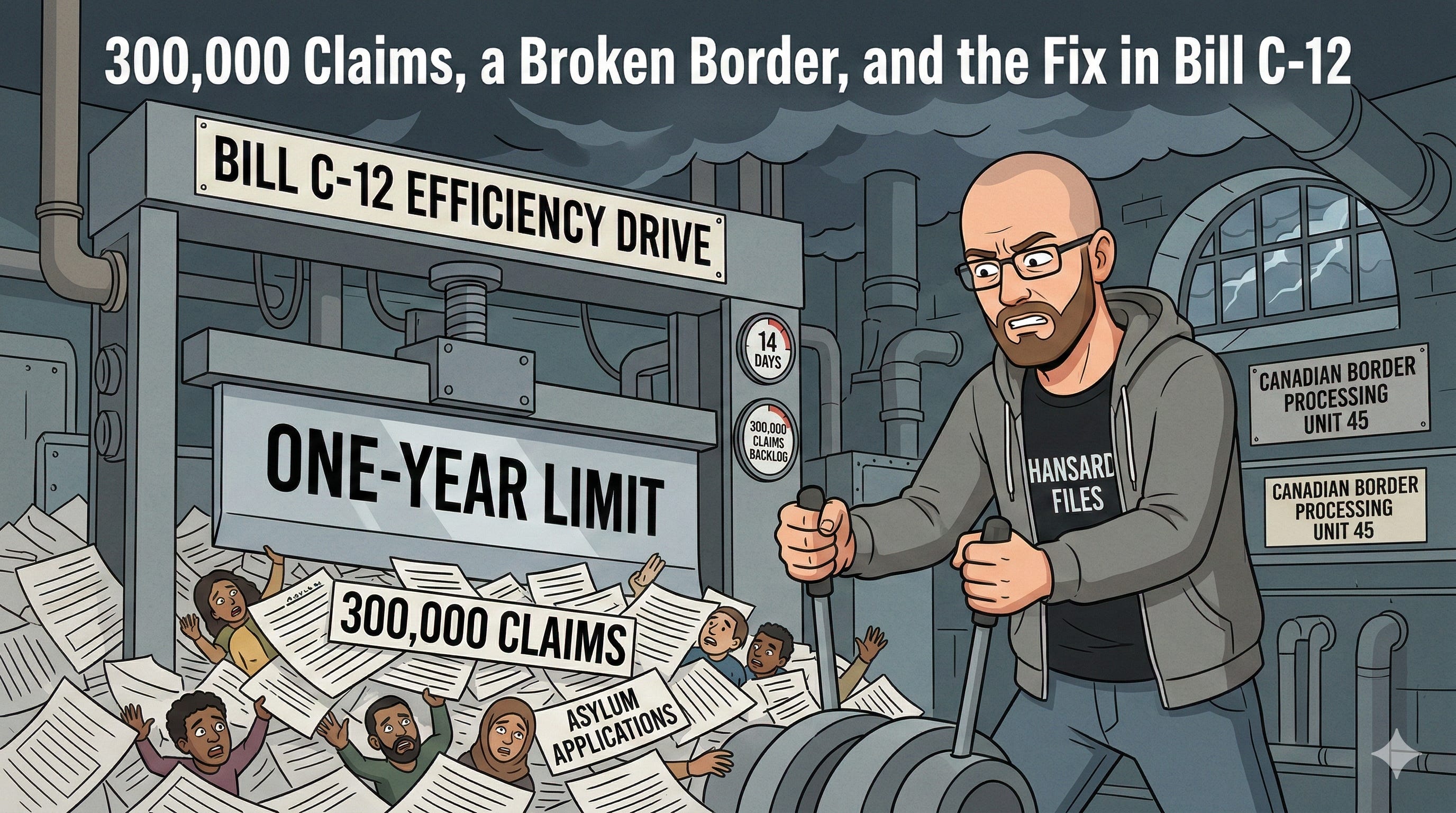
In the quiet, wood-paneled committee rooms of the Senate of Canada, a legislative storm was brewing in February 2026. Over the past decade, the Canadian immigration and border security apparatus has buckled under the weight of unprecedented global migration and the sophisticated tactics of transnational organized crime. The human cost is staggering. On the streets, the illicit fentanyl trade has claimed the lives of over 55,000 Canadians. Meanwhile, inside the bureaucratic corridors of Immigration, Refugees and Citizenship Canada, an astonishing backlog of 300,000 asylum claims has effectively paralyzed the system. In response to this dual crisis, the federal government has introduced Bill C-12, a sweeping legislative package designed to overhaul how the nation polices its borders, processes refugees, and shares intelligence. Yet, as lawmakers study the proposed law, a profound ideological and operational battle has emerged. The stakes could not be higher, pitting the grim mathematics of a public health disaster against the fundamental human rights of the world’s most vulnerable people.
The Fentanyl Crisis and the Promise of Bill C-12
The federal government insists that the legislation is a necessary evolution to match the fast-moving tactics of modern crime syndicates. Testifying before the Standing Senate Committee on National Security, Defence and Veterans Affairs, Minister of Public Safety Gary Anandasangaree framed the bill as a critical tool for law enforcement. He reminded the committee of the devastating toll of the opioid epidemic, noting that each night, more than twenty families go to bed having lost a loved one to illicit drugs.
The Royal Canadian Mounted Police corroborated this stark reality. Senior Deputy Commissioner Bryan Larkin introduced the concept of poly-criminality, explaining that modern crime groups no longer specialize in a single illicit trade. Instead, they seamlessly pivot between organized crime, human smuggling, and terrorist financing to maximize profits. During a recent enforcement sprint between May and October, a coalition of agencies seized 386 kilograms of fentanyl and nearly 6,000 kilograms of cocaine.
To combat this, the legislation modifies the Customs Act and the Oceans Act. Brian Sauvé, representing the National Police Federation, praised Part 2 of the bill. This section allows the Minister of Health to quickly classify emerging precursor chemicals under Schedule V, giving law enforcement the authority to intercept these substances before they are synthesized into deadly opioids on Canadian streets. Sauvé noted that these measures could have allowed police to intercept chemicals used in massive British Columbia fentanyl labs earlier in the year.
The bill also extends a formal security mandate to the Canadian Coast Guard. Adam Lajeunesse, an associate professor at St. Francis Xavier University, contextualized this shift for the Arctic. He argued that while high-intensity military conflicts are unlikely in the far north, Canada faces an increasing array of hybrid threats, including illegal fishing and unauthorized marine scientific research by foreign adversaries. Integrating the Coast Guard into a common operating picture with the Department of National Defence will multiply Canada’s situational awareness in the vast, ice-covered waters.
Indigenous Jurisdiction and the Jay Treaty
However, this expansion of maritime authority is not universally welcomed. Grand Chief Cody Diabo of the Mohawk Council of Kahnawà:ke expressed deep reservations regarding the Coast Guard’s new powers over inland waters. Diabo asserted that First Nations possess an inherent right and jurisdiction to protect their own territories, and that no Canadian legislation should diminish that authority.
Diabo warned that increased border enforcement often results in racial profiling and the criminalization of Indigenous peoples who frequently cross the border. He pointed to the Jay Treaty Border Alliance, noting that Indigenous people are currently forced to navigate complex immigration systems simply to visit family or return to their traditional homelands across the United States border. He emphasized that First Nations people are neither immigrants nor refugees, and that the federal government must engage directly with rights holders rather than imposing unilateral security measures.
A System Paralyzed by 300,000 Claims
The security apparatus is only one half of the legislative package. The other half attempts to salvage an immigration and refugee system that is collapsing under its own weight. Minister of Immigration, Refugees and Citizenship Lena Metlege Diab bluntly outlined the institutional crisis. The asylum system currently groans under a staggering backlog of approximately 300,000 cases. Diab argued that while Canada has an absolute obligation to protect those fleeing torture and persecution under the 1951 Refugee Convention, the system is being heavily strained by individuals using asylum claims as a backdoor to regular immigration pathways.
To stem the tide, the legislation introduces rigid timelines. Claimants arriving from the United States would have just 14 days to request protection, while others would face a strict one-year limitation period from their date of first entry into Canada. The mathematical impact of these limits is massive. Jason Hollmann, Director General of Asylum at the immigration department, revealed that if the one-year rule had been applied between June and October of the previous year, it would have summarily eliminated 19,000 out of 50,000 applications.
The One-Year Clock and the Threat of Deportation
For human rights organizations, these efficiency measures represent a catastrophic abandonment of Canada’s humanitarian obligations. Testifying before the Standing Senate Committee on Social Affairs, Science and Technology, a coalition of advocates tore into the proposed timelines.
Julia Sande, a campaigner for Amnesty International Canada, stated unequivocally that the length of time it takes a person to file a claim has absolutely no bearing on whether they face genuine persecution. By implementing the one-year bar, Sande warned that the government is targeting refugees based on the mechanics of their arrival rather than the substance of their danger. The legislation forcibly removes these delayed claimants from the independent Immigration and Refugee Board and funnels them into the Pre-Removal Risk Assessment process.
This shift is far from a mere administrative shuffle. The new system offers significantly fewer procedural safeguards. Claimants are stripped of their right to a mandatory oral hearing, relying instead on paper-based assessments conducted by civil servants. Azadeh Tamjeedi, Senior Legal Officer for the United Nations High Commissioner for Refugees in Canada, testified that oral hearings are vital for assessing credibility, especially when documentary evidence from war-torn nations is scarce. Furthermore, the alternative process eliminates the automatic right to appeal. An incorrect decision by a single officer could result in an individual being deported to face torture before the Federal Court can even review the case.
The strict deadlines also ignore the psychological realities of trauma. Basel Abou Hamrah of the Canadian Council for Refugees explained that delay is frequently a survival strategy for marginalized groups. LGBTQ+ individuals, domestic abuse survivors, and political dissidents often require time to build trust and find a safe environment before disclosing the deeply personal reasons for their flight. By prioritizing speed over safety, the bill penalizes those whose identities make them the most vulnerable.
Unprecedented Power and the Public Interest
Beyond the restrictive timelines, Part 7 of the bill introduces executive powers that critics describe as alarmingly broad. The legislation grants the federal cabinet the authority to cancel, suspend, or vary immigration documents and applications en masse if doing so is deemed in the public interest.
Timothy McSorley, representing the International Civil Liberties Monitoring Group, argued that this vague terminology is ripe for political abuse. He noted that public safety and national security have historically been weaponized by governments to enact discriminatory policies against specific ethnic, religious, or political groups. The power to cancel documents in bulk raises the terrifying prospect of entire populations losing their legal status overnight.
Karen Cocq of the Migrant Rights Network was even more direct, telling senators that mass cancellation powers are inherently mass discrimination powers. She reminded the committee of Canada’s dark history with similar executive decrees, pointing to the use of orders in council to deport labour organizers during the 1919 Winnipeg General Strike, to turn away Jewish refugees aboard the MS St. Louis in 1939, and to intern Japanese Canadians in 1945. Cocq argued that no regulatory amendments could salvage Part 7, insisting that the sweeping authority must be completely deleted from the bill.
Following the Money in Transnational Crime
The legislation’s sprawling reach also extends deeply into the financial sector. Hartland Elcock, representing the Canadian Bankers Association, testified that banks already devote significant resources to combatting money laundering and terrorist financing. They frequently participate in public and private partnerships with the federal financial intelligence unit to track illicit funds tied to the fentanyl trade. While the banking sector supports the overall security goals of the bill, Elcock proposed targeted amendments to ensure that new administrative monetary penalties are applied transparently and predictably, rather than arbitrarily penalizing institutions for administrative delays beyond their control.
This financial scrutiny highlights the vast scope of the legislation, which attempts to regulate everything from Arctic icebreakers to corporate bank accounts and vulnerable asylum seekers. The government insists that the system is broken and requires these drastic, multi-jurisdictional measures to protect Canadian lives. Civil society warns that this efficiency is being purchased at the unacceptable price of human rights and procedural fairness. As the Senate continues its deliberations, the final outcome of this legislation will ultimately dictate not just the security of Canada’s borders, but the very moral character of the nation.
Our team at Hansard Files spends countless hours digging through dense parliamentary archives so you don’t have to. If you believe in the power of deep, independent investigative journalism, please subscribe to support our work.
Source Documents
Senate of Canada. (2026, February 11). Evidence of the Standing Senate Committee on National Security, Defence and Veterans Affairs
Senate of Canada. (2026, February 10). Evidence of the Standing Senate Committee on Social Affairs, Science and Technology
Senate of Canada. (2026, February 9). Evidence of the Standing Senate Committee on National Security, Defence and Veterans Affairs
Senate of Canada. (2026, February 12). Evidence of the Standing Senate Committee on National Security, Defence and Veterans Affairs
Good to know - those changes to wait times for immigration claims will result in less long term costs to public services - addressing these backlogs is a sign that our government has taken the problem seriously
Agree with the what if’s, but control is required. I agree the backdoor is being abused. So are education claims. Need far more enforcement and CLEAR requirements. Canadian’s have rights first and foremost.