


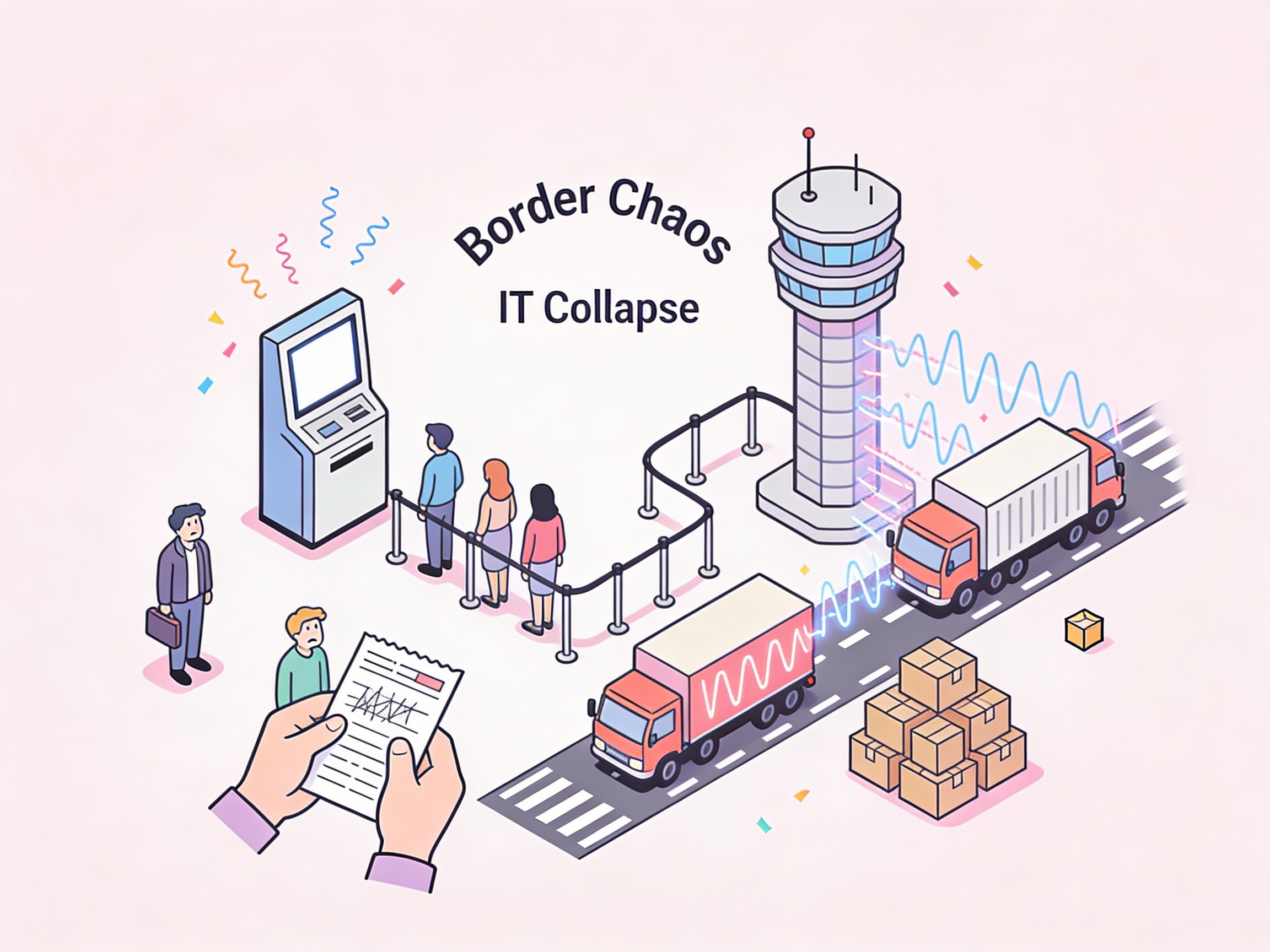
At 2:30 a.m. on September 28, 2025, in the quiet hum of Shared Services Canada’s data centers, technicians initiated what should have been a routine database upgrade for the Canada Border Services Agency (CBSA). Screens flickered as code rolled out across live production systems supporting traveller kiosks, inspection booths, and commercial cargo clearances. No alarms sounded at first; the upgrade had succeeded in rehearsals. But within hours, corruption spread like digital wildfire through live data, crashing primary inspection kiosks at major airports and crippling electronic manifests for trucks, ships, planes, and trains nationwide.
Passengers arriving at Toronto Pearson or Vancouver International stared at blank kiosks, queues snaking through terminals like veins clogged with frustration. Border officers at Windsor and Emerson crossings waved through hundreds of trucks manually, backlogs piling up into days-long delays that threatened supply chains from auto parts to perishables. Airlines scrambled for manual no-fly list checks, stranding passengers in foreign hubs and domestic gates.
The Fatal Patch: Human Error Ignites Cascade
Deep in the report’s technical autopsy, the root cause emerges starkly: a prerequisite patch skipped by SSC engineers, unchecked by vendor software. “The vendors upgrade process did not check for this patch,” the document states flatly, revealing how human oversight turned a non-disruptive plan into cascading failures. Data corruption prevented even backups from saving the day, forcing teams into frantic rollbacks and manual repairs that stretched into October.
By afternoon on September 29, compounding the nightmare, SSC pushed an “emergency security patch” to CBSA firewalls without notifying the agency or airlines. Communications snapped between carriers and the Interactive Advance Passenger Information (IAPI) system, halting board/no-board decisions for seven critical hours from 2 p.m. to 8 p.m. ET. Planes sat idle, passengers fumed in seats, and missed connections rippled across global routes.
Southern Ontario ports like Windsor-Detroit bore the brunt, with trucks idling for hours or days; Manitoba crossings echoed the gridlock. Officers relied on training and ground cues for risk assessments, countering claims of missed lookouts. Yet the stakes loomed larger: unguuarded borders risked national security, economic lifelines strained under perishable freight rotting in rail yards and marine holds.
Frontline Fighters Amid Digital Darkness
Imagine a CBSA officer at Pearson’s secondary inspection, radio crackling amid offline systems, eyes scanning manifests scribbled by hand. From September 28’s partial outage (1:30 p.m. to 4 p.m.) to full blackouts totaling over 14 hours across days, primary systems failed repeatedly: 9 hours overnight into September 29, 2-hour spikes on October 2, a midnight hour on October 4. Commercial portals limped for 46.5 hours straight, performance degrading into October 6.
Erin O’Gorman, CBSA President, and Scott Jones, SSC President, signed the October 31 submission to Ministers of Public Safety and Government Transformation. Their joint probe laid bare the human toll: stranded families, delayed shipments, eroded trust with airlines and trade partners. “Delays boarding certain passengers in foreign and domestic airports,” the report notes, as carriers fell back to outage protocols too slow for peak travel.
Highway crossings swelled with backups, southern Ontario and Manitoba ports reporting multi-day truck jams. Marine and rail yards choked on uncleared goods, air cargo halted. Frontline agents adapted, but inconsistency plagued responses; contingency plans bent but did not fully break the chaos.
Lessons Forged in the Breach: A Roadmap to Resilience
In boardrooms overlooking Ottawa’s Rideau Canal, presidents O’Gorman and Jones pored over failure timelines, distilling pain into action. Under “People and Organizational Factors,” the report demands joint reviews for IT change roles by March 2026, cultural shifts at SSC to grasp CBSA’s real-world stakes. Collaboration forums with airlines and trade chains launch by November 2025, rebuilding frayed trust.
Process gaps glare: unintegrated change management, missing approvals. Fixes include tight integrations, audits by October 2026, bolstered emergency plans exercised by March. Communications overhaul spans internal protocols, live industry channels, government updates, all targeted for November.
Technology’s fragility dominates: fragile ecosystems, single failure points, aging tech debt ignored. By October 2026, architectures face scrutiny; redundancies harden, frontlines insulated from back-end woes. Technical debt elevates to top risk, renewal prioritized with central agencies by March 2026. Commitments ring clear: “CBSA and SSC remain committed to ensuring that CBSA IT services are reliable and fully support Canada’s economic and national security needs.”
Echoes of Vulnerability: Borders on the Brink
As repair crews toiled past October 25, data fixes ongoing, the report’s timelines pulse with urgency. November 2025 deadlines crowd for processes and partnerships; March 2026 for people and planning; 2026 horizons for tech overhauls. Southern Ontario’s truckers, Manitoba’s haulers, airport workers, and global carriers watch, wondering if promises hold against next glitch.
The document, stamped with Crown copyright, stands as indictment and blueprint. What began in predawn code became a national wake-up: borders digitized to the hilt, yet felled by unchecked patches. Canada’s gateways, vital arteries for 38 million citizens and trillion-dollar trade, teetered on human error’s edge.
Now, with ministers briefed and actions queued, the question hangs: will fortified systems avert the next outage, or expose deeper fractures in federal IT? Stakeowners from Pearson ramps to Pacific ports demand more than words; they seek unbreakable digital shields.
Source Documents
Canada Border Services Agency and Shared Services Canada. (2025, October 31). Joint Report on CBSA IT Outages between September 28 and October 5, 2025.