


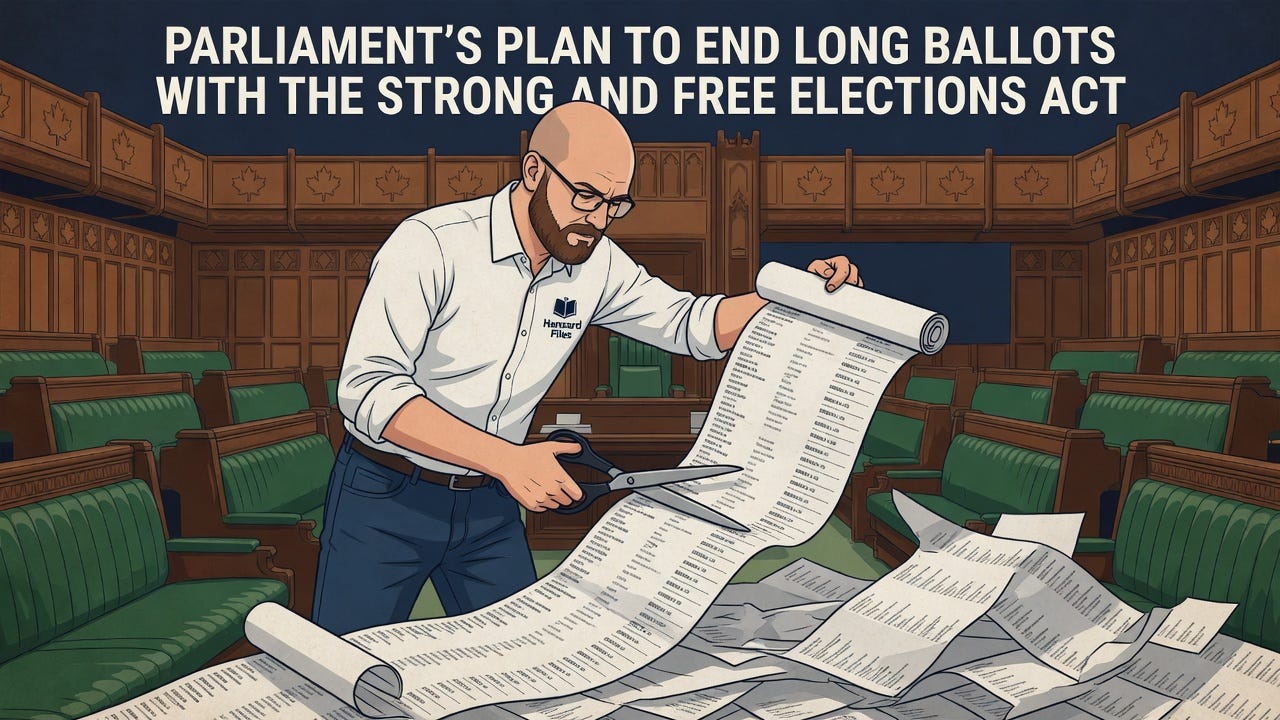
On the morning of April 24, 2026, Hon. Kevin Lamoureux rose in the House of Commons to speak on Bill C-25. The Parliamentary Secretary to the Leader of the Government in the House of Commons brought more than a dozen elections of personal experience to the debate. He had represented Winnipeg North through six federal campaigns and earlier served provincially in Inkster. He described knocking on doors, meeting voters, and building support the old-fashioned way. Then he turned to a problem that had grown in recent by-elections and the last general election: unduly long ballots filled with names submitted to prove a political point rather than to offer genuine representation.
Lamoureux explained the practical fix contained in the Strong and Free Elections Act. Voters would be limited to signing only one nomination form in a riding. Each candidate would require a unique official agent. The measures would not stop serious candidates who actually gather the required signatures by meeting people. They would, however, end the tactic of circulating sheets for 100 names at once and turning the ballot into a confusing list that discourages participation and muddies voter choice.
The room listened. This was not abstract theory. It was a veteran MP describing the lived reality of campaigning and the quiet erosion of clarity at the ballot box.
A week of quiet but consequential reforms
That Friday debate capped a week in which the House moved forward on several fronts aimed at strengthening public trust in Canadian institutions.
On Monday, April 20, members resumed consideration of private member Bill C-226, An Act to establish a national framework to improve food price transparency. Lamoureux again took the floor, this time highlighting consumer confusion over shrinkflation and inconsistent package sizes. He noted that Quebec already had measures in place and argued a national framework would give other provinces a model while allowing them to go further. The recorded division was deferred until after Oral Questions the following day.
Tuesday, April 21, brought two distinct government initiatives. Hon. Steven MacKinnon introduced Bill C-28, An Act to amend the Aeronautics Act and other Acts, which would create a framework for Canadian space launches. The bill received first reading and was set for second reading at the next sitting. Later, the House concurred in the 23rd report of the Standing Committee on Procedure and House Affairs, which adjusted membership on the Veterans Affairs committee. Then Garnett Genuis moved concurrence in the seventh report of the Standing Committee on Human Resources, Skills and Social Development and the Status of Persons with Disabilities. In his speech, Genuis described a metastasizing youth unemployment crisis and what he called profession prejudice: the elite tendency to dismiss trades and practical careers that actually pay well and face critical shortages while young people struggle to find work that matches their skills. He outlined a four-part plan: unleash the economy, fix immigration, fix training, and build homes where the jobs are.
Wednesday, April 22, produced the week’s clearest show of cross-party consensus. The House took the deferred recorded division on Bill S-211, An Act respecting a national framework on sports betting advertising. The motion passed 291 to 28. The bill now moves to the Standing Committee on Canadian Heritage. Earlier that day, members heard statements on the UQTR Patriotes hockey championship, a campaign to rebuild Kamloops’ historic Red Bridge, and Earth Day reflections.
Thursday, April 23, focused on accountability and oversight. Hon. Kevin Lamoureux tabled the government’s responses to 28 petitions. John Brassard presented the fifth report of the Standing Committee on Access to Information, Privacy and Ethics, a comprehensive review of the Conflict of Interest Act that included recommendations for strengthening the legislation. The committee requested a government response under Standing Order 109. John Williamson presented two reports from the Standing Committee on Public Accounts, one on the National Trade Corridors Fund and another on Main Estimates 2026-27, plus a third report calling for modernization of section 13 of the Auditor General Act to improve access to information. Petitions were also tabled urging support for Bill C-260, the care not coercion act, after veterans described being directed toward medical assistance in dying when they sought help to live.
Friday returned the House to Bill C-25. After Lamoureux’s personal reflections, the debate continued. Hon. Steven MacKinnon gave notice under Standing Order 57 that he intended to move at the next sitting to limit further debate on Government Business No. 9, the closure mechanism available when the government believes time has been sufficient. The clerk had earlier informed the House of the Speaker’s unavoidable absence, and Deputy Speaker Tom Kmiec (Calgary Shepard) took the chair.
The human thread running through the records
What connects these seemingly separate files is a shared concern for clarity, fairness, and protection of ordinary Canadians. The long-ballot fix speaks directly to the moment a voter stands in the polling station and tries to make sense of the choices. The food-price framework addresses the moment a family opens a smaller package at the same price. The youth-training motion addresses the moment a young person finishes school and cannot find work that matches the shortages employers report. The Conflict of Interest report and Public Accounts scrutiny address the moment citizens ask whether the rules governing those in power are strong enough. The veterans’ petitions address the moment someone who served the country reaches out for help and receives the wrong answer.
None of these changes happened in a single dramatic vote or viral confrontation. They advanced through the steady rhythm of statements, reports, deferred divisions, and notices of motion that make up the daily work of the House. The transcripts capture the arguments, the personal stories, and the procedural steps that together shape the rules Canadians live under.
What changes at the next election and beyond
When the next federal election arrives, the rules for getting on the ballot will be tighter. Voters in ridings that once faced pages of names may see shorter, clearer lists. Provinces watching the food-price framework will have a federal model to consider or improve upon. Young people entering the workforce may find training programs better aligned with actual job openings. Veterans seeking support will have additional parliamentary attention on whether the system offers care first. Public office holders will operate under whatever strengthened conflict rules emerge from the committee’s recommendations.
These are not revolutionary shifts. They are incremental adjustments born of observed problems and cross-party agreement on specific fixes. The Hansard record of April 20-24, 2026, shows a Parliament still capable of identifying friction points in the systems it oversees and moving, however deliberately, to reduce them.
The next time you stand in a voting booth, compare grocery prices, help a young person explore trades training, or hear a veteran’s story, these days in the House will already be shaping the options in front of you.
Hansard Files spends weeks in the archives so you don’t have to. If stories like this matter to you, subscribe — it keeps this work independent.
Related Hansard Files Articles


Source Documents
House of Commons Canada. (2026, April 20). *Journals*, No. 106.
House of Commons Canada. (2026, April 20). *House of Commons Debates (Hansard)*, Volume 152, No. 106.
House of Commons Canada. (2026, April 21). *Journals*, No. 107.
House of Commons Canada. (2026, April 21). *House of Commons Debates (Hansard)*, Volume 152, No. 107.
House of Commons Canada. (2026, April 22). *Journals*, No. 108.
House of Commons Canada. (2026, April 22). *House of Commons Debates (Hansard)*, Volume 152, No. 108.
House of Commons Canada. (2026, April 23). *Journals*, No. 109.
House of Commons Canada. (2026, April 23). *House of Commons Debates (Hansard)*, Volume 152, No. 109.
House of Commons Canada. (2026, April 24). *Journals*, No. 110 (Unrevised).
House of Commons Canada. (2026, April 24). *House of Commons Debates (Hansard)*, Volume 152, No. 110.
What is a deferred division please? Also thank you, I am very glad I decided to subscribe to your substack.
Nice to see parliament doing what parliament is supposed to do. sharing.