


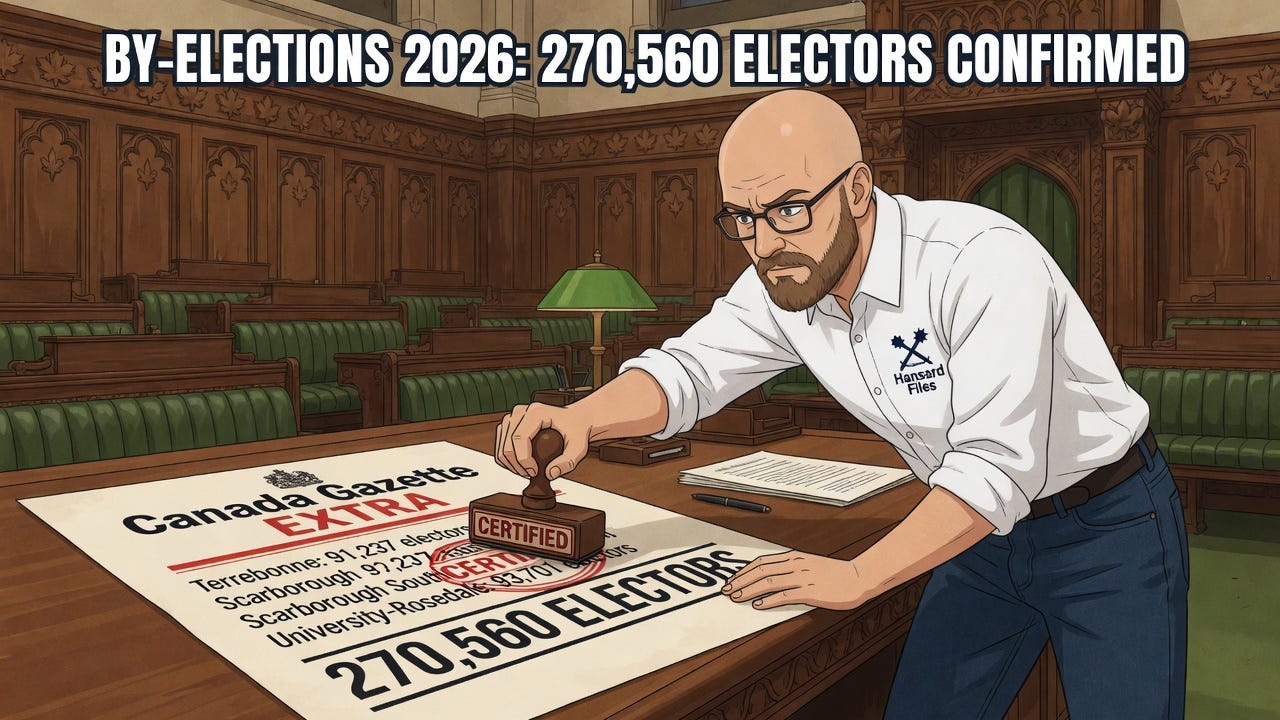
Friday, April 3, 2026. In the quiet offices of the Chief Electoral Officer in Ottawa, Stéphane Perrault signs a formal notice. No cameras flash. No speeches echo. Yet that single page, rushed into the EXTRA edition of the Canada Gazette, locks in the exact scale of three pending by-elections that will test turnout, spending limits and campaign strategies across two provinces. The Canada Gazette determination, published under subsection 105(2) of the Canada Elections Act, is now public record.
The numbers are precise, final and binding:
Terrebonne, Quebec: 91,237 electors on the revised lists.
Scarborough Southwest, Ontario: 85,622 electors.
University-Rosedale, Ontario: 93,701 electors.
Together they total 270,560 Canadians whose names now define the battlefield for the next federal votes in those ridings.
The Precise Voter Baseline That Shapes Every Campaign
Under the Canada Elections Act, these revised-list counts are not estimates. They are the official figures Perrault has certified for the pending by-elections. Candidates must calculate spending ceilings against them. Parties must plan get-out-the-vote operations around them. Poll workers will measure every ballot cast against these exact totals. The Canada Gazette EXTRA made the data instantly available to every campaign headquarters, every journalist and every voter in the three districts.
The notice appears in both official languages, signed by Perrault on April 3. It carries the weight of law. No further adjustments appear in the document. The three ridings, one in Quebec and two in Ontario, now operate under the same national standard. The publication marks the moment the by-elections move from planning to measurable reality.
From EXTRA to Full Edition: Broader Government Notices Land on April 4
The very next day, Saturday, April 4, the regular Canada Gazette Part I, Vol. 160, No. 14 arrives. Its table of contents runs from government notices on page 642 through proposed regulations on page 685. The Office of the Chief Electoral Officer section again references the pending by-elections, reinforcing the Friday EXTRA. Yet the Saturday edition widens the lens to everyday decisions that touch thousands of Canadians.
One of the most immediate impacts comes from the Department of Citizenship and Immigration. Under the Financial Administration Act and the Immigration and Refugee Protection Regulations, permanent residence fees will rise at 9:00 a.m. Eastern daylight time on April 30, 2026. The increases reflect the cumulative Consumer Price Index adjustment for 2024 and 2025, rounded to the nearest five dollars.
Right of Permanent Residence Fee jumps from $575 to $600.
Most economic immigration principal applicants move from $950 to $990.
Family sponsorship fees rise from $85 to $90.
Business principal applicants see their fee climb from $1,810 to $1,895.
Accompanying spouses, common-law partners and dependent children face similar proportional increases across federal high-skilled, provincial nominee, family reunification and protected-persons streams. The Canada Gazette tables compare current fees (April 2024–March 2026) against the new rates (April 2026–March 2028) in exhaustive detail.
Environmental and Regulatory Updates Round Out the Week’s Gazette
The same April 4 edition contains two environmental notices from the Department of the Environment under the Canadian Environmental Protection Act, 1999. One amends the Non-domestic Substances List by adding dozens of chemical identifiers in numerical order. The second issues final Release Guidelines for Chemicals Used in the Rubber Product Manufacturing Sector, including BENPAT and TMTD. These guidelines set concentration targets for industrial effluent, define normal operating conditions and establish verification processes for facilities across the sector.
Appointment opportunities appear under the Privy Council Office. Canadians have until April 8 to apply for Commissioner of Competition and until April 23 for Director of the Canadian Museum of Immigration at Pier 21. An erratum corrects a French-language heading in an earlier Bank Act notice.
Each of these items follows the same formal path: drafted, bilingual, published in the Canada Gazette to become official.
The pending by-elections now sit alongside these updates in the public record. Voter counts are locked. Fees are rising. Chemicals and appointments move forward. Ordinary Canadians in Terrebonne, Scarborough Southwest and University-Rosedale will feel the by-election machinery first, yet the wider Canada Gazette announcements remind them that government decisions ripple far beyond any single riding.
What happens next in these three districts will be measured against the exact numbers published April 3. And every Canadian affected by the April 30 fee increases or the new environmental guidelines will know the rules because the Canada Gazette put them in print, in plain sight.
Hansard Files digs through every Canada Gazette EXTRA and full edition so you don’t have to. Subscribe to back independent reporting that keeps democracy’s paperwork in plain sight.
Source Documents
Canada Gazette. (2026, April 3). EXTRA Vol. 160, No. 4. Office of the Chief Electoral Officer. Determination of number of electors.
Canada Gazette. (2026, April 4). Part I, Vol. 160, No. 14.
Thanks for an excellent update, Hansard!
By-elections tend to attract very little voter turnout. Given two of the three by-elections are in "safe" ridings, the total number of voters might be a more interesting metric than the results.