


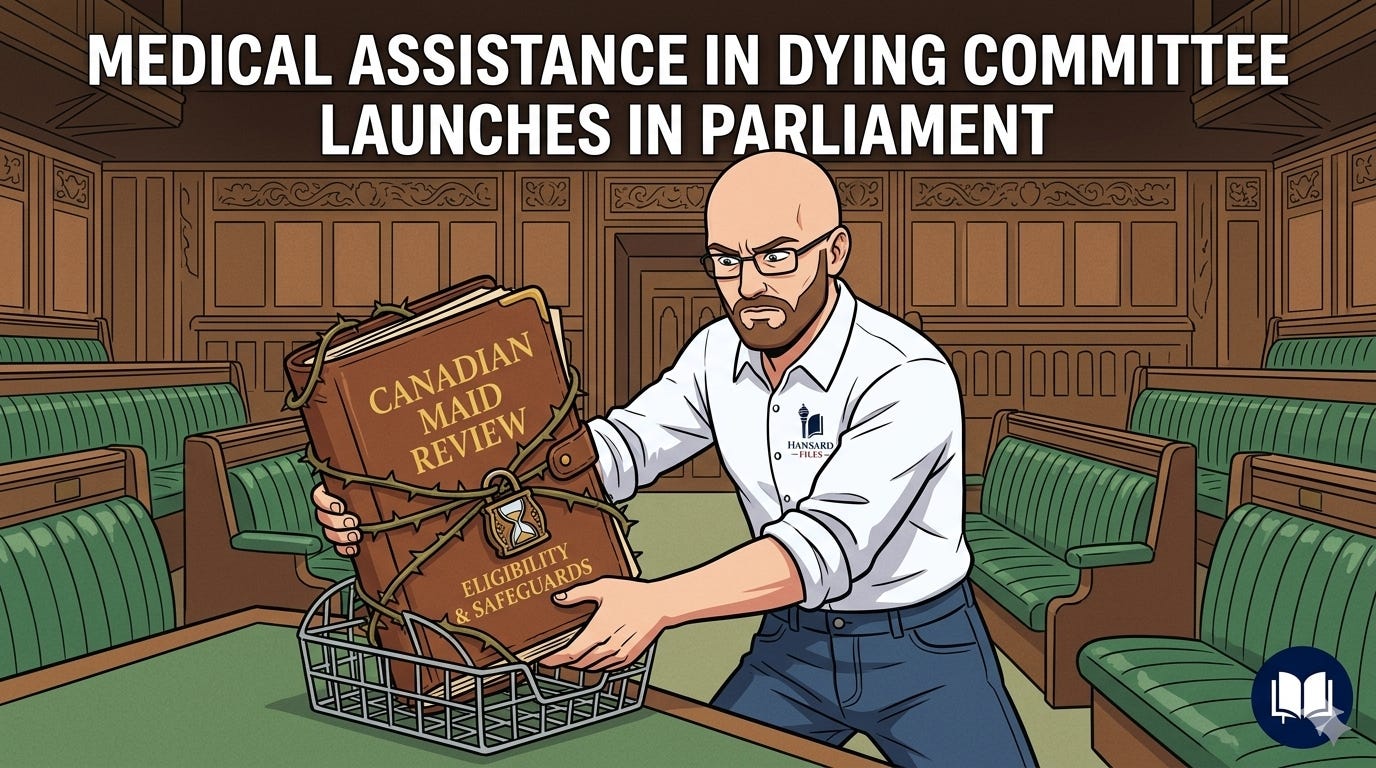
In the wood-paneled committee rooms of Parliament Hill on Tuesday, March 10, 2026, the Special Joint Committee on Medical Assistance in Dying convened its first session under bright gallery lights. Medical Assistance in Dying, the framework that has reshaped end-of-life choices for thousands of Canadians since its passage, now stood at the threshold of fresh parliamentary review. No dramatic testimony filled the air yet. Instead, the room buzzed with the quiet mechanics of democracy: electing leaders, adopting rules and preparing for the weighty debates ahead.
Co-Chairs Marcus Powlowski, MP for Thunder Bay—Rainy River, and Senator Yonah Martin opened the session at 6:40 p.m. The joint clerk confirmed quorum. Routine motions passed swiftly, but not without moments of parliamentary colour. Senator Yonah Martin welcomed returning and new members after a last-minute Senate vote. “We made it on time,” she noted. Powlowski, chairing for the House, quipped about his “unenviable job” surrounded by lawyers and a former appeal court judge. “This is a new one for me,” he said. “I’ve done many things in my life, but this is my first time being the chair of a committee.”
The committee elected vice-chairs Tamara Jansen (Conservative) and Luc Thériault (Bloc Québécois) without contest. Seventeen routine motions followed, covering analysts from the Library of Parliament, a subcommittee on agenda and procedure, witness time (five minutes opening, with structured rounds), document distribution in both official languages and meals during extended sittings. Luc Thériault raised a practical concern about sound balance for interpreters during hybrid meetings. “I have to max out my volume, which is really dangerous,” he said. Powlowski acknowledged it was a recurring issue from the Health committee. The motion passed.
By 7:00 p.m. the public portion ended. The committee moved in camera to finalize internal matters. The stage was set for future evidence on Medical Assistance in Dying eligibility, safeguards and potential expansions.
Electing Leaders and Adopting Rules for Medical Assistance in Dying Scrutiny
The election of co-chairs followed established parliamentary tradition. Powlowski, representing the House of Commons side, and Martin, the Senate side, assumed their roles without contest. Members moved and seconded motions with the familiar “Hear, hear!” affirmations echoing through the chamber. Time allocation for future witnesses drew brief discussion on balance between House and Senate voices, but consensus formed quickly on standard procedures: meals during extended sittings, document distribution and confidentiality protocols.
These organizational steps, though procedural, carry national stakes. The committee’s mandate will shape future amendments to Medical Assistance in Dying legislation. Canadians grappling with terminal illness, chronic conditions or mental-health eligibility wait for the next phase of evidence and recommendations.
Infrastructure Powers Face Parallel Oversight Under the Building Canada Act
Across the Hill the same evening, the Special Joint Committee on the Exercise of Powers Under the Building Canada Act held its own inaugural session and quickly descended into substantive debate. Co-Chairs Dean Allison, MP, and Senator Patti LaBoucane-Benson opened at 6:35 p.m. Elections mirrored the Medical Assistance in Dying panel, but the routine motions sparked real drama.
Senator Toni Varone moved an amendment to witness time allocation, proposing equal four-minute rounds for all members in the first round and adjustments thereafter to ensure every senator and MP speaks once before repeats. “It would also allow you to cede your time,” Varone explained, citing Senator Jim Quinn’s rationale for fairness in this unique joint body.
Bloc MP Patrick Bonin objected strongly. “We are very uncomfortable with the proposal, which we think will greatly reduce our influence,” he said, arguing it shifted proportions from one intervention in eight to one in sixteen. Conservatives supported the fairness principle for elected members. After a ten-minute suspension, the amendment passed 8-7 on a recorded vote.
Debate then turned to voting rules. Joint Chair LaBoucane-Benson noted the Senate chair could vote while House co-chair Allison could not under current rules. Shannon Stubbs called it a point of order: “This committee is not a creature of the Senate, nor is it a creature of the House.” Gabriel Hardy warned that opposition proposals would always be defeated without fair voting. The committee suspended again, then adjourned at 7:50 p.m. unresolved, to resume the following Thursday with full membership. Billions in infrastructure funding and project approvals now hang on these procedural precedents.
Foreign Affairs Committee Turns to Venezuela Crisis
Simultaneously, the Standing Committee on Foreign Affairs and International Development held a substantive evidence session on the situation in Venezuela. Chair Ahmed Hussen welcomed officials from Global Affairs Canada. Wendy Drukier, Director General of South America and Hemispheric Affairs, outlined the post-Maduro landscape after the U.S. Operation Absolute Resolve on January 3, 2026. “The context has now changed,” she stated. Delcy Rodríguez serves as de facto acting president. Over 600 political prisoners have been released, though hundreds remain. An amnesty law passed with limitations.
Michael Chong pressed on Canada’s support for opposition leaders María Corina Machado and Edmundo González Urrutia in any transition. Drukier confirmed yes. On diplomatic recognition, Canada has not recognized the current regime and awaits a “recognized, democratic, transparent process.” Ambassador Stuart Savage detailed ongoing OAS engagement, including nine discussions since the disputed 2024 elections.
The session underscored Canada’s $260 million in aid since 2019 and commitment to a Venezuelan-led democratic transition.
A Full Week of Parliamentary Activity Across Standing Committees
The March 10 meetings formed part of a broader mobilization. Standing committees convened throughout the week of March 9 to 12, 2026, each electing chairs and adopting operating rules for the 45th Parliament, 1st Session. Public Safety and National Security met twice. Human Resources, Transport, Infrastructure and Communities, and National Defence opened earlier. Indigenous and Northern Affairs, Agriculture and Agri-Food, Health, Official Languages and others followed suit.
Additional standing committees on Public Accounts, Fisheries and Oceans, Canadian Heritage and Science and Research also began their work. The synchronized start illustrated the 45th Parliament’s determination to activate every oversight lever early in the session.
These first meetings, though routine on the surface, mark the moment when elected representatives and senators transition from campaign promises to concrete accountability. Every motion adopted today will govern months of testimony, reports and potential legislation affecting Medical Assistance in Dying eligibility, infrastructure project timelines, trade negotiations, public safety measures and Venezuela’s unfolding crisis.
Parliamentary committees are where the real work of governing happens, away from the spotlight of Question Period. The 45th Parliament has signaled its intent: no major file will escape scrutiny.
Hansard Files digs through dense transcripts to surface the stories shaping Canada. Subscribe to support independent parliamentary investigation and never miss the next committee breakthrough.
Source Documents
Parliament of Canada. (2026, March 10). *Special Joint Committee on Medical Assistance in Dying, Evidence, Number 001*. 45th Parliament, 1st session.
Parliament of Canada. (2026, March 10). *Special Joint Committee on the Exercise of Powers Under the Building Canada Act, Evidence, Number 001*. 45th Parliament, 1st session.
Parliament of Canada. (2026, March 10). *Standing Committee on Foreign Affairs and International Development, Evidence, Number 025*. 45th Parliament, 1st session.
Parliament of Canada. (2026, March 10). *Standing Committee on Public Safety and National Security, Evidence, Number 027*. 45th Parliament, 1st session.
Parliament of Canada. (2026, March 12). *Standing Committee on Public Safety and National Security, Evidence, Number 028*. 45th Parliament, 1st session.
Parliament of Canada. (2026, March 9). *Standing Committee on Human Resources, Skills and Social Development and the Status of Persons with Disabilities, Evidence, Number 027*. 45th Parliament, 1st session.
Parliament of Canada. (2026, March 10). *Standing Committee on Government Operations and Estimates, Evidence, Number 030*. 45th Parliament, 1st session.
Parliament of Canada. (2026, March 10). *Standing Committee on Indigenous and Northern Affairs, Evidence, Number 024*. 45th Parliament, 1st session.
Parliament of Canada. (2026, March 11). *Standing Committee on Public Accounts, Evidence, Number 027*. 45th Parliament, 1st session.
Parliament of Canada. (2026, March 10). *Standing Committee on Agriculture and Agri-Food, Evidence, Number 026*. 45th Parliament, 1st session.
Parliament of Canada. (2026, March 9). *Standing Committee on Transport, Infrastructure and Communities, Evidence, Number 024*. 45th Parliament, 1st session.
Parliament of Canada. (2026, March 12). *Standing Committee on Canadian Heritage, Evidence, Number 027*. 45th Parliament, 1st session.
Parliament of Canada. (2026, March 10). *Standing Committee on Health, Evidence, Number 024*. 45th Parliament, 1st session.
Parliament of Canada. (2026, March 11). *Standing Committee on Fisheries and Oceans, Evidence, Number 027*. 45th Parliament, 1st session.
Parliament of Canada. (2026, March 10). *Standing Committee on Official Languages, Evidence, Number 024*. 45th Parliament, 1st session.
Parliament of Canada. (2026, March 9). *Standing Committee on National Defence, Evidence, Number 026*. 45th Parliament, 1st session.
Parliament of Canada. (2026, March 10). *Standing Committee on Canadian Heritage, Evidence, Number 026*. 45th Parliament, 1st session.
Parliament of Canada. (2026, February 26). *Standing Committee on Science and Research, Evidence, Number 027*. 45th Parliament, 1st session.
MAID is a powder keg waiting to blow.