


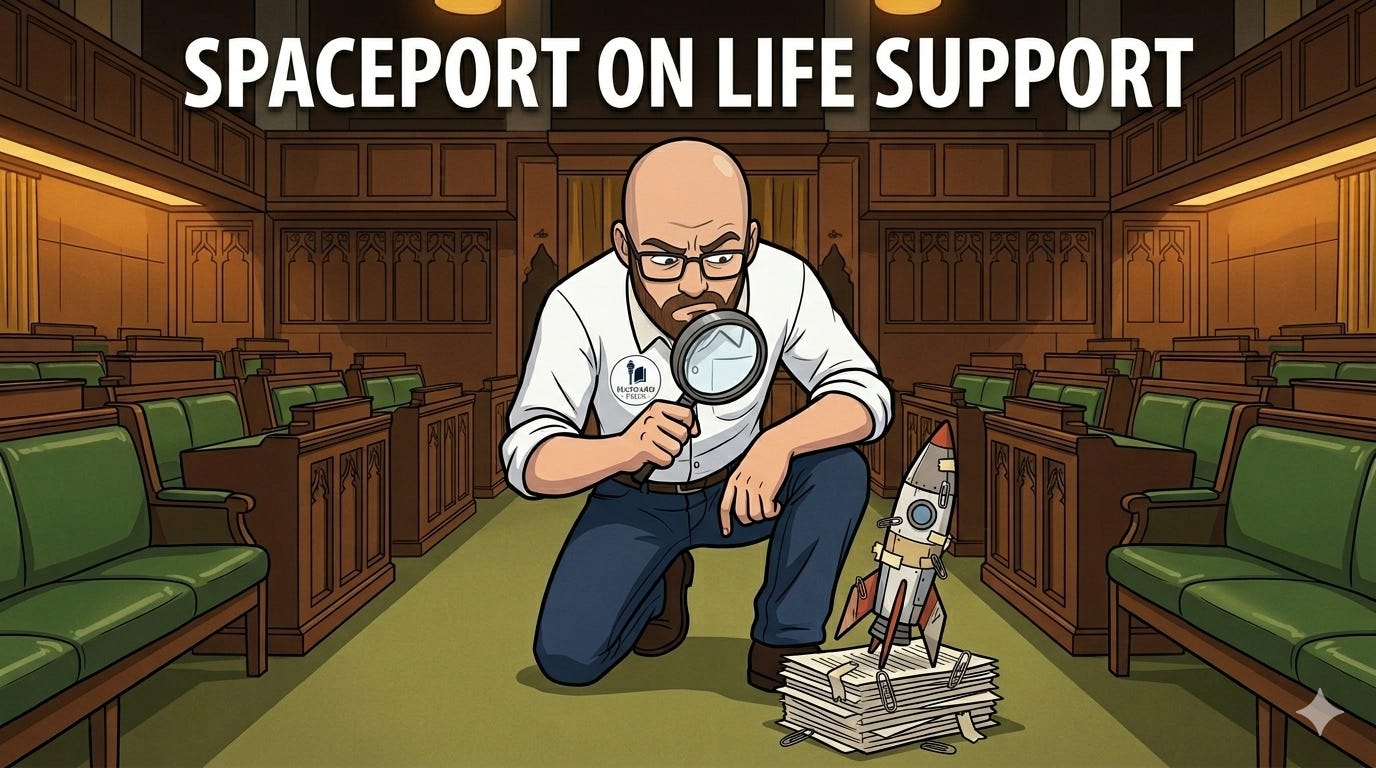
The number that stopped the debate was $13,472.
That’s what Maritime Launch Services paid the province of Nova Scotia to lease the land for Spaceport Nova Scotia, the company’s proposed commercial orbital launch facility. Thirteen thousand, four hundred and seventy-two dollars a year. The federal Department of National Defence, meanwhile, had committed $20 million a year to the same company under a separate agreement, part of a broader $200-million federal deal. The question that hung over the House of Commons on the evening of June 8, 2026, as MPs debated the department’s $17.9-billion Main Estimates, was a simple one: what exactly had taxpayers purchased?
Conservative MPs pressed hard. Maritime Launch Services, they argued, wasn’t a firm on the cusp of a breakthrough. It was a firm on the cusp of collapse. The company had reported less than $15,000 in revenue. It had accumulated $47 million in losses. Its independent auditors had issued going-concern warnings, the kind of language that signals a company may not survive to the next fiscal year. The chair of the company’s board, the opposition noted in the House, had a history of securities infractions on his record. And the firm had heavy lobbying ties to the government.
The government defended the deal as an investment in Canada’s sovereign space launch capability and domestic industrial capacity. Canada, the argument went, was the only G7 country without an orbital spaceport. The Spaceport Nova Scotia project, supporters said, represented exactly the kind of infrastructure the country needed to build strategic independence in a domain increasingly central to national security and economic competitiveness.
What the record didn’t resolve was the gap between those two descriptions.
$200 million, $15,000 in revenue, and an auditor’s warning
The Main Estimates debate gave Parliament a formal mechanism to force the question into the open record. The scrutiny focused on Vote 5, the Department of National Defence appropriation, and whether the Maritime Launch Services agreement represented sound stewardship of public funds or a bet placed on a company that the financial record suggested could not sustain itself.
The numbers MPs cited were drawn from the company’s own filings. Less than $15,000 in revenue. $47 million in accumulated losses. Auditor-flagged viability concerns. Against that backdrop, the $20 million annual federal payment wasn’t a partnership with a functioning commercial enterprise. It was, critics argued, the company’s primary revenue source. The federal contract wasn’t complementing a commercial operation. It was substituting for one.
The opposition also raised the lobbying record. Heavy government ties, they said. A chair whose regulatory history raised governance questions. Parliament had not been walked through any independent assessment of the company’s financial viability before the commitment was made.
The government did not produce one during the debate.
The chair’s record and the governance question
The securities infractions attributed to the company’s chair were raised by opposition members as a governance concern, not a legal finding by Parliament. No parliamentary determination was made about his fitness for the role, and the government did not directly address the allegation during the debate.
What the government did address was the strategic rationale. Canada’s absence from the sovereign launch market has real consequences, ministers and their allies argued. The country depends on foreign launch infrastructure for satellite deployment that supports Arctic sovereignty, climate monitoring, communications resilience, and defence operations. Building domestic capacity is a national security imperative, not a discretionary investment.
That framing is coherent. It’s also one that, by itself, doesn’t answer the question Parliament was actually asking: whether the specific company chosen to carry that imperative forward was capable of delivering on it.
What the record shows
Maritime Launch Services completed a suborbital launch demonstration from the Nova Scotia site on June 10, 2026, two days after the parliamentary debate. The demonstration was conducted in partnership with T-Minus Engineering B.V. The company announced it as a milestone in building operational readiness.
That announcement arrived after the Commons debate, not before it. Parliament voted on the Main Estimates without it.
The formal concurrence motion on Vote 5 passed. The $17.9 billion in National Defence appropriations was approved. The $20 million annual commitment to Maritime Launch Services, embedded in that larger appropriation, went with it.
The record now shows that MPs voted to continue funding a company whose auditors had questioned whether it could survive, whose revenues were negligible relative to the public money flowing toward it, and whose chair’s background had been raised in the House without a government response. Whether that investment produces an orbital launch capability or becomes another line in a long history of federal procurement disappointments is a question Parliament won’t be able to answer for years. What it had before it on June 8 was the financial record, the unanswered questions, and a vote.
It voted yes.
The week’s other stories, briefly
The Maritime Launch debate was the sharpest moment in a week that moved fast across five sitting days. What follows is a brief account of the other threads Parliament handled between June 8 and June 12.
June 8: A unanimous vote, decades in the making
The day opened with something rare. Bill S-228, a Criminal Code amendment to make forced sterilization an explicit criminal offence, passed unanimously. Every party supported it. The bill had travelled a long road from the testimony of survivors like Nicole Rabbit, a member of the Blood Tribe in Alberta who described being coerced into sterilization on an operating table in Saskatoon in 2001 while recovering from a C-section. Parliament had heard those accounts. On June 8, it finally acted on them.
The same day, a Conservative opposition motion framing Canada as “the only G20 country in a recession” was debated at length and ultimately defeated. The opposition cited downgraded growth forecasts from Scotiabank and the Bank of Montreal (both below one percent), an eight percent rise in insolvencies and ten percent rise in bankruptcies from the Office of the Superintendent of Bankruptcy, and a United Way report finding that 60 percent of Canadians feel financial anxiety and 2.2 million are waiting in food bank lines. The government countered with 88,000 to 90,000 jobs created in May alone, a AAA credit rating, and Canada leading the G7 in per capita direct investment inflows. Neither side moved the other.
June 9: Splitting the surveillance bill
The House agreed to split Bill C-22, the Lawful Access Act, in two. Part 1 covers basic subscriber confirmation rules, allowing police to verify without a warrant whether a suspect is a customer of a telecommunications provider. Part 2 is the broader architecture: metadata access, location services, and mandatory technical capability requirements for electronic service providers. The Conservative motion to separate them passed.
Jacob Mantle of the CPC did not mince words about the package as it stood: “I would describe Bill C-22 right now as a big, fat dumpster fire.”
Later that day, Bill C-20, the Build Canada Homes Act, passed third reading. The legislation establishes a new Crown corporation to build affordable housing on public lands, backed by an initial $13 billion allocation. The opposition argued the bill creates a fourth housing bureaucracy alongside CMHC, Canada Lands Company, and the Canada Infrastructure Bank, with no explicit completion targets for a country that needs 480,000 homes per year and is projected to build roughly half that in 2026.
The day ended with Liberal MP Nathaniel Erskine-Smith delivering a farewell address. He had crossed the floor on confidence votes and was leaving.
His parting line: “We all win elections as a team, but we should remember why we win elections. We win elections to serve ideas. We do not come up with ideas to serve elections.”
June 10: Hate crimes, bail reform, and nooses
The House debated Senate amendments to Bill C-9, the Combatting Hate Act, including the explicit designation of a noose as a hate symbol. Members also worked through bail and sentencing reform (Bill C-14) and legislation on electronic product repairability and electoral deepfake transparency. The House recognized National Indigenous History Month and Portuguese Heritage Month, and concurred in Bill S-210, the Ukrainian Heritage Month Act, at report stage.
June 11: A death, a self-government agreement, and a time allocation fight
The House paused on June 11 to mourn Toronto Police Service tactical officer Marc Pinizzotto, killed in the line of duty during a national security investigation. He was 43, a father of two, and an 18-year veteran of the service. Every party offered condolences.
The same day, Parliament advanced Bill C-27, the Tłegǫ́hłı̨ Got’įnę self-government act, with cross-partisan support. The legislation flows from the 1993 Sahtu Dene and Métis Comprehensive Land Claim Agreement and would give the nation authority to make its own laws, elect its own leadership, and deliver healthcare, education, and land management.
One MP’s framing of it: “Their ancestors governed themselves long before Canada existed, and this legislation would recognize that truth and restore the space for Indigenous decision-making to flourish again.”
The government also passed a time allocation motion to force through Bill C-30, the spring economic update, over opposition objections about debate being cut short.
June 12: Tariffs, time, and a framework for missing seniors
The final sitting day of the week was dominated by procedural battles over the time allocation motion for Bill C-30 and a running argument about U.S. tariff exposure and the government’s response to it. Among the Private Members’ Business items on the floor was Bill C-263, the Silver Alert National Framework Act, which would create a Canada-wide alert system for missing seniors living with dementia or other cognitive conditions, modelled on the Amber Alert system. No final vote on that bill was recorded this week.
The Prime Minister’s travel expenses also drew renewed criticism. The opposition put specific numbers on the floor: $159,781 spent on inflight food during a trip to Athens, and $175,248 for a trip to Zurich, totalling nearly $1 million in inflight catering over the past year.
Parliament rose for the week. The Maritime Launch vote was already in the record. The rest, as usual, moved on.
Hansard Files goes to the primary record so you don’t have to. If accountability journalism like this matters to you, consider subscribing to keep this work independent.
Related Hansard Files Articles


Source Documents
Government of Canada. (2026, June 8). House of Commons Debates (Hansard), 45th Parliament, 1st Session, No. 131. Ottawa: House of Commons.
Government of Canada. (2026, June 9). House of Commons Debates (Hansard), 45th Parliament, 1st Session, No. 132. Ottawa: House of Commons.
Government of Canada. (2026, June 10). House of Commons Debates (Hansard), 45th Parliament, 1st Session, No. 133. Ottawa: House of Commons.
Government of Canada. (2026, June 11). House of Commons Debates (Hansard), 45th Parliament, 1st Session, No. 134. Ottawa: House of Commons.
Government of Canada. (2026, June 12). House of Commons Debates (Hansard), 45th Parliament, 1st Session, No. 135. Ottawa: House of Commons.
Government of Canada. (2026, June 8–12). Journals of the House of Commons, 45th Parliament, 1st Session, Nos. 131–135. Ottawa: House of Commons.
The Cape Canaveral launch facility was built by government money, the ESA launch facility at in French Guiana, was built with government money. There are hundreds of launch sites around the world (even Iran has a bunch) so I think it is fine for the Canadian Government to fund this one on the east coast.
I guess there are a few issues with the MLS Spaceport. The company is a startup that is also in the process of developing a new rocket. I guess they must have a reasonably good system as they were selected to receive money as part of the DND rocket development competition. The investors and Governments have funded the rocket development but it is still not flight-ready yet and of course, has no payload.
MLS has a lease on one of the few sites that are appropriate for launching rockets into space and people knowledgeable to operate it. The government has a couple of choices regarding the ability to launch rocket from Canadian soil. There is the Newfoundland spaceport, reviving the Churchill spaceport, there is also a potential spaceport in Northern Quebec on Indigenous territory where a Concordia University sub-orbital rocket was launched last year.
None of these are operated by a well-backed operating concern.
The Government could takeover one of these locations and operate the spaceport directly or through a crown corporation, incentivise a Canadian company already active in aerospace like MDA to operate the spaceport and finally support a new company to enlarge the aerospace industry, support a new entrant and develop a local industry.
These decisions are always a difficult balance of cost-benefit, and risk analysis. It is certain that while the facilities are being built and Canadian launchers are available, there will be little revenue for the spaceport. The alternative options may also end up costing more in the long term.