


Nicole Rabbit was scheduled for a C-section at the University of Saskatoon on September 11, 2001. She trusted the medical team. Then she smelled burning flesh. Strangers insisted she tie her tubes. No one asked what she wanted. No one explained why. She signed no forms. She did not learn until later that the sterilization could not be reversed.
Twenty-five years after that September morning, her testimony, delivered in fragments before a parliamentary committee, echoed through the floor of the House of Commons on Monday, May 4, 2026, as members of every party rose to speak on Bill S-228, a Criminal Code amendment to make forced sterilization an explicit form of aggravated assault. The 45th Parliament, 1st Session had barely found its footing after a controversial manufactured majority, and already, in its first full sitting week of May, it was confronting the unhealed wounds of a century.
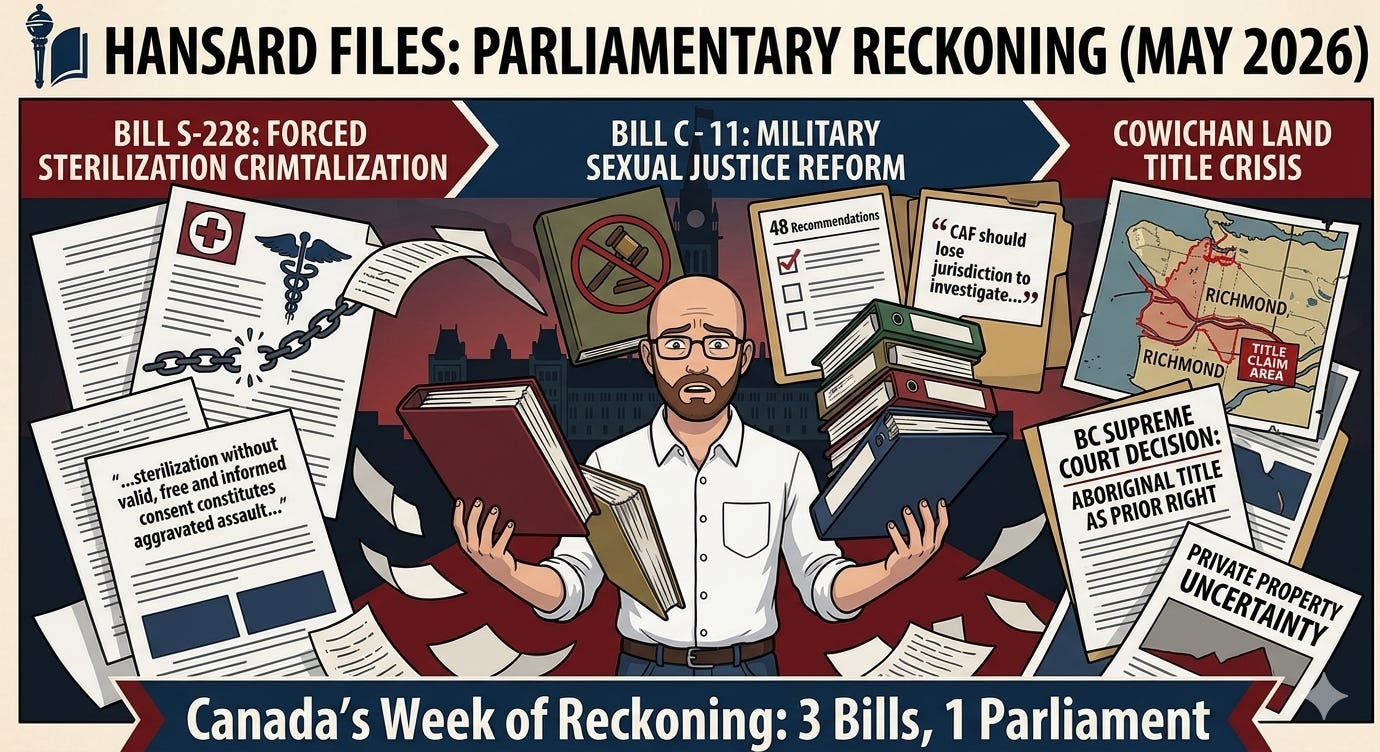
That week, volumes 116 through 120 of the Official Report of House of Commons Debates revealed three crises colliding at once: a long-overdue bill to criminalize forced sterilization, a sharply contested military justice overhaul for Canadian Armed Forces sexual assault survivors, and a seismic court ruling threatening the property titles of hundreds of thousands of British Columbians. Taken together, they formed something rarer than any single piece of legislation: a parliamentary portrait of a country grappling, simultaneously, with its colonial past, its institutional failures, and the foundations on which ordinary Canadians believe they stand.
Bill S-228 and the Survivors Who Made It Happen
The morning of May 4 opened with the House of Commons receiving additional 2026 reports from the Auditor General of Canada, tabled by the new Speaker, the Honourable Francis Scarpaleggia. Within minutes, the chamber shifted to Private Members’ Business for third reading of Bill S-228, An Act to amend the Criminal Code (sterilization procedures).
Jamie Schmale, the Conservative member for Haliburton—Kawartha Lakes and the bill’s House sponsor, rose at the despatch box to make the case with quiet urgency. “We are no longer debating whether the issue deserves attention,” he said. “We are deciding whether Parliament will act.” The bill, he explained, does not create a new offence. It makes explicit what should already be obvious: that sterilization without valid, free and informed consent constitutes aggravated assault, the most serious category of assault under the Criminal Code.
The evidence assembled before Parliament was not theoretical. Senate committee studies, academic research, and survivor testimony had documented that forced and coerced sterilization was not a relic of Canada’s eugenics era, however horrific that era was. Between 1966 and 1976, as Bloc member Andréanne Larouche of Shefford reminded the chamber, 1,150 of approximately 1,200 documented sterilizations in one tracked period were performed on indigenous women. In Alberta alone, 74 per cent of those sterilized were indigenous. The Sexual Sterilization Act of Alberta was repealed in 1972, but survivors continued coming forward with accounts from modern hospitals well into the 21st century.
Bloc member Sébastien Lemire of Abitibi—Témiscamingue read Nicole Rabbit’s testimony into the record: “I trusted the medical team but knew something wasn’t right when I smelled the burning flesh. These were strangers who I had no previous encounters with who insisted I tie my tubes. The medical team took advantage of me in a vulnerable state....No one asked me what I wanted.”
That testimony, delivered to the Standing Committee on Indigenous and Northern Affairs, was the specific human cost beneath the legislative language. And it was not an isolated case. Over 100 women filed a class action lawsuit in Saskatchewan. Thirty Atikamekw women filed a lawsuit in Quebec. Testimony had recently been heard in 35 additional cases. A judge in Ontario, meanwhile, had publicly found no credibility in the testimony of 48 women who came forward, a detail the member for Waterloo, Bardish Chagger, raised pointedly in the chamber.
A Bipartisan Moment in a Fractured Parliament
What made the Bill S-228 debate remarkable was not only its subject matter but its political texture. In a Parliament where the Liberal government had, the previous week, secured a working majority through floor-crossings, and in which accusations of democratic abuse were flying hourly, the sterilization bill achieved something almost unprecedented: genuine cross-party consensus.
Leslyn Lewis, Conservative member for Haldimand—Norfolk, drew a line from the Nuremberg Code, established in the aftermath of documented medical experimentation on human beings in the Second World War, directly to the Canadian government’s own nutritional experiments on indigenous children in residential schools, experiments that deliberately withheld nutrients and dental care while children were divided into test and control groups. “Forced sterilization is not in isolation from policies that have been advanced in this nation,” she said. Parliamentary Secretary Kevin Lamoureux, speaking for the government, called it “a form of discrimination...that took place here in Canada” that had caused “a very serious violation of human rights.” The Bloc’s Larouche supported the bill while raising jurisdictional concerns about Quebec’s health care authority. Elizabeth May of the Green Party voted in favour.
Minister Rebecca Chartrand of Northern and Arctic Affairs connected the bill directly to Red Dress Day, observed the following morning on May 5, and to the ongoing third national summit on missing and murdered indigenous women, girls, and 2SLGBTQI+ people meeting simultaneously in Ottawa. “When we talk about MMIWG,” she said, “we must understand that it is all connected.”
Chris Bittle, Liberal member for St. Catharines and a member of the committee that studied the bill, offered perhaps the most precise legal account: the committee had heard from 19 witnesses, no criminal charges had ever been laid in Canada in a case involving alleged coerced sterilization, and that absence of accountability had “contributed to a profound erosion of trust in institutions.”
Bill S-228 passed report stage on Monday and its third reading was scheduled to conclude, at the latest, in a second hour of debate. As Parliamentary Secretary Lamoureux predicted from his seat, it would receive all-party support and proceed to royal assent.
The Military Justice Fault Line
Within an hour of the sterilization debate being adjourned for government business, the House erupted over something no less urgent and far more politically charged.
Bill C-11, the Military Justice System Modernization Act, had been travelling through Parliament since it was first introduced, carrying the weight of two Supreme Court reports. Former Justice Louise Arbour’s 2022 independent review had produced 48 recommendations, the fifth of which was unambiguous: the Canadian Armed Forces should lose jurisdiction to investigate and prosecute Criminal Code sexual offences. Former Justice Morris Fish had produced three independent reviews reinforcing the case for structural independence. By May 2026, 47 of Arbour’s 48 recommendations had been implemented. The final legislative piece was Bill C-11.
The controversy was not about the goal. Opposition parties and the government agreed that the chain of command had to be removed from the prosecution of sexual assault. The fight was about method and about democracy.
The Liberal government, newly emboldened by its manufactured majority through floor-crossings (BQ and NDP members crossing the floor was described by critics as a “backdoor deal”), had moved time allocation, colloquially known as closure, on May 4, limiting further debate to a single sitting day each for report stage and third reading. Standing Order 67.1 allowed 30 minutes of questions before the vote. What followed was a sustained confrontation between the Minister of National Defence, David McGuinty, and the entire opposition, spanning both official languages and all three opposition parties.
James Bezan of Selkirk—Interlake—Eastman called it “disgusting.” Elizabeth May voted against time allocation on democratic principle, even while supporting Arbour’s recommendations. The Bloc’s Maxime Blanchette-Joncas asked why the government had spent 10 years doing nothing and was now suddenly in a hurry. The BQ’s Jean-Denis Garon accused the minister of reading scripted answers and asked him plainly whether what the Liberals were doing that day was democratic.
When Victims’ Voices Were Overruled by a Majority
The deeper grievance was structural. At committee stage, Conservative, NDP, and Bloc members had collaborated to pass amendments based directly on witness testimony. Key among them: a survivor’s right to choose whether their case was prosecuted in the civilian or military system, and a sunset clause requiring parliamentary review after four years. Veterans had testified that handing everything to the civilian system, already chronically under-resourced and understaffed, would leave them without justice rather than deliver it. Retired police officer Harb Gill, Conservative member for Windsor West, noted that only five or six per cent of sexual assault cases in the civilian world proceed to charge, likely fewer in a CAF context.
When the Liberals reconstituted their committee majority through the floor-crossings, they reversed those amendments. McGuinty held firm, citing Arbour’s finding that offering a victim a choice between military and civilian courts was “a false choice,” because it placed a burden on a traumatized person to choose between two unequal systems, one of which carried the potential for chain-of-command interference.
Sherry Romanado, Parliamentary Secretary to the Minister of National Defence and a member of the very committee that had voted for the sunset clause, acknowledged on Friday, May 8, in third reading debate, that she had voted for the amendment and still personally supported it. She expressed hope the Senate would restore it.
The bill passed third reading on Friday. But the manner of its passage, stripping out committee-agreed amendments by invoking a majority assembled through floor-crossings, became its own story, a story about the machinery of parliamentary democracy.
Property Beneath Their Feet
On Thursday, May 7, the House pivoted again.
The Conservative opposition motion for supply day was dedicated entirely to the Cowichan Tribes v. Canada property rights crisis. The motion, introduced by Jamie Schmale, called on the government to argue in the Cowichan appeal that fee simple property ownership has priority over aboriginal title, to replace the federal government’s existing Litigation Guideline 14 with a directive requiring aggressive defence of private property rights, and to strike a special parliamentary committee to examine the legal and constitutional dimensions of the issue.
The Cowichan case was, at the time of the debate, the longest civil trial in Canadian history, spanning over 500 days. In August 2025, the B.C. Supreme Court, Justice Young presiding, issued a ruling that had since reshaped real estate markets across Metro Vancouver. The court held that aboriginal title, as established by the Cowichan Tribes over approximately 800 acres of land within the City of Richmond, constitutes a “prior and senior right” to the Crown grants of fee simple title that underpin standard property ownership. Sections 23 and 25 of British Columbia’s Land Title Act, the sections that underpin the principle of title indefeasibility, did not apply to aboriginal title over those lands.
Approximately 150 private landowners held property within the declared title area. Development financing had reportedly been frozen. Property values had dropped. A major commercial landowner, Montrose, had applied to reopen the trial as an affected party.
Tako Van Popta, Conservative member for Langley Township—Fraser Heights and a former corporate and real estate lawyer with decades of practice in Metro Vancouver, quoted directly from paragraph 2193 of the decision. The judge’s language was unambiguous about the logical implication: not “what remains of Aboriginal title after the granting of fee simple title” but rather “what remains of fee simple title after Aboriginal title is recognized.”
The Government’s Defence and the Jurisdictional Maze
Minister of Crown-Indigenous Relations Rebecca Alty spoke at length in opposition to the Conservative motion. Her argument rested on three pillars.
First, the Liberals had appealed the Cowichan decision and would “advance all legally viable arguments” to protect private property. Second, the Musqueam Rights Recognition Agreement, signed in February 2026 and cited by Conservatives as deepening uncertainty, was a bilateral framework agreement between Musqueam and the federal government about processes for future negotiations, not a transfer of land or an agreement touching private property, which falls under provincial jurisdiction under section 92 of the Constitution Act. Third, Litigation Guideline 14 did not prohibit any specific legal defence; it required that any defence be grounded in evidence and principle.
On the guideline that had directed federal lawyers away from the extinguishment argument in the original trial, the government’s response was nuanced. The judge herself had noted, at paragraph 2096 of the Cowichan decision, that “Canada initially argued extinguishment but abandoned its reliance on this defence in its amended response to the civil claim filed November 22, 2018.” Van Popta argued that abandoning extinguishment in 2018, under the Attorney General’s direction, was the original error that now bound the Crown on appeal. Alty countered that extinguishment was not a foregone defence and that all arguments remained on the table.
The New Brunswick Court of Appeal had taken a directly opposite position to the B.C. Supreme Court in the J.D. Irving Ltd. v. Wolastoqey Nation case of December 2025, finding that while aboriginal title compensation could potentially be awarded against the Crown, a declaration of aboriginal title could not be made over privately owned land. Two Canadian courts, two fundamentally different legal conclusions. The Supreme Court of Canada was being asked to consider whether to hear the Wolastoqey appeal.
Alty’s most pointed counterargument was directed at the Conservatives’ proposal to have Parliament debate an active court case: doing so, she warned, could “negatively impact Canada’s legal position” by injecting political rhetoric into arguments on appeal.
A Trade War in the Background
Running beneath all three debates, like a bass note heard only when the chamber fell silent, was the US tariff crisis.
On Tuesday, May 5, the Bloc Québécois used its opposition supply day for a motion condemning US tariffs that came into force on April 6, 2026, specifically the executive order that imposed a flat 25 per cent tariff on any product containing more than 15 per cent steel, aluminum, or copper by value. The previous regime taxed the metal component at 50 per cent; the new one taxed the entire product at 25 per cent. The arithmetic was devastating for Quebec’s manufacturing regions.
Gabriel Ste-Marie, member for Joliette—Manawan and the motion’s lead sponsor, provided the most precise accounting of the crisis: 441,000 manufacturing workers in Quebec, 9,700 jobs already lost in the preceding year, two hundred jobs eliminated at the metal powder plant in Sorel-Tracy, ninety positions gone when the La Perle foundry in Saint-Ours closed. According to Desjardins, approximately 24 per cent of Quebec’s exports to the United States had moved into penalty territory. A University of Calgary study cited in debate put the figure for Quebec as high as 55 per cent if broader supply chain effects were included.
The government had announced, the preceding Monday, $1 billion in loans and $500 million for regional development agencies. Industry groups had explicitly told committee they did not want loans. They wanted wage subsidies to retain skilled workers, direct liquidity measures, and accelerated protection against Chinese steel dumping in the Canadian domestic market. “Offering loans to businesses that are already in debt,” Ste-Marie said, “is like offering a second credit card to someone who cannot even pay off their first.”
Xavier Barsalou-Duval, member for Pierre-Boucher—Les Patriotes—Verchères, added a specific political indictment: the Prime Minister had been unaware of the April 6 executive order when asked about it in Question Period two weeks after it took effect.
The Week in Parliament
By Friday, May 8, the pattern of the week had clarified itself into something instructive. Bill C-11 proceeded to third reading debate. The military justice bill would clear the Commons and proceed to the Senate, where Romanado publicly hoped the sunset clause would be restored. Bill S-228 would continue its legislative journey. The Cowichan motion had passed 169 to 164 on May 4, producing a symbolic rebuke of the government. The Privacy Commissioner had tabled a special report on Thursday revealing unauthorized disclosures and modifications of taxpayer personal information at the Canada Revenue Agency.
Each of these issues was distinct. But across the five days they formed a unified portrait. The people who appeared most frequently in the transcripts, those whose names filled the witness lists and whose testimony punctuated debates, were not lawyers or economists. They were a woman who smelled burning flesh in a Saskatoon hospital in 2001 and did not know what had been done to her until later. They were veterans who described reporting sexual assault in a system where the person hearing the complaint controlled their career. They were families in Richmond who discovered through news reports, not government notification, that a court had potentially unsettled the legal foundation of their homes.
The 45th Parliament, one week into its first May sitting, was conducting three intersecting arguments about consent: reproductive consent, the consent of soldiers who must report assault to their superiors, and the implicit social consent that Canadians gave when they purchased land, paid mortgages, and trusted that what was registered in the land title office was real. Each argument turned on the same axis: whether institutions in Canada could be trusted to uphold the rights they claimed to protect.
Hansard Files digs through hundreds of pages of dense parliamentary archives so you don’t have to. If this investigation added something to your understanding of what Parliament is actually doing, please subscribe and help keep this work independent.
Source Documents
House of Commons of Canada. (2026, May 4). House of Commons Debates, Official Report (Hansard), 45th Parliament, 1st Session, Volume 152, No. 116. Parliament of Canada.
House of Commons of Canada. (2026, May 5). House of Commons Debates, Official Report (Hansard), 45th Parliament, 1st Session, Volume 152, No. 117. Parliament of Canada.
House of Commons of Canada. (2026, May 6). House of Commons Debates, Official Report (Hansard), 45th Parliament, 1st Session, Volume 152, No. 118. Parliament of Canada.
House of Commons of Canada. (2026, May 7). House of Commons Debates, Official Report (Hansard), 45th Parliament, 1st Session, Volume 152, No. 119. Parliament of Canada.
House of Commons of Canada. (2026, May 8). House of Commons Debates, Official Report (Hansard), 45th Parliament, 1st Session, Volume 152, No. 120. Parliament of Canada.
What a mess in BC with the land title issue.
Really enjoy the Hansard Files, keep it coming!