


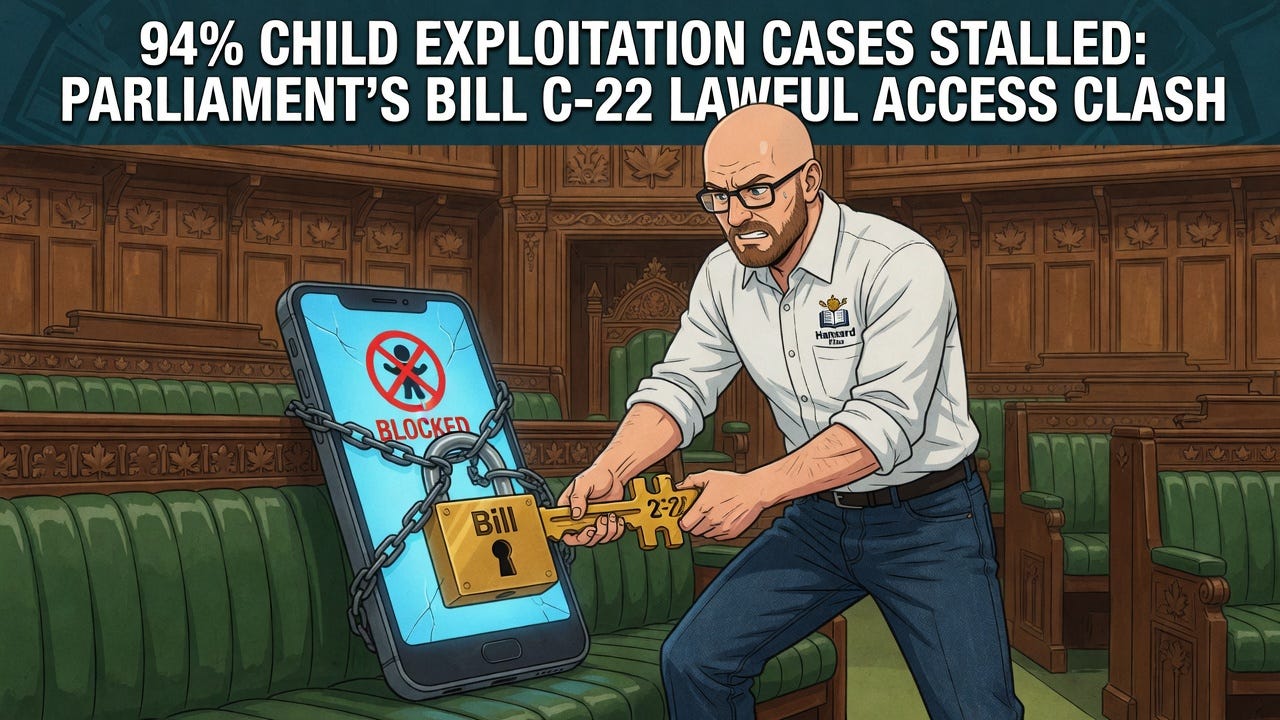
The House of Commons fell quiet at 10 a.m. on Friday, April 17, 2026. Parliamentary Secretary Patricia Lattanzio rose, voice steady, and laid bare a grim statistic. In 2024 alone, police reported more than 16 cases of child pornography, exploitation and abuse. In 94 percent of those cases, investigators could not identify a suspect or gather enough evidence to proceed. Criminals hid behind anonymous usernames, burner phones and IP addresses while outdated laws left officers waiting for data that often vanished before warrants arrived. “Bill C-22,” she said, “is really about one simple thing: keeping Canadians safe in a digital world that criminals are increasingly exploiting.”
That moment crystallized a week of high-stakes debate inside the 45th Parliament. From the emotional push for intimate-partner protections to opposition demands for fuel-tax relief and petitions decrying rising crime, MPs confronted the same tension: how to deliver safety without eroding rights.
The Digital Investigative Stall Bill C-22 Was Built to Fix
Bill C-22, the Lawful Access Act, 2026, resumed second reading after April 15. Conservatives, led by Ziad Aboultaif of Edmonton Manning, acknowledged the gap. Canada remains the only Five Eyes nation without a modern lawful-access regime. Investigative leads in child sexual exploitation, human trafficking and organized crime evaporate because authorities cannot quickly obtain basic subscriber information tied to an IP address or phone number. Even when legal authority exists, service providers often lack the infrastructure to deliver data in usable form.
The bill creates a narrower framework than its predecessor, Bill C-2, which Conservatives forced the government to abandon. It targets telecommunications and internet service providers, not every business. It authorizes confirmation-of-service demands, emergency powers, structured international requests and mandatory compliance, including technical capabilities for metadata retention. Crucially, it prohibits demands for web-browsing history, social-media activity or the content of communications. A mandatory parliamentary review after three years is baked in.
Aboultaif told the House his constituents were flooding him with privacy concerns. “How secure would those systems be?” he asked. “How safe would those systems be?” Yet he conceded the legislation improved on earlier versions and offered a reasonable compromise between collective security and individual rights. Bloc Québécois MP Claude DeBellefeuille pressed him on whether the National Security and Intelligence Review Agency should receive real-time notification of ministerial orders, as in Australia, rather than after the fact. Aboultaif agreed the bill needed committee scrutiny to strengthen oversight, including a clearer role for the Privacy Commissioner.
Lattanzio countered with the human cost. Citing Supreme Court guidance from the Spencer decision, she argued police now possess lawful authority to obtain basic subscriber data linked to specific online activity. Without it, evidence disappears and victims wait in vain. Organized crime, she noted, exploits digital tools for fraud, extortion, auto theft and extremism. “Lawful access is absolutely required and it’s required now,” she quoted from the head of the Canadian Association of Chiefs of Police.
Bailey’s Law: Turning One Tragedy Into Lasting Criminal Code Change
Three days earlier, on April 13, the House had advanced Bill C-225, colloquially known as Bailey’s Law. Sponsored by Frank Caputo of Kamloops—Thompson—Nicola, the private member’s bill amends the Criminal Code to treat the murder of an intimate partner as first-degree murder and to recognize coercive control in sentencing. It passed report stage without debate and moved swiftly to third reading with all-party support.
Caputo spoke from the heart. Bailey McCourt, in her mid-30s, had seen her abuser convicted of assault, choking and threats. Three hours later, while free on bail, he killed her. Caputo recalled writing the bill years earlier after seeing how the law treated intimate-partner assault the same as a bar fight. “Intimate partners are within a relationship of trust,” he said, “and often of financial dependence.” He thanked Bailey’s family, who sat in the gallery, and credited cross-party collaboration for strengthening the text at committee. The bill marked the most substantial change to intimate-partner violence law since the 1980s removal of the marital rape exemption.
Fuel Taxes, Farm Relief and the People’s Petitions
The week’s other business underscored Canadians’ broader anxieties. On April 14, Jasraj Hallan of Calgary East moved an opposition motion to remove federal fuel taxes for the rest of 2026, citing gas prices nearly 20 percent higher than in the United States. Conservatives argued the excise tax, GST on fuel, clean-fuel standard and rising industrial carbon tax added 25 cents per litre at the pump. The motion highlighted affordability pressures on families, farmers and truckers.
That same day, David Bexte of Bow River introduced Bill C-273, the Facilitating Agricultural Regulatory Modernization Act. It would fast-track products already approved by two allied countries, cutting red tape that buries Canadian farmers in delays while competitors move ahead.
Petitions throughout April 14–16 reflected raw public frustration: calls to repeal soft-on-crime policies, protect preborn children as victims in violent offences, reverse agricultural research cuts, and strengthen monitoring of online drug trafficking targeting youth. Statements by members on April 15 touched opioids, seniors’ isolation, and innovative frostbite treatment in Yukon, reminding MPs that policy touches real lives in every corner of the country.
On April 16, routine proceedings included Bill C-25, the Strong and Free Elections Act, and continued petitions on religious freedom and public safety.
Balancing Rights and Reality in Committee
Across five days the House returned again and again to the same question: in an age of rapid technological change, how does Parliament equip law enforcement without repeating past overreach? Conservatives repeatedly reminded members they had blocked Bill C-2 because it reached too far, into cash limits, mail opening and data demands on hospitals and dry cleaners. Bill C-22, they said, was narrower and included safeguards, yet still required robust committee work.
Liberals insisted the legislation modernized the Criminal Code for 2026 realities while respecting the Charter. Both sides agreed the bill should proceed to committee, where civil-liberties groups could be heard and amendments tested against constitutional standards.
Hansard Files digs through dense parliamentary archives to uncover these critical stories. Subscribe to support independent investigations into Ottawa’s inner workings.
Related Hansard Files Articles


Source Documents
House of Commons. (2026, April 13). *Debates* (Vol. 152, No. 101).
House of Commons. (2026, April 14). *Debates* (Vol. 152, No. 102).
House of Commons. (2026, April 15). *Debates* (Vol. 152, No. 103).
House of Commons. (2026, April 16). *Debates* (Vol. 152, No. 104).
House of Commons. (2026, April 17). *Debates* (Vol. 152, No. 105).
C-22 in it's current form is a BAD idea. Dr Matt Strauss nails most of the concerns.
https://x.com/strauss_matt/status/2046568434226405824
Although I'm retired now, this is an area where I have significance expertise. If you want to talk about this, send me a DM.