


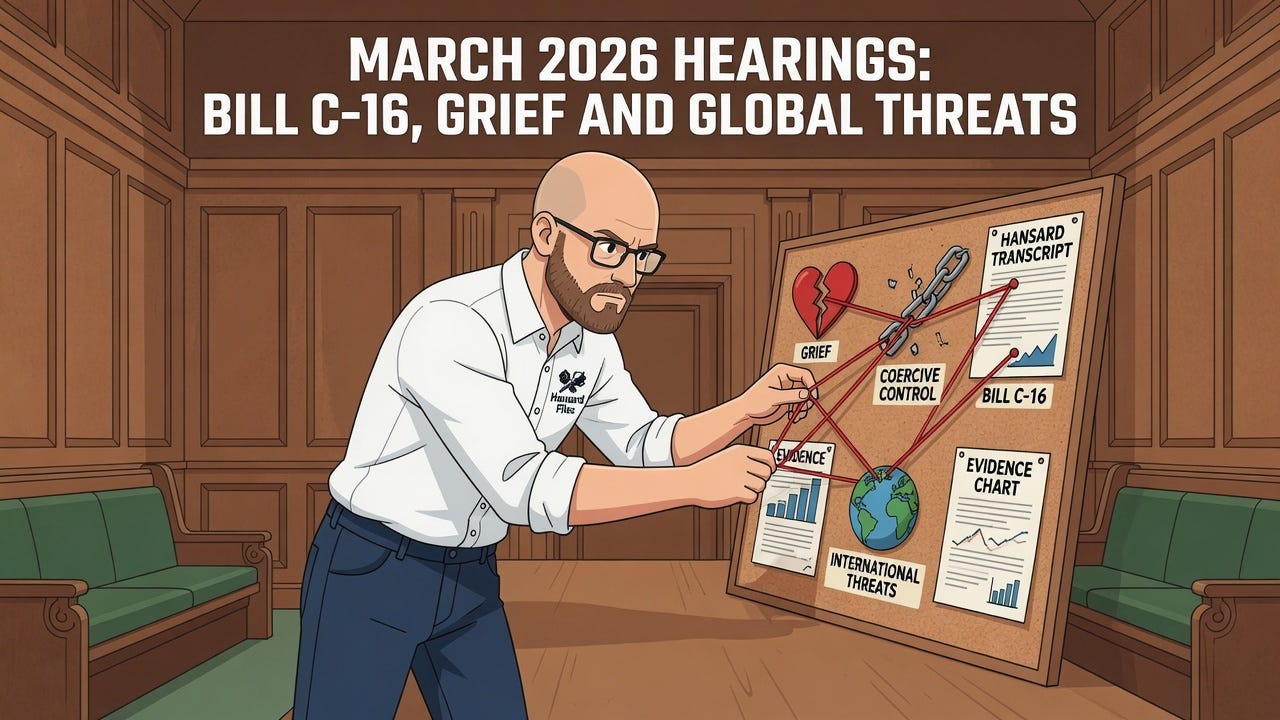
On Monday, March 23, 2026, in Room 253-D of Centre Block, the Standing Committee on Justice and Human Rights fell silent as Chair James Maloney gave the floor to the Honourable Sean Fraser, Minister of Justice. The wood-panelled chamber felt smaller than usual. Fraser looked directly at the MPs and began outlining Bill C-16, the Protecting Victims Act. His voice stayed measured, but the stakes hung heavy. Survivors had waited years for this moment. Families shattered by coercive control, sextortion and online exploitation now watched from the public gallery as the minister described how the bill would finally give police and courts tools to intervene before violence turned lethal.
Across Parliament Hill that same week, nearly every standing committee sat in session. From March 11 to March 26, 2026, more than twenty evidence meetings unfolded in parallel. The 45th Parliament’s committee machine ran at full throttle. Some hearings featured ministers defending budgets and policies. Others brought raw human testimony that left MPs reaching for tissues. The volume of work reflected a government racing to advance legislation before the spring break and opposition parties determined to hold the line on crime, spending and sovereignty.
Bill C-16 Takes Centre Stage in Justice Committee
Minister Fraser laid out the centrepiece of Bill C-16. A new standalone offence would criminalize coercive and controlling behaviour in intimate relationships. Behaviours drawn straight from survivor accounts, isolating a partner, monitoring movements, or cutting off family contact, would now carry criminal consequences before fists flew. The bill would also create a first-degree murder qualifier when femicide or coercive control formed part of the killing. On the digital front, updated provisions would target sextortion involving minors, non-consensual intimate images and AI-generated deepfakes. Fraser noted a two-year coming-into-force window for the coercive-control offence to train police and Crown prosecutors nationwide.
Conservative MP Larry Brock pressed hard. He cited official statistics: human trafficking up 84 percent, sexual assaults up almost 76 percent, violent crime up almost 55 percent. Brock asked why the bill did not restore more mandatory minimum penalties previously struck down. Fraser replied that Bill C-16 would reinstate several minimums but include a judicial safety valve. Judges could depart only in rare, exceptional cases after weighing specific criteria, satisfying the Supreme Court’s guidance in R. v. Senneville while preserving public confidence. The exchange grew tense when Brock referenced the Bailey McCourt case in British Columbia. Fraser acknowledged the tragedy and insisted the new tools would prevent similar outcomes.
Heartbreak Drives Human Resources Committee Debate
Two weeks earlier, on Thursday, March 12, the Standing Committee on Human Resources, Skills and Social Development and the Status of Persons with Disabilities heard from Lily Hamill. Her voice cracked as she described the death of her daughter Lyrica. The committee studied proposed changes to bereavement and compassionate leave after child loss or miscarriage. Hamill spoke of the impossible return to work, the financial strain, and the isolation that followed. Other witnesses echoed her call for workplace policies that recognized grief as a legitimate barrier. Chair Robert Morrissey kept the tone respectful. MPs from all parties nodded as parents shared stories that transcended party lines. The testimony underscored how personal loss collides with federal labour standards.
Foreign Affairs Committee Examines Venezuela and Democracy
That same busy Thursday, the Standing Committee on Foreign Affairs and International Development heard from Daniel Di Martino of the Manhattan Institute. MPs Michael Chong and Alexis Brunelle-Duceppe pressed witnesses on democracy erosion, migration flows, oil dynamics and potential Canadian interventions. The discussion moved between Venezuela’s political crisis and broader hemispheric security. Chair Ahmed Hussen steered the conversation back to evidence-based policy. The hearing reflected Canada’s ongoing navigation of unstable regions and the human cost measured in displaced families.
Defence, Resources and Immigration Committees Tackle Sovereignty and Numbers
On Monday, March 23, the Standing Committee on National Defence examined critical minerals and rare-earth supply chains essential for defence procurement. Officials discussed sovereign capabilities and concerns over reliance on foreign sources, with China frequently referenced. MPs questioned witnesses on strategic reserves and cooperation with allies. Parallel to that, the Standing Committee on Citizenship and Immigration heard the minister address asylum claims, international students and temporary residents. Heated exchanges centred on processing backlogs, admission numbers and program integrity. Chair Julie Dzerowicz maintained order as members pressed for data on system pressures.
Environment Committee Scrutinizes Spending and Carbon Policy
Also on March 12, the Standing Committee on Environment and Sustainable Development welcomed Minister Julie Dabrusin to defend supplementary estimates. Discussion covered carbon pricing, clean-technology projects and federal environmental spending. Some questioning turned pointed as MPs sought accountability on project outcomes and household impacts. Chair Angelo Iacono guided the session through detailed line-by-line review.
Parallel Hearings Across Every Portfolio
The committee schedule left little breathing room. On March 12 alone, the Standing Committee on Official Languages heard from Canadian Parents for French and Professor Stéphanie Chouinard on French-language regulations and federal action plans. The Industry and Technology Committee, Science and Research Committee, Natural Resources Committee, International Trade Committee, Government Operations and Estimates Committee, Procedure and House Affairs Committee, and Transport, Infrastructure and Communities Committee all convened public evidence sessions. Many focused on estimates or ongoing studies. Public Accounts held two separate meetings, March 23 and March 25, reviewing government spending under Chair John Williamson.
Later dates filled the calendar further. The Standing Committee on Canadian Heritage met March 26. Agriculture and Agri-Food sat March 24. Fisheries and Oceans gathered March 23. The Standing Committee on Transport, Infrastructure and Communities held sessions on both March 11 and March 23. Each room hosted its own high-stakes conversation, yet the collective rhythm showed Parliament working at capacity.
What These Hearings Mean for Ordinary Canadians
Across every committee room, the same underlying tension surfaced. How does government protect victims before harm occurs? How does it support families shattered by loss? How does it secure supply chains, manage borders, safeguard language rights and steward the environment without losing public trust? The answers will shape legislation introduced in the coming months. For a parent navigating grief after child loss, for a young person targeted online, for communities worried about violent crime or global supply disruptions, these standing committee hearings are not abstract. They are the place where policy meets lived reality.
The clause-by-clause work on Bill C-16 and parallel bills lies ahead. Spring 2026 on Parliament Hill is proving one of the busiest in recent memory.
Hansard Files digs through dense parliamentary transcripts so you don’t have to. These stories from the committee rooms shape your daily life. Subscribe to support independent, non-partisan investigation.
Source Documents
House of Commons Canada. (2026, March 12). *Standing Committee on Foreign Affairs and International Development, Evidence, Number 026, 45th Parliament, 1st Session*.
House of Commons Canada. (2026, March 23). *Standing Committee on Justice and Human Rights, Evidence, Number 021, 45th Parliament, 1st Session*.
House of Commons Canada. (2026, March 12). *Standing Committee on Human Resources, Skills and Social Development and the Status of Persons with Disabilities, Evidence, Number 028, 45th Parliament, 1st Session*.
House of Commons Canada. (2026, March 12). *Standing Committee on Official Languages, Evidence, Number 025, 45th Parliament, 1st Session*.
House of Commons Canada. (2026, March 12). *Standing Committee on Industry and Technology, Evidence, Number 028, 45th Parliament, 1st Session*.
House of Commons Canada. (2026, March 23). *Standing Committee on Citizenship and Immigration, Evidence, Number 025, 45th Parliament, 1st Session*.
House of Commons Canada. (2026, March 12). *Standing Committee on Government Operations and Estimates, Evidence, Number 031, 45th Parliament, 1st Session*.
House of Commons Canada. (2026, March 12). *Standing Committee on Natural Resources, Evidence, Number 027, 45th Parliament, 1st Session*.
House of Commons Canada. (2026, March 26). *Standing Committee on Canadian Heritage, Evidence, Number 029, 45th Parliament, 1st Session*.
House of Commons Canada. (2026, March 12). *Standing Committee on Science and Research, Evidence, Number 028, 45th Parliament, 1st Session*.
House of Commons Canada. (2026, March 25). *Standing Committee on Public Accounts, Evidence, Number 029, 45th Parliament, 1st Session*.
House of Commons Canada. (2026, March 12). *Standing Committee on International Trade, Evidence, Number 027, 45th Parliament, 1st Session*.
House of Commons Canada. (2026, March 12). *Standing Committee on Procedure and House Affairs, Evidence, Number 025, 45th Parliament, 1st Session*.
House of Commons Canada. (2026, March 23). *Standing Committee on National Defence, Evidence, Number 028, 45th Parliament, 1st Session*.
House of Commons Canada. (2026, March 23). *Standing Committee on Transport, Infrastructure and Communities, Evidence, Number 026, 45th Parliament, 1st Session*.
House of Commons Canada. (2026, March 23). *Standing Committee on Public Accounts, Evidence, Number 028, 45th Parliament, 1st Session*.
House of Commons Canada. (2026, March 23). *Standing Committee on Fisheries and Oceans, Evidence, Number 028, 45th Parliament, 1st Session*.
House of Commons Canada. (2026, March 24). *Standing Committee on Agriculture and Agri-Food, Evidence, Number 028, 45th Parliament, 1st Session*.
House of Commons Canada. (2026, March 11). *Standing Committee on Transport, Infrastructure and Communities, Evidence, Number 025, 45th Parliament, 1st Session*.
House of Commons Canada. (2026, March 12). *Standing Committee on Environment and Sustainable Development, Evidence, Number 029, 45th Parliament, 1st Session*.
## SEO Metadata
**URL Slug:** march-2026-standing-committee-hearings-bill-c-16-grief-global-threats
word-count: 1487
Until I started following you and reading your posts, I had no idea of that committees were where the real work of parliament went on. Thank you for this.
Committees were by far my favourite part of Hill work. I miss working on them. One note though, JUST didn't meet in Centre Block, they met in 425 Wellington. 253D and the rest of the building have been closed since 2019 and will be so for some time yet.