


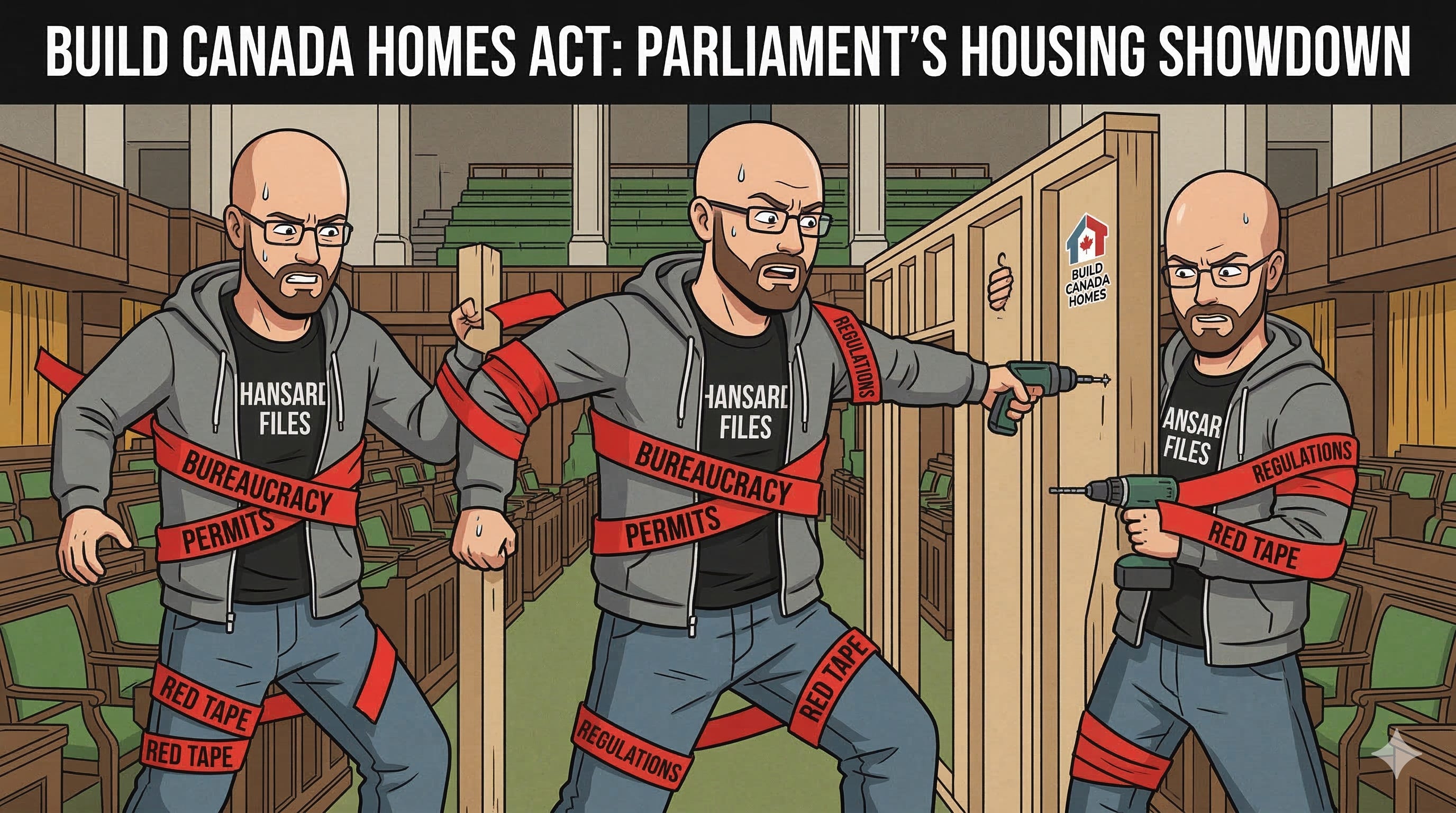
The House of Commons chamber fell quiet after prayer on Friday, March 13, 2026. Outside, families across Canada continued their daily struggle for shelter. Inside, lawmakers turned to the next chapter of a crisis that had simmered for sixteen years since a 2010 warning of a housing bubble at its “precarious 30-year peak.”
The moment arrived under Government Orders. The House resumed debate on Bill C-20, An Act respecting the establishment of Build Canada Homes. This legislation would transform an existing initiative into a full Crown corporation empowered to build truly affordable homes on federal lands, using low-interest loans, equity investments, and modern factory methods.
Dominique O’Rourke, the Liberal member for Guelph and former city councillor, rose first. She paused to wish her husband Mike a happy 20th anniversary before diving in. “As a former city councillor, I am very familiar with the development process and acutely aware of the housing crisis,” she said. “The need is very clear. Across the country, far too many Canadians are struggling to find homes they can afford.”
O’Rourke laid out the bill’s core promise. Build Canada Homes would partner with non-profits, Indigenous organizations, private developers, and all levels of government. It would prioritize Canadian materials under the government’s buy-Canadian policy, spark factory-built housing like Guelph’s Pacd Homes that assemble additional dwelling units in four to six weeks, and drive productivity in a sector TD Bank had flagged as one of the lowest-performing at a 30-year low. Six federal land projects were already advancing. Hundreds more sat under review. “These are concrete results,” she declared, “that show how this new approach is turning ambition into action.”
The legislation also planned to transfer land holdings and development expertise from Canada Lands Company Limited to the new corporation, streamlining federal tools for public good. Oversight would come from a board of directors, with a chairperson and CEO appointed by the Governor in Council. Once passed, Build Canada Homes would gain the independence of a Crown corporation while remaining accountable to Parliament.
The Housing Crisis That Refuses to Fade
Sixteen years after the Canadian Centre for Policy Alternatives sounded the alarm, the same pressures persisted. Construction costs had doubled. Land and labour prices climbed. Supply had never kept pace with demand. Governments had long assumed the private sector would fill the gap for community, affordable, social, and supportive housing. It had not.
O’Rourke described the gap plainly. The private sector maximizes profits. Non-market affordable homes for vulnerable families and seniors with mental illness fall outside that mandate. Build Canada Homes would target exactly those projects. In Guelph, advocates had just submitted a portfolio including permanent supportive housing. “These are not projects that the private sector would build,” she noted.
Opposition Fires Back: Bureaucracy or Breakthrough?
Ziad Aboultaif, the Conservative member for Edmonton Manning, stood quickly. “Who builds homes? It is builders,” he said. “They need the government to get out of the way.” Another layer of bureaucracy, he warned, would slow production and productivity. “We do not need another bureaucracy to stand in the way.”
O’Rourke responded that municipalities had already streamlined processes. The private sector builds market housing, but for thirty years communities had waited for non-market units. “Build Canada Homes is going to fill that gap for true market affordability.”
Mario Simard of the Bloc Québécois raised a separate concern. The Prime Minister had promised an ambitious construction program to aid the forestry sector, battered by U.S. tariffs. The bill mentioned no specific lumber priority. By the time Build Canada Homes scaled up, Simard feared the industry might already be gone. O’Rourke agreed on the need to support lumber, steel, and auto sectors hit by tariffs, but noted liquidity programs existed and the bill’s scope was limited to creating the corporation. “We need to use Canadian lumber,” she affirmed.
Parliamentary Secretary Kevin Lamoureux offered congratulations on the anniversary before the debate moved on.
Innovation, Jobs, and the Path Forward
Supporters highlighted tangible progress since the initiative launched in September 2025. Landmark agreements with provinces and municipalities were signed. Federal land projects advanced toward construction. Thousands of affordable homes were committed. Shovels were expected in the ground this year. Every new unit would boost demand for Canadian steel, lumber, and aluminum while exerting downward pressure on market prices.
The corporation would also champion modern methods of construction, factory-built homes, and training investments already underway. As a Crown corporation it could hold assets, make investments, and conduct complex transactions with greater flexibility than a special operating agency.
Critics maintained that speed required removing barriers, not adding federal layers. The exchange captured the tension at the heart of the debate: whether a new federal entity could accelerate supply where markets and past governments had fallen short.
What Comes Next for Canadian Families
The motion to advance Bill C-20 to committee remained before the House. Passage would fulfill a Budget 2025 commitment and give Build Canada Homes the legal and operational autonomy to meet its mandate while preserving accountability to Parliament.
A home, speakers reminded the chamber, is more than shelter. It is security, stability, and connection to community. As the housing crisis enters its third decade, the Build Canada Homes Act represents one federal attempt to close the gap that private markets alone have not filled. Whether the new Crown corporation delivers the scale and speed Canadians need will now rest with the committee process and the months ahead.
Hansard Files digs through dense parliamentary archives to uncover these stories. Subscribe today to support independent investigations that bring Canada’s political heart into focus.
Source Documents
House of Commons of Canada. (2026, March 13). *Official report (Hansard), Volume 152, No. 096*.
House of Commons of Canada. (2026, March 11). *Official report (Hansard), Volume 152, No. 094*.
House of Commons of Canada. (2026, March 9). *Official report (Hansard), Volume 152, No. 092*.
House of Commons of Canada. (2026, March 12). *Official report (Hansard), Volume 152, No. 095*.
House of Commons of Canada. (2026, March 10). *Official report (Hansard), Volume 152, No. 093*.
The laws of Supply and Demand aren't all that difficult to understand, yet politicians seem determined to misrepresent reality. The federal gubbermint has next to nil jurisdiction on the Supply side of housing BUT they have jurisdiction on immigration/refugee/student visas etc which is the primary driver of Supply side of housing. If our population wasn't being massively inflated by the federal government, there would be no housing crisis... period... full stop.
Housing certainly is a mess, Hansard, and I doubt there will be no easy path forward. Unless I am mistaken, doesn’t housing fall under provincial jurisdiction?
Maybe it’s better for minor coordination involvement by the feds and allocate funds to the provinces, and say “it’s in your ball court”.