


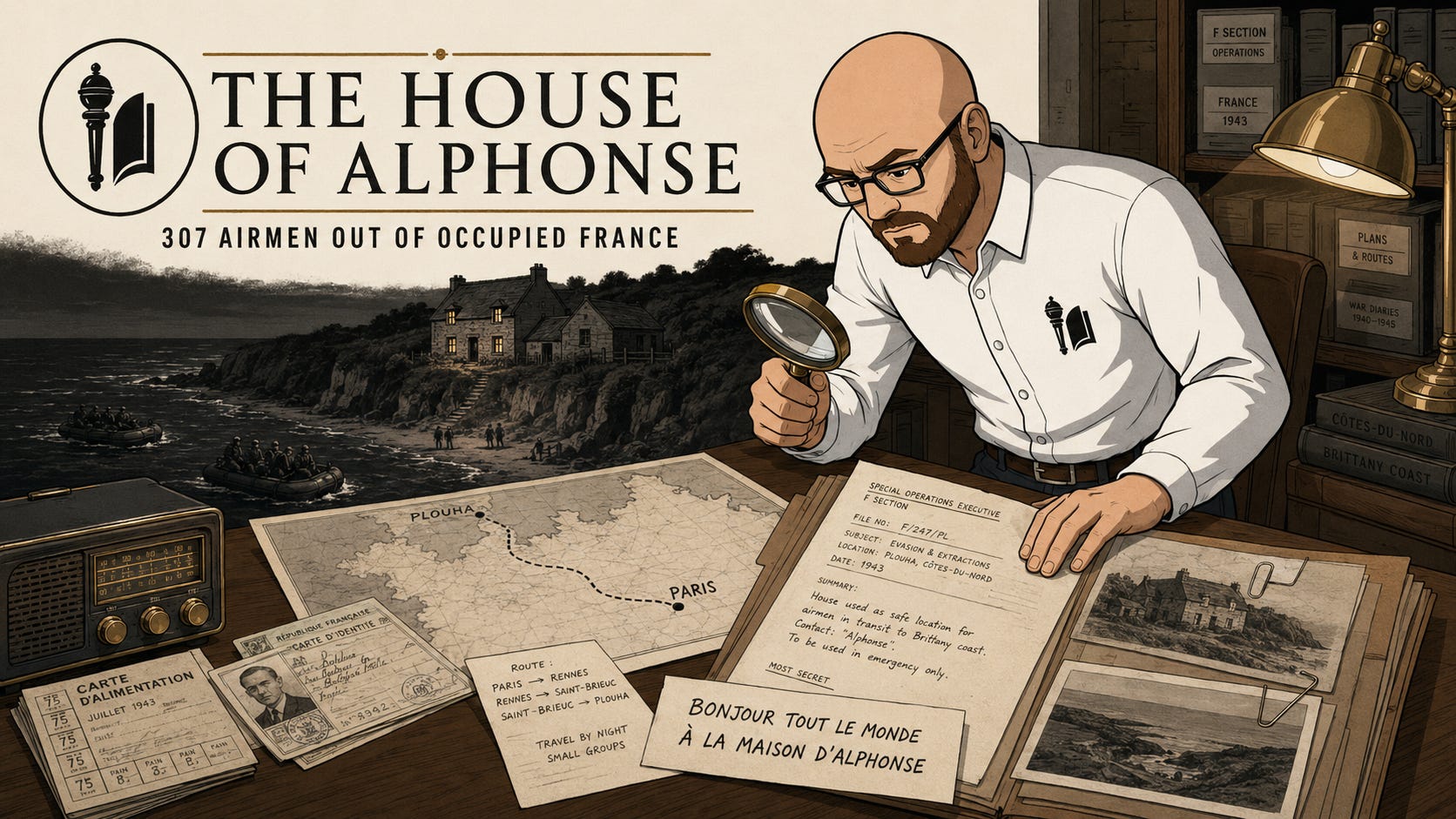
On the moonless night of January 29, 1944, sixteen Allied airmen and two British agents waited inside a small stone farmhouse near the village of Plouha. They had gathered after dark, moving in small groups to avoid notice. A radio in the farmhouse carried the BBC French Service. Right after the news broadcast, the set crackled with the agreed signal: Bonjour tout le monde à la Maison d’Alphonse.
The phrase meant the pickup was on. The men filed out into the cold and began the steep climb down the cliffs to the narrow beach below. A single flashlight blinked toward the sea. German patrols walked the coastline, alert for any sign of the coming invasion. For long minutes the group stood in silence on the dark shingle. Then three small rubber rafts appeared out of the blackness. Arms, money and supplies came ashore. The airmen and the two outward-bound agents climbed aboard. The rafts slipped back into the night toward a British gunboat waiting 140 kilometres across the Channel.
Canadian secret agents had made every step of that journey possible.
From Dieppe Captives to MI.9 Volunteers
Four French-Canadian soldiers captured during the August 1942 Dieppe raid managed to escape German hands and reach England. Conrad LaFleur, Robert Vanier, Guy Joly and Lucien Dumais had all volunteered for the army in 1939. Once free, all four chose to return to occupied France as agents for MI.9, the British organization responsible for helping Allied prisoners and downed airmen escape.
Lucien Dumais of Montreal was thirty-eight, a tough sergeant with the Fusiliers Mont-Royal. After his escape he trained for four months with the British First Army in North Africa, then volunteered for MI.9 work because routine camp life no longer suited him. Tall, dark-haired Raymond LaBrosse had gone overseas in 1940 as a signalman with the Royal Canadian Corps of Signals. The British services needed fluent French wireless operators. LaBrosse became MI.9’s first Canadian agent. His first mission ended when the Gestapo infiltrated the network and he had to flee. He was eager to go back.
The two men trained together in everything from ju-jitsu to building and operating wireless sets. They received fountain pens that fired tear gas, buttons that hid compasses, stacks of francs and forged identity papers. Each carried his own code, unknown to the other. In November 1943 a Lysander aircraft landed them at night in a meadow roughly eighty kilometres north of Paris. Dumais became Lucien Desbiens, a mortician from Amiens. LaBrosse became Marcel Desjardins, a salesman of electrical medical equipment. Their task was to locate Allied airmen shot down over France and move them safely out of the country.
Building the Shelburne Line
The operation was called Bonaparte and formed the heart of the larger Shelburne escape network. Safe houses had to be found where airmen could wait. Food and clothing were strictly rationed, so both had to be obtained quietly. Doctors willing to treat wounded men and printers ready to produce false papers at short notice had to be recruited. Local volunteers had to be trusted without certainty. One careless word could bring the Gestapo.
To move openly by train from Paris to the coast, the airmen had to learn to pass as French labourers, right down to the way they held and smoked their cigarettes. LaBrosse travelled the countryside locating places from which he could exchange coded messages with MI.9 headquarters in London. German radio-detection vans were always a threat. After careful search, a small isolated beach near Plouha was chosen as the pickup point. The nearby stone farmhouse belonging to a Resistance worker became known as the House of Alphonse.
Post-war German records later showed the Gestapo never came close to destroying the network. The security held.
The First Pickup and the Numbers That Followed
The January 29 evacuation succeeded. Sixteen airmen and two agents reached England. By the end of March 1944 the Dumais and LaBrosse team had escorted 128 airmen and seven agents to safety. In total, 307 Allied airmen owed their liberty to Shelburne and its key operation, Bonaparte.
The network never lost one of its human cargo. The only physical casualty was the House of Alphonse itself, later burned by the Germans who suspected it was a Resistance site. After the Normandy landings on June 6, 1944, rail travel became nearly impossible for civilians. No further sea evacuations were mounted, yet both Canadians chose to remain in France. They organized, equipped and fought alongside Resistance units attacking German convoys moving toward the invasion front.
After liberation Dumais stayed on to help root out German stay-behind agents. LaBrosse was posted to the Paris section of British intelligence. Both received the Military Cross as well as French and American decorations. Both returned to their families in Canada and resumed ordinary lives. A plaque honouring the Canadian secret agents who worked with the French Resistance was unveiled at Plouha in June 1984 during ceremonies marking the fortieth anniversary of D-Day.
The Saboteur Who Earned an SS Guard of Honour
Other Canadian agents operated on different terms. Gustave Daniel Alfred Biéler, originally from France, had emigrated to Montreal at twenty and become a Canadian citizen in 1934. In 1942, at thirty-eight, he volunteered for the Special Operations Executive. He parachuted into France southwest of Paris, injured his back severely on landing, and spent months recovering. While convalescing he recruited agents for a sabotage network that eventually ran twenty-five armed teams. They blew rail lines, switching boxes and derailed German troop trains across northern France.
In January 1944 the Gestapo closed in on radio transmissions from St. Quentin. Biéler and his radio operator, thirty-two-year-old Yolande Beekman, were arrested in a small café. For months he was tortured. The Gestapo learned nothing from him except respect for his courage and dignity. In September he was taken to his execution. An SS guard of honour accompanied him. Instead of being gassed or hanged, he was shot, the only known case of an officer in these circumstances executed by firing squad. Another Canadian agent who survived, Gabriel Chartrand, later called Biéler “the great Canadian war hero.”
The Wider Record
Of roughly 1,800 SOE agents sent into occupied France, only twenty-five were Canadians. Seven of those twenty-five were captured and executed. The ratio says little about the individual courage required to jump at night into enemy territory. Similar small numbers of Canadians served with SOE in Yugoslavia, Italy and, as Force 136, in Japanese-occupied Asia. Chinese-Canadians played a particularly large role in the Asian operations because they could often speak local languages and move more freely among local populations. The dedication list in the official record names dozens more whose stories remain only partly known.
These men and women worked without public recognition, without rousing send-offs, and with the certain knowledge that capture meant no protection under the Geneva Convention. Their battles left no captured ground and no body counts for newspapers. What they left was a record of individual acts that helped thousands reach safety and weakened the enemy’s hold from within.
Hansard Files spends weeks in the archives so you don’t have to. If stories like this matter to you, subscribe to keep this work independent.
Related Hansard Files Articles


Source Documents
Veterans Affairs Canada. (1985). Uncommon courage: Canadian secret agents in the Second World War. Ottawa: Public Affairs Division, Veterans Affairs Canada.
"What they left was a record of individual acts that helped thousands reach safety and weakened the enemy’s hold from within." Ever grateful ...
This year is the hundredth anniversary of the Royal Canadian Legion. We Remember. Nous nous souvenons.