


The letter arrived on the desk of the Director of Army Recruiting in March 1943, after three full years of war. It was from a Command Recruiting Officer on the Pacific coast, and it didn’t pull punches.
“To my mind,” the officer wrote, “the great fundamental cause for this is that there has not been created, even after three years of war, a general public opinion that women are needed in the Army.”
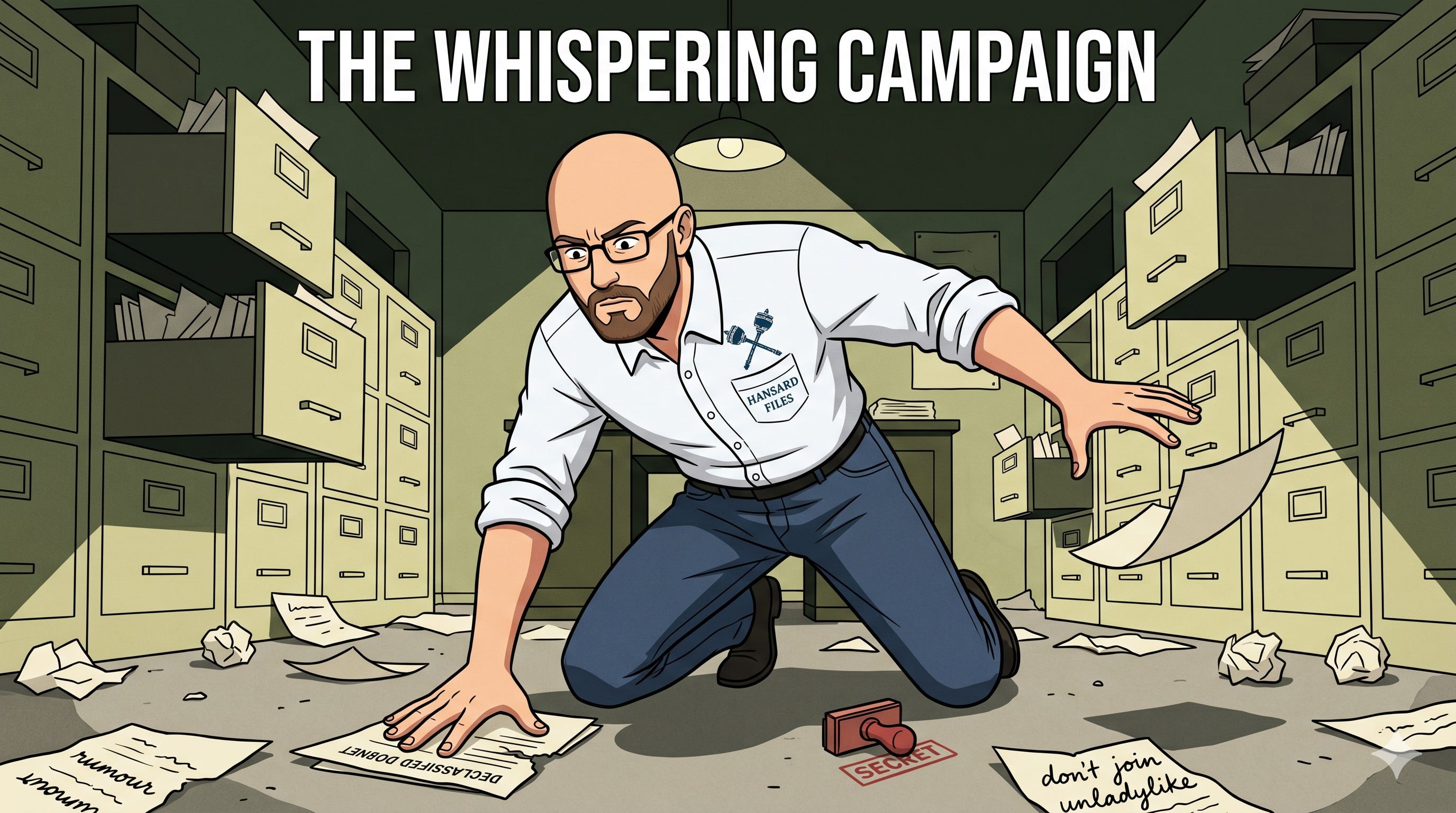
He went on. There were soldiers who actively resented women in uniform. Many girls held good civilian jobs and were loath to leave them. There was no esprit de corps, no national sense of urgency. And there was something harder to quantify, something spreading quietly across the country on trains and in boarding houses and in letters home from servicemen overseas. A whispering campaign. Vicious, coordinated, and almost impossible to stop.
This recruiting officer’s letter, and the classified report that preserved it, is the document Canada’s women’s wartime services never quite got. Report No. 68 of the Historical Section, Army Headquarters, completed on 17 June 1954 and stamped “SECRET” before being declassified, is a frank, sometimes startling account of how Canada fumbled the mobilization of its women’s services, and how those women served effectively anyway.
Three Years of Stalling Before a Single Uniform
The story starts not in 1941, but years earlier. Women had served in auxiliary capacities during the First World War. In 1918, the Militia Council in Ottawa discussed forming a Canadian Women’s Army Auxiliary Corps. No action was taken. Not then, and not through the long interwar years that followed.
When war came again in 1939, Canadian women responded the way they had the last time: they organized themselves. By October 1938, a voluntary corps had already formed in Victoria, B.C. Once war was declared, unofficial corps appeared coast to coast. The Canadian Red Cross Corps. The Women’s Transport Service Corps. The Alberta Women’s Service Corps. The Saskatchewan Auxiliary Territorials. The Nova Scotia Women’s Service Corps. The British Columbia Women’s Service Corps. Women were not waiting for permission.
Most of these corps applied for official recognition. All were refused.
National Defence Headquarters had its reasons. In a memorandum circulated to branch heads on 26 August 1940, the Adjutant-General spelled them out. Giving recognition to these existing organizations would trigger “jealous claims” that would make it impossible to use any of them. “The establishment of an entirely new Corps with open recruiting will be the only satisfactory method for some time to come,” he wrote.
So the women who had already organized, trained, and showed up were set aside. Ottawa would do this its own way.
The process that followed was achingly slow. A survey of District Officers Commanding in late 1940 established that the military could absorb 1,888 women as replacements: 848 as clerks and telephone operators, 639 as cooks, 386 as officers’ mess staff, and 15 as motor transport drivers. The Department of National Defence was already employing 593 women as civil servants. Discussions dragged through 1941. The Cabinet War Committee directed a study. That study went back to the Cabinet War Committee. More discussions. A public announcement finally came on 26 June 1941, nearly two full years after Canada entered the war.
Even then, the creation of the Canadian Women’s Army Corps on 13 August 1941 came with a notable restriction. C.W.A.C. personnel would not, at least for the present, be employed as clerks, stenographers, or typists at National Defence Headquarters. The Civil Service Commission had objected. Its chairman, C.H. Bland, had made his position plain at a September 1941 meeting: permanent civil servants would not be given leave to enrol. Temporary employees would be discouraged. In his view, women might be used as ambulance drivers, hospital dietitians, “practically any work except typists, stenographers, secretaries, and clerks.”
It wasn’t until the summer of 1942 that C.W.A.C. members were introduced to headquarters at all.
“We Serve That Men May Fly”
The Royal Canadian Air Force moved faster, if only slightly. Order in Council P.C. 4798 of 2 July 1941 authorized the Canadian Women’s Auxiliary Air Force, their function defined as releasing men “presently employed in administrative, clerical and other comparable types of service employment” to take on heavier duties. By February 1942 the organization was redesignated the Royal Canadian Air Force (Women’s Division). The Navy, initially resistant, reversed course by the end of 1941 and the Women’s Royal Canadian Naval Service was officially established by Order in Council on 31 July 1942, with an authorized complement eventually set at 6,386.
All three services began with a narrow conception of what women could do. The C.W.A.C. initially assumed it could simply enlist fully qualified women. No trades training would be necessary. That assumption, the report notes with quiet candour, “was soon dispelled.” By the end of 1942, the army had expanded the list of trades C.W.A.C. personnel could be trained for to include medical, clerical, dental, automotive, signals, stores, and a catch-all “sundry” category that ranged from armourers to shoemakers to postal sorters.
The Air Force had started with eight trades for airwomen. It eventually expanded that number to 65 out of a possible 102 R.C.A.F. trades. The first group of airwomen replacements reported to No. 1 Service Flying Training School at Uplands, near Ottawa, on 2 January 1942. Initial planning had assumed a three-to-two replacement ratio, meaning three women for every two men freed. In practice it worked out to one for one. In a few trades, two airwomen replaced three airmen.
The Navy faced its own gap. The W.R.C.N.S. had hoped to relieve 1,456 male cooks and 1,146 male stewards. It never managed to recruit enough Wrens to do it.
The Whispering Campaign
Then came the rumours. The report’s section on recruiting problems is, by any measure, extraordinary. It preserves, with flat bureaucratic language, a catalogue of slander that was being spread across Canada throughout 1942 and 1943.
A Wartime Information Board report dated 19 March 1943 estimated that 75 percent of the rumours being circulated to discourage enlistment referred directly to sexual immorality. The examples in the document are specific and dated. Quebec, September 1942: C.W.A.C. personnel were recruited “preferably among ladies of easy virtue.” A train from Toronto to Barrie, October 1942: C.W.A.C.s and airwomen were being supplied by their medical officers with prophylactics. Toronto, October 1942: over 18 percent of women had become pregnant since joining. Winnipeg, December 1942: a landlady was warned not to rent a room to a member of the Women’s Army Corps because they all had syphilis. Another Winnipeg rumour from the same month: the government had set aside a special building for Air Force and Army women to give birth to their illegitimate children.
The Wartime Information Board noted something important about these rumours. They were categorically different from rumours that circulated about male servicemen. Stories about men in uniform typically portrayed them as victims of bureaucratic neglect or poor leadership. These stories attacked the women’s own conduct and character. The report stated plainly that such “frequency, persistence and wide distribution” suggested “a strongly entrenched prejudice against the Women’s Services.”
Some of this hostility came directly from servicemen. The document includes letters written by men stationed in Canada, warning sisters and girlfriends to stay out of the women’s services. “Don’t join the CWAAFs or the CWACs,” one letter read. “I haven’t met a fellow yet in the Air Force who hasn’t advised his sister to keep out of them.”
The historian J.M. Hitsman, who compiled the report, understood what this was. What was being resented, he observed, was innovation itself. These women wore uniforms, marking themselves apart. They had demonstrated they could look after themselves without parental oversight. The historical response to women who departed from the norm had always been the same: accusations of immorality. What made this episode particularly corrosive was that soldiers, the very men whose testimony carried weight with families back home, were among the most active spreaders.
Paradoxically, as the report noted, some rumours were probably the result of servicewomen’s high standards. A soldier who had been rebuffed might “take his revenge by blackening the character of the whole corps.”
A Public That Took Years to Care
In the spring of 1943, the Army commissioned a public opinion survey from Elliott-Haynes Limited of Toronto and Montreal. The results were sobering.
Only seven percent of the adult public felt the wartime role of women should be in uniform. English-speaking Canadians were five times more aware of the need for women’s service than French-speaking Canadians. The public believed women joined for adventure and patriotism. Three specific factors were listed as hampering recruitment: a feeling that the armed forces were an unladylike occupation for women; a tendency among young women to cling to the comforts of civilian employment rather than risk an “unpredictable existence”; and organized ill-will, particularly from servicemen, who discouraged their female relatives from enlisting.
There was a deeper friction too, structural and specific: the question of direct commissions. Many capable women, the report concluded, had simply never enlisted. Service in the ranks was a prerequisite for commissioning in the C.W.A.C. Women who could not afford to start as privates, or who were uncertain how long they would have to wait before being commissioned, stayed away. A 1946 report by Lt.-Col. Daisy I. Royal recommended that opportunities for direct appointment based on civilian qualifications should be expanded. The R.C.A.F. Women’s Division had already quietly commissioned 92 officers directly from civilian life, despite an early instruction that all promotions would come from the ranks.
The Numbers That Stayed Invisible
Even with all of this, the women came. The appendix tables in the report capture the scale. The C.W.A.C. received its first 1,256 members in the latter months of 1941. By 1942, it added another 7,466. In 1943, the peak recruiting year, 7,887 more joined. Total wartime enlistment for the C.W.A.C. reached 21,622. The R.C.A.F. Women’s Division added 17,006 over the same period. The W.R.C.N.S. enrolled 6,781 Wrens, reaching a peak strength of 5,893.
By 31 May 1945, 84 C.W.A.C. officers and 1,475 other ranks were serving overseas, 1,303 of them in the United Kingdom alone. Another 170 were in Northwest Europe. From late 1942, airwomen had been serving in the United Kingdom; in all, 117 officers and 1,205 members of the R.C.A.F. Women’s Division served there. The first W.R.C.N.S. draft reached the United Kingdom only late in 1943, with 503 Canadian Wrens eventually serving overseas by war’s end.
The wastage numbers were harder to look at. Discharge rates rose steadily. The leading causes were neuropsychiatric illness, pregnancy, and general unsuitability. By 1944, neuropsychiatric conditions accounted for 58.7 percent of all medical discharges for women in the R.C.A.F. Women’s Division, compared to 44.9 percent for men. The C.W.A.C. saw 1,849 of its 3,450 medically discharged members leave for mental and nervous disorders.
Lt.-Col. Royal’s 1946 report was clear about one contributing cause: the shock of institutional life on women who had never lived communally, stripped of privacy, in environments not built with them in mind. Where comfortable quarters, good food, and adequate recreation were provided, morale and efficiency rose noticeably. Where they weren’t, the numbers told their own story.
The Administrative Weight They Carried
There was a final irony buried deep in the report, in the section on C.W.A.C. administrative overhead. Because the corps existed as a distinct entity within the army, rather than being integrated the way the Wrens and the Air Force Women’s Division were, it carried a disproportionate administrative burden.
A strength return from 12 December 1944 told the story starkly. Of the total 566 C.W.A.C. officers and 11,576 other ranks, only 215 officers and 7,566 other ranks were actually replacing men. The remaining 2,311 all ranks on depot and unit staffs were required to administer those 7,781 replacements. A January 1945 memo to the Director of Staff Duties noted the obvious: the system was top-heavy and uneconomical. A reorganization was proposed. By January 1945, it was too late to implement.
The Navy and Air Force had avoided this by building their women’s services directly into the existing structure. The C.W.A.C., shaped partly by early political compromises and partly by a Civil Service Commission unwilling to surrender turf, spent the war carrying administrative weight that cost the government money and diluted the corps’ effective strength.
What the Archives Keep
Demobilization was not swift. The C.W.A.C. reached nil strength in October 1946. The last three Wrens returned to civilian life in December. Ten members of the R.C.A.F. Women’s Division were released early in 1947. Six remained in the Air Force as messing officers.
The 1954 report, written by J.M. Hitsman and reviewed by former wartime directors of all three services including Mrs. Adelaide Sinclair, the wartime Director of the W.R.C.N.S., and Wing Officer W.M. Taylor, former Senior W.D. Staff Officer at Air Force Headquarters, reads today as something more than a military administrative post-mortem. It is a document about what happens when institutions resist the people serving them. About the price of delay and half-measures when urgency demanded full commitment. About a generation of women who showed up despite the rumours, despite the pay gap, despite the whispering campaign, despite the paperwork.
More than 45,000 of them put on a uniform. The archives know their names. The question is whether the rest of us are paying attention.
Hansard Files spends weeks in the archives so you don’t have to. If stories like this matter to you, subscribe to keep this work independent.
Related Hansard Files Articles


Source Documents
Hitsman, J.M. (1954, June 17). “Manpower” Problems of the Women’s Services During the Second World War. Report No. 68, Historical Section (G.S.), Army Headquarters. [Declassified; Directorate of History, National Defence Headquarters, Ottawa, July 1986.]
I really enjoy reading these. I've come to recognize I feel time differently. Being born in the 60's, I consider the 1940's to be extremely recent. This article is contemporary living memory, not something that can be pushed into some "past" to be ignored or forgotten.
There are myths that androcentrism, gender hierarchies, and even the belief in a gender binary tied to reproductive organs are things of the past under Canada's Western European systems. I see no evidence of fundamental systemic change, only marketing slogans and other distractions.
On THIS continent, with pre-existing nationalities, women served in powerful political and military roles for centuries before the subjects of Christian European Monarchies who thought of women and children as property started to visit this continent and impose their less advanced ideologies on others.
"Even with all of this, the women came."