


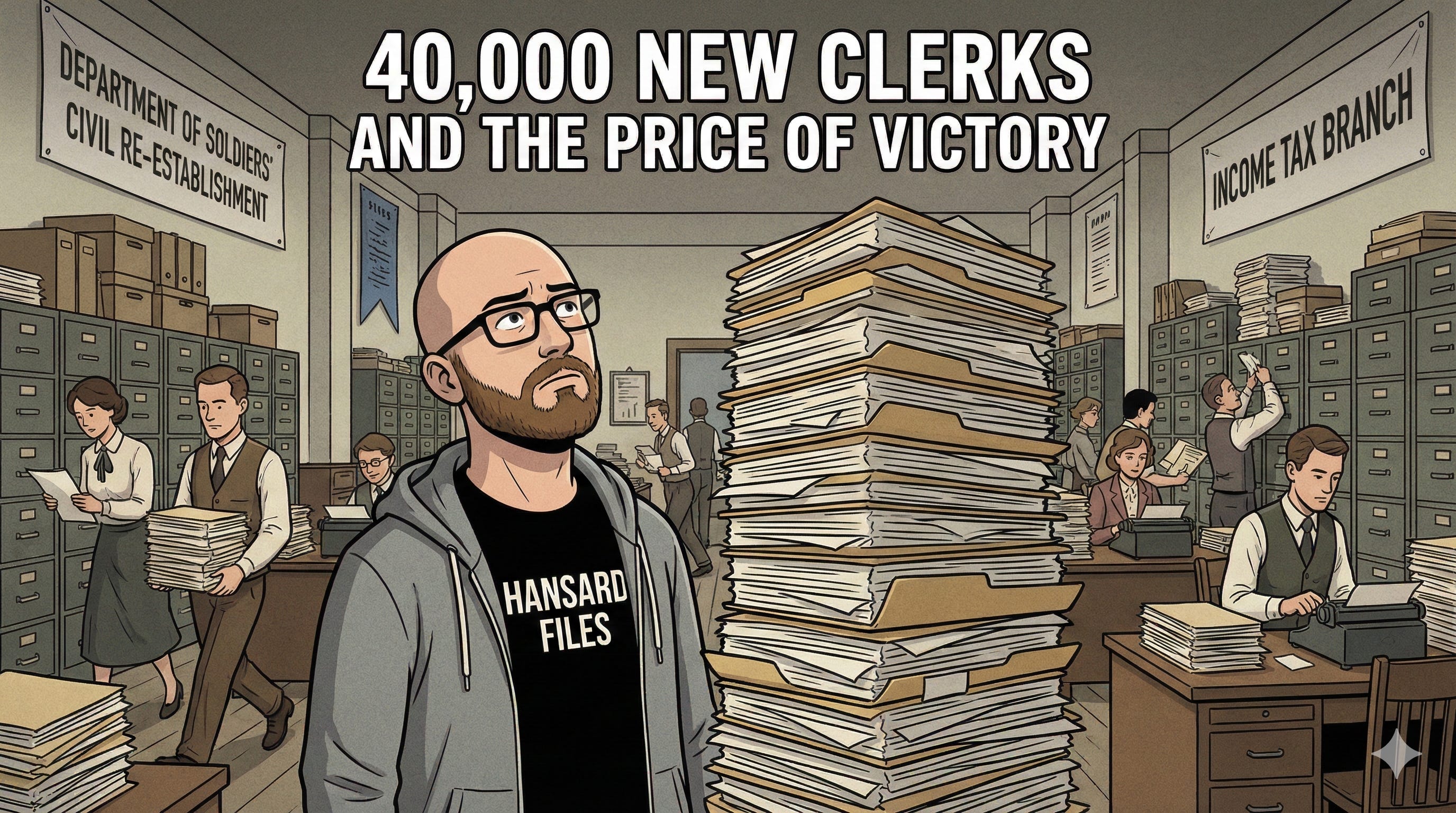
The Ottawa of 1912 was a town of modest ambitions. In the ledgers of the Dominion Bureau of Statistics, the federal government was a manageable, almost quaint entity. The Department of Agriculture was busy inspecting hogs; the Department of the Interior was quietly surveying the western plains; and the Post Office was the undisputed giant of the civil service, employing the vast majority of the King’s servants. The federal expenditure was a tidy $87 million.
By 1924, that world had been incinerated.
A review of the Civil Service Personnel and Salaries (1912-1924) reveals a government in the throes of a violent metamorphosis. The Great War did not just send soldiers to the front; it mobilized an army of clerks, stenographers, and inspectors at home. In the span of a decade, the Canadian state quadrupled its spending and birthed entirely new bureaucratic organisms to manage the carnage. The primary keyword for historians looking at this era is usually “trench warfare,” but the domestic story is one of “civil service personnel”—a massive, permanent expansion of the state that no amount of peacetime austerity could reverse.
The Mobilization of Paper
When the first shots were fired in 1914, the Canadian government was ill-equipped for total war. The Department of Militia and Defence was a relatively sleepy organization. But modern warfare is as much about logistics and payroll as it is about artillery. As the Canadian Expeditionary Force grew, so did the administrative tail required to wag it.
The statistical retrospective shows that the machinery of war required immediate, explosive growth in staffing. The Department of Militia and Defence didn’t just recruit soldiers; it recruited a legion of civilian support staff. But the real explosion happened in the immediate aftermath. The government suddenly found itself responsible for a generation of broken men.
This necessitated the creation of the Department of Soldiers’ Civil Re-establishment (SCR). It was a bureaucratic titan built overnight. Between January 1919 and January 1920 alone, the SCR added 5,048 employees to its payroll. These were not soldiers; they were the doctors, nurses, limb-makers, and vocational trainers tasked with putting 40,000 wounded veterans back together. Simultaneously, the Soldier Settlement Board swelled by 1,107 employees in a single year, scrambling to process land grants for returning heroes.
The Taxman Cometh
Perhaps the most enduring legacy of the war found in these files is not the Department of Defence, but the Department of Finance. In 1912, federal revenue was largely derived from customs and excise taxes—duties on goods crossing the border. But the war cost more than tariffs could cover.
The solution was the Income War Tax Act of 1917, a “temporary” measure designed to fund the war effort. The personnel records from 1912-1924 document the physical manifestation of this new tax. In 1916, the Income Taxation Branch was organized. By 1920, the Finance Department had to hire 453 new staff members just to process the returns. The following year, they added another 472.
While the Department of Militia and Defence eventually shrank—shedding 2,863 employees between 1920 and 1921 as the army demobilized—the tax collectors remained. The state had discovered a new revenue stream, and it had built a permanent bureaucracy to harvest it. The temporary war measure had required a permanent administrative architecture.
The “Blanketing In” of the Bureaucracy
The most fascinating bureaucratic maneuver revealed in the report is a phenomenon known as “blanketing in.” During the war, thousands of employees were hired on a “temporary” basis. They were meant to be stop-gap measures, filling chairs until the crisis passed. But bureaucracy has a survival instinct.
As the war ended, the government faced a choice: fire thousands of people or formalize their status. They chose the latter. The report cites P.C. 2958, a Privy Council order dated December 16, 1920. This regulation allowed for the “blanketing in” of temporary staff, effectively converting them into permanent civil servants.
The impact was visible across every department. The Department of the Interior, for example, saw an increase of 171 employees between 1921 and 1922, largely due to this regulatory magic. Surveyors and field clerks who had been paid via outside votes were suddenly brought onto the permanent head office pay list. The war had created a new baseline for government employment. The “temporary” state had calcified into the permanent state.
The Inflationary Spiral
It wasn’t just the number of employees that changed; it was the cost of keeping them. The war unleashed severe inflation, eroding the purchasing power of the civil servant’s dollar. The government responded with the “Bonus,” a cost-of-living adjustment that appears throughout the salary tables.
In the Department of Justice, what began as a “special living allowance” for penitentiary staff evolved into a complex bonus structure. The government was chasing its own tail: hiring more people to manage the war, then paying them more money so they could afford to live in a war-inflated economy.
By 1923, total federal expenditure had settled at $332 million—nearly four times the 1911 level. The population had only grown from 7.2 million to 9 million. The per-capita cost of government had exploded.
The Permanent Leviathan
By 1924, the chaos of demobilization had largely stabilized, but the government of 1912 was gone forever. The Department of Health, non-existent before the war, was now a fixture, having absorbed quarantine services from Agriculture and immigration medical inspections. The Royal Canadian Mounted Police had absorbed the Dominion Police, expanding its jurisdiction nationwide.
The “temporary” agencies of the war years—the Soldier Settlement Board, the Income Tax Branch, the expanded Pension Commission—had woven themselves into the fabric of Canadian life. The statistical summary ends in 1924, capturing a government that had ceased to be a mere night-watchman and had become an active, expensive participant in the lives of its citizens. The 40,000 clerks recruited to fight the Kaiser had, in the end, built the modern Canadian state.
If you enjoyed this deep dive into the archives of the Canada, subscribe to Hansard Files. We read the dusty reports so you don’t have to.
Source Documents
Dominion Bureau of Statistics. (1925). Civil Service Personnel and Salaries in the Month of January, 1912-1924.
And it's never stopped growing since.