


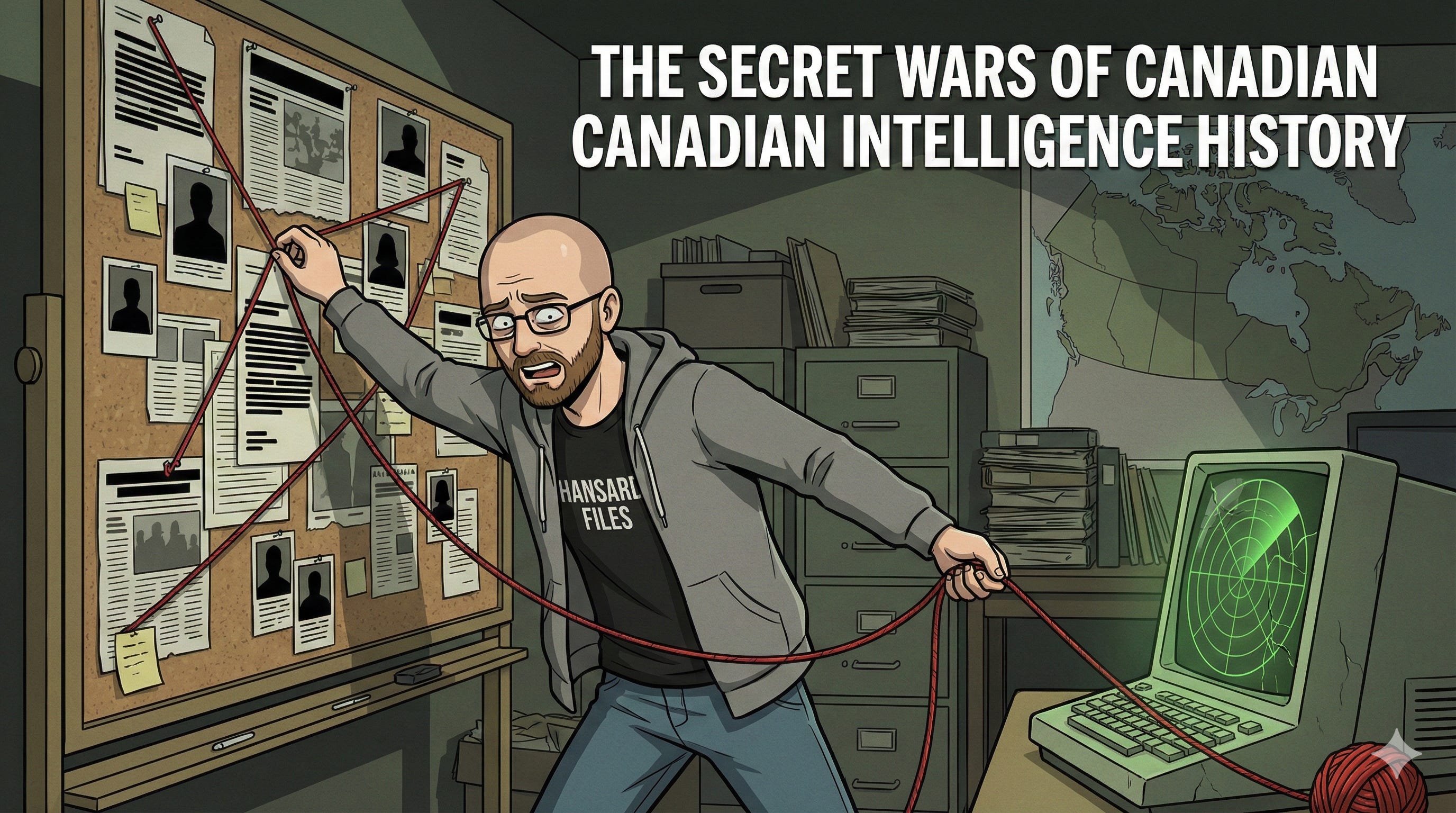
On a crisp October morning in 1970, members of the Front de libération du Québec abducted British trade commissioner James Cross from his Montreal home. Days later, a separate terrorist cell snatched Quebec Minister of Labour Pierre Laporte. As the nation plunged into what would become known as the October Crisis, the Canadian government feared the worst. Behind closed doors, a hastily assembled Task Force on Kidnapping began investigating whether these violent separatists were forging an international terror network. They hunted for links between the kidnappers and foreign states like Cuba and Algeria, desperately trying to map a shadow war that threatened to tear the country apart.
This frantic search for hidden threats was not an isolated incident. The timeline of Canadian intelligence history is defined by these high-stakes moments. From the muddy battlefields of the 19th century to the digital frontiers of the 21st, Canada has constantly adapted its clandestine operations to survive.
The Fenian Infiltrators and the First Secret Police
The origins of the Canadian secret service are rooted in the existential anxieties surrounding the American Civil War. Authorities originally established a secret police force to prevent Southern Confederates from using Canadian soil as a staging ground. However, the focus quickly shifted to a much more immediate threat. The Fenian Brotherhood, an Irish nationalist organization based in the United States, devised a radical strategy. They planned to invade Canada, pull British troops across the Atlantic, and use the distraction to liberate Ireland.
The Canadian government, led by John A. Macdonald, took the threat of an invasion incredibly seriously. Macdonald personally micromanaged a secret police force divided into two branches. Gilbert McMicken, a shrewd and cool-headed Scottish immigrant, ran the operations in Canada West (present-day Ontario). Early efforts were disastrous. Detectives lacked training, suffered from low morale, and frequently turned on one another.
The tide turned when McMicken recruited operatives who could seamlessly blend into the Fenian ranks. The ideal spy was a capable Irish Roman Catholic who could speak the Irish language, a skill often used by the Fenians to hide their secrets from outsiders. McMicken’s top detective, Charles Clarke, established a completely fake Fenian Circle in Missouri. Operating under the alias Cornelius O’Sullivan, Clarke infiltrated the Fenian headquarters in New York, attending mass and Sunday dinners with the Brotherhood’s president, William Roberts.
An even more prolific spy was Thomas Billis Beach. A runaway Englishman who fought in the American Civil War under the false identity of Henri Le Caron, Beach became an embedded agent for both the British and Canadian governments. Rising to the rank of Adjutant General of the Irish Republican Army, Beach meticulously documented the locations of Fenian arms caches, providing hand-drawn diagrams of the barns where weapons were stored. He handed the complete Fenian war plans to the Canadian secret service. When the Fenians finally attacked in May 1870, the Canadian militia was waiting, resulting in a total disaster for the invaders.
A Future Prime Minister’s Codebreaking Secret
The need for actionable intelligence did not vanish with the Fenians. Decades later, as the Second World War engulfed the globe, Canada found itself relying entirely on the British Foreign and Dominions Offices for intelligence. The country lacked any domestic capacity to decipher intercepted enemy communications.
Enter Lester Bowles (Mike) Pearson. Long before he became the 14th Prime Minister of Canada, Pearson served as the First Secretary at the Canadian High Commission in London from 1935 to 1941. Endowed with sharp wit and high intellect, Pearson deeply embedded himself within the British intelligence community. He read classified reports in the Foreign Office and became Canada’s primary liaison with the Government Code and Cypher School (GC&CS).
Despite repeated offers from the British to help Canada establish its own cryptographic bureau, officials in Ottawa stubbornly refused. It was not until 1941 that the Department of External Affairs relented, utilizing secret funds from the National Research Council to launch the Examination Unit. Pearson was appointed Chairman of the Examination Unit Advisory Committee.
However, the launch was marred by a colossal diplomatic blunder. Ottawa hired the controversial American codebreaker Herbert Osborne Yardley to lead the unit. Yardley had previously burned the intelligence communities of both the United States and Britain by publishing a tell-all book about their trade secrets. When British and American agencies discovered Yardley was working in Ottawa under an assumed name, they immediately threatened to cut off all cooperation. Pearson used his characteristic diplomatic aplomb to fire Yardley, smooth ruffled feathers, and secure a veteran British replacement, firmly establishing Canada’s first foreign intelligence service.
Harvesting Nuclear Clouds and Submarine Hunting
As the hot war ended, the Cold War began, bringing an entirely new set of technological terrors. In 1949, the Soviet Union detonated its first atomic device. Eager to understand the lethality of the expanding Soviet nuclear arsenal, Canadian defence officials pioneered a highly classified scientific intelligence program.
Starting in 1951, specially modified Royal Canadian Air Force (RCAF) aircraft flew harrowing missions over the sub-Arctic and the Atlantic seaboard. . Flying bi-weekly from bases like Cold Lake, Alberta, these T-33 jets were fitted with filter assemblies designed to capture radioactive debris from Soviet nuclear plume clouds drifting high in the atmosphere. Ground crews extracted the contaminated filters and rushed them to specialized laboratories in southern Ontario. At McMaster University, nuclear chemists utilized mass spectrometry to analyze the uranium and plutonium isotopes within the debris, attempting to deduce the exact composition of the Soviet weapons.
While the RCAF patrolled the skies, the Royal Canadian Navy monitored the ocean depths. A vital node in this underwater surveillance network was the Canadian Forces Station Bermuda. Operating from 1963 to 1993, this high frequency direction finding station sat astride the Atlantic shipping lanes. . The station’s primary mission was to detect and track Soviet ballistic missile submarines that threatened North America. The facility proved its immense strategic value in October 1986, when its operators successfully located the Soviet submarine K-219 after it suffered a catastrophic explosion in a missile tube, guiding American patrol planes to the site before the vessel sank.
Interrogating Defectors and the Domestic Threat
Technology alone could not piece together the puzzle of the Soviet bloc. Human intelligence remained critical. In 1953, the Joint Intelligence Bureau created a dedicated interview program to extract secrets from Canadian travellers, immigrants, and defectors. When Soviet scientist Mikhail Klochko defected in 1961, he was recognized as a goldmine of information. Allied intelligence agencies submitted over 650 questions, leading to nine months of exhaustive interviews detailing everything from precious metals mining to the Sino-Soviet split.
But while eyes were fixed overseas, domestic unrest began to boil. Following the First World War, military intelligence intensely monitored organized labour during the Workers’ Revolt. In Winnipeg, undercover military agents infiltrated left-wing organizations like the Anti-Conscription League. Major-General Huntly Ketchen utilized these informants to track the Winnipeg Trades and Labor Council during the 1919 General Strike, sharing intelligence with local police and private citizen militias.
This legacy of domestic surveillance continued into the Cold War. The Royal Canadian Mounted Police heavily monitored political dissidents, drawing sharp criticism from the New Democratic Party. When the RCMP’s surveillance of a minor postal employee and KGB spy named Victor Spencer became public, the resulting scandal nearly toppled a minority government. The public outcry led directly to the Royal Commission on Security, which eventually recommended stripping the RCMP of its security functions.
From Apprehended Insurrections to the Emergencies Act
This tension between civil liberties and national security reached a breaking point during the 1970 October Crisis. When the FLQ kidnapped James Cross and Pierre Laporte, the federal cabinet invoked the War Measures Act, citing an “apprehended insurrection”. The legislation provided the state with terrifying, unchecked power. Police conducted over 1,600 raids and detained 497 individuals without criminal charge or access to legal counsel.
The dragnet was devastatingly broad. Detainees included folk singers, poets, and social activists who simply shared a belief in Quebec independence, rather than violent terrorism. Later, senior RCMP officials admitted they had never been consulted on the proclamation. Had they been asked, they would have advised against using such disproportionate powers.
The blatant overreach of the War Measures Act paved the way for its repeal. It was replaced by the Emergencies Act, a more nuanced legislative tool requiring strict parliamentary oversight and compliance with the Canadian Charter of Rights and Freedoms. This new framework remained untouched for decades until 2022, when it was invoked to dismantle the Freedom Convoy blockades that paralyzed downtown Ottawa and crippled cross-border trade.
The Digital Renaissance and a New Era of Sharing
The failures and scandals of the 1970s birthed a modernized intelligence apparatus. In 1984, the Canadian Security Intelligence Service (CSIS) was officially created as a civilian agency. Concurrently, Canada’s signals intelligence agency, the Communications Security Establishment (CSE), experienced a massive operational renaissance.
Through Project Elevator in 1984, CSE purchased a Cray X-MP/11 supercomputer to revolutionize its codebreaking operations. . The agency also expanded its reach, participating in the Echelon commercial satellite monitoring program and launching Project Pilgrim to place permanent intercept sites within Canadian diplomatic facilities abroad.
Today, the threats have mutated from Soviet subs to transnational terrorism and sophisticated cyber-attacks. The mandate of these agencies has expanded to protect the 80 percent of Canada’s critical infrastructure that is owned by the private sector. In June 2024, the passing of Bill C-70 amended the CSIS Act, granting the agency the unprecedented ability to disclose specific threat intelligence directly to non-governmental partners to build resiliency against foreign interference.
The United States utilizes similar mechanisms, such as the Duty to Warn directive, which legally obligates intelligence agencies to notify private individuals or corporations of impending threats to life or safety. While Canada is rapidly adapting to this collaborative model, the cultural shift towards an open willingness to share intelligence remains the highest hurdle.
As the world grows more volatile, understanding the deep roots of these clandestine agencies is vital. From the bumbling Fenian spies to the high-tech server farms of today, analyzing the raw, unclassified truths of the past is the only way to ensure the security mechanisms of the future remain accountable to the citizens they are sworn to protect.
We dig through the redacted files, parliamentary archives, and dusty bureaucratic records so you don’t have to. Subscribe to Hansard Files to support independent, deep-dive investigations into the hidden machinery of our government.
Source Documents
Canadian Security Intelligence Service. (2025, December). Canadian Intelligence History: A Celebration of CSIS’ 40th Anniversary.
Hi! Thomas Billis Beach was my great x3 grandfather and I recently started reading about him. I just did a random search on Substack (started mine in December), and this popped up. So cool! I'm currently reading one of two books about him and then I'm going to read his memoir.
I'm surprised you glazed over the obvious point that the minority government which nearly toppled in 1966 over the KGB spy Victor Spence was led by Liberal PM Lester Pearson (mentioned previously in the article) and the NDP who objected were led by eugenics fan Tommy Douglas.