


It was called “sword exercise,” a term that suggests military discipline or perhaps a fencing lesson. For Private John L. Davis, regimental number 18036, standing in the mud of the Hestenmoor prisoner of war camp, it meant something else entirely. It meant standing rigidly at attention while a German guard whirled a heavy sword around his head and body, the steel blade hissing inches from his face. It was a psychological torture designed to break the nerve of a man already buried alive by shellfire at Ypres.
Davis survived the sword. He survived the beatings with rifle butts at Giessen and the forced labor at Soltau. He escaped in 1918, returned to Canada, married a widow, and found work in the Edmonton Power House. But by 1930, the “severe psycho-neurosis” that shook his hands and clouded his mind was making life impossible.
He was one of hundreds of men who came forward that year, ghosts of a war that had ended twelve years prior, asking the Canadian government to fulfill a promise written into the Treaty of Versailles. Germany was supposed to pay for the damage done to civilian and military prisoners. In the depths of the Great Depression, with unemployment soaring, the prospect of a reparations check was a lifeline.
But when Davis’s case reached Commissioner Errol M. McDougall in Ottawa, the answer was cold, legalistic, and final. The Commissioner admitted the neurosis was real. He admitted the beatings likely happened. But he could not be certain, fifteen years later, that the shivering man before him was broken by the German sword or simply by the passage of time.
“I remain unconvinced,” McDougall wrote, “that claimant’s experiences as a prisoner have necessarily resulted in his now impaired state of health”.
The claim was disallowed. Davis got nothing.
The Court of Delayed Justice
This was the McDougall Commission on Reparations, a bureaucratic tribunal set up to adjudicate the maltreatment of prisoners of war. Its task was monumental and macabre: to assign a dollar value to suffering that had occurred over a decade ago, in a country thousands of miles away, behind barbed wire where no records were kept.
By 1930, the Canadian government was facing a flood of claims. The initial fervor of the Armistice had faded, replaced by the grinding economic reality of the 1930s. Old soldiers who had managed to hold it together during the Roaring Twenties were now collapsing—physically and financially. They appeared before Commissioner McDougall in Halifax, Montreal, Winnipeg, and Vancouver, clutching sworn statements and medical certificates, hoping to prove that their rheumatism, their blindness, or their “nerves” were the direct result of German cruelty.
Commissioner McDougall, a King’s Counsel, approached the job with the skepticism of a high-court judge and the parsimony of a Depression-era accountant. In his report to the Governor General, he lamented that the work was “laborious” and the report “voluminous”. He was suspicious of the memories of old men.
“Stories, which have become exaggerated with the passage of time, have been carefully scrutinized and confined within the bounds of probability,” he wrote in his opening remarks.
His mandate was strict. This was not a charity. It was not a pension board. To win an award, a soldier had to prove three things: that he was maltreated; that the maltreatment violated the laws of war; and—most difficult of all—that he had a permanent disability directly caused by that specific act of maltreatment.
General starvation didn’t count. McDougall ruled that “lack of food whilst a prisoner of war, unless deliberately imposed upon a prisoner, is to be regarded as maltreatment”. If everyone in Germany was starving, the prisoners had to starve too. It was a brutal logic that disqualified hundreds of men who had wasted away to skeletons in the camps of 1917.
The Ill-Famed Mines
For those who could prove specific brutality, the testimony offered a glimpse into a hell that the Canadian public had largely forgotten. The report details the geography of suffering: the salt mines of Beienrode, the coal mines of Wittenberg, and the blast furnaces of Westphalia.
Samuel Ramsden, a private in the 29th Battalion, testified that he was kicked by guards, knocked down with a rifle butt, and had his teeth knocked out, splitting his chin open. He was forced to sleep in a room with twelve other men and an open latrine, the stench and disease permeating their clothes and skin. Despite being declared fit only for light work, he was thrown into an iron foundry to load ore and work 24-hour shifts.
Then there were the men sent to the “ill-famed salt mines at Beienrode”. Working deep underground in saline dust without proper respirators or clothing caused chronic respiratory failure and skin lesions that refused to heal. Commissioner McDougall, usually so skeptical, seemed to accept the horror of Beienrode as an established fact. In cases involving these mines, he was occasionally willing to “give claimant the benefit of the doubt,” acknowledging that the brutal conditions themselves constituted maltreatment.
But even here, the burden of proof was crushing. Men who had been forced to work in munitions factories—a clear violation of international law prohibiting prisoners from manufacturing weapons to be used against their own countrymen—often found their claims rejected.
Robert Henry Rock, Case 2123, was forty-five years old when he enlisted in 1914. He was shot in the abdomen at the Second Battle of Ypres and captured. Despite his wound, he was sent to a camp near Essen and ordered to work on munitions. When he and other Canadians refused, they were “roughly handled,” denied Red Cross parcels, and thrown into solitary confinement.
Rock stood before the commission in 1931 as a broken man, suffering from general debility and defective vision. He asked for compensation for the forced labor and the long hours standing at attention. McDougall turned him down. The Commissioner argued that Rock’s debility was “quite general” and likely due to his advanced age rather than the German prison camps. The fact that he was forced to make shells to kill Canadians was irrelevant if it couldn’t be medically proven to have ruined his eyes or his heart.
The Court of Delays
When the Commission did decide to pay, the amounts were arbitrary and strangely precise. Yet for many, the rejection came down to a date on a calendar.
For British soldiers who moved to Canada after the war, the Commission had to decide if they were “Canadian” enough to receive Canadian reparations. McDougall drew a hard line: if you arrived in Canada after the treaty was signed, you were Britain’s problem.
This jurisdictional hair-splitting led to tragic absurdities. David John Evans (Case 2122) had been beaten at Gustrow and Schneidemuhl camps, suffering injuries to his head and hands. But because he was an Imperial soldier who didn’t move to Canada until 1929, McDougall washed his hands of him. “I do not consider that this Commission has jurisdiction,” he wrote. Evans was told that his claim “lay with the Imperial authorities” [snippet from prompt, verified in File 2].
The “date constitutive of jurisdiction” was fixed at January 10, 1920. Arrive on January 11, and your suffering was no longer Canada’s concern.
The Medical Filter
The ultimate gatekeepers of the reparations fund were not the lawyers, but the doctors. Commissioner McDougall relied heavily on Dr. J.P.S. Cathcart, the Chief Psychiatrist to the Department of Pensions. Dr. Cathcart sat in on the sessions, watching the veterans tremble, stutter, and weep.
The medical profession in the 1930s was deeply suspicious of “neurasthenia” (shell shock) and “functional” disorders. They constantly looked for physical causes—bad teeth, old age, syphilis—to explain away the symptoms of trauma.
In the case of Henry Bertram Arnold (Case 2124), the veteran claimed that being forced to work in the intense heat of blast furnaces and then thrust into the freezing cold had caused his chronic bronchitis. He also testified that he was beaten for escaping and placed in freezing cells for seven days without food. A doctor confirmed he had chronic bronchial conditions.
But the Commission’s medical advisors found a way out. They suggested the bronchitis “may possibly have resulted from the effect of gas” from which Arnold was suffering when captured, rather than the maltreatment in the camps.
This created a bureaucratic trap. If the gas caused it, it was a “service injury” pensionable by the regular Pension Board. But Arnold had likely already been denied or given a pittance by that Board. McDougall washed his hands of it: “His recourse, if any, is before the Board of Pension Commissioners”.
This “pension vs. reparation” shell game trapped hundreds of men. If they claimed their injury was from the war, McDougall told them to go to the Pension Board. If they went to the Pension Board, they were often told their condition wasn’t service-related. They bounced between bureaucracies, carrying their scars with them.
The Legacy of Denial
The McDougall Report is a document of its time—precise, unemotional, and rigidly adhering to the letter of the law while ignoring its spirit. It reveals a government terrified of setting a precedent, terrified of the cost of acknowledging the full scale of the war’s psychological toll.
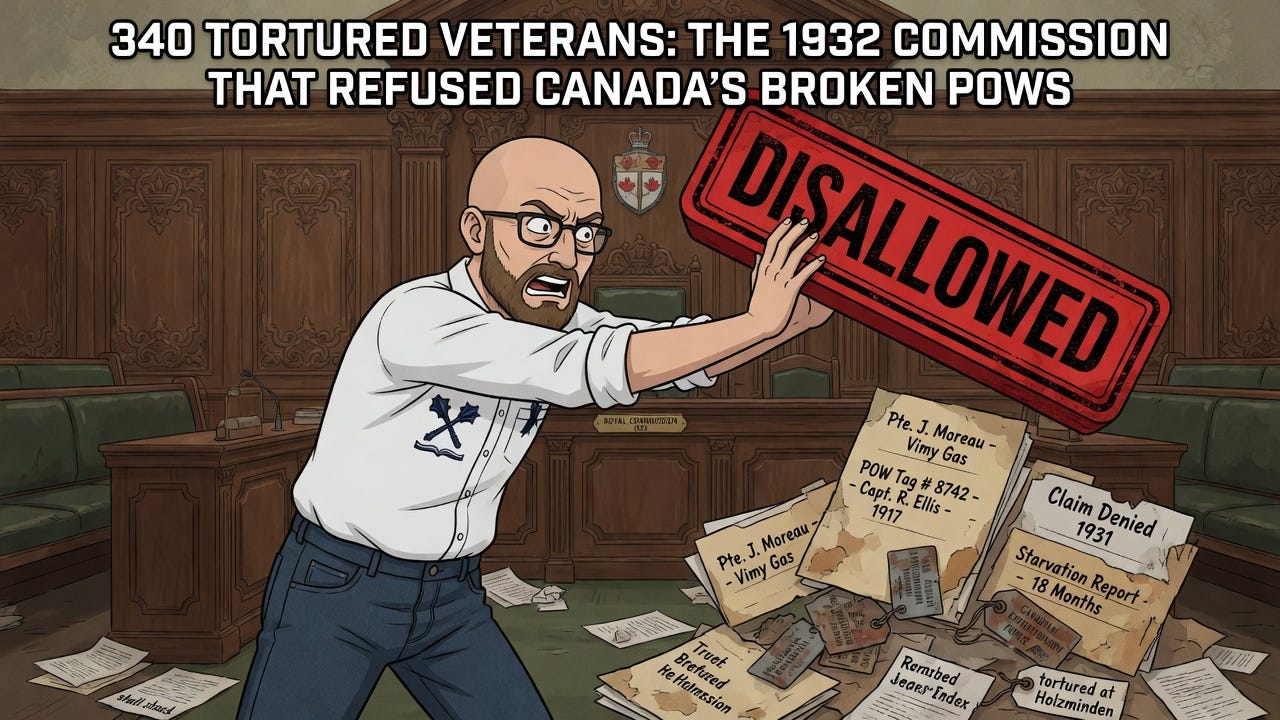
Reading the files today, the “disallowed” stamps on cases like John Davis and Robert Rock feel like a second betrayal. These men had survived the first industrial war in human history. They had endured the “sword exercises,” the rifle butts, and the starvation of the camps. They had come home to build the country, only to be broken by the Depression.
When they finally asked for what was owed to them—not as charity, but as a debt paid by the enemy—they were met with a lawyer asking for proof that a beating in 1916 was the sole cause of a tremor in 1931.
In the end, McDougall disposed of 340 cases in this specific report. Some men got a few hundred dollars. Many got nothing but a train ticket home and a suggestion to apply for a pension they had already been denied. The “Book of Remembrance” in Ottawa lists the names of the dead, but the McDougall Report lists the names of the survivors who found that their country’s gratitude had a very strict statute of limitations.
If you believe that history should be measured not just by the battles won, but by the promises kept to those who fought them, subscribe to Hansard Files. We read the redacted files so you don’t have to.
Source Documents
McDougall, E. M. (1932). Reparations 1930-31: Report, Maltreatment of Prisoners of War (Front Matter & Introduction). King’s Printer.
McDougall, E. M. (1932). Reparations 1930-31: Report, Maltreatment of Prisoners of War (Cases 1958-2000). King’s Printer.
McDougall, E. M. (1932). Reparations 1930-31: Report, Maltreatment of Prisoners of War (Cases 2123-2125). King’s Printer.
There should be a memorial to these men in Ottawa, even, if necessary, in the Canadian War Museum. They are victims of war as much as the dead.
Are all of the names of the claimants listed somewhere?