


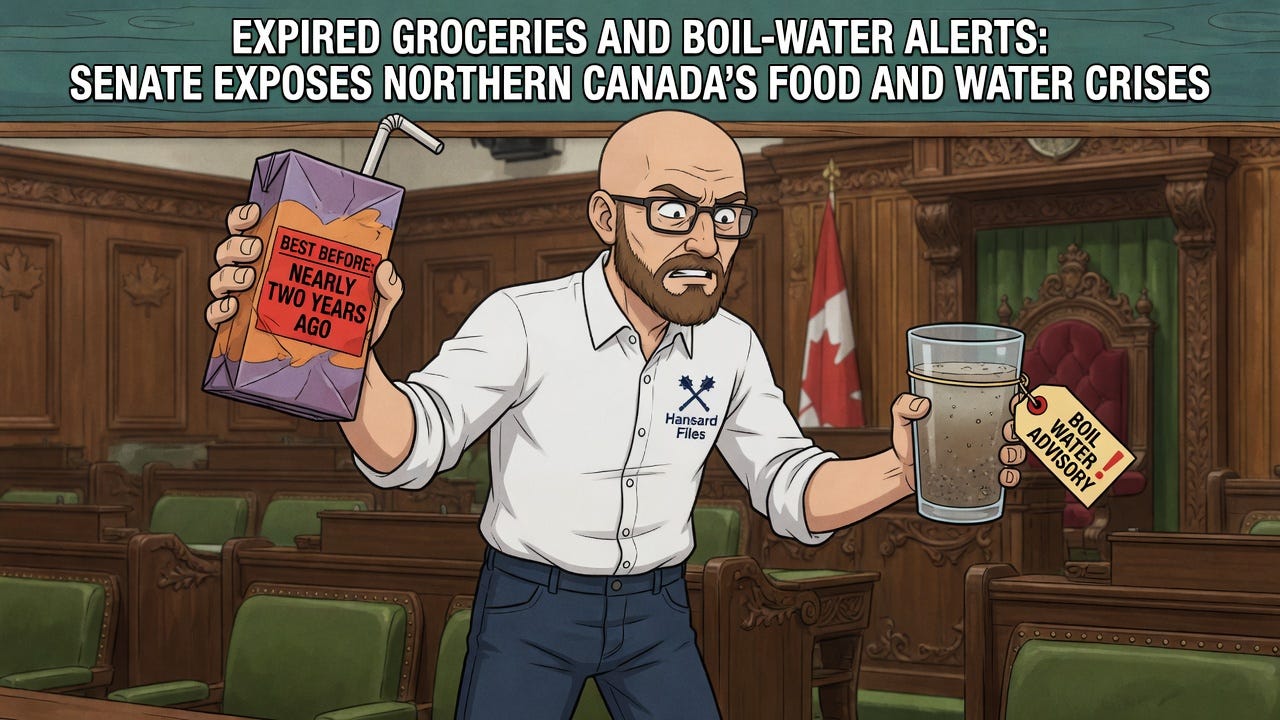
The item sat on the counter in Ulukhaktok. Senator Dawn Anderson had picked it up herself at the local Northmart in July 2025. She prepared it back at her lodging. The colour was off. A stale odour rose from the pan. One bite told the rest: the best-before date had passed nearly two years earlier. Later that same visit to the Inuvialuit community of roughly 400 souls, accessible mainly by air and once-a-year sealift, juice boxes appeared at a community meeting. Six months past their best-before date. These were Nutrition North Canada items, subsidized to help northern families afford food.
Senator Anderson rose in the Senate on April 15, 2026, and asked the chamber a quiet, devastating question. “Would this be tolerated in Ottawa?” She paused. “Would any grocery store in southern Canada leave products on shelves for years past their best-before date and still charge full price?” The answer hung in the air. In the North, it happens without viable oversight.
The day before, on April 14, the same senator had stood to describe parallel failures in drinking water. In November 2025 the Chief Environmental Health Officer issued a boil-water advisory for Hay River, Enterprise, Kátł’odeeche First Nation and Kakisa. Residents were told to keep showers brief and leave windows open when temperatures dipped below minus 20 Celsius. Testing in Hay River showed trihalomethanes exceeding Health Canada’s guideline of 100 micrograms per litre. Lead levels in schools and public buildings across Yellowknife, Fort Smith, Aklavik, Tsiigehtchic, Behchokǫ̀, Fort Simpson and more reached as high as 20 times the maximum acceptable concentration. In Ulukhaktok itself untreated source water tested positive for coliforms. Sachs Harbour faced its own boil-water advisory in February 2026 after frozen infrastructure shut down the treatment system. At least 12 of the territory’s 33 communities had been touched by these recurring risks.
The Human Stakes of “Legal but Unacceptable”
Senator Anderson did not mince words. Best-before dates mark quality. Expiry dates, enforced by the Canadian Food Inspection Agency, mark safety. Yet in practice the line blurs when one store serves an entire isolated community and no alternatives exist. The supply chain is fragmented: the North West Company delivers the goods, the CFIA regulates expiry dates only, Indigenous Services Canada oversees the subsidy. No single authority holds clear accountability for quality once products reach the shelf. Since July she had contacted all three. Dialogue continued. Products past best-before remained on sale. Nutrition North Canada itself sat under review.
She invoked Truth and Reconciliation Commission Call to Action 19: close the health gaps between Indigenous and non-Indigenous peoples. “Equality should not depend on where you live,” she said. In the North, people are captive consumers. When quality fails, dignity suffers.
The statements landed amid a week already heavy with northern voices. On April 14 Senator Yonah Martin had shared the profound grief still rippling through Tumbler Ridge, British Columbia, after the February 10 tragedy that claimed eight lives. She had carried books of condolences from the Senate to the families, watching grace and forgiveness unfold in a small-community room. Healing, she reminded colleagues, would require real systemic change in rural mental-health and health-care supports.
Resilience on Display: Arctic and Labrador Winter Games
The very next day, April 15, Senator Pat Duncan rose to celebrate the Arctic Winter Games that had just wrapped in Whitehorse. More than 2,000 young athletes, supporters and cultural performers from Alaska, northern Alberta, Greenland, the Northwest Territories, Nunavut, Nunavik, Labrador Inuit Nunatsiavut and even Sami delegates from the Nordic countries had gathered. The games were more than sport. They were “reconcili-action,” symbolized by lapel pins bearing the number 91, honouring Truth and Reconciliation Commission Call to Action 91 on Indigenous protocols at international sporting events. Generational stories flowed: Senator Nancy Karetak-Lindell’s granddaughters winning bronze in girls’ hockey where her sons had once competed for Nunavut. High-fives on the ice, pin exchanges between Alaskan and Greenland delegates. The games built leaders who give back to the North.
On April 16 Senator Judy A. White brought the story home to Labrador. Every three years Happy Valley–Goose Bay hosts the Labrador Winter Games, known locally as the Friendship Games. Traditional events like the Labrathon, a snowshoe race and survival contest with mandatory “tilt” stops for fire-lighting, ice-fishing and trap-setting, test skill and fortitude. This year records fell in the seal-kick category, a traditional Inuit sport. Christopher Penney jumped 9.3 feet to claim victory. Labrador City took the Labrador Cup. The games blend indoor table tennis and volleyball with dog-team racing and snowshoeing, honouring ways of life practised for generations.
These events stood in powerful counterpoint to the food and water warnings. Northern communities do not merely endure. They build friendships, leadership and cultural continuity even as infrastructure strains.
First Nations Health, Cultural Leadership and Broader Northern Voices
April 16 also saw Senator Mary Jane McCallum pay tribute to the First Nations Health and Social Secretariat of Manitoba. Staff and management, three of whom sat in the gallery, support 63 First Nations, seven tribal councils and three provincial-territorial organizations. Their work includes repatriating health data for sovereignty, delivering the new Regional Social Survey on child and family well-being, and advancing culturally grounded programs amid environmental emergencies, workforce shortages and jurisdictional complexities.
Earlier that week Senator Farah Mohamed had spoken of His Highness Prince Rahim Aga Khan’s visit, highlighting investments in affordable housing models like Generations Toronto and plans for similar projects across the country. In Laval, ground was broken on a new Jamatkhana. The visit underscored partnership, pluralism and service at a time when the world feels divided.
Cultural threads wove through the three days too. Senator Réjean Aucoin celebrated Acadian storyteller Clara Dugas winning the people’s choice award at the Combat des contes de la Francophonie. Senator Éric Forest honoured radio legend Jean Brisson on his 95th birthday, his voice still brightening Saturday mornings on CFYX FM after 70 years on air.
What the Record Demands
Question period that week touched related pressures: fuel surcharges driving grocery costs higher, temporary excise-tax suspensions announced, calls for deeper relief. Yet the senators’ statements cut deeper. They asked when “legal” stops being acceptable. They asked how many more best-before dates must pass, how many more boil-water advisories must be issued, before accountability matches the promise of equity.
The Nutrition North program remains under review. Federal dollars, such as the $20.1 million for a new water-treatment plant in Hay River, signal movement. Still, the Senate record from April 14 to 16 stands as an unflinching ledger: northern families deserve the same standards the rest of Canada takes for granted.
Canadians watching these proceedings now hold that ledger. The question is no longer whether the gaps exist. It is whether the country will close them before another winter, another spoiled meal, another boil-water advisory reminds us how far we still have to go.
Hansard Files spends weeks in the archives so you don’t have to. If stories like this matter to you, subscribe — it keeps this work independent.
Related Hansard Files Articles


Source Documents
Senate of Canada. (2026, April 14). Debates of the Senate, 1st Session, 45th Parliament, Volume 154, Number 62.
Senate of Canada. (2026, April 15). Debates of the Senate, 1st Session, 45th Parliament, Volume 154, Number 63.
Senate of Canada. (2026, April 16). Debates of the Senate, 1st Session, 45th Parliament, Volume 154, Number 64.
How are products that are 2 years past Best Before still on shelves to buy? I don't mean why haven't they been tossed, I mean how was it that these products were not purchased before they passed that date? How long had they sat on a shelf before they were purchased? Were they recently delivered to the store to be sold? If so, who was responsible for that? So many questions, I hope there are answers.
I live in a rural area and my home has it's own well. I test the water and if I started to have issues with the well, I am responsible for dealing with it.
Back in the 1990s I worked in BC including flying into remote reserves, "boil water" was a familiar issue. I spoke to one of the traditional elders who shrugged and said the gubbermint installed a treatment plant but it stopped working. Eventually the gubbermint will fix it.
I found that mindset as foreign to me as that of migrants publicly defecating and dumping garbage on streets. Oh... Canada... :(