


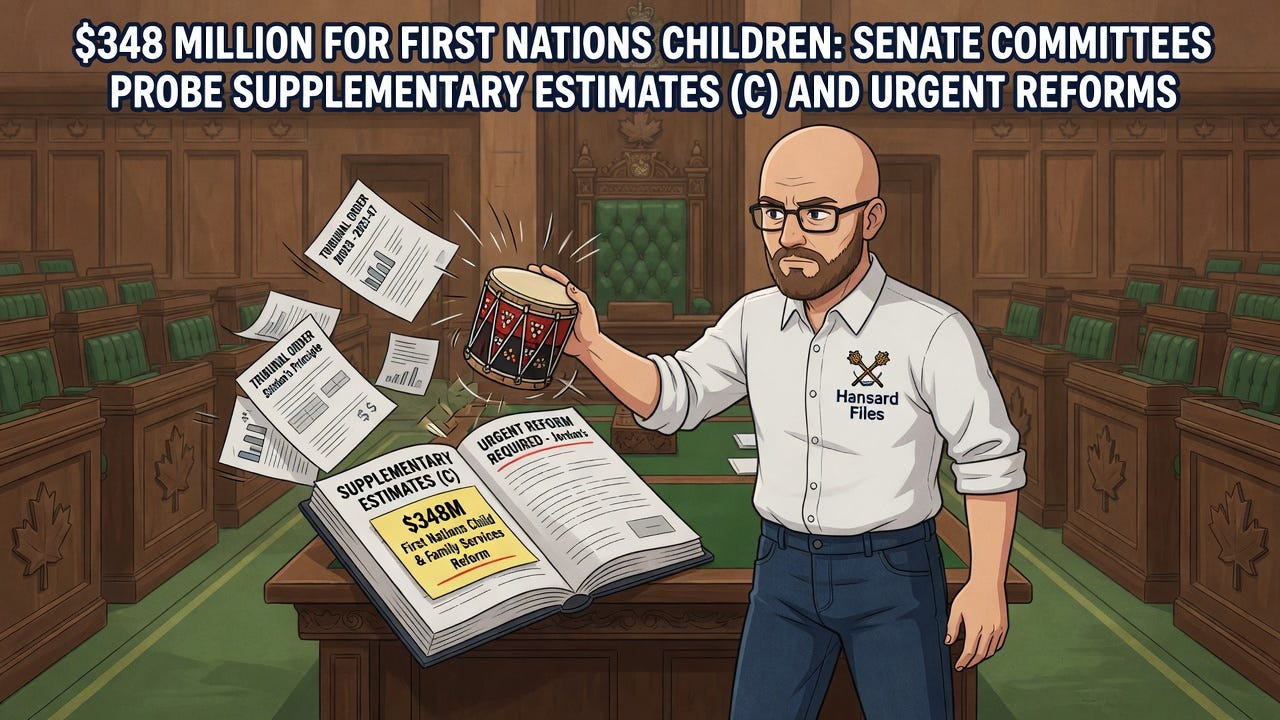
Senator Michèle Audette lifted the small chichigouan drum her son received at birth and struck it once, twice, three times. The soft, resonant beats filled the videoconference chamber on March 25 as she opened the Standing Senate Committee on Indigenous Peoples. “It’s a way to Innu-ize the official opening,” she said, her voice steady. The moment grounded the room in protocol and memory before the committee turned to the government’s response to its own 2023 report, *Honouring the Children Who Never Came Home: Truth, Education and Reconciliation*.
At virtually the same hour, across the Senate complex, the Standing Senate Committee on National Finance opened its study of Supplementary Estimates (C) for the fiscal year ending March 31, 2026. Officials from Indigenous Services Canada and Crown-Indigenous Relations and Northern Affairs Canada sat ready. The numbers they carried were not abstract. The Supplementary Estimates (C) reflected a net increase of $513 million, including $509 million in new funding, pushing Indigenous Services Canada’s total authorities to $27 billion. Of that, $348 million was earmarked for reforms to the First Nations Child and Family Services Program, money required to comply with Canadian Human Rights Tribunal orders and to advance long-term national reform.
The $348 Million Tribunal Mandate: Delivering on Child and Family Services Reform
Marc Geoffrion, Deputy Chief Financial Officer at Indigenous Services Canada, laid out the allocation plainly. The $348 million would sustain ongoing reforms to the First Nations Child and Family Services Program while respecting tribunal directives. Senators pressed for timelines, outcomes and accountability. The funding was not new policy. It was the cost of honouring legal obligations born from decades of documented shortfalls in care for First Nations children.
Parallel discussions in the Indigenous Peoples committee kept the human cost front and centre. Witnesses and senators revisited the 2023 report’s six recommendations and a follow-up 2024 document on missing records and missing children. Officials detailed progress on commemoration, education and data sharing. The drumbeat from the chair’s opening lingered as a reminder that reconciliation is not a line item. It is measured in children returned to families, records preserved and systems rebuilt.
$156 Million Lifeline: Medical Travel Costs in Nunavut and the Northwest Territories
The same Supplementary Estimates (C) package included $156 million to cover medical travel costs in Nunavut and the Northwest Territories. Officials explained the department would now enter formal funding agreements with the two territorial governments. Senators from northern regions and those representing remote First Nations communities asked pointed questions about wait times, capacity and the human stories behind each flight or ferry. One senator noted the funding would offset costs already incurred while negotiations on longer-term arrangements continued.
A further $5 million was allocated to sustain the Major Projects Office and its Indigenous Advisory Council. The money would support consultation and community readiness activities tied to major resource and infrastructure projects, delivered through the Strategic Partnerships Initiative. Decisions on individual projects would remain with the Privy Council Office. Senators probed whether this amount would be enough to move communities from consultation to meaningful participation.
From Budget Implementation to Bail Reform: Bill C-15 and Bill C-14 Under Scrutiny
National Finance also continued clause-by-clause review of Bill C-15, the budget implementation legislation tabled the previous November. In the Standing Senate Committee on Legal and Constitutional Affairs, senators examined Divisions 30 and 31 of that same bill alongside Bill S-209, which seeks to restrict young persons’ online access to pornographic material. Days later the same committee opened study of Bill C-14, the bail and sentencing reform act. Minister of Justice Sean Fraser described it as a core public-safety priority. The bill would impose reverse onus on serious offences such as extortion and tighten conditional sentencing for certain sex crimes. Senators weighed the balance between community safety and Charter rights, asking officials from the Department of Justice how the changes would be monitored and whether data would show reduced repeat offending.
Global Shockwaves and Strategic Recalibration: Iran, International Assistance and Defence Procurement
The Standing Senate Committee on Foreign Affairs and International Trade met twice in the same week. On March 25 officials briefed senators on Canada’s international assistance priorities amid rising global needs, conflicts in the Middle East and Russia’s war in Ukraine. Secretary of State for International Development Randeep Sarai acknowledged mounting pressure on aid budgets and the need for more deliberate, agile delivery. The following day the committee heard from Global Affairs Canada on the situation in Iran. Assistant Deputy Minister Alexandre Lévêque described far-reaching implications across a fragile region, reiterated Canada’s public statements on loss of life and outlined sanctions and diplomatic posture.
Simultaneously, the Standing Senate Committee on National Security, Defence and Veterans Affairs advanced its study of defence procurement in the context of Canada’s commitment to higher spending. Aerospace industry leaders and Indigenous business representatives pressed for meaningful set-asides and faster timelines. Senators explored how procurement could strengthen both sovereignty and economic resilience.
SME Credit Access, Official Languages and the Full Picture of Oversight
The Standing Senate Committee on Banking, Commerce and the Economy examined barriers to credit and capital markets for small- and medium-sized enterprises, seeking ways to drive productivity and growth. The Standing Senate Committee on Official Languages reviewed the regulatory framework of Part VII of the Official Languages Act, hearing from literacy networks and French-language cultural organizations on implementation gaps.
Across five days, from March 23 to March 26, and even referencing earlier February hearings on Bill C-15 elements, the Senate’s standing committees formed a mosaic of accountability. Senators introduced themselves by province and territory. They acknowledged traditional territories. They asked questions that cut across spending lines, legal obligations and international realities.
What these parallel proceedings make clear is that every dollar in Supplementary Estimates (C), every reform in child and family services, every adjustment in foreign policy or criminal law lands directly in the lives of Canadians, from remote northern communities to urban centres facing public-safety concerns.
Hansard Files digs through dense Senate transcripts to surface these moments of oversight, reconciliation and fiscal scrutiny so readers understand what Ottawa is funding and why. Subscribe today to support independent investigative reporting that keeps democracy accountable.
Related Hansard Files Articles

Source Documents
Standing Senate Committee on National Finance. (2026, March 24). *Evidence*. 44th Parliament, 1st Session. Parliament of Canada.
Standing Senate Committee on Indigenous Peoples. (2026, March 25). *Evidence*. 44th Parliament, 1st Session. Parliament of Canada.
Standing Senate Committee on National Finance. (2026, March 25). *Evidence*. 44th Parliament, 1st Session. Parliament of Canada.
Standing Senate Committee on Banking, Commerce and the Economy. (2026, March 25). *Evidence*. 44th Parliament, 1st Session. Parliament of Canada.
Standing Senate Committee on National Finance. (2026, March 24). *Evidence* (Bill C-15). 44th Parliament, 1st Session. Parliament of Canada.
Standing Senate Committee on Foreign Affairs and International Trade. (2026, March 26). *Evidence*. 44th Parliament, 1st Session. Parliament of Canada.
Standing Senate Committee on Foreign Affairs and International Trade. (2026, March 25). *Evidence*. 44th Parliament, 1st Session. Parliament of Canada.
Standing Senate Committee on Legal and Constitutional Affairs. (2026, February 4). *Evidence* (Bill C-15 elements and Bill S-209). 44th Parliament, 1st Session. Parliament of Canada.
Standing Senate Committee on Legal and Constitutional Affairs. (2026, March 25). *Evidence* (Bill C-14). 44th Parliament, 1st Session. Parliament of Canada.
Standing Senate Committee on Official Languages. (2026, March 23). *Evidence*. 44th Parliament, 1st Session. Parliament of Canada.
Standing Senate Committee on National Security, Defence and Veterans Affairs. (2026, March 23). *Evidence*. 44th Parliament, 1st Session. Parliament of Canada.
Anyone getting "grifter fatigue" from all of these special interests demanding funding or is it just me?