


The clock in Room 160-S of the Centre Block read 5:09 p.m. when Senator Claude Carignan, chair of the Standing Senate Committee on National Finance, brought the room to order. Senators from Quebec, Ontario, New Brunswick and Prince Edward Island introduced themselves one by one. Pierre Tessier, Assistant Deputy Minister and Chief Financial Officer at Veterans Affairs Canada, sat ready with his briefing book.
Tessier began by acknowledging the traditional, unceded territory of the Algonquin Anishinaabe people. Then he delivered the numbers that defined the evening. In the 2024-25 fiscal year more than 8,500 Canadian Armed Forces members were released, roughly 2,500 for medical reasons. Approximately 35,000 veterans now draw the Income Replacement Benefit. Last year alone the department received 84,000 applications for Pain and Suffering Compensation and supported nearly 1,000 veterans through the Veterans Emergency Fund.
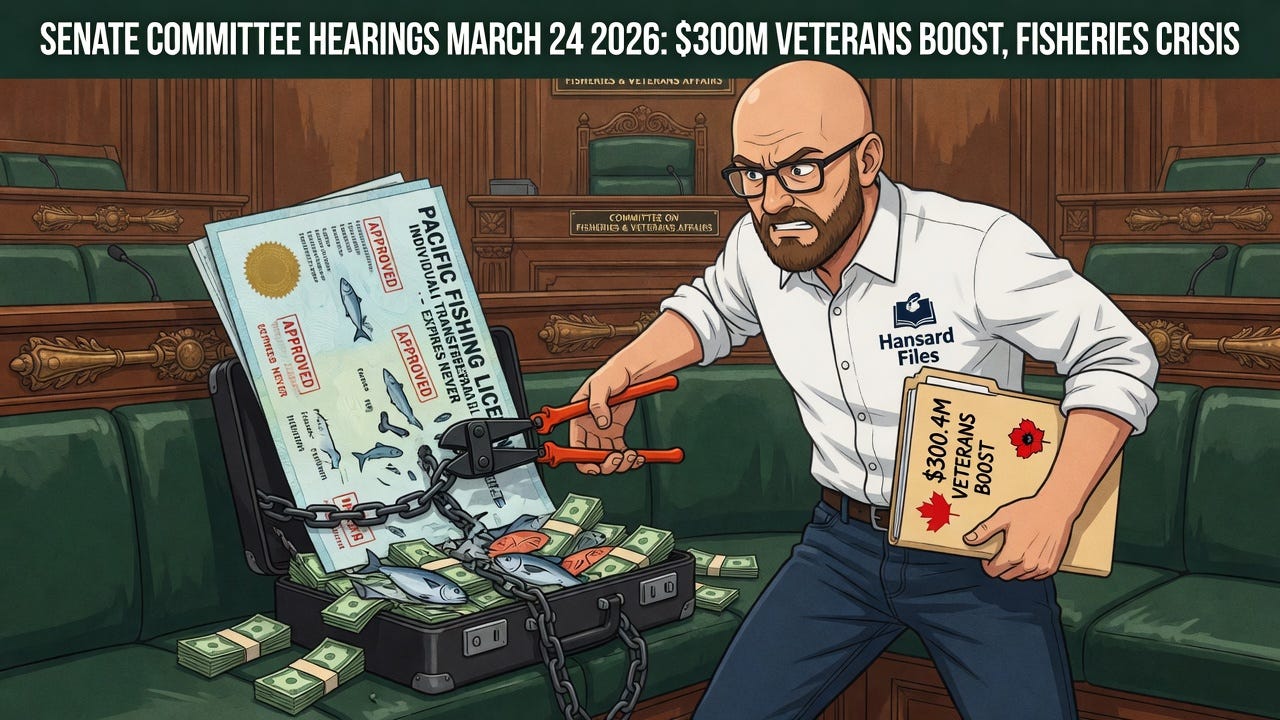
That single panel, part of Senate committee hearings March 24 2026, set the tone for a day when multiple committees peeled back layers of federal spending, coastal livelihoods and national priorities. By evening, senators in another room would hear Melanie Sonnenberg, president of the Canadian Independent Fish Harvesters’ Federation, declare that the Pacific fisheries licensing regime was failing the very people who harvest the resource.
Veterans Affairs Canada Seeks $300.4 Million as Demand Surges
Tessier told the committee that Supplementary Estimates (C) represented the final chance this fiscal year to adjust planned spending so that every eligible veteran receives support. The request totalled $300.4 million, lifting the department’s budget from $7.853 billion to $8.154 billion, a modest 3-per-cent increase. Of that amount, $213 million would cover a higher volume of Pain and Suffering Compensation decisions, $70 million would address rising demand and costs in the Income Replacement Benefit, and $20 million would meet increased need for veteran support services. A small internal reallocation of $100,000 would bolster the Veterans Emergency Fund.
Senators pressed for details. Senator MacAdam asked about current wait times for processing applications. Officials explained that processing had improved because of recent investments, though backlogs remained in some areas. Senator Dalphond inquired about the average lump-sum payment under Pain and Suffering Compensation and whether new programs were driving the increase in applications. Tessier confirmed the numbers were still rising, though at a slower pace than before. Senator Hébert wanted to know whether savings from staff reductions were being offset by new costs elsewhere. The exchange underscored the tension between fiscal restraint and the human cost of delayed support.
Tessier closed his remarks by framing the request in personal terms. Every dollar authorised, he said, is an investment in an individual’s well-being and their ability to live with dignity after military service. The committee moved on to questions about immigration and Canada Post, but the veterans file remained the emotional core of the session.
Pacific Fisheries Licensing: Active Harvesters Lose 50 to 80 Per Cent to “Armchair” Owners
At 6:34 p.m. the Standing Senate Committee on Fisheries and Oceans convened under Senator Fabian Manning. Melanie Sonnenberg rose to speak for independent harvesters. She described a system that has turned fishing licences and quotas into tradable commodities rather than a right to harvest Canada’s ocean resources. On the Atlantic coast, owner-operator and fleet-separation policies protect active fishers. On the Pacific, she said, the regime is a stark outlier.
Young independent harvesters face prohibitive entry costs. Active fishers are forced to lease the right to fish from non-active owners, often surrendering 50 to 80 per cent of their landed value simply to leave the dock. Profits flow to processing conglomerates, corporate owners and foreign investors instead of coastal communities such as Prince Rupert, Campbell River or Tofino. Sonnenberg called it a generational squeeze and an economic hollowing-out.
She urged the committee to recommend a made-in-British Columbia owner-operator rule, requiring licence holders to be physically present on the vessel, often described as “boots on the boat.” An immediate freeze on licence transfers to anyone other than active harvesters and First Nations should be imposed while clear rules are developed. A transition period modelled on the Atlantic Policy for Preserving the Independence of the Inshore Fleet would give current holders time to adjust.
Sonnenberg also called for a public registry of beneficial ownership and mandatory registration of fishing companies with FINTRAC, the financial intelligence agency. Finally, she asked for loan guarantees and stable borrowing programs, similar to Farm Credit Canada, to help new entrants and retiring owners transfer licences back to local harvesters.
Senator C. Deacon pressed her on whether the Department of Fisheries and Oceans was listening. Sonnenberg replied that, from her perspective, the department had managed to ignore the issue despite repeated meetings and reports. Senator M. Deacon noted the palpable frustration and waning patience in the witnesses’ voices. Senator Cuzner asked whether DFO even knew the extent of the leasing arrangements. The testimony left senators with a clear question: who exactly is the Pacific fishery for?
Defence Procurement Must Include Indigenous Business Set-Asides
One day earlier, on March 23, the National Security, Defence and Veterans Affairs Committee heard Michael Jacobs of the Canadian Council for Indigenous Business make the case for economic reconciliation. As Canada prepares to reach 2 per cent of GDP in defence spending, Jacobs argued that the coming wave of procurement must include mandatory Indigenous business set-asides of 5 per cent, scaling to 10 per cent, on both prime contracts and subcontracts in aerospace, shipbuilding, cybersecurity, munitions and NORAD modernisation.
Jobs alone are not enough, he said. Set-asides create ownership, asset-building and long-term industrial capacity. Even a modest 5-per-cent allocation would direct several billion dollars to Indigenous firms over the coming decade, narrowing persistent income and wealth gaps.
Other Senate Committee Hearings Address Rules, Equity and AI
In the Rules, Procedures and the Rights of Parliament Committee, senators reviewed draft amendments to committee membership rules, debating pagination, ex-officio listings and the relevance of social-media hashtags. The discussion reflected ongoing efforts to ensure fair, balanced and transparent processes.
The Human Rights Committee, drawing on earlier evidence, examined employment equity in the federal public service. Officials reported that representation of women, Indigenous peoples and visible minorities now exceeds labour-force availability, while persons with disabilities still lag. Departments continue workforce analysis and barrier removal.
The Transport and Communications Committee heard from experts on generative AI in the creative sector. Viet Vu of the Dais at Toronto Metropolitan University described how creative professionals use the technology thoughtfully for augmentation yet face outright replacement when others apply the same tools. He called for stronger protections around attribution, ownership and deepfake labelling.
What These Senate Committee Hearings Mean for Canadians
Across these meetings, senators examined billions in spending adjustments, the survival of coastal economies, the future shape of defence procurement and the rapid arrival of artificial intelligence. The evidence is now public. Veterans wait for faster processing. Independent fishers fight to keep wealth in their communities. Indigenous businesses seek a guaranteed share of new defence contracts. Creative workers navigate disruption.
Every question asked in those committee rooms, every number tabled and every recommendation offered forms part of the accountability mechanism that turns policy into action. The transcripts sit in the official record, waiting for Canadians to read them, to press their elected representatives and to demand that the promises made in Ottawa reach the people they are meant to serve.
Hansard Files digs through dense committee transcripts so you don’t have to. These stories only reach you because independent readers like you power the work. Subscribe today to keep the archive alive.
Source Documents
Standing Senate Committee on National Finance. (2026, March 24). *Evidence*.
Standing Senate Committee on Fisheries and Oceans. (2026, March 24). *Evidence*.
Standing Senate Committee on National Security, Defence and Veterans Affairs. (2026, March 23). *Evidence*.
Standing Committee on Rules, Procedures and the Rights of Parliament. (2026, March 24). *Evidence*.
Standing Senate Committee on Human Rights. (2026, February 2). *Evidence*.
Standing Senate Committee on Transport and Communications. (2026, March 24). *Evidence*.
So much good stuff. Thank you!!
Regarding the fisheries part of your write-up, one of the interesting side effects of excessive gubbermint bureaucracy is how small independent operators always end up being squeezed out. It's not that long ago all of the fishermen were independents. Alas.
Equity vs equality shouldn't be a question but here we are with a gubbermint determined to impose equal outcomes (equity) by favouring some and suppressing others, destroying equality. Brutal... just brutal...
Thank you for another update, Hansard. I should follow veterans affairs matters more closely but I believe all monetary and non-monetary support should be maximized for deserved veterans’ benefits.