


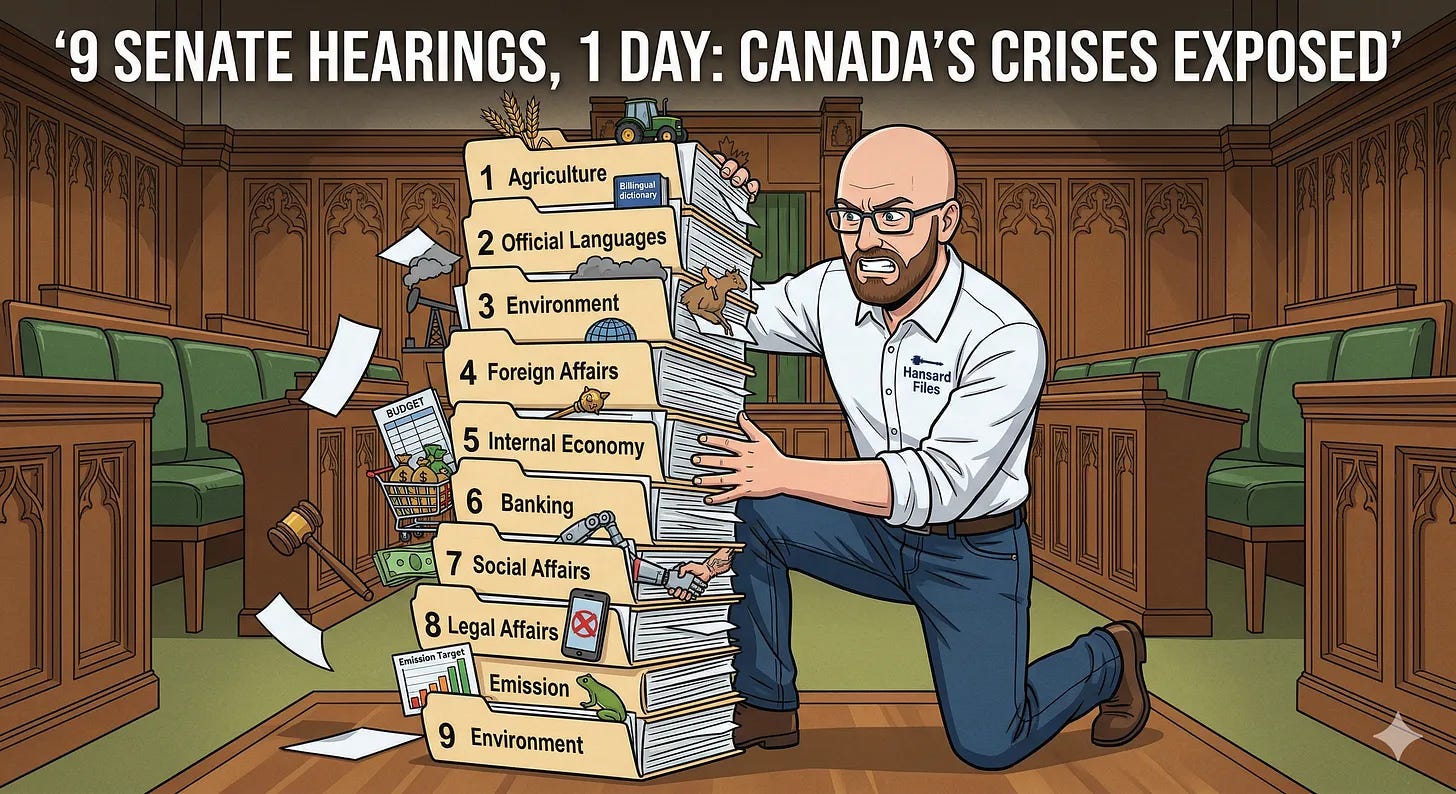
Thursday, March 12, 2026, began like any other on Parliament Hill, but inside committee rooms across the building, nine separate Senate meetings unfolded in parallel. At 8:01 a.m., senators in the Agriculture and Forestry committee grilled Competition Bureau officials about grocery giants squeezing farmers. Down the hall, the Internal Economy committee quietly approved minutes and living-expense adjustments. By 8 a.m., the Energy, Environment and Natural Resources committee opened its review of the 2025 progress report on Canada’s 2030 Emissions Reduction Plan. At 10:30 a.m., four more committees fired up simultaneously: Legal and Constitutional Affairs on restricting young persons’ online access to pornographic material; Foreign Affairs on consular emergencies in the Middle East; Social Affairs, Science and Technology with world-renowned AI expert Yoshua Bengio; and Banking, Commerce and the Economy on capital access for small- and medium-sized enterprises. Official Languages wrapped up its evening session from the night before. In one ordinary weekday, Senate committee hearings laid bare the urgent policy battles defining Canada’s future.
Senator Rosemary Moodie called her Social Affairs committee to order at 10:30 a.m. “Professor Bengio, the floor is yours.” The Turing Award winner, Mila founder and most-cited computer scientist on earth, did not waste a second. Artificial intelligence capabilities are surging while safety efforts lag, he warned. Intelligence equals power, and that power is concentrating fast in a handful of companies racing winner-take-all. “If trends continue,” Bengio said, “this power can be misused by nefarious or power-hungry humans… or potentially turned against humans by the AI themselves.” Senators leaned in as he described machines soon as competent as humans across skills, yet companies lack incentive to build safe systems. The room fell silent. This was no abstract lecture. It was a direct call for Canada to act before frontier AI outpaces safeguards.
Bengio’s Urgent AI Warning Sparks National Reflection
Bengio’s testimony dominated Senate committee hearings that morning, but it was only one thread in a tapestry of national stakes. He urged transparency as the top regulation, followed by regulators with real power to pause dangerous systems. Senators pressed him on everything from global alliances to protecting developing nations. Bengio answered with calm precision, optimistic yet unflinching: Canada must invest in independent research, partner with like-minded countries and treat AI governance like nuclear non-proliferation. His words echoed long after the gavel fell, framing the day’s other debates as part of the same larger challenge: how a middle power like Canada steers powerful technologies and economic forces toward the public good.
Youth Protection Takes Centre Stage in Legal Affairs
Just metres away, the Legal and Constitutional Affairs committee wrapped debate on draft observations for Bill S-209, An Act to restrict young persons’ online access to pornographic material. Senator Raymonde Saint-Germain and Senator Baltej Dhillon had crafted language stressing that traditional penalties fail against powerful distributors. “Alternative solutions that place responsibility on these organizations” were needed, they argued, after Senator Dhillon’s call to think creatively. Senator Julie Miville-Dechêne pushed for clearer wording on administrative penalties. The committee agreed and moved on, signalling Parliament’s push to shield Canadian youth from harmful online content through smarter accountability, not just fines.
Food Security and Grocery Power Under the Microscope
At 8:01 a.m., Agriculture and Forestry senators confronted Competition Bureau Canada officials Mike Hollingworth and Melissa Fisher on the role of the agri-food sector in food security. Canadians feel the squeeze at grocery checkout, they noted. The Bureau’s dual role, enforcement against anti-competitive practices and advocacy for competition-friendly rules, came under scrutiny. How do major chains’ buying practices affect small growers? What about mergers? Senators demanded answers on whether the Bureau could better protect producers and consumers from concentrated power in the food supply chain. Hollingworth emphasized market studies and enforcement as tools to keep prices down and innovation up.
Emissions Progress and Endangered Species Face Tough Questions
Two Environment and Natural Resources hearings ran that week, both underscoring climate and biodiversity urgency. On March 10, officials Tara Shannon and Aura Pantieras defended federal support for COSEWIC, the independent body assessing species at risk. With over 80,000 wildlife species in Canada and mounting pressures, senators questioned whether $1.5 million and volunteer scientists were enough. On March 12, the same committee turned to the 2025 progress report on the 2030 Emissions Reduction Plan. Associate Assistant Deputy Minister Judy Meltzer and colleagues outlined sector-by-sector road maps toward net-zero by 2050. Senators probed gaps between ambition and delivery, demanding evidence that Canada remains on track for Paris Agreement targets.
Consular Crises and Middle East Volatility
In Foreign Affairs and International Trade, Director General Sébastien Beaulieu updated senators on Canada’s 24-7 consular response to the volatile Middle East situation. From chartered flights out of Beirut to coordination with the Canadian Armed Forces, Global Affairs teams had scaled operations amid fast-moving security threats. Beaulieu stressed that protecting Canadians abroad remained the highest priority, even as missions operated in complex environments. Senators asked about limits of assistance for those choosing to stay in affected areas and lessons from parallel crises in Mexico and Cuba.
Official Languages and the Fight for Substantive Equality
The evening before, Official Languages senators heard experts Geneviève Tellier and Stéphanie Chouinard on the regulatory framework for Part VII of the Official Languages Act. Tellier highlighted subsection 41(8), requiring evidence-based positive measures. Chouinard and later witnesses warned that draft regulations risk repeating past failures by lacking concrete obligations. The discussion turned on whether Treasury Board guidance would finally deliver substantive equality for francophone minority communities or merely repeat decades of ambiguity.
Internal Housekeeping Keeps Democracy Running
While higher-profile debates raged, the Internal Economy, Budgets and Administration committee handled the machinery of the Senate itself. Chair Senator Tony Loffreda moved quickly through the consent agenda, approving February minutes and a senator’s living-expense exception. Routine but essential, these decisions ensure the institution functions smoothly so that the other eight committees can focus on policy.
Unlocking Capital for Small Business Growth
In Banking, Commerce and the Economy, TSX Venture Exchange President Andrew Creech and Canadian Securities Exchange CEO Richard Carleton painted a picture of Canada’s unique public-market ecosystem. Fifty-eight percent of corporate issuers on the TSX and TSXV have market caps under $50 million; on the Venture Exchange, it is 88 percent. The Capital Pool Company program has helped over 2,800 early-stage firms go public since 1986. Senators explored liquidity challenges, international investor interest and how venture markets feed the senior TSX, driving productivity and growth for SMEs.
What One Day of Senate Committee Hearings Means for Canadians
By late afternoon on March 12, 2026, the gavel had fallen on nine distinct Senate committee hearings. Yet the threads wove together: power concentration, whether in AI companies, grocery chains or global crises, demands smarter accountability. Youth protection, species survival, emissions targets, linguistic rights and economic access are not separate files. They are interlocking pieces of Canada’s future. Ordinary Canadians may never read the full Hansard transcripts, but the decisions forged that day, on artificial intelligence safeguards, food affordability, climate action and more, will shape daily life for years ahead. In committee rooms across Parliament Hill, senators turned evidence into policy, urgency into action. The question now is whether the rest of Parliament, and the country, will listen.
Hansard Files digs through dense Senate archives to surface these urgent stories so Canadians stay informed. Subscribe to support independent investigation that holds democracy accountable.
Source Documents
Senate of Canada. (2026, March 12). *Evidence of the Standing Senate Committee on Legal and Constitutional Affairs*.
Senate of Canada. (2026, March 10). *Evidence of the Standing Senate Committee on Energy, the Environment and Natural Resources*.
Senate of Canada. (2026, March 12). *Evidence of the Standing Senate Committee on Foreign Affairs and International Trade*.
Senate of Canada. (2026, March 9). *Evidence of the Standing Senate Committee on Official Languages*.
Senate of Canada. (2026, March 12). *Evidence of the Standing Senate Committee on Social Affairs, Science and Technology*.
Senate of Canada. (2026, March 12). *Evidence of the Standing Committee on Internal Economy, Budgets and Administration*.
Senate of Canada. (2026, March 12). *Evidence of the Standing Senate Committee on Agriculture and Forestry*.
Senate of Canada. (2026, March 12). *Evidence of the Standing Senate Committee on Energy, the Environment and Natural Resources*.
Senate of Canada. (2026, March 12). *Evidence of the Standing Senate Committee on Banking, Commerce and the Economy*.
Thanks for this detailed report. Your work in informing us is so important! I do wonder what the senators do with all the new insights they gain? I see far to many politicians (federal, provincial, municipal) making impassioned speeches to the effect "somebody ought to do something!". If not them, WHO?