


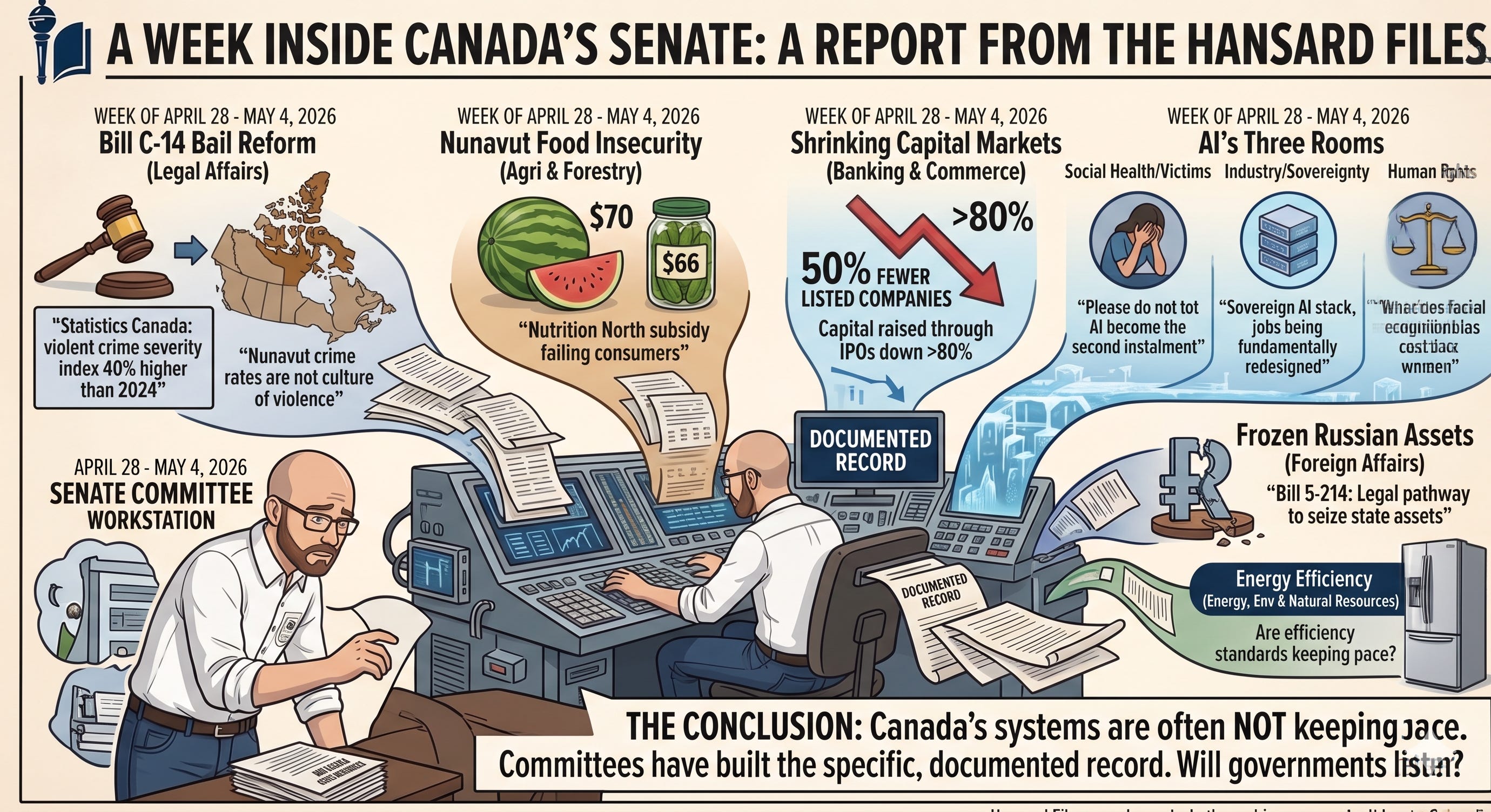
The week started quietly. On Tuesday morning, April 28, Bill Kroll, the Chief Financial Officer of the Department of Justice, sat before the Standing Senate Committee on National Finance and worked through $1.7 billion in spending authorities with the calm precision of a man who had done this before. By the time the same week ended in a Human Rights committee room on Monday, May 4, Senator Mary Jane McCallum was drawing a line between AI chatbots and residential schools.
What happened in between was a week’s worth of the Senate of Canada doing what it does best when it works: grinding, carefully, through the unglamorous architecture of national life. Seventeen committees met across six days. The topics ranged from the Energy Efficiency Act to Russian central bank reserves. The thread running through all of it was a single, recurring question. Are Canada’s systems, its justice system, its capital markets, its northern food supply, its approach to digital technology, keeping pace with the country’s actual problems?
The honest answer, committee room after committee room, was often no. But the testimony was specific about why. And specific is where things can change.
Bail, Jails, and the Nunavut Problem Nobody in Ottawa Likes to Name
Two days after Kroll’s budget briefing, something sharper entered the air.
On April 29, and again the following morning, the Standing Senate Committee on Legal and Constitutional Affairs heard evidence on Bill C-14, the government’s bail and sentencing reform legislation. The bill’s supporters came with numbers. Statistics Canada’s Lucie Léonard told senators that the violent Crime Severity Index was 40% higher in 2024 than a decade earlier. From 2019 to 2024, roughly one in three individuals accused of homicide were under some form of justice system supervision at the time of the offence, whether on bail, remand, or probation.
The Toronto Police Association and the National Police Federation were unequivocal. Pass the bill. Pass it quickly. Clayton Campbell, speaking for 8,800 TPA members, said the reforms would close real gaps his officers experienced every day, particularly around repeat violent offenders who cycle through arrest and release in a matter of days. Brian Sauvé of the National Police Federation added a problem that might not have landed the way his supporters intended: provincial pretrial facilities in New Brunswick are at 156% occupancy. A judge denying bail has to make that decision knowing where they are sending someone. The infrastructure required to implement tougher bail is not there.
Then Angnakuluk Friesen walked in.
She opened in Inuktitut. That detail matters. Friesen is a criminal defence lawyer from Rankin Inlet who came to Nunavut Legal Aid in January of this year after four years as a federal Crown prosecutor. She came to Ottawa in person, alongside her colleague Patrick Smith, to tell senators what Bill C-14 would actually do in a territory of 40,000 people where, in 2025, more than 22,000 criminal incidents were reported.
“The fact is,” she said, “rampant violence is not a part of Inuit culture.”
That sentence was its own argument. Nunavut’s crime rates are not evidence of a culture of violence. They are evidence of what decades of colonial disruption, inadequate housing, resource inequality and the forced transition from a land-based economy do to communities. Friesen laid out three specific ways Bill C-14 would disproportionately harm Nunavummiut. Restricting conditional sentence orders would push more Inuit into custody, increasing recidivism for clients with no criminal record. Reversing the onus on breaking and entering charges would criminalize a cultural norm: in Inuit households, extended family and friends arrive unannounced. It is not trespassing. It is how community works. And disqualifying people with indictable offences from acting as sureties would gut Nunavut’s bail system, which depends on sureties precisely because there are no other resources to house or supervise accused people in communities accessible only by air.
Smith had spent 26 years in Nunavut. He put it plainly: “Unfortunately, as in the past, decisions made in Ottawa ripple across the North with many unforeseen consequences for the Inuit.” The committee has the tools to see both sets of concerns. What it does with them is still open.
$70 Watermelons and the Question Nobody Answered
Senator Nancy Karetak-Lindell is a former Member of Parliament from Nunavut and now sits in the Red Chamber. On April 28, she brought the same territory, and the same structural critique, to the Agriculture and Forestry Committee’s study on food security.
She opened simply: “It is very telling that we are not talking about food security but rather insecurity.”
Her testimony was careful and precise, and the specifics stopped the room. Last month, she said, a watermelon in a Nunavut community was priced at $70. The Nutrition North Canada subsidy applied: $2.19. A one-litre jar of no-name pickles cost more than $66.
Nutrition North Canada runs $2.19 against $70 and calls it a subsidy. The subsidy goes to retailers, not consumers, with an expectation, not a mechanism, for savings to be passed on. Karetak-Lindell was clear about what is missing: transparency about how the money moves at the store level, and direct accountability to the households it is supposed to help.
She went further. Inuit cannot sell geese despite overpopulation in some regions, because of the Migratory Birds Convention Act. Traditional systems of sharing country food across communities run into transport and distribution restrictions. Nunavut’s fish and seafood quota sits at roughly 52%, while seven other jurisdictions often hold 80% to 90% of adjacent offshore resources. Halibut is harvested in Inuit territory and exported abroad while local families face food insecurity.
She ended with a line that carried the weight of the whole testimony: “These barriers undermine systems that have sustained Inuit for generations.”
The committee has been studying this for months. The questions it will eventually have to answer are the same ones Karetak-Lindell posed: who benefits from the resources harvested in Nunavut’s waters, and how is access structured?
Canada’s Capital Markets: 50% Fewer Listed Companies and No Good Answer
On the afternoon of April 29, the Banking, Commerce and the Economy Committee heard from Dan Daviau, Chairman and CEO of Canaccord Genuity Group, Canada’s largest independent investment bank. His testimony was a controlled demolition of comfortable assumptions about where Canada sits economically.
The numbers were blunt. Since 2008, the number of companies listed on Canadian public markets is down by 50%. Capital raised through initial public offerings is down more than 80%. In 2025 alone, $45 billion left public markets through privatizations or company sales. That same year, more than $130 billion of Canadian money flowed into foreign securities, while foreign investors reduced their exposure to Canadian equities.
The TSX’s ten largest companies have an average age exceeding 100 years. Canada’s broad market indexes have 16% exposure to technology, health care and consumer sectors. The S&P 500 is at 30%, mostly in companies founded after 1970.
Canada’s major pension funds manage approximately $4 trillion. They allocate a small fraction to Canadian equities.
What Daviau was describing is a country whose financial architecture is built around stability, not growth, and where that stability has become a structural problem. Growth companies can’t get domestic risk capital. They go elsewhere, taking head offices, intellectual property, high-value jobs and future tax revenue with them. Daviau had four targeted recommendations: tax incentives to stimulate investment in public-market growth sectors, regulatory calibration for smaller issuers, greater pension fund participation in Canadian equities, and reduced concentration of capital markets among the large, risk-averse banks. The last point was the most pointed. The top five banks control the largest investment banks, 90% of retail investors and four of the five largest public asset management institutions in Canada.
The hearing continues. Whether the committee’s eventual recommendations will match the scale of the problem Daviau described is the open question senators in this room have been circling for months.
AI’s Week: Three Rooms, Three Different Arguments
Artificial intelligence surfaced in three separate committee rooms during this stretch of sittings, and the three conversations sounded almost like they were happening in different countries.
In the Transport and Communications Committee on April 29, Aaron Shull of the Centre for International Governance Innovation put the most direct case on the table. Canada has been here before, he said. Social media reshaped children’s mental health, classrooms and democratic processes while Parliament waited for the courts to act. The bill for that delay is now coming due in litigation rooms across North America. An Ontario man has sued OpenAI alleging that 21 days and 90,000 words of ChatGPT conversation induced and reinforced a psychotic delusion. Four concurrent lawsuits against the same company involve suicides. In British Columbia, the Tumbler Ridge shooting in February of this year killed six children and two adults. The platform the shooter had used flagged his account internally more than six months earlier, identified the danger, and chose not to escalate to police. The CEO has since apologized.
“Please do not let AI become the second instalment,” Shull told the committee.
His proposed approach was structural: provenance standards for AI-generated content, platform duties on recommendation and impersonation, legal modernization beyond the elections context, and direct support for victims.
The Social Affairs, Science and Technology Committee on April 30 heard a different register entirely. Bell Canada and Coveo came to talk about sovereignty and industrial adoption. John Menezes, CEO of Bell Cyber Inc., framed the moment as a railroad decision for Canada. The railroad built the country. The question now is who builds and controls the digital infrastructure that AI runs on. Bell is investing in what Menezes called a “sovereign AI stack”: Canadian networks, Canadian data governance, Canadian compute. His framing was about national capability, not human cost. “Tens of millions of jobs will be reshaped every year by AI, not eliminated, but fundamentally redesigned,” he said. He told his own team directly that the jobs they hold today would not exist in their current form within a year, because they would be needed at a higher level.
Then, on May 4, the Human Rights Committee’s session arrived. (See the previous Hansard Files article on that hearing for the full testimony from Kristen Thomasen and Tracy Luca-Huger.) That room had different questions. What happens to young people who close the AI tool and find nobody there? What does facial recognition bias cost Black women in encounters with law enforcement? When a chatbot always tells you your question was great, how does a young person ever learn to hear honest feedback? The human cost of the technology, not the opportunity or the governance framework, was the subject.
Three rooms. Three weeks. The same technology. Not one of them was saying the same thing.
Frozen Russian Assets and a Legal Gap Canada Has Already Acknowledged
The Foreign Affairs and International Trade Committee began its study of Bill S-214 on April 30. The legislation, sponsored by Senator Donna Dasko and carried forward from former Senator Ratna Omidvar, who joined from Berlin by videoconference, would amend the Special Economic Measures Act to create a legal pathway to seize and repurpose foreign state assets, including central bank reserves, from perpetrators who breach international peace and security.
The specific context is Russia’s invasion of Ukraine. Western countries froze hundreds of billions in Russian state assets after February 2022. The bulk, roughly €180 billion, sits with Belgium’s Euroclear. Canada already amended SEMA in June 2022 to permit not just freezing but potentially disposing of those assets. The bill would make that pathway explicit and operative through executive order, with seized assets directed to victims.
Senator Omidvar, speaking from Berlin where she is now working, framed the stakes in exactly the terms the committee needed to hear: the legal architecture was recognized, in principle, by Canada years ago. What has been missing is the specific mechanism to act. Senators on the committee will probe whether the bill’s legal foundations are solid enough to survive challenge, and what a Canadian precedent would mean for global asset forfeiture norms. The study continues.
Energy Efficiency and the Appliances Bill Nobody Wrote About
On the same evening Bill C-14 began its first Senate committee hearing, Bill S-4 was getting its own study in the Energy, Environment and Natural Resources Committee. The legislation amends the Energy Efficiency Act. It was sponsored by Senator Duncan Wilson of British Columbia.
The witnesses included Whirlpool Canada, the Consumers Council of Canada, the Association of Home Appliance Manufacturers Canada, and Ann Fitz-Gerald of the Balsillie School of International Affairs. The subject is appliances: whether Canada’s energy efficiency standards are keeping pace with global standards, whether consumers are being protected, and whether the regulatory framework is positioned to handle product categories that barely existed when the original legislation was written.
It is not a glamorous study. It also shapes every refrigerator, dishwasher and clothes dryer sold in this country. The committee is working through it methodically.
The Institutional Picture
What this week of sittings produced, taken as a whole, is something worth naming. The Senate was not, during these hearings, the theatrical chamber of rhetorical combat that draws cameras and comment. It was something quieter and more useful: a machine for receiving specific evidence about specific problems and building a documented record.
That record will matter. The Nunavut Legal Aid testimony on Bill C-14 is now part of the official record on bail reform. So is the Statistics Canada data on homicide supervision. So is Daviau’s analysis of Canada’s contracting public markets. So is Friesen’s description of what happens when Ottawa legislates without imagining how laws land in fly-in communities.
The Senate cannot fix any of these things directly. It can study them, hear witnesses who know them from the inside, and recommend. What governments do with those recommendations is where the work either compounds or gets wasted. That is the bet the institution makes, every session, in every room.
This week’s rooms were doing the work. Whether anyone is listening is the question that follows them home.
Hansard Files spends weeks in the archives so you don’t have to. If stories like this matter to you, subscribe to keep this work independent.
Related Hansard Files Articles


Source Documents
Canada. Parliament. Senate. Standing Senate Committee on National Finance. (2026, April 28). Evidence (43ev57652.pdf)
Canada. Parliament. Senate. Standing Senate Committee on Agriculture and Forestry. (2026, April 28). Evidence (31ev57656.pdf)
Canada. Parliament. Senate. Standing Senate Committee on Energy, the Environment and Natural Resources. (2026, April 28). Evidence (32ev57657.pdf)
Canada. Parliament. Senate. Standing Senate Committee on Legal and Constitutional Affairs. (2026, April 29). Evidence (36ev57664.pdf)
Canada. Parliament. Senate. Standing Senate Committee on Transport and Communications. (2026, April 29). Evidence (32ev57668.pdf)
Canada. Parliament. Senate. Standing Senate Committee on Banking, Commerce and the Economy. (2026, April 29). Evidence (34ev57663.pdf)
Canada. Parliament. Senate. Standing Senate Committee on Legal and Constitutional Affairs. (2026, April 30). Evidence (37ev57675.pdf)
Canada. Parliament. Senate. Standing Senate Committee on Social Affairs, Science and Technology. (2026, April 30). Evidence (37ev57676.pdf)
Canada. Parliament. Senate. Standing Senate Committee on Foreign Affairs and International Trade. (2026, April 30). Evidence (33ev57673.pdf)
Canada. Parliament. Senate. Standing Senate Committee on Human Rights. (2026, May 4). Evidence (17ev57678.pdf)
The bail reform demonstrates not only that the federal government was somewhat over-reliant on bail conditions keeping people from repeating but also how provincial governments failed to keep up their side of the justice system by providing courts, support staff, and jail space to hold the accused, and the convicted.
That situation in Nunavut around the bail issue is, to me, evidence of a court and justice system that needs to be completely re-designed.