


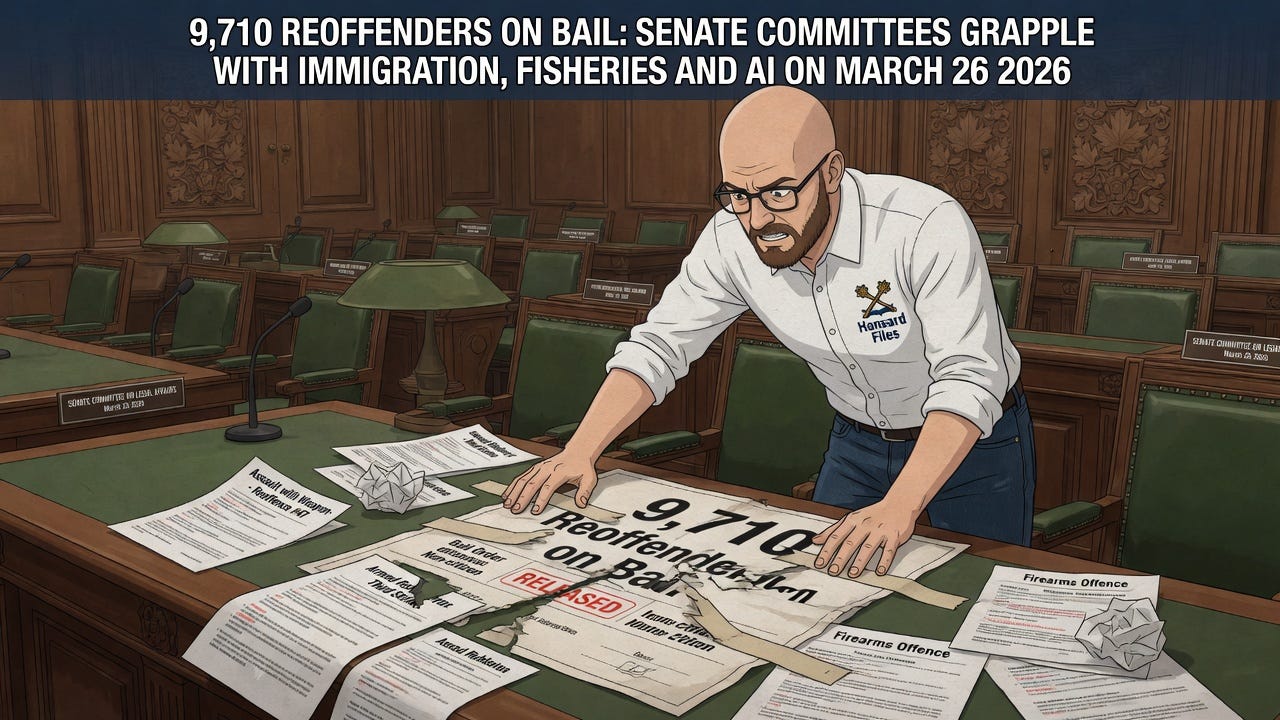
In a committee room in Ottawa on the morning of March 26, 2026, Thomas Carrique, Commissioner of the Canadian Association of Chiefs of Police, delivered a statistic that hung heavy in the air. Between 2023 and 2025 alone, the Ontario Provincial Police charged 9,710 offenders with new offences while they were already out on bail. Those same individuals faced more than 54,000 charges, including 7,540 violent crime charges: 4,277 assaults, 879 sexual assaults, 146 robberies, seven attempted murders and 10 homicides. Across the corridor and in videoconference rooms throughout the building, other Senate committees convened at the same hour, each dissecting a different but equally urgent thread of Canada’s future.
Reaffirming Immigration’s Enduring Value
Down the hall in the Standing Senate Committee on Social Affairs, Science and Technology, witnesses urged senators to pass Bill S-215, An Act respecting National Immigration Month. Thanh Phan, board member of the Canadian Immigration Lawyers Association, spoke first. A naturalized Canadian himself, he reminded the room that Canada is a nation built by immigrants. Immigration, he said, is not merely history but central to the country’s identity and economy. Newcomers sustain the workforce, support public services and drive long-term prosperity. At the same time, Phan acknowledged recent public scrutiny over housing, infrastructure and system integrity. The government’s decision to lower immigration targets reflected legitimate concerns, yet he argued that striving for a better system and championing immigration are not opposing goals. Designating November as National Immigration Month would create space for education, reflection and celebration while countering misinformation.
Thi Be Nguyen, president of UniAction, followed with her own story. In 1980, forty-six years earlier, she arrived in Canada as a refugee with her parents and siblings. Canada had offered her family safety and opportunity. Her testimony underscored the human dimension behind the policy debate. Witnesses from INICI and Bienvenue à l’immigrant echoed the call for the bill, framing it as a national acknowledgment of immigration’s foundational role.
Defending the $1 Billion Inshore Fishery Backbone
Simultaneously, in the Standing Senate Committee on Fisheries and Oceans, Dwan Street, president of the Fish, Food and Allied Workers Union (Unifor) in Newfoundland and Labrador, described the inshore owner-operator fishery as the economic backbone of coastal communities. It generates more than $1 billion annually and anchors employment, food security and tourism from St. John’s to L’Anse au Loup. Street warned that without stronger enforcement of the owner-operator and fleet separation policies, corporate consolidation, foreign control and federal loopholes continue to erode harvester independence. She cited the Policy for Preserving the Independence of the Inshore Fleet in Canada’s Atlantic Fisheries (PIIFCAF) and noted that the Federal Court has confirmed the minister’s authority to enforce these rules. Yet no charges have been laid against violators. Controlling agreements, beneficial ownership schemes and transfers to Indigenous communal licences, she argued, act as back doors for corporate interests, inflating licence prices and blocking young harvesters from entering the industry.
Bail Reform, AI Adoption and Environmental Accountability
In the Legal and Constitutional Affairs committee, police leaders pressed for Bill C-14 amendments to strengthen bail and sentencing. Carrique highlighted the need for clearer reverse onus provisions, stricter conditions for violent and repeat offenders, and a more rigorous surety and forfeiture process. He welcomed measures addressing random or unprovoked violence and supported limited police authority to publish youth identities in urgent public-safety cases.
In the same building, the Social Affairs committee heard from Glenda Crisp, CEO of the Vector Institute, on artificial intelligence. Canada still ranks third globally in AI research, yet it has slipped to eighth overall in the Tortoise Global AI Index. Infrastructure ranks sixteenth, the operating environment eighteenth and commercial strategy tenth. Crisp described adoption as fundamentally a trust problem: 69 percent of regular AI users trust the technology, compared with only 5 percent of non-users. Only 20 percent of Canadians feel prepared for the changes AI will bring. She called the $2-billion Sovereign AI Compute Strategy essential but two years behind schedule, warning that delays risk driving talent and start-ups south of the border.
Later that morning, the Energy, Environment and Natural Resources committee received the Commissioner of the Environment and Sustainable Development, who outlined lessons from past federal sustainable development strategies and performance audits on species-at-risk assessments and the 2030 Emissions Reduction Plan. The commissioner noted that Environment and Climate Change Canada had not provided the Committee on the Status of Endangered Wildlife in Canada with sufficient support to complete timely assessments, projecting over a century to evaluate all potentially at-risk species at the current pace of sixty per year.
In the Banking, Commerce and the Economy committee, Kevin McCoy of the Canadian Investment Regulatory Organization discussed barriers to capital-market access for small- and medium-sized enterprises, including challenges in junior public markets and concerns over short selling in small-cap stocks.
A Single Day, Parallel National Choices
Across these Senate committee hearings March 26 2026, senators heard consistent themes: the need for evidence-based policy, stronger enforcement, public trust and long-term planning. Witnesses repeatedly stressed that symbolic gestures alone would not suffice; concrete action on bail, immigration recognition, fishery protections, AI infrastructure and environmental accountability would determine whether Canada’s institutions keep pace with the pressures facing ordinary Canadians.
The decisions emerging from these parallel sessions will shape housing pressures and workforce needs, coastal community livelihoods, public safety on the streets, technological competitiveness and the health of the natural environment. For families in rural Newfoundland, recent immigrants building new lives, small-business owners seeking capital, or communities worried about violent crime and climate impacts, the stakes feel immediate.
Hansard Files digs through dense parliamentary transcripts so you don’t have to. These stories matter to your future. Subscribe today to support independent, non-partisan investigation.
Related Hansard Files Articles

Source Documents
Canada. Parliament. Senate. Standing Senate Committee on Social Affairs, Science and Technology. (2026, March 26). *Evidence* (31ev-57592.pdf).
Canada. Parliament. Senate. Standing Senate Committee on Fisheries and Oceans. (2026, March 26). *Evidence* (21ev-57588.pdf).
Canada. Parliament. Senate. Standing Senate Committee on Legal and Constitutional Affairs. (2026, March 26). *Evidence* (31ev-57591.pdf).
Canada. Parliament. Senate. Standing Senate Committee on Social Affairs, Science and Technology. (2026, March 25). *Evidence* (30ev-57582.pdf).
Canada. Parliament. Senate. Standing Senate Committee on Fisheries and Oceans. (2026, March 12). *Evidence* (19ev-57563.pdf).
Canada. Parliament. Senate. Standing Senate Committee on Banking, Commerce and the Economy. (2026, March 26). *Evidence* (29ev-57590.pdf).
Canada. Parliament. Senate. Standing Senate Committee on Energy, the Environment and Natural Resources. (2026, March 26). *Evidence* (27ev-57587.pdf).
I note that here was no mention of the provinces in the discussions of the Justice Committee. While the Federal government makes the laws, the provinces execute them and as far as bail goes, the provinces are falling down by providing insufficient court space, insufficient court support (staff, crown attorneys), and jail space to hold these desperate criminals. The feds are not fault free either, considering the number of judges that are needed to be appointed, but if there is no where for them to work, what would be the point? Alberta is even threatening to make their situation worse if they do not get their way in appointing these judges.