


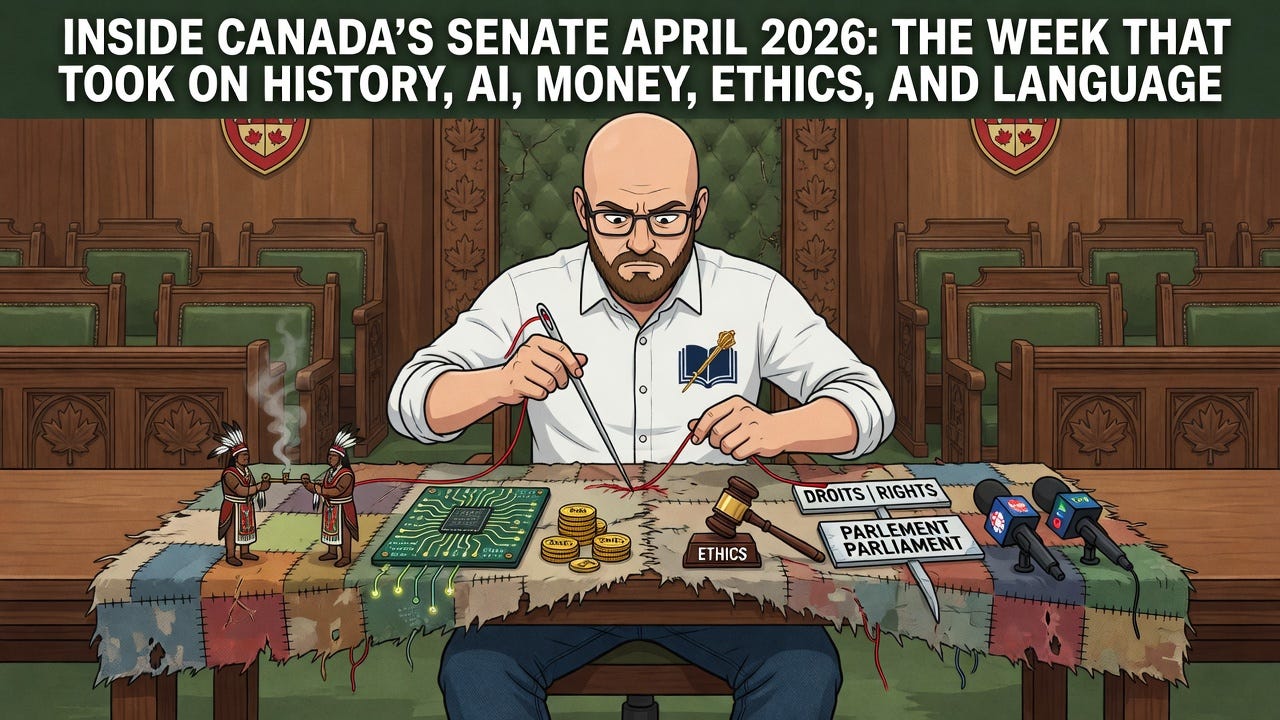
On April 14, 2026, in Room 160-S of the Senate of Canada Building, Senator Mary Jane McCallum looked across the table at Grand Chiefs Garrison Settee and Walter Wastesicoot and spoke the words that had lived in Dene oral memory for more than three centuries: “We are here because of Thanadelthur.” The young Dene woman, barely out of her teens in the late 1600s, had been kidnapped by Cree near present-day Arviat, then led a winter expedition with Hudson’s Bay Company trader William Stuart to broker peace. After ten days of waiting, she crested a hill. The pipe was lit. Her words, still repeated by Elders, sealed the moment: “Years from now, around the fires, our children will play together.”
That same week, in rooms down the corridor and across the Hill, other Senate committees were doing parallel, equally consequential work. While one group confronted the past to build a national day of recognition, another examined whether artificial intelligence would erase entry-level jobs for young Canadians. A third heard Desjardins executives explain why 430,000 small businesses still struggle for credit. A fourth debated changing one capital letter in an ethics report. A fifth weighed how to embed a “francophone lens” in every federal program. And a sixth continued its long study of whether local broadcasting, including CBC/Radio-Canada, could survive the digital cliff.
This was the Senate in mid-April 2026 — not the theatrical chamber debates, but the quiet, grinding committee evidence that actually shapes law and national memory.
The Dene Peacemaker Who Refused to Let History Stay Buried
The Standing Senate Committee on Indigenous Peoples met twice that week on Bill S-225, An Act to establish National Thanadelthur Day. On April 14, McCallum, the bill’s sponsor, sat as witness with the chiefs. She placed Thanadelthur inside the collision of cultures: the arrival of European capitalism as a “foreign culture” that tested a Dene woman’s power in a fast-changing world. The chiefs spoke of unanimous resolutions and the pride the story now brings to children who once saw no reflection of themselves in schoolbooks.
The next evening the same committee heard from educator Rosalie Tsannie-Burseth of Hatchet Lake Denesuline First Nation and Florence Hamilton of Dene Routes. Tsannie-Burseth walked senators through the epic logistics — the long march, the stalled talks, the pipe ceremony that turned enemies into allies. Hamilton described her own reconnection with Dene identity and the 2019 renaming of Churchill’s central square to Thanadelthur Square. Senators asked about school curricula, possible monuments, funding for children’s books, and whether the day could honour Indigenous women’s leadership the way Harriet Tubman is honoured. The bill now carries the weight of that living testimony toward a possible February 5 national day.
AI’s Shadow Falls on the Vulnerable
Two days earlier, on April 13, the Standing Senate Committee on Human Rights opened its study on the impact of artificial intelligence on human rights and economic security, especially for vulnerable groups and the international right to work. Mahtab Laghaei of The Dais at Toronto Metropolitan University delivered the opening message: AI will not cause mass unemployment, but it will quietly rewrite entry-level roles. Employers will seek different skills. Young people — already entering an unstable economy — face the sharpest edge. Laghaei, herself young, called it the “short end of the stick.” Shelby Austin of Arteria AI joined her.
The same day the Standing Senate Committee on Transport and Communications heard Jeffrey Beatty, chairperson of the Deaf Wireless Canada Committee, warn that AI policy will be incomplete if accessibility is treated as secondary rather than foundational. For the estimated 4 million deaf, deaf-blind, or hard-of-hearing Canadians, AI affects whether captions work, relay services function, and public safety communications remain reliable. Nathan Sanders of Harvard’s Berkman Klein Center added global context. The committee was told, plainly, that the technology reshaping every sector could either include or erase entire communities.
Credit, the Quiet Crisis for 430,000 Businesses
On April 15 the Standing Senate Committee on Banking, Commerce and the Economy continued its eighth meeting on access to credit and capital markets for small- and medium-sized enterprises. Jean-Yves Bourgeois and Bernard Brun of Desjardins Group — an institution with more than $510 billion in assets and support for 430,000 Canadian businesses — described the daily reality: SMEs are the backbone of productivity and innovation, yet many still hit walls when they need capital to grow. The testimony was technical but the stakes were national: without better credit access, the productivity improvement the country says it wants remains out of reach.
Ethics Rules Get a Quiet Rewrite
That same April 14, the Standing Committee on Rules, Procedures and the Rights of Parliament met under Senator Peter Harder to finish its study on the membership of the Standing Senate Committee on Ethics and Conflict of Interest for Senators. The revised draft report had one major change: the section previously called “Evidence and Recommendations” was renamed “Evidence and Considerations” just before paragraph 18. The tweak allows a cleaner, separate section for actual amendments so colleagues can understand the recommendations when the report is tabled. Senators reviewed principles of fair and balanced composition, flexible membership numbers, vacancy processes, changes in affiliation, continuity between sessions, and reducing obstacles to membership. It was the third time through the text. They hoped to finish that day.
Linguistic Duality Gets Regulatory Teeth
Also on April 13, the Standing Senate Committee on Official Languages examined the regulatory framework for Part VII of the Official Languages Act. Yan Plante of RDÉE Canada and Antoine Désilets of Société Santé en français told senators that modernization raised high hopes but an incomplete regulation would be worse than none. They called for a mandatory “francophone lens” across all federal programs, policies, and initiatives — not a box to tick, but a real shift. Canada has more than 116,000 francophone businesses outside Quebec, 40 percent with sales over $1 million. Part VII, they said, is the beating heart of the federal commitment to official language minority communities. The regulations must deliver on it.
Local Media’s Slow Fade
In a related Transport and Communications hearing from the previous November that still echoed in April discussions, publisher David Clinton of The Audit laid out CRTC data: outside the Greater Toronto Area, the number of local radio and TV properties had dropped 25 percent since 2011. Traditional radio listenership was falling 4.8 percent compounded annually while digital audio rose 9.3 percent. CBC, he noted, was losing audience on radio and not fully replacing it online. The committee was examining whether local and regional services could survive the transition.
The Unseen Work That Holds the Federation
In eight hearings across five days, senators moved between 17th-century Dene peace walks and 21st-century algorithmic disruption, between credit lines for corner stores and capital-letter changes in ethics reports, between francophone economic development and the survival of northern radio signals. No single headline captured it. No viral clip went viral. Yet this is how the Senate actually functions — room by room, witness by witness, principle by principle — stitching together the country’s past, present, and future.
The week ended without fanfare. Reports will be drafted. Bills will advance or stall. But the record now contains the voices: a Dene educator describing an epic hilltop arrival, a young policy analyst warning about entry-level jobs, a deaf advocate insisting accessibility must be foundational, Desjardins executives describing 430,000 businesses, a rules chair explaining one capital G, francophone leaders demanding a lens in every program, and a data analyst charting the slow disappearance of local media.
Canada’s Senate does not only debate in the Red Chamber. In April 2026 it spent a week inside the fault lines — reconciliation, technology, economy, governance, language, and memory — and left the evidence for anyone willing to read it.
Hansard Files spends weeks in the archives so you don’t have to. If stories like this matter to you, subscribe — it keeps this work independent.
Related Hansard Files Articles


Source Documents
Standing Committee on Rules, Procedures and the Rights of Parliament. (2026, April 14). Evidence on membership of the Standing Senate Committee on Ethics and Conflict of Interest for Senators. (14ev-57601.pdf)
Standing Senate Committee on Indigenous Peoples. (2026, April 14). Evidence on Bill S-225, An Act to establish National Thanadelthur Day. (25ev-57598.pdf)
Standing Senate Committee on Indigenous Peoples. (2026, April 15). Evidence on Bill S-225, An Act to establish National Thanadelthur Day. (26ev-57612.pdf)
Standing Senate Committee on Banking, Commerce and the Economy. (2026, April 15). Evidence on access to credit and capital markets for small- and medium-sized businesses. (30ev-57609.pdf)
Standing Senate Committee on Human Rights. (2026, April 13). Evidence on the impact of artificial intelligence on human rights and economic security. (14ev-57595.pdf)
Standing Senate Committee on Transport and Communications. (2026, April 14). Evidence on opportunities and challenges of artificial intelligence in the ICT sector. (27ev-57600.pdf)
Standing Senate Committee on Transport and Communications. (2024, November 19). Evidence on local and regional services provided by CBC/Radio-Canada. (105ev-57052.pdf)
Standing Senate Committee on Official Languages. (2026, April 13). Evidence on the regulatory framework for Part VII of the Official Languages Act. (16ev-57597.pdf)
Thank you. Having attend elementary and secondary school in the 50s-60s, I had not learned of Thanadelthur and her role (I probably knew more about Sacagawea). It is excellent that we are coming to a point where indigenous heros and heroines are being celebrated in our shared land.