


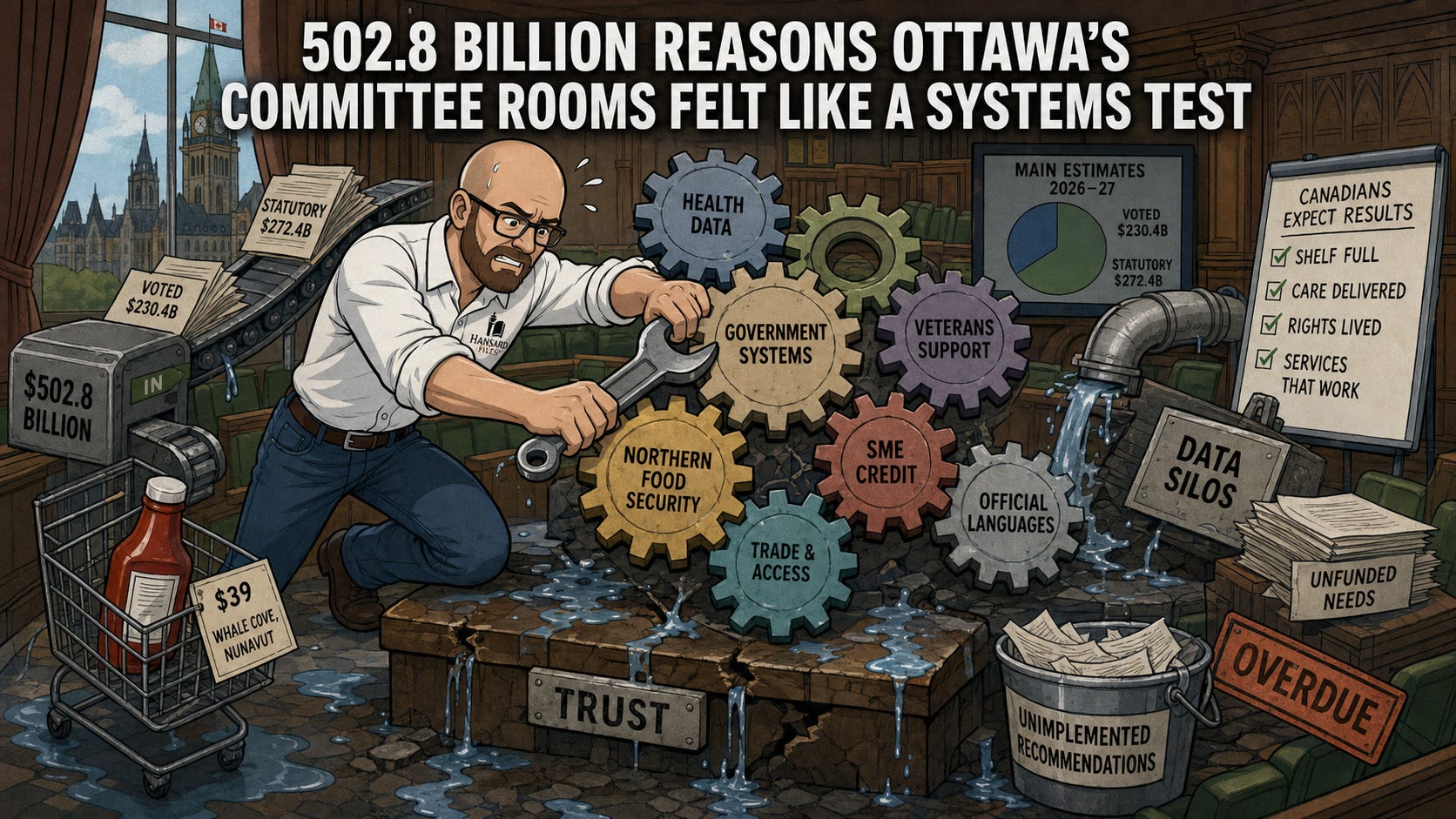
At the Arctic Winter Games in Whitehorse, Senator Pat Duncan heard the sort of detail that makes a committee room stop feeling abstract. A bottle of ketchup in Whale Cove, Nunavut, she told the Senate’s agriculture committee, could cost $39. In Whitehorse, the same bottle cost $3.
That was how the week began in the record: not with a grand theory of government, but with a condiment on a northern shelf.
The numbers that followed were larger, and colder. Across Parliament Hill, senators spent the week of April 14, 2026, moving from one national system to another. Food security in the Yukon. Bail reform and remand. Health data trapped in incompatible software. Artificial intelligence moving faster than law. Independent fisheries under pressure from corporate control. Veterans receiving repayment letters measured in tens of thousands of dollars. A $502.8 billion spending plan.
In the April 14 National Finance Committee, Treasury Board officials described the 2026-27 Main Estimates as $230.4 billion in voted spending and $272.4 billion in statutory spending, spread across 130 organizations. The language was procedural. The implication was not.
This was not one hearing about one problem. It was a week-long audit of whether Canada’s public machinery can still connect intention to outcome.
The North As Warning Light
The Yukon witnesses did not present northern food security as charity. They framed it as resilience.
Duncan mapped the territory for senators: Iqaluit to Grise Fiord, Old Crow to Beaver Creek, highways, fly-in communities, self-governing First Nations, grocery chains, old experimental farms and a modern population concentrated in Whitehorse. Then Derrick Hastings, farm manager for Tr’ondëk Hwëch’in First Nation, explained how a farm that began with food security and youth training had become a social enterprise.
Food security, he said, was national security. In this case, First Nation national security.
Randy Lamb, an agrologist with the Yukon government, gave the committee the technical frame. The Yukon’s food self-sufficiency had been estimated at only 1% to 2% in a 2010 food-system report, then roughly 4% to 8% in a 2020 territorial review. Local production had increased, but the vulnerabilities remained: cold soils, short seasons, long supply lines, and a territory north of 60 dependent on roads that weather can close.
Kari Johnston brought the problem back to the household. Her Kluane Region Food Hamper Program began during the pandemic. Five years later, it was still running, still growing, and serving an estimated 25% of households in the region every month. The monthly cost was $15,000 to $20,000.
Then came the infrastructure image: five sea cans being converted into a modular food hub, one for hydroponic growing, one for a commercial kitchen, one for butchery, one for frozen and root-crop storage, and one as a permanent home for the food bank.
It was small-scale, practical and urgent. It also posed the week’s central question. If the federal government could understand the strategic value of the Alaska Highway in 1942, could it understand the strategic value of northern food infrastructure in 2026?
The Ledger Beneath Everything
The next morning, National Finance turned to the Main Estimates. The headline figure was enormous: $502.8 billion in planned budgetary spending.
The details mattered. Voted budgetary spending was up $7.5 billion, roughly 3.4%, almost entirely because of defence-sector increases tied to NATO targets. Statutory spending rose $8.4 billion to $272.4 billion. Officials said $86.4 billion had already been provided through the first appropriation act, with the remaining voted amount expected in a second bill in June.
The Main Estimates were not a full fiscal picture. Officials made clear that later budget decisions, including any spring economic update, would come through supplementary estimates. For readers outside Ottawa, that distinction is usually invisible. For senators, it was the map of how money enters government slowly, in layers, and sometimes after programmes have already been announced.
Global Affairs Canada sought $7.2 billion, down $1.2 billion from the prior year’s Main Estimates. Environment and Climate Change Canada sought about $1.71 billion, down roughly $1.41 billion or 45.3%. Officials tied those changes to programme sunsets, expenditure reviews, fuel-charge revenue distributions and prior climate-finance commitments.
The figures were not merely reductions or increases. They were choices being translated into authorities, authorities into departmental plans, and plans into services Canadians may or may not actually see.
That is why a later exchange about government technology carried unusual weight. Asked about oversight, a Treasury Board official described challenging departments on whether a project needed a “Cadillac” or a “Toyota.” The point was plain: spending control is no longer just about whether money is approved. It is about whether Ottawa can identify what is enough, what is duplicative, and what is being built because someone failed to notice that another department already had it.
The Systems That Would Not Speak
At the Social Affairs committee, Bill S-5 turned the same question toward health care.
The Canadian Medical Association told senators that Canada had moved into digital records, but thousands of separate systems often could not communicate. Sometimes, the committee heard, they were not designed to.
The promise of the bill was straightforward: common national standards, a prohibition on data blocking, and a path toward secure exchange among patients, clinics, hospitals and laboratories. One line from the CMA carried the policy argument in miniature: when information moves, capacity appears.
The Canadian Nurses Association made it concrete. Nurses, the committee heard, spend time searching for or recreating information, which increases errors, delays decisions and adds strain to a workforce already under pressure. A rural nurse practitioner should be able to see discharge summaries, lab results and imaging in real time.
But the warnings were as important as the support. The Canadian Association of Social Workers asked who would benefit, and who might be harmed if data sharing widened without safeguards. Survivors of violence, children in protection systems, people experiencing homelessness, people using mental-health or substance-use services, and Indigenous communities could all face new risks if consent, privacy and Indigenous data sovereignty were weak.
The Canadian Bar Association added a lawyer’s caution: interoperability was necessary, but not sufficient. Health information is governed mainly by provincial and territorial law. Bill S-5 could make systems capable of communicating, but it did not itself authorize the sharing of health information. The definition of data blocking, the CBA warned, could even capture legitimate privacy practices unless clarified.
This was the week’s pattern again. The machine could be modernized. But if the legal, ethical and operational parts did not line up, modernization could reproduce the very failures it promised to solve.
Bail, AI And The Speed Of Fear
In another committee room, Bill C-14 put fear into legal form.
The Legal and Constitutional Affairs committee heard from Professor Danardo Jones, who described bail as one of the most contested spaces in Canadian criminal procedure, where liberty, reasonable bail and the presumption of innocence collide with public anxiety. He disputed the claim that the empirical record supported a bail system in crisis driven by repeat violent offenders on release.
Professor Debra Parkes focused on women. She told senators that women made up more than 75% of provincial and territorial custody admissions in the most recent statistics, and that only 25% of women in provincial custody were sentenced. The rest were on remand. Indigenous women, she said, were overrepresented in provincial correctional facilities at a rate 15.4 times higher than non-Indigenous women.
The bill’s tightening of bail rules, she warned, would not solve housing instability, untreated trauma, mental-health needs, substance use, racism or lack of support. It would likely push more women, especially Indigenous and Black women, into pretrial custody.
That same evening, the Transport and Communications committee examined artificial intelligence. The testimony moved from regulatory design to existential risk. One witness called Canada’s AI laws outdated and piecemeal, arguing that privacy, cybersecurity, online harms and risk-management rules had to fit together. Another warned that superintelligence could arrive within two to five years and urged Canada to treat it as a national and global security threat.
The claims were different in scale. The structural problem was familiar. Law was being asked to catch systems already in motion.
Trust As The Scarce Resource
By April 15, the Veterans Affairs subcommittee had reached perhaps the week’s most human version of the same failure.
Veterans Ombud Nishika Jardine described her office as a route of recourse for veterans and families who believe they have been treated unfairly by Veterans Affairs Canada. She spoke of sacred trust, then of its erosion.
One accepted recommendation, from January 2021, still had not been implemented. It concerned mental-health treatment benefits for family members in their own right when the issue was service-related. Jardine asked senators to imagine telling a widow whose veteran spouse had taken their own life that Veterans Affairs could no longer provide mental-health treatment for her and her children because the law would not allow it.
She also described veterans receiving overpayment letters for income replacement benefits, with some amounts in the tens of thousands of dollars. The question was not only how the overpayments happened. It was how a department missed them for years, then handed the consequences to individual veterans.
On April 20, the Official Languages committee heard a parallel warning from Quebec’s English-language school boards. Process alone, Joseph Ortona told senators, would not protect minority-language communities. Consultation reports could not sustain communities, and students could not build futures on procedures.
Part VII of the Official Languages Act, he argued, had to produce measurable benefits, not merely documentation of federal intentions.
There it was again: the distance between a declared right and a lived result.
The Country At The Table
The week also reached outward.
At Foreign Affairs, International Trade Minister Maninder Sidhu presented Bill C-13 as the legal path for the United Kingdom’s accession to the CPTPP. The United Kingdom, he said, was Canada’s third-largest single-country trading partner. With the U.K. inside the agreement, the CPTPP would become a trans-regional pact linking the Pacific and the North Atlantic, with tariffs eliminated on the vast majority of goods traded between Canada and Britain.
At Fisheries and Oceans, witnesses from Atlantic Canada warned that public resources can quietly slip away even when licences still appear independent on paper. Amanda Johnson of Fundy North Fishermen’s Association said the owner-operator policy had not failed because it was flawed. It had failed because it was not being enforced. Young harvesters, priced out by entry costs in the millions, were being pushed into controlling agreements just to begin.
At Banking, witnesses discussing SME credit described a different kind of leakage. Jeffrey Deacon told senators Canada had 100,000 fewer entrepreneurs than 20 years earlier despite adding 10 million people. SMEs represented 98% of Canadian businesses and more than half of private-sector employment, yet roughly half of financing requests faced rejection or partial financing. His proposed growth fund could mobilize $2 billion to $5 billion in non-dilutive financing over five years.
At Energy, Bill S-4 added another version of the same concern, as plumbing, heating and electrical-sector witnesses supported modernization while warning that regulatory non-alignment with North American standards could raise costs and complexity.
Trade access, fishery access, credit access, health-data access, benefit access, language-rights access. The word kept changing. The architecture did not.
What The Week Revealed
No single committee held the whole story. That is why the story matters.
The Agriculture committee saw the cost of dependence when one highway, one storm or one supply chain can decide whether shelves stay full. National Finance saw the scale of federal spending and the difficulty of tracing money into outcomes. Social Affairs saw that digital systems can create capacity only if law, consent and standards move together. Legal Affairs saw public safety reforms colliding with constitutional restraint and unequal remand. Transport saw technology outrunning the statutes meant to govern it. Veterans Affairs saw trust damaged by delay, form letters and repayment demands. Official Languages saw rights that can be documented without being felt. Fisheries and Banking saw local independence squeezed by capital structures.
The record does not prove that government cannot respond. It shows something more precise, and more useful. Canada’s problems are increasingly systems problems. They sit between departments, jurisdictions, software vendors, regulators, courts, markets and communities. They do not yield to announcement alone.
That is what made the $39 bottle of ketchup such a fitting beginning. It was not just a price. It was the visible end of a chain that runs through infrastructure, geography, policy, climate, commerce and federal attention.
By the end of the week, the Senate record had become a quiet warning. A country can vote money, pass bills, consult communities and still fail at the point where the citizen meets the system. Or it can treat that point as the real test of public power.
For Canadians, that is where Parliament stops being theatre. It is where the shelf is empty or full. Where the discharge summary arrives or does not. Where a veteran gets care or a debt letter. Where a young fisher buys a licence or signs away control. Where rights are lived, not merely written down.
Hansard Files spends weeks in the archives so you don’t have to. If stories like this matter to you, subscribe to keep this work independent.
Related Hansard Files Articles


Source Documents
Senate of Canada, Subcommittee on Veterans Affairs. (2026, April 15). Evidence: Issues relating to Veterans Affairs, including services and benefits provided, commemorative activities, and implementation of the Veterans Well-being Act.
Senate of Canada, Standing Committee on Internal Economy, Budgets and Administration. (2026, April 16). Evidence: Financial and administrative matters.
Senate of Canada, Standing Senate Committee on Official Languages. (2026, April 20). Evidence: Regulatory framework of Part VII of the Official Languages Act.
Senate of Canada, Standing Senate Committee on Fisheries and Oceans. (2026, April 16). Evidence: Independence of commercial inshore fisheries in Atlantic Canada and Quebec.
Senate of Canada, Standing Senate Committee on Agriculture and Forestry. (2026, April 14). Evidence: Food security in Canada and wildfires in Canada.
Senate of Canada, Standing Senate Committee on Foreign Affairs and International Trade. (2026, April 15). Evidence: Bill C-13, United Kingdom accession to the CPTPP.
Senate of Canada, Standing Senate Committee on Foreign Affairs and International Trade. (2026, April 16). Evidence: Bill C-13, United Kingdom accession to the CPTPP.
Senate of Canada, Standing Senate Committee on Energy, the Environment and Natural Resources. (2026, April 16). Evidence: Bill S-4, Energy Efficiency Act.
Senate of Canada, Standing Senate Committee on Banking, Commerce and the Economy. (2026, April 16). Evidence: Access to credit and capital markets for SMEs.
Senate of Canada, Standing Senate Committee on Legal and Constitutional Affairs. (2026, April 15). Evidence: Bill C-14, bail and sentencing.
Senate of Canada, Standing Senate Committee on Social Affairs, Science and Technology. (2026, April 15). Evidence: Bill S-5, Connected Care for Canadians Act.
Senate of Canada, Standing Senate Committee on Social Affairs, Science and Technology. (2026, April 16). Evidence: Bill S-5, Connected Care for Canadians Act.
Senate of Canada, Standing Senate Committee on Transport and Communications. (2026, April 15). Evidence: Opportunities and challenges of artificial intelligence in the information and communication technology sector.
Senate of Canada, Standing Senate Committee on National Finance. (2026, April 14). Evidence: Main Estimates for the fiscal year ending March 31, 2027.
Senate of Canada, Standing Senate Committee on National Finance. (2026, April 15). Evidence: Main Estimates for the fiscal year ending March 31, 2027.
Senate of Canada, Standing Senate Committee on National Finance. (2026, April 21). Evidence: Main Estimates for the fiscal year ending March 31, 2027.
Jeezus
Thanks for another insightful article Hansard.