


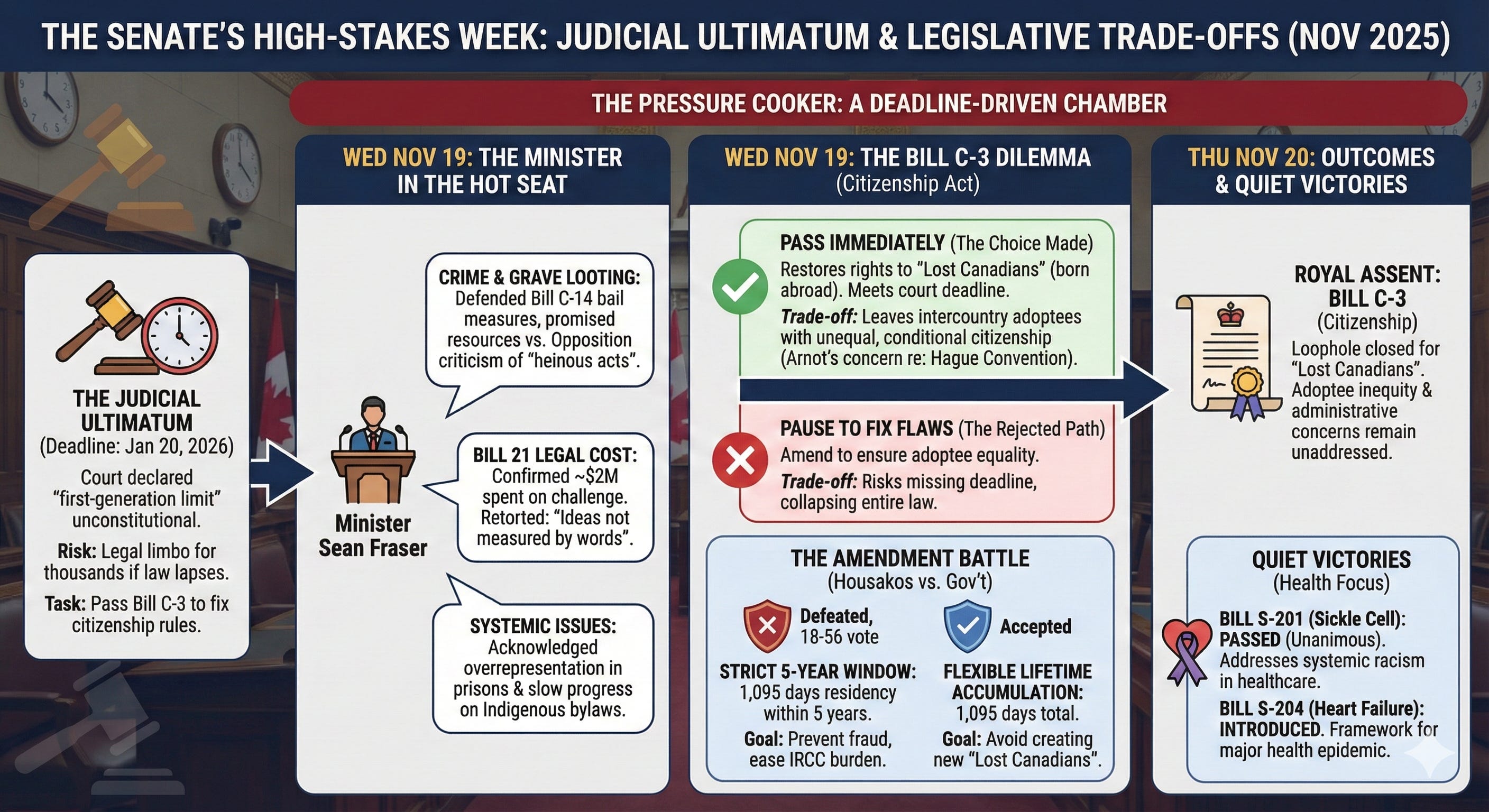
The Senate of Canada is often described as a place of sober second thought, a legislative chamber designed to temper the populist impulses of the House with calm deliberation. But during the third week of November 2025, the Red Chamber felt less like a sanctuary of contemplation and more like a trauma unit operating under the flashing lights of a judicial ultimatum.
At the center of the storm was a deadline that could not be negotiated. In 2023, the Ontario Superior Court of Justice had declared portions of the Citizenship Act unconstitutional. The court found that the “first-generation limit”—a rule preventing Canadians born abroad from passing citizenship to their children if they too were born abroad—created a tiered class of citizens. The court had given Parliament a strict timeline to fix it. If they failed, the law would lapse, plunging thousands of families into legal limbo.
With the clock ticking down to a January 20 extension, the Senate faced a binary choice: pass Bill C-3 immediately to restore rights to “Lost Canadians,” or pause to fix glaring flaws in the legislation that risked discriminating against a new group—intercountry adoptees.
It was a week defined by high-stakes trade-offs, where the rights of the many were weighed against the procedural constraints of the few.
The Minister in the Hot Seat
Before the legislative machinery could grind toward the citizenship vote, the Senate summoned the man responsible for the nation’s legal framework. On Wednesday, November 19, Minister of Justice Sean Fraser walked onto the floor of the Senate to face a barrage of questions regarding the fraying edges of public safety.
The atmosphere was combative from the first exchange. Senator Leo Housakos, Leader of the Opposition, opened with a grim account of recent crimes in the Greater Toronto Area, where thieves had looted over 300 graves and mausoleums.
“It’s unimaginable that after a decade of Liberal governments, Canada has reached a point where not even the dead are safe,” Housakos charged, framing the desecration as a total failure of the justice system.
Minister Fraser, attempting to lower the temperature, acknowledged the “heinous” nature of the acts but pivoted to a defense of his government’s strategy. He outlined a three-pronged approach: stronger laws for serious crimes, more resources for the RCMP and border services, and upstream investments in mental health and housing to prevent criminality before it starts.
“We believe when serious crimes take place, the perpetrator should face serious penalties,” Fraser insisted, citing Bill C-14’s tougher bail measures for repeat violent offenders.
But the interrogation quickly shifted from the graveyard to the courtroom. Senator Claude Carignan pressed the Minister on the government’s spending to challenge Quebec’s secularism law, Bill 21. Carignan revealed that the federal government had spent nearly $2 million on legal arguments, calculating the cost at “$181 per word”.
Fraser did not flinch. “The importance of ideas cannot be measured in the number of words,” he retorted, asserting the federal obligation to intervene when Charter rights are at stake.
Yet, beneath the political sparring, a deeper anxiety permeated the chamber. Senators from all affiliations pressed the Minister on the overrepresentation of Indigenous and Black Canadians in prisons, the failure to enforce First Nations bylaws, and the rising tide of antisemitism and online hate. Fraser admitted that on issues like Indigenous bylaw enforcement, the conversation was “earlier in its implementation” than he would like, a candid admission of a 160-year failure.
The Adoptee’s Dilemma
Once the Minister departed, the Senate turned its attention to the main event: Bill C-3. The legislation was designed to allow Canadians born abroad to pass citizenship to their children, provided they could prove a “substantial connection” to Canada—defined as spending 1,095 cumulative days physically in the country.
Senator Suze Youance, speaking for the absent sponsor Senator Coyle, framed the bill as a victory for gender equality and modern mobility. She argued that the current law forced Canadian women living abroad to fly home in late-stage pregnancy just to ensure their infants would be citizens. Bill C-3 would end this “reproducive tourism” by allowing parents to prove their connection to Canada through residency rather than birth location.
But as the debate unfolded, a glaring inequity emerged. Senator David Arnot rose to speak for a group that the bill risked leaving behind: intercountry adoptees.
Arnot explained that under Bill C-3, children adopted from abroad by Canadian families would be subjected to the same “substantial connection” test as children born abroad to expat parents. This, he argued, violated the Hague Convention, which mandates that intercountry adoptees must be treated the same as domestic adoptees.
“When Canadian parents adopt a child from abroad, they do not say to the child, ‘You are Canadian but only conditionally,’” Arnot said, his voice cutting through the technical jargon. “They say, ‘You are ours’”.
The tragedy, Arnot admitted, was that the Senate had no time to fix it. The court deadline of January 20, 2026, meant that amending the bill and sending it back to the House of Commons could result in the entire law collapsing, leaving no rules in place for citizenship transmission. He urged the Senate to pass the bill to save the “Lost Canadians” but to go on record that the treatment of adoptees was a constitutional breach waiting to be challenged in court.
The Battle for Integrity
Not everyone was willing to accept the bill as written. Senator Leo Housakos launched a final attempt to amend the legislation, arguing that the “substantial connection” test was dangerously vague.
As drafted, a parent could accumulate their 1,095 days of Canadian residency at any point in their life before their child’s birth. Housakos argued this was administratively impossible to verify and prone to fraud. He proposed an amendment requiring that the 1,095 days be accumulated within a specific five-year window, mirroring the requirements for naturalized citizens.
“Citizenship in Canada should not just be a piece of paper,” Housakos thundered. “It should be the most essential, valuable identity element of our nation”. He warned that without clear metrics, the bureaucracy at Immigration, Refugees and Citizenship Canada (IRCC) would be overwhelmed, citing testimony that the department already struggled to track basic data.
The government pushed back hard. Senator Patti LaBoucane-Benson argued that restricting the residency requirement to a five-year window would create a new cohort of “Lost Canadians”—people who had deep ties to Canada but whose time in the country was spread out over decades rather than concentrated in a single block.
“We risk excluding parents who clearly have strong connections to Canada,” LaBoucane-Benson warned, urging the chamber to prioritize flexibility for global Canadian families over rigid administrative convenience.
The bells rang for the vote. The tension in the chamber was palpable. When the count was tallied, the amendment was defeated 18 to 56. The Senate had chosen the broader, more flexible path, accepting the risks identified by Arnot and Housakos to meet the judicial mandate.
A Quiet Victory and a Looming Shadow
While the citizenship battle consumed the oxygen in the room, the Senate managed to pass another critical piece of legislation with far less fanfare. Bill S-201, the National Framework on Sickle Cell Disease Act, received third reading.
Senator Tony Ince and Senator Sharon Burey championed the bill, highlighting the systemic racism and neglect faced by the predominantly Black patients suffering from the disease. The bill mandates the creation of a national registry and better training for health professionals, addressing a gap where patients in pain crises are often dismissed as drug seekers.
Senator Burey described the passing of the bill as an act of building “a strong Canada where all Canadians matter”. It was a rare moment of unanimity in a fractured week.
Meanwhile, the shadow of another health crisis loomed. Senator Yonah Martin introduced Bill S-204 to establish a framework for heart failure, a condition she described as a “revolving-door” epidemic costing the health system hundreds of millions annually. With 750,000 Canadians currently living with heart failure, the bill aims to replicate the success of the national diabetes framework.
The Ink Dries
On Thursday, November 20, the Deputy of the Governor General arrived at the Senate. In a formal ceremony, Royal Assent was granted to Bill C-3.
The legal loophole that had plagued “Lost Canadians” for years was finally closed. Families who had lived in fear of being stateless could now claim their birthright. Yet, the victory was tempered by the knowledge of what was left undone. The intercountry adoptees remain in a second tier of citizenship transmissibility, their equality sacrificed to the clock. The concerns about administrative chaos at the IRCC remain unaddressed.
As the Senate adjourned, the lights dimmed on a week where the legislative branch was forced to sprint to keep pace with the judiciary. They had beaten the deadline, but the debate over who belongs—and how they prove it—is far from over.
Source Documents
Senate of Canada. (2025, November 18). Debates of the Senate (Hansard), 1st Session, 45th Parliament, Volume 154, Issue 34.
Senate of Canada. (2025, November 19). Debates of the Senate (Hansard), 1st Session, 45th Parliament, Volume 154, Issue 35.
Senate of Canada. (2025, November 20). Debates of the Senate (Hansard), 1st Session, 45th Parliament, Volume 154, Issue 36.