


The letters arrive quietly, but the violence follows with deafening volume. In cities like Abbotsford, Surrey, and Brampton, small business owners are checking their mailboxes with a mounting sense of dread. The demands printed on these illicit notices are crude, but they carry the weight of a loaded gun. The criminals demand millions in “protection money,” warning victims not to contact the police. When a business owner in British Columbia recently ignored a demand for two million dollars, their property was riddled with bullets under the cover of darkness.
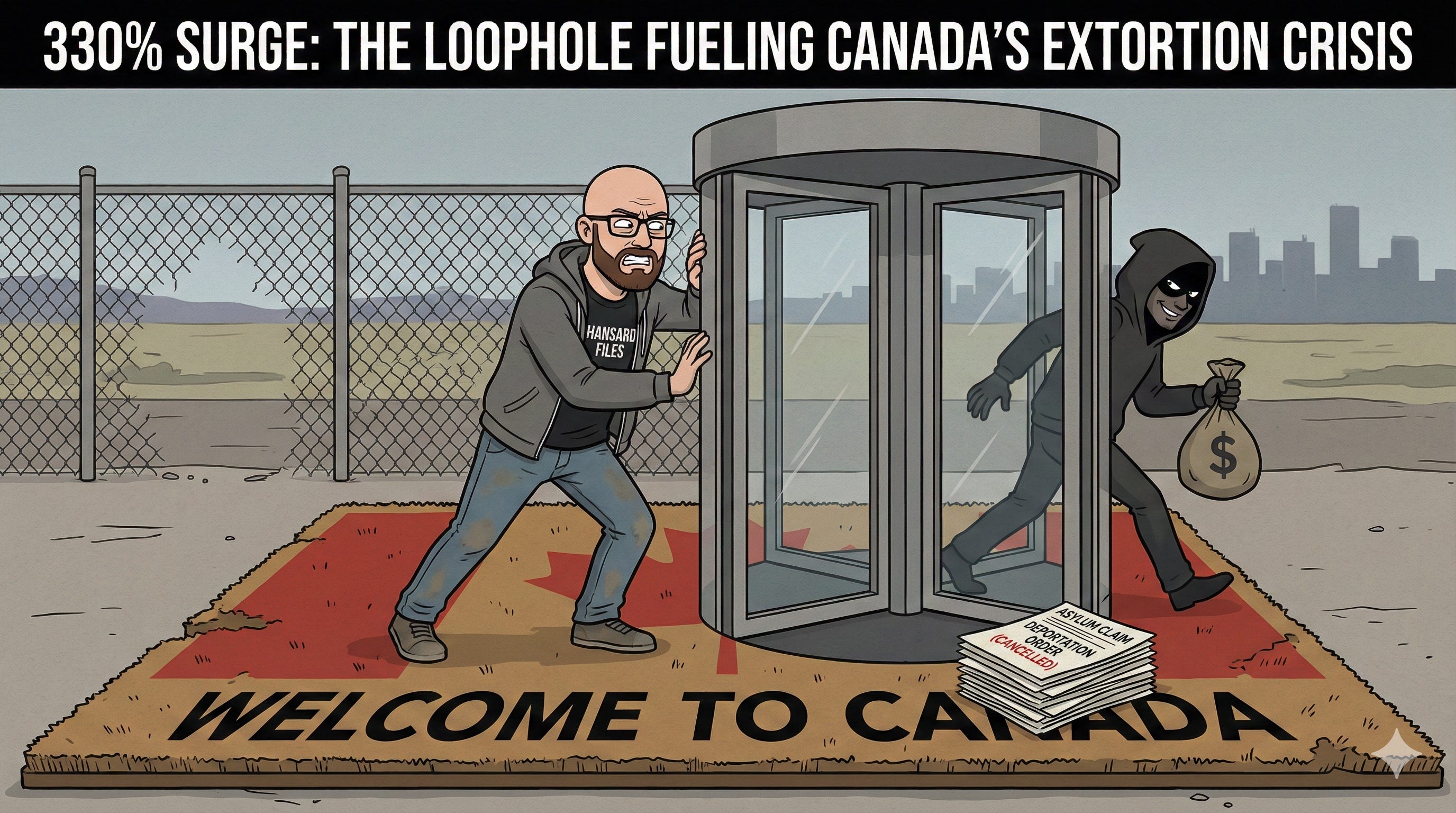
This is the very human face of the Extortion Crisis currently gripping Canada. It is a wave of coordinated intimidation that has driven a staggering 330 percent surge in extortion incidents across the country since 2015. But behind the shattered glass and the burning storefronts lies a bureaucratic nightmare that is actively paralyzing law enforcement. When police finally track down the suspects orchestrating these transnational terror campaigns, the perpetrators are frequently deploying a devastatingly simple legal shield. They are claiming asylum.
The Anatomy of a Transnational Extortion Crisis
In the halls of the House of Commons on February 10, 2026, the sheer scale of the terror was laid bare. Conservative MP Brad Redekopp read directly from an extortion letter sent to a business in Abbotsford, British Columbia. The broken English of the threat did nothing to mask its lethal intent.
“WARNING... we are Indian gang members, we want our share from your business like protection money,” the letter read. “We asking only 2 million in cash... we have links all over do not ignore us, it will efect you realy bad. we gave you 1 month to decide.”
This was not an isolated incident. In Surrey alone, there were 36 similar incidents reported in the single month of January 2026. Criminal networks, often operating with transnational ties to countries like India, are systematically preying on diaspora communities. The statistics are chilling. Across Canada, the number of people charged with extortion rose from 680 in 2015 to 1,258 in 2024. The rate per 100,000 citizens ballooned from 8.56 to 31.82, representing a 272 percent increase. In British Columbia, extortion incidents have skyrocketed by nearly 500 percent.
These networks operate with a brazen disregard for local law enforcement because they understand the vulnerabilities of the Canadian justice system. They target the most vulnerable demographic, primarily newcomers and established immigrants who have worked for decades to build their businesses. The criminals demand exorbitant sums, threatening the lives of the owners and their families. If the money is not paid, the threats materialize into drive-by shootings and orchestrated arsons. It is a campaign of terror designed to extract wealth through fear, and it is working precisely because the traditional deterrents of the justice system have been compromised.
The Ludicrous Loophole and the 300,000-Person Backlog
The most shocking revelation in this escalating crisis is not just the violence itself, but the legal maneuvering used by the perpetrators once caught by police. Recently, the British Columbia Extortion Task Force identified and moved against over a dozen suspects tied to these extortion rings. However, the moment the Canada Border Services Agency began investigating them for deportation, 14 of the suspects immediately claimed refugee status.
By invoking the Immigration and Refugee Protection Act, these individuals effectively put their deportations on hold. The law dictates that they cannot be removed from the country until the Immigration and Refugee Board processes and decides upon their asylum claims. British Columbia Premier David Eby, a New Democrat, publicly described this abuse of the asylum system as “ludicrous,” demanding immediate federal intervention.
The reality on the ground is that claiming asylum in Canada buys an immense amount of time. There are currently nearly 300,000 people in the asylum queue. To put that into perspective, the backlog is roughly equivalent to the entire population of the city of Saskatoon. It takes an average of nearly four years to process these complex claims. During this multi-year limbo, approximately 100,000 of these individuals are simply waiting for basic security clearances.
For a transnational gang member, this four-year processing window is an operational goldmine. They are shielded from immediate deportation, granted the ability to remain in Canadian communities, and afforded ample time to continue their illicit activities or orchestrate further extortion campaigns. Conservative MP Michelle Rempel Garner brought this to the forefront of parliamentary debate, pointing out that this loophole allows violent criminals to avoid deportation, claim social benefits, and make a complete mockery of Canada’s immigration integrity.
The Judicial Merry-Go-Round of Bill C-5 and Bill C-75
The Extortion Crisis is deeply intertwined with broader systemic changes to Canada’s criminal justice system over the past decade. Opposition members argue that the surge in violence is the direct result of a “catch-and-release” judicial philosophy engineered by the current Liberal government.
At the center of this fierce debate are two pieces of legislation. Bill C-5 systematically removed mandatory minimum sentences for a swath of serious crimes, including extortion with a firearm and robbery. Bill C-75 introduced the “principle of restraint” into the national bail system. This principle effectively instructs judges and justices of the peace to release accused criminals at the earliest possible opportunity, utilizing the least restrictive conditions available.
According to law enforcement officers and municipal leaders, this legislative framework has created a revolving door for repeat violent offenders. Police across the country express intense frustration, noting that they frequently arrest individuals for violent crimes only to see them released back into the community before the arresting officers have even finished their shifts.
Furthermore, there is mounting outrage over the leniency granted to non-citizens convicted of serious crimes. Under current immigration law, a non-citizen who serves a sentence of more than six months is subject to automatic deportation. To circumvent this, defence attorneys routinely request sentences just under the six-month threshold. During the parliamentary debate, Rempel Garner highlighted a deeply disturbing case in Barrie, Ontario, where a non-citizen pleaded guilty to raping a 13-year-old girl and impregnating her twice. The court granted an adjournment specifically to evaluate how his guilty plea and sentence would affect his immigration status. This practice of prioritizing a criminal’s residency status over the gravity of their violent offenses has severely damaged public confidence in the judicial system.
The Legislative Counter-Offensive and Bill C-12
The Liberal government vehemently pushes back against the narrative that they are soft on crime. Ruby Sahota, the Secretary of State for Combatting Crime, took to the floor of the House to defend the government’s record, accusing the Conservatives of engaging in “rage bait” and deliberately obstructing vital public safety legislation.
The government points directly to Bill C-12, the Strengthening Canada’s Immigration System and Borders Act, currently sitting in the Senate. Sahota argued that had the Conservatives not delayed earlier iterations of this legislation (originally tabled as Bill C-2), the suspects in the Surrey extortion cases would have been legally barred from making asylum claims. Under the new provisions, any individual who entered Canada irregularly or who has been in the country for over 12 months will be ineligible to file a claim for asylum. The government asserts that this will effectively close the loophole being exploited by transnational gangs.
Additionally, the government is pouring massive financial resources into targeted enforcement. They have allocated 100 million dollars to the Peel Regional Police to combat extortion in Ontario. In British Columbia, the RCMP’s national coordination and support team has taken conduct of 32 files across the Lower Mainland, resulting in multiple arrests and the execution of nearly 100 judicial authorizations. The Canada Border Services Agency has also opened investigations into 111 foreign nationals in the Pacific region, resulting in the successful removal of nine individuals to date.
The government is also pushing forward with Bill C-14, the Bail and Sentencing Reform Act. This legislation aims to establish reverse-onus bail provisions for violent extortion and mandate consecutive sentences when extortion is combined with other serious crimes like arson or firearms offenses. The Liberals argue that this suite of legislation, combined with a 1.3 billion dollar border plan to hire thousands of new CBSA and RCMP officers, constitutes the most robust law enforcement investment in Canadian history.
A High-Trust Society on the Brink
Despite the billions of dollars promised and the legislative maneuvers underway in Ottawa, the reality on the streets remains extraordinarily grim. The Extortion Crisis is not just a statistical anomaly. It is a fundamental threat to the high-trust society that has defined Canada for generations.
The fear is no longer confined to major urban centers. Conservative MP Jonathan Rowe detailed how the breakdown in law and order is shattering the cultural fabric of rural Newfoundland. In communities where leaving doors unlocked was once a point of pride, residents are now installing security cameras and locking their homes in broad daylight. Traditional cultural activities, such as mummering, are slowly fading as the inherent trust between neighbors evaporates in the face of rising break-and-enters and drug-related crime.
The debate raging in the House of Commons is fundamentally about the value of Canadian citizenship and the basic social contract between the state and its people. When millions of immigrants come to Canada to build a better life, they do so with the expectation that the rule of law will protect them. Instead, they are finding themselves on the front lines of a turf war, extorted by the very transnational elements they sought to escape, while the perpetrators manipulate a broken asylum system to evade justice.
Whether the government’s new legislative toolkit will be enough to stem the tide remains to be seen. But for the business owners waking up to bullet holes in their windows and threatening letters on their doorsteps, the political bickering in Ottawa offers little comfort. They are trapped in the crossfire of the Extortion Crisis, waiting for a legal loophole to close before their livelihoods, or their lives, go up in smoke.
Hansard Files combs through thousands of pages of unredacted parliamentary transcripts to expose the critical policy failures shaping your world. Subscribe today to support independent, uncompromising investigative journalism that holds the halls of power accountable.
Source Documents
House of Commons. (2026, February 9). House of Commons Debates, Official Report (Hansard), 152(82).
House of Commons. (2026, February 10). House of Commons Debates, Official Report (Hansard), 152(83).
House of Commons. (2026, February 11). House of Commons Debates, Official Report (Hansard), 152(84).
House of Commons. (2026, February 12). House of Commons Debates, Official Report (Hansard), 152(85).
House of Commons. (2026, February 13). House of Commons Debates, Official Report (Hansard), 152(86).
This is horrifying.
The name tells the game: Immigration and Refugee Protection Act (IRPA).
IRPA was one of Jean Chretien's "gifts" to Canada. When it was implemented, Citizenship & Immigration Canada (CIC) soon realized deportations were almost impossible.
Keeping in mind this legislation was completed in the aftermath of the horrific events of Sept 11, 2001 and put into force in June 2002, one can only guess why Chretien wanted to prevent deportations of immigrants and refugees.