


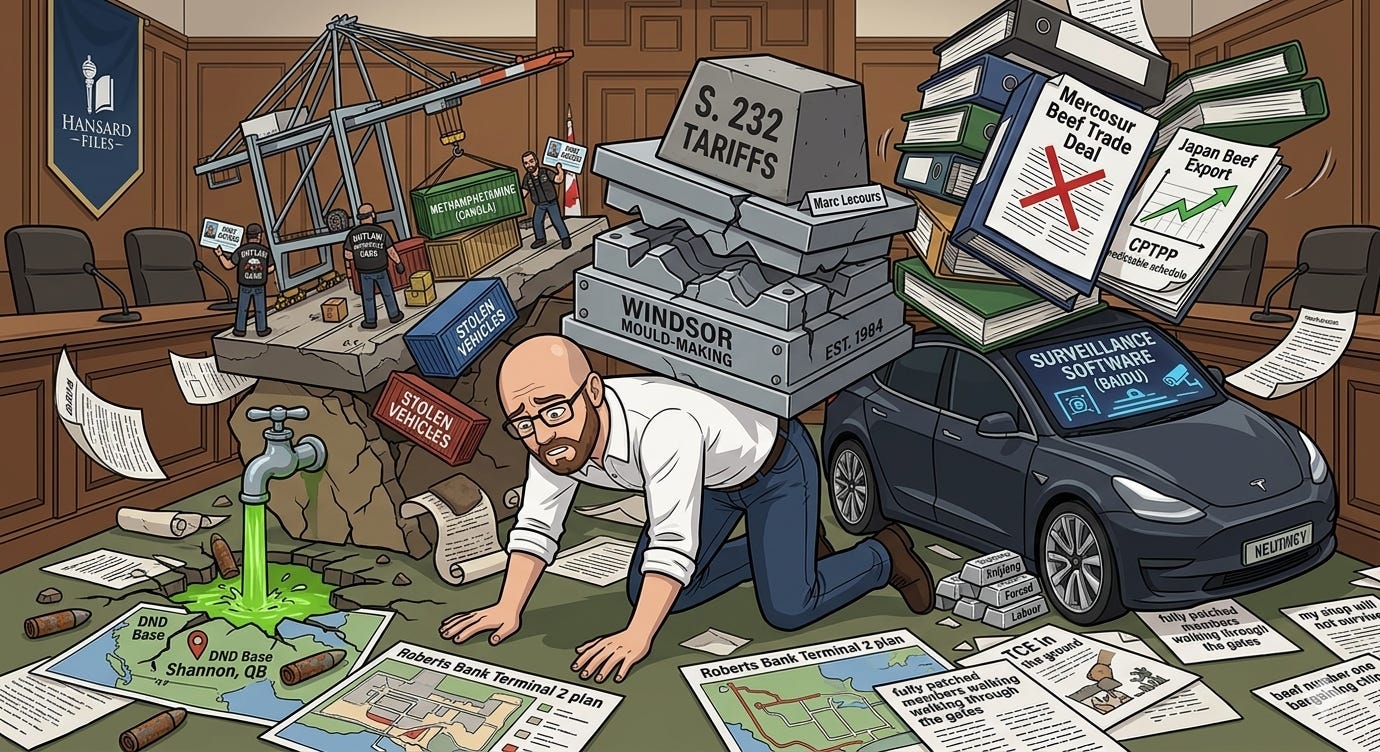
Marc Lecours flew to Ottawa to say something he’d been turning over for weeks. He is 42 years into the mould-making trade, a Windsor founder, a father. His son works in his shop. His voice, when he finally spoke to the Standing Committee on Industry and Technology on April 27, was not theatrical. It was just tired.
“My shop will not survive these tariffs,” he told the room. “Windsor is globally recognized for its mould-making expertise. If we lose that position, we will not get it back.”
In Room 415-D of Wellington Building, committee chair Ben Carr let that sentence land.
Then he moved on to the next witness.
That moment, quiet and ordinary and devastating, captures something about the week of April 23 to 30, 2026, in Ottawa’s parliamentary committee system. Across five different rooms, five different studies, five distinct crises unfolded in testimony that will not make the evening news. Organized crime at the ports. Federal contamination abandoned in the ground beneath Quebec municipalities. Canadian beef finding footholds in Japan while the Mercosur talks threaten to undercut it. Chinese EVs carrying surveillance software. A Windsor machinist watching a decades-built industry go dark.
None of these stories connects to the others. But set side by side, they form something like a national portrait: a country being squeezed from many directions at once, turning to Parliament for answers, and getting, at best, a record.
The Docks Are Not Secure
Thursday afternoon, April 23. The Standing Committee on Public Safety and National Security was studying the role of the Canada Border Services Agency in the H2O highway corridor. What it got instead was a retired police chief drawing the most vivid picture of port vulnerability that committee rooms had heard in years.
Neil Dubord spent nine and a half years as Chief of Police in Delta, British Columbia, directly adjacent to Deltaport, one of the largest container terminals in Canada. His testimony was operational, specific, and deliberately stripped of euphemism.
“Our national port system handles roughly 6.1 million shipping containers a year,” he told the committee. “It’s a brilliant logistical engine, but it has been weaponized.”
What follows that sentence, in the Hansard record of SECU-34, is not abstract. Dubord described 6,330 kilograms of methamphetamine intercepted hidden inside canola oil jugs. He described 57,000 vehicles stolen across Canada in a single year, roughly 60% of which are expected to be shipped overseas. He described cartel recruiters targeting kids as young as 15 to steal those cars, and explicit police testimony that young recruits are tortured if they fail.
Then he said this: in the greater Vancouver area alone, 30,000 people hold port access cards. Under 20% of them are required to have federal security clearances. “Fully patched members of outlaw motorcycle gangs are walking through the gates, operating the cranes and managing digital manifests,” Dubord testified. “A physical fence is entirely useless when organized crime holds the key to the front gate.”
Conservative MP Frank Caputo, who spent most of his career in the justice system, confirmed the picture. “This is not as though it’s a secret,” he said. “It’s all very well known. It might not be well reported or publicly discussed, but it’s something that I think most people in all facets of the port system or the justice system know about.”
The most alarming detail was not the drugs or the cars. It was the mathematics. Border agents can physically inspect 1% to 2% of outbound containers. The sheer volume of global trade makes more impossible. Add the insider threat, and the inspection rate becomes largely theatrical.
Dubord proposed four concrete remedies: a permanent integrated task force to cut jurisdictional silos, private sector screening technology as a force multiplier, mandatory universal security clearances for all port workers, and a $5 per-container levy applied across shipping volume to generate over $30 million annually, ring-fenced for enforcement.
The committee listened carefully. Nothing was adopted. The record was made.
Twenty-Six Years of Poison in the Ground
The same Thursday, in a different room, a mayor from a small Quebec city arrived at the Standing Committee on National Defence carrying a frustration that was polite, precise, and three decades old.
Sarah Perreault is the Mayor of Shannon, Quebec. Shannon, a city of 7,000 residents, has lived with one of Canada’s worst trichloroethylene contamination events since the late 1990s, when the provincial government discovered that federal military operations at the adjacent base had poisoned the groundwater. The federal government eventually built a municipal water system at a cost of nearly $35 million and established a monitoring committee that still meets, sporadically, today.
“Twenty-six years later,” Perreault told NDDN-34 on April 29, “the ground is still contaminated.”
Her testimony was not a complaint exactly. It was a careful account of what it means for a small city to share its infrastructure, its tax base, and its fate with a federal military institution that doesn’t require building permits, doesn’t ask about schools, and changes its base commander every two years, restarting every relationship from zero.
DND is now planning to build 1,100 new housing units on base land within Shannon’s territory. The population will jump from 7,000 toward 10,000 residents. Perreault was not informed in advance, was not consulted on location or design, and was not asked whether the French-language elementary school, already projected to exceed capacity in 2026, could absorb the children. “They aren’t asking me for any permits,” she said. “They’re just building.”
Serge Villandré, Chief Administrative Officer of Terrebonne, told a parallel story from a different angle. His city had been waiting for federal action on the former Saint-Maurice test shooting range, 6.5 square kilometres of contaminated land abandoned by DND in 1967 that sits squarely in the middle of Terrebonne’s growth corridor. When Terrebonne tried to build a road interchange through a corner of the site earlier this year, workers hit unexploded ordnance. DND had assessed the risk as very low.
The contractor’s bill for decontamination came in at $1.7 million. The initial DND estimate had been $600,000. More than a month earlier, Terrebonne had been told by the deputy minister of National Defence, on the record at committee, that funding was available and that someone from the department would call.
“No, we’ve not had any calls from anyone,” Villandré told the committee flatly. “We just want to ensure that we can develop our region.”
The interchange project is now nearly two years behind schedule. Terrebonne taxpayers are carrying the cost of a contamination inherited from the federal government’s military activities. The city has the potential to build 5,000 housing units on the broader site, once it is safe. But it isn’t safe, and no timeline exists.
“My Shop Will Not Survive”
By Monday afternoon, April 27, the Industry and Technology committee had convened for an emergency study of the Section 232 tariff changes, the April proclamation that extended U.S. tariffs on steel, aluminum, and copper from the metal content alone to the full value of finished products.
The impact was not gradual. For manufacturers in southern Ontario, it was immediate and structural.
Great Lakes Copper in London, Ontario, is the last copper tube mill in Canada. When the original 232 tariffs arrived, roughly 50% of its shipments went to the U.S. The company absorbed the early disruption, maintaining higher-margin business and products that American mills struggle to replicate. The April change removed that option. A 50% tariff now applies to the full invoice price. The business that kept them viable in the American market is gone. Despite this, the company is prepared to invest $65 million in a facility modernization that could secure its operations for a generation, if any level of government can provide support for 15% of eligible capital expenditure. The ask has been made repeatedly. The answer has not come.
Arctic Snowplows, also London-based, had already lost 40% of its U.S. sales before April. Now, with the new tariff structure, the projected loss is 90%. The only surviving customers are a handful of intensely loyal buyers and parts orders. A $2,450 duty applies to a $10,000 plow. The only way to reduce that is to use American steel, which costs more, which doesn’t fully offset the duty saving, and which would raise their Canadian costs simultaneously because their production line cannot cleanly segregate material by destination.
“They buy a sheet of metal and laser cut 30 parts to build plows not only for the U.S. but for Canada,” Jason Bates of EMC Canada told the committee. “In short, it simply cannot be done economically unless we switch to all U.S. steel.”
Then came Lecours.
His Windsor precision machining companies employ 20 skilled workers. He described completing PPE moulds in two weeks during COVID-19, work that would normally take eight. He described his son, who is a machinist and who Lecours is watching over. And he described, with no dramatics, a shop that won’t survive.
“If we’re playing the game, we need to know the rules,” he told the committee. “If they’re changing the rules as we go, we cannot play the game.”
Vincent Caron of the Ontario Chamber of Commerce put numbers to the picture. Before the April change, the effective U.S. tariff rate on Ontario exports was around 4%. The April proclamation increased Ontario’s effective tariff burden by more than 50% in a single month. Only 26% of Ontario firms now plan to increase investment over the coming year. The capital decisions have already been made. Order books were already thinning before the April change took effect.
The Japanese Lesson Nobody Is Applying
The same week, on April 30, the International Trade Committee heard testimony that cut in a different direction entirely: what good trade diversification actually looks like, and how rarely it resembles what’s currently being negotiated.
CIIT-35 was studying Canada’s trade relationship with Japan. Tyler Fulton, president of the Canadian Cattle Association, used the word “stark” when describing the contrast between the Japan relationship and the Mercosur negotiations. It was an understatement.
In 2025, Canada exported $378 million in beef and beef products to Japan. The value has grown by roughly 76% since 2018, powered by the CPTPP’s predictable, science-based tariff schedule. Japan buys chuck rolls and short plate, cuts not in high demand in Canada. The premium the Japanese market pays flows directly back to Canadian ranchers as a signal about what to produce. Everyone wins.
Mercosur is the mirror image. Brazilian and Argentine beef is lower cost, carries lower standards on labour, environment, and food safety, poses biosecurity risks that haven’t been fully quantified, and competes at exactly the price points where Canadian beef is strongest. The local demand in Mercosur countries, Fulton told the committee, is not for the kind of high-quality grain-fed beef Canada produces. There is no reciprocal opportunity. Canada’s beef sector, he said, is essentially “the number one bargaining chip on the negotiating table” in negotiations that offer it no upside.
Alexa Young, Vice-President of the Vancouver Fraser Port Authority, added the infrastructure dimension. The Port of Vancouver moves about $350 billion in goods annually. It has increased capacity by 70% over 15 years through roughly $9 billion in cumulative investment. To double exports to non-U.S. markets, as Prime Minister Carney has committed, the single most important shovel-ready step is Roberts Bank Terminal 2: a three-berth container terminal that would unlock $100 billion in additional annual trade capacity. It has its environmental assessment approvals. It has the consent of 27 First Nations. It needs a final investment decision and early construction support from the Major Projects Office.
“Let’s get Roberts Bank Terminal 2 up and running,” Young said. “That’s going to increase capacity by $100 billion annually. It’s also going to relieve some of the congestion that we’re seeing in Burrard Inlet.”
Japanese customers, she noted, are watching for one thing above all: reliability. Labour disruptions, port closures, and supply chain unpredictability have damaged Canada’s reputation as an open-for-business trade partner. The ambition to look west is right, she said. The domestic infrastructure and stability work has to match it.
The Cars That Listen
Back in the Science and Research committee on April 23, the China-EV study resumed with testimony that sat somewhere between national security briefing and cautionary tale.
Margaret McCuaig-Johnston, a senior fellow at the University of Ottawa with a decades-long focus on Chinese science and technology policy, addressed the Baidu software installed in vehicles imported from China, including western-branded vehicles like Tesla manufactured in China. The data from microphones, cameras, and GPS systems, she told the committee, is stored in China, where it can be accessed by officials under a legal framework that requires any firm or individual in China to cooperate with intelligence requests if asked.
This is not speculation about capability. She cited a U.S. Department of Energy report warning that a coordinated surge through charging infrastructure could destabilize the electrical grid. She cited documented 2015 research in which security experts remotely took over a Jeep Cherokee at highway speed. And she cited a new regulation issued by Beijing on April 7, after her co-authored letter to the Prime Minister, that explicitly prohibits anyone in China from disclosing supply chain information, including whether products contain materials from Xinjiang.
“Why would Beijing pass such a regulation?” she asked. “It is because they don’t want anyone to know.”
The forced labour angle runs deeper. Importing products made with forced labour into Canada is illegal. The aluminum in many Chinese-built vehicles comes from Xinjiang, a region under continuous international scrutiny for the use of Uyghur forced labour. Canada has a U.S. section 301 investigation bearing down on it, one that will assess whether Canada is adequately enforcing its own forced labour import policies. If the answer is no, all Canadian goods entering the U.S. face the risk of new tariffs.
David Shipley of Beauceron Security widened the frame. The cybersecurity problem, he told the committee, is not unique to Chinese vehicles or electric vehicles. It applies to almost every new vehicle on Canadian roads. A modern pickup truck is a computer on wheels. So is a Civic. The architecture, the wireless connectivity, the software-defined steering, all of it is vulnerable. The difference with vehicles from China is not that the technology is different. It’s that the entity potentially accessing it is a foreign government with a documented intelligence mandate.
Five committees. Five separate crises. None of them dramatic enough, on their own, to sustain weeks of front-page coverage. Gangs inside the port gates. Unexploded shells under a Quebec road project two years behind schedule. A copper tube mill that is the last of its kind in Canada, being taxed out of the American market. Beef farmers who’ve built a $378 million relationship with Japan watching their government consider a deal that would hand the same shelf space to lower-standard competitors. Cars that may be listening to their drivers.
The function of parliamentary committees is to put these things on the record, to question the officials responsible, and to make the evidence available to anyone paying attention.
Marc Lecours paid attention. He bought a plane ticket and came down to say his shop wouldn’t survive. His son is a machinist. He made the committee hear that.
What happens next is still the question that the committee system cannot answer. That part belongs to everyone else.
Hansard Files spends weeks in the archives so you don’t have to. If stories like this matter to you, subscribe to keep this work independent.
Related Hansard Files Articles


Source Documents
House of Commons Standing Committee on Public Safety and National Security. (2026, April 23). Evidence, Number 034 (45th Parliament, 1st Session). Ottawa: House of Commons.
House of Commons Standing Committee on Government Operations and Estimates. (2026, April 23). Evidence, Number 037 (45th Parliament, 1st Session). Ottawa: House of Commons.
House of Commons Standing Committee on Science and Research. (2026, April 23). Evidence, Number 033 (45th Parliament, 1st Session). Ottawa: House of Commons.
House of Commons Standing Committee on Industry and Technology. (2026, April 27). Evidence, Number 035 (45th Parliament, 1st Session). Ottawa: House of Commons.
House of Commons Standing Committee on National Defence. (2026, April 29). Evidence, Number 034 (45th Parliament, 1st Session). Ottawa: House of Commons.
House of Commons Standing Committee on International Trade. (2026, April 30). Evidence, Number 035 (45th Parliament, 1st Session). Ottawa: House of Commons.
Personally, I would not care if Beijing is amused bu my singing along with oldies on the radio, or tracking my journeys to the east coast or even to the local grocery stores. However, if monitoring is major issue for some, such as MPs, government officials, members of the Canadian armed forces, then the should not be driving Chinese vehicles. Or any other vehicle that can be used to monitor their locations or conversations, because, let's face it, every modern vehicle has that capability. If we want to take vehicle security seriously, then we need to design and build a Canadian vehicle that includes Canadian designed and built electronics, or returns to the non-electronic world of the 60s and 70s.
And PP tries to condense all these complexities into three word slogans🤦🏻♀️