


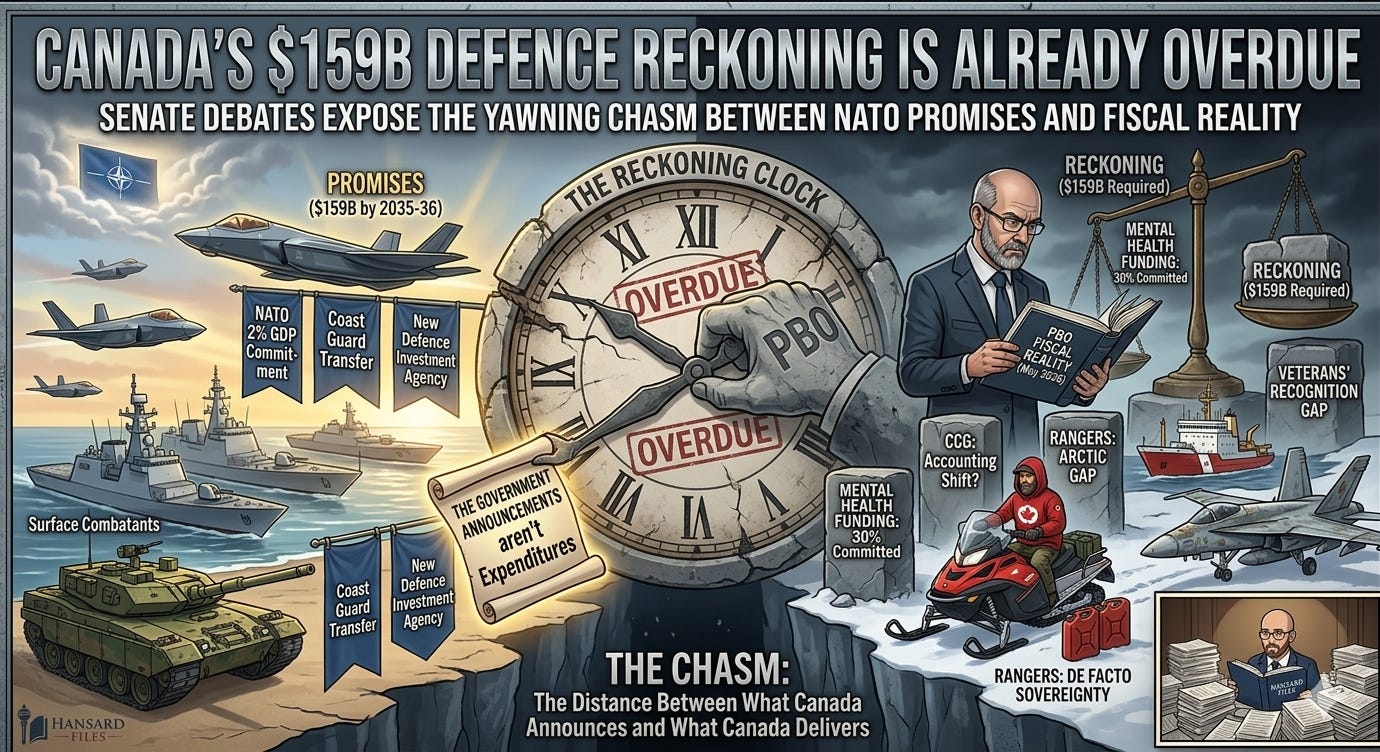
Parliament Hill, May 5, 2026. The chamber galleries held officers of the Royal Canadian Air Force, a visiting delegation from war-ravaged Ukraine, and a room full of senators who had just been told, politely but unmistakably, that the numbers do not add up. Senator David Wells rose during Question Period to deliver a pointed warning: the Parliamentary Budget Officer had released a report that week showing the government’s spring fiscal update did not include all the spending required to meet Canada’s own NATO commitment. Meeting the 5% GDP defence pledge, the PBO calculated, would require core defence spending to reach $159 billion by 2035-36. The government, in its public projections, had not accounted for all of it.
“Announcements aren’t expenditures,” Senator Michael MacDonald said, seconds later, in a separate exchange that felt like a one-sentence summary of the entire week.
What followed over three sitting days, May 5 through May 7, was a high-stakes parliamentary argument about the nature of Canada’s commitments: to its allies, to its veterans, to the communities on its northern frontiers, and to the credibility of its own fiscal framework. The Hansard record of those sessions, running to nearly three hundred pages, reveals a government defending promises on multiple fronts while critics pressed on every one of them.
The $159 Billion Gap Nobody in Government Would Acknowledge
The specific figure comes from the PBO’s spring fiscal update analysis, cited in Senate Question Period on May 5. Wells framed it with surgical precision: the fiscal anchor the government had chosen, a declining deficit-to-GDP ratio, can improve even while the debt-to-GDP ratio worsens, if interest rates rise or GDP growth weakens. He asked why the government had chosen a measure that does not, in his words, accurately indicate whether finances are actually sustainable.
Senator Pierre Moreau, the Government Representative in the Senate, replied that Canada holds the lowest net debt-to-GDP ratio in the G7, the second-lowest deficit-to-GDP ratio in the G7 and a triple-A credit rating from both Standard & Poor’s and Moody’s. “I do not agree,” he said flatly when MacDonald pressed him on whether the chosen anchor was misleading.
That exchange set the tone for the defence spending debate that ran through all three issues. On May 6, Senator Housakos returned with a harder version of the same question, noting that Moreau had cited $81.8 billion over five years for military modernization: tanks, light-armoured vehicles, long-range missiles, artillery, $2.6 billion for recruitment and retention, $844 million for infrastructure. “Those are aspirational,” Housakos replied. “Those are promises. Those are line items.” He noted that Canada’s defence procurement system had failed to deliver on commitments under three successive governments, including the present Liberal government over the previous decade, and asked how the ambitious list would actually be executed within the next 36 months.
Moreau responded with a defence of the government’s overall economic record, a pivot that Housakos noted did not answer the question about a concrete implementation plan.
The Coast Guard Transfer and the Accounting Question Nobody Answered
Beneath the headline numbers, Wells had surfaced a specific accounting problem that received far less attention than it deserved. He reminded the chamber that the Prime Minister had shifted the Canadian Coast Guard from the Department of Fisheries and Oceans to the Department of National Defence the previous year. “That is not new spending; that’s shifting old spending,” he said. He then asked whether other defence-related expenditures had been shifted rather than newly created, which would further inflate the apparent commitment without adding real capability.
Moreau did not provide a specific answer to whether other such transfers exist. The exchange was brief, but the implication for the PBO’s $159 billion calculation is not trivial: if the denominator of “defence spending” is partly composed of reassigned budget lines from other departments, the distance between the government’s announced commitments and genuine new investment is larger still.
The Defence Investment Agency, created to consolidate procurement and anchor purchases to domestic industrial benefits, was mentioned in response to Senator Colin Deacon’s May 5 questions about small- and medium-sized enterprises. It received “establishment funding” in the Spring Economic Update, Moreau confirmed, though that funding still required legislative approval. Deacon had specifically asked about procurement opportunities under $5 million for SMEs, which he argued is where the government’s ability to act as a “first customer” and accelerate dual-use technology exports actually matters. Moreau committed to sending Deacon the details once the agency’s procurement strategy is outlined, and promised to bring the question to the minister’s attention. That question remained open as of the May 7 sitting.
Veterans and the Language of Sacrifice: Bill S-246
The Senate’s debate on defence money was flanked, on both sides, by a different kind of accountability argument: whether Canada uses the right words to describe what it asks of its soldiers.
Bill S-246, the Wartime Service Recognition Bill, sponsored by Senator Hassan Yussuff and supported on second reading by Opposition Leader Housakos on May 5, addresses a gap that has quietly infuriated Gulf War veterans for more than three decades. Under Canada’s current legislative framework, the Emergencies Act requires that a conflict endanger Canada’s sovereignty or territorial integrity before it can be legally recognized as “war.” The Gulf War, the Balkans mission and Afghanistan did not meet that threshold. Veterans of those conflicts are designated as having performed “special duty service,” a category that carries benefits protections but lacks the moral weight of “wartime service.”
Housakos traced the genealogy of the problem with care. The Korean War, he noted, was also fought without an official declaration of war, yet Korean War veterans were included in the “wartime service” category. “Gulf War veterans therefore argue there is an inconsistency,” he said. “If Korea could be recognized as ‘wartime service’ despite the absence of an official declaration of war, why couldn’t the same reasoning apply to the Gulf, the Balkans or Afghanistan?”
The House of Commons Standing Committee on Veterans Affairs had published a report in December 2024 entitled The Persian Gulf War Was a War, documenting precisely this tension. In the 2025 election campaign, Prime Minister Mark Carney proposed to expand service recognition by reviewing the designation of certain military missions. As of the May 5 sitting, Housakos noted, no concrete measures had been implemented to act on that commitment.
Bill S-246 does not create new financial benefits. It would establish a legislative framework and objective criteria, including the level of risk, the nature of operations and deployment conditions, with a review of Canadian operations since the end of the Korean War. A government order could then formally designate certain service as “wartime service.” The bill was referred to the Standing Senate Committee on National Security, Defence and Veterans Affairs.
“To those who have served in a theatre, who have been exposed to real threats and who have borne the consequences of their service for years, the words their country uses matter,” Housakos said. “That is the issue Bill S-246 seeks to address.”
The Rangers: Sovereignty on Snowmobiles
A quieter but equally striking thread ran through the May 5 sitting in an inquiry on the Canadian Rangers opened by Senator Pat Duncan of Yukon. Duncan’s remarks were, on the surface, a tribute to individuals. In substance, they were a detailed argument about a sovereignty gap in Canada’s North that no amount of defence spending announcements has closed.
The entire Canadian Armed Forces presence in the Yukon, Duncan told the Senate, totals three, sometimes four, personnel, stationed at Boyle’s Barracks on the Alaska Highway outside Whitehorse. The larger Joint Task Force North is located in Yellowknife, Northwest Territories, not in the Yukon at all. Yukoners regularly see and hear U.S. military aircraft, including four F-35B fighters refuelling in Whitehorse three weeks before her speech, while Canadian CF-18s appear only on ceremonial occasions.
The de facto sovereignty presence in every Yukon community, Duncan argued, is the Canadian Rangers: civilian part-time soldiers recruited from local, often Indigenous, communities, paid a modest daily allowance and recognized by their distinctive red hoodies.
Duncan described Operation NANOOK-NUNALIVUT 2026, a 52-day patrol of more than 5,000 kilometres from the Yukon-Alaska border to Churchill, Manitoba, conducted partly by Canadian Rangers in temperatures where minus 40°C “felt like a heat wave.” The operation had been four years in planning, was led by Lieutenant-Colonel Travis Hanes, and included rangers from communities across the North who greeted the patrol in each settlement with traditional food and dance.
She also described Richard Newell of the Carcross Ranger Patrol Group, who in 2025 received the fifth clasp of his Canadian Forces’ Decoration, representing 62 years of service. Only four individuals had previously received that many clasps: Queen Elizabeth The Queen Mother, Prince Philip, Princess Alexandra and Air Commodore Leonard Birchall. Newell is the only living recipient still serving.
The contrast between this picture and the $81.8 billion in procurement announcements was left implicit but was difficult to miss: Canada’s actual, daily, on-the-ground assertion of sovereignty in 40% of its landmass rests on part-time civilian volunteers who ride snowmobiles and know how to find fuel in a blizzard.
Mental Health Funding: A $500 Million Fund with 30% Committed
Veterans’ mental health was not the only front on which gaps between commitment and delivery were documented that week. Senator Danièle Henkel presented a stark figure on May 5: in Canada, a veteran dies by suicide every nine days. Suicide rates among certain veteran cohorts run up to 157% higher than in the general population. One parliamentary committee had described the existing strategy as a “checklist” lacking measurable objectives or strict monitoring of results.
Moreau’s response was that the government had launched a national conversation on men’s and boys’ mental health, running until June 1, with the goal of establishing a national strategy. He committed to ensuring veterans’ specific circumstances are accounted for in that strategy.
On May 6, Senator Katherine Hay pressed further. She noted that Canada has the fourth-highest youth suicide rate in the industrialized world and that a $500 million Youth Mental Health Fund, announced in the 2025 budget with three pillars (Integrated Youth Services, community capacity building and Indigenous mental health wellness), had closed its call for proposals 15 months earlier with roughly 30% of the fund committed. She asked when the remaining funds would be dispersed.
Moreau listed specific allocations: $10 million each to United Way Winnipeg, CAMH in Toronto, and Choices for Youth in Newfoundland for Integrated Youth Services; $4.4 million to CAMH and $10 million to Kickstand Alberta for community capacity; and noted $4 billion in separate Indigenous mental health investments outside the Fund. He did not provide a timeline for the remaining uncommitted allocation.
The Canada Health Transfer’s scheduled reduction from 5% to 3% starting in 2028 compounded the picture, raised by senators on May 6 in the context of mental health service demand that is growing, not contracting.
Health Data, Trade and the Bills Moving Through
Not all the week’s business was contested. Bill S-5, the Connected Care for Canadians Act on health information technology interoperability and anti-data-blocking, passed its Senate committee stage on May 5 and advanced to third reading debate on May 6. Senator Senator Joan Kingston described a health system where the lack of interoperability contributes to “widespread harm” costing nearly $10 billion annually in inefficiencies, duplicated tests, longer wait times and burnout among health care workers. A committee amendment added language affirming Indigenous data sovereignty, the first time that term has appeared in proposed federal legislation.
Bill C-18, the Canada-Indonesia Comprehensive Economic Partnership Agreement implementation bill, passed third reading unanimously on May 5. Senator Clément Gignac noted that Statistics Canada data released that morning showed Canadian exports to countries other than the United States had increased 9% in March, after a 10% increase in February, with the U.S. share of Canada’s international trade at a “historic” 66% low. Both government and opposition senators, including Housakos, supported the bill while noting that the U.S. relationship remains foundational.
Bill S-239, Senator Marty Klyne’s Competition Act amendments, received supporting debate from Senator Peter Harder, who cited an IMF finding that removing Canada’s internal trade barriers, equivalent to a 9% national tariff, could boost real GDP by nearly 7% over the long run, roughly $210 billion, more than three times the federal deficit.
The Senator Who Said Goodbye
Against this backdrop of contested budgets and unfunded commitments, the May 7 sitting included a valediction from Senator Stan Kutcher, who announced his retirement due to health problems that had made it “impossible” to fulfill his obligations. His farewell was, in the Hansard tradition, a matter of record. But it was also, unusually, a political document.
Kutcher warned that generative AI has “the potential to reverse” the democratizing effect of the printing press, concentrating knowledge in the hands of the few and making “transparency and accountability only words again.” He cited the 2026 Edelman Trust Barometer’s finding that 7 in 10 people from 25 nations are hesitant or unwilling to trust those with different values or backgrounds, and Statistics Canada data showing fewer than 50% of Canadians have high trust in the federal government and that trust in government integrity sits at roughly 25%.
His prescription was three qualities: compassion, curiosity and critical analysis, and the warning that a chamber selected rather than elected carries a special responsibility to resist the drift toward opinion-based governance at precisely the moment when that drift is most dangerous globally.
The chamber responded with sustained applause.
What the Week Revealed
The three Hansard issues of May 5 through May 7 share a structural argument that surfaces in the defence spending debate, the Veterans recognition debate, the Rangers inquiry, the mental health funding gap and even in Senator Kutcher’s farewell: the distance between what Canada announces and what Canada delivers has become a standing vulnerability, visible to every parliamentary watchdog, to the country’s allies and to the veterans and communities waiting on the outcomes.
The $159 billion figure the PBO has attached to the 5% NATO commitment is not a criticism of the commitment itself. It is, as Senator MacDonald put it, a reminder that announcements are not expenditures. The Senate, in three days, documented both the aspiration and the gap. Whether the distance between them narrows is a question for the next fiscal year, and the one after that.
Hansard Files digs through dense parliamentary archives so you don’t have to. Every article is sourced directly from the official record. If independent legislative journalism matters to you, subscribe.
Source Documents
Senate of Canada. (2026, May 5). Debates of the Senate, 1st Session, 45th Parliament, Volume 154, Number 71 (Official Report/Hansard). Senate of Canada. https://www.parl.ca
Senate of Canada. (2026, May 6). Debates of the Senate, 1st Session, 45th Parliament, Volume 154, Number 72 (Official Report/Hansard). Senate of Canada. https://www.parl.ca
Senate of Canada. (2026, May 7). Debates of the Senate, 1st Session, 45th Parliament, Volume 154, Number 73 (Official Report/Hansard). Senate of Canada. https://www.parl.ca
House of Commons Standing Committee on Veterans Affairs. (2024, December). The Persian Gulf War Was a War. Parliament of Canada. https://www.parl.ca
International Monetary Fund. (2026). Internal Trade Barriers in Canada: Costs and Implications (with contributions from Federico Díez, Yuanchen Yang, and Trevor Tombe). IMF.
Thanks for another great update, Mike. As usual your great reporting has shown more questions than answers.
This is the shit we've allowed. Everything sounds good but tracks bad. It's incredible that even when voices of reason and accountability are raised, the solutions that serve taxpayers get kicked down the road, or brushed aside.