


The numbers landed on the table in Room 415 of Wellington Building the way a verdict lands in court: quietly, and with devastating finality. On the morning of April 20, 2026, Canada’s Auditor General, Karen Hogan, told the House of Commons Standing Committee on Citizenship and Immigration that the international student program had experienced a systemic breakdown of integrity controls. The international student fraud crisis, she testified, was not an isolated failure. It was a documented pattern, embedded in policy, sustained by underfunding, and left unaddressed for years.
“IRCC had a lot of information at their disposal,” Hogan told the committee, “and they didn’t effectively follow up when their own processes identified fraud indicators. We would expect that those kinds of things would not be ignored.”
They were.
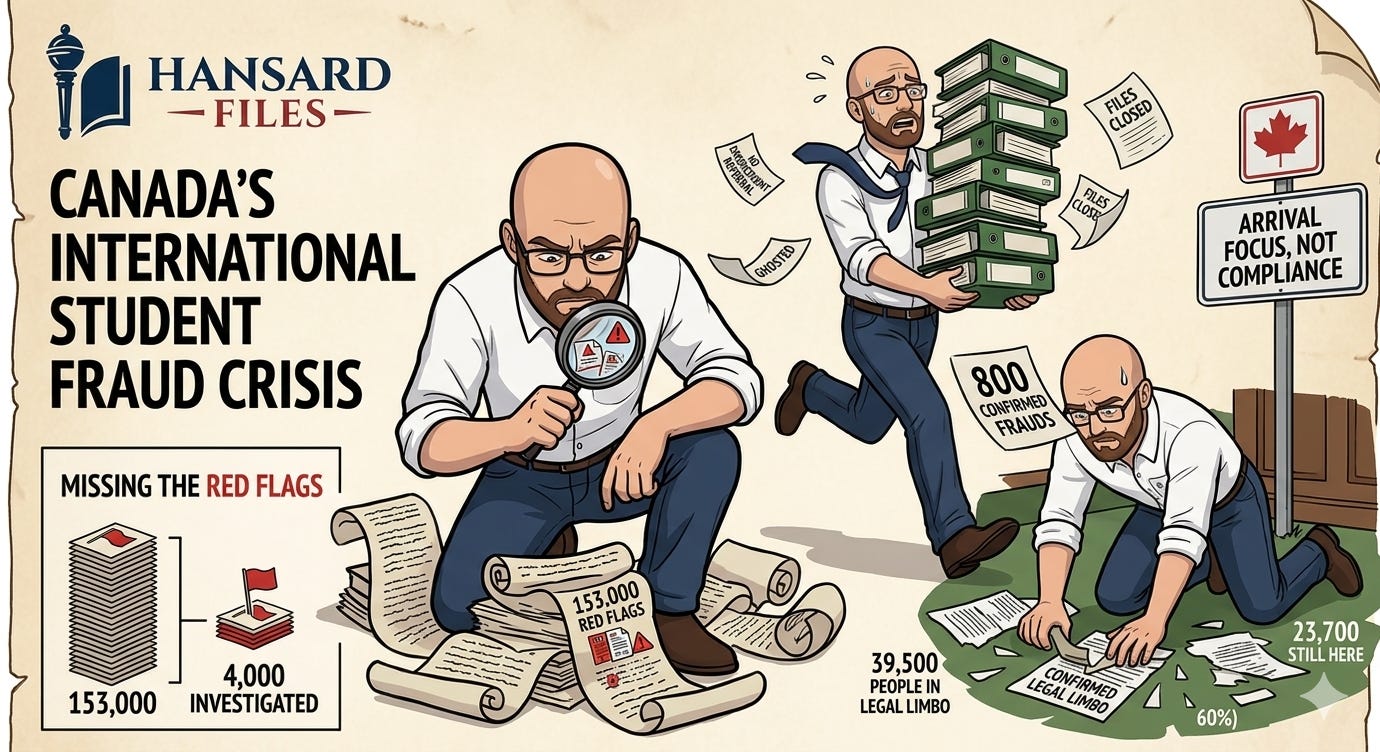
153,000 Red Flags, 4,000 Investigations
The scale of what the Auditor General’s office uncovered is difficult to process as abstraction. Between 2023 and 2024, designated learning institutions, the colleges and universities responsible for the students in their programs, flagged over 153,000 potential cases of non-compliance with study permits to Immigration, Refugees and Citizenship Canada. These were not vague suspicions. They were formal flags from the institutions most familiar with their own students.
The department investigated approximately 4,000 of them.
The arithmetic is not an accident of bureaucratic strain. It is a portrait of a department that, as Hogan testified, was “focused on getting through the applications” rather than managing the risks inside the system once those applications were approved. The culture of IRCC, new Deputy Minister Ted Gallivan acknowledged with striking candour, “was really focused on facilitating the arrival process and handling all the work related to it. There was a strong emphasis on the arrival itself, and that was where it ended.”
Where it ended, it turned out, was approximately at the border.
800 Confirmed Frauds, Zero Consequences
The story grows more troubling when the audit narrowed its focus. In three targeted investigations, IRCC’s own fraud detection activities identified 800 cases where study permits had been issued using fraudulent documents. Not suspected, not flagged for review. Confirmed.
No follow-up occurred on any of them.
The Auditor General’s office examined what happened next. In most instances, these 800 individuals continued to apply for other immigration permits while still in Canada. More than half of those subsequent applications have since been approved.
When Bloc Québécois MP Claude DeBellefeuille pressed Hogan on this directly, asking why there had been no follow-up on the confirmed fraud cases, the Auditor General’s response was direct: “I asked the team this question and was given no reasonable explanation as to why these cases were not followed up.”
Gallivan, who took the job four weeks before the hearing, did not defend his department’s prior conduct. He committed to a 100% review of all problematic letters of acceptance beginning in the summer of 2026. Whether the commitment holds will be tested against a backlog that has grown for years.
“Ghosting” the Government: The Non-Response Strategy That Worked
Perhaps the most damaging finding in the audit involved not what IRCC did but what happened when IRCC tried to do something. Of the 4,000 non-compliance investigations that were initiated, 1,600 were simply dropped because the students under investigation failed to respond to the department’s requests for information.
IRCC’s policy, the audit found, was to make just two contact attempts over a six-month period. If no response arrived, the file was marked inconclusive and closed. No enforcement referral. No flag on the file for future applications. No consequences.
Conservative MP Costas Menegakis put the question plainly: “Your report found that 1,600 investigations into non-compliant students were simply dropped because the individuals failed to respond. Does this mean, in your opinion, that for a student looking to evade the law, the most effective strategy would be to simply not respond to the government’s emails?”
Hogan’s response was precise and devastating: “I think young individuals today would say this is ‘ghosting’. Ghosting the department seemed to have no consequences.”
Gallivan heard the comment and stated that IRCC intends to impose consequences for non-response going forward. The mechanism for doing so, he acknowledged, does not yet exist.
39,500 People Without Status, 60% Still Here
The audit’s most consequential finding concerned not fraud detected in advance but status unmonitored after permits expired. The Auditor General’s office worked through IRCC’s own databases to identify roughly 549,000 international students whose study permits had expired in 2024. Of those, the audit found that approximately 93% remained in Canada under some form of continued status, a transition the system was designed to facilitate.
But 39,500 individuals did not apply for any subsequent permit. They had no legal basis to remain in Canada.
The department had not identified this cohort. The Auditor General’s office identified it for them.
When those 39,500 cases were then run against Canada Border Services Agency entry and exit data, the finding was stark: roughly 60% of those individuals, approximately 23,700 people, were still in Canada with no status and no active file.
“I think this indicates that rigour was applied maybe at the front end of the application process,” Hogan told MP Vincent Ho, “but that the department needs to do a better job once people are in the country and clearly identify whether they’re complying at the end of a permit.”
The IRCC-CBSA Information Silo
Running through the entire hearing was a question that multiple MPs asked in multiple ways: why had IRCC and CBSA not been sharing the data that would have made these problems visible and actionable years earlier?
CBSA President Erin O’Gorman confirmed that the agency has an entry-exit system capable of running large inventories against immigration data to determine whether individuals had left the country. IRCC, she noted, can examine individual cases but lacks the same capacity for population-level analysis.
The collaboration to combine these capabilities had not happened before the audit identified the gap.
Gallivan, pressed on this by Bloc MP Martin Champoux, offered a cultural explanation rather than a procedural one. “The culture of the department I inherited was really focused on facilitating the arrival process,” he said. “There was no further interest afterward.”
Champoux did not accept the framing. “I just want to point out that you’ve been aware of the gist of the issue since 2023,” he told Gallivan. “The information in this report therefore wasn’t a big surprise when it was submitted in March. You already knew about it.”
Gallivan acknowledged that a four-year reform plan had been put in place in 2023, and that the Auditor General’s audit landed at its halfway point. He said he believed there had been progress on the numerical front, that permit volumes had been reduced sharply. What remains, he conceded, is the integrity work.
The Student Direct Stream: A Risk Gap That Has Now Been Closed
One program received specific scrutiny. The Student Direct Stream, a “light touch” application process that allowed expedited processing, had been used disproportionately by applicants from a country the audit identified as high risk.
Hogan described the disconnect carefully. The concern, she said, was “a disconnect between the risk rating of a country and the light touch applied in the initial application, and then doubling down on a light touch in the subsequent application.”
The Student Direct Stream has since been cancelled. But the audit made clear that cancelling the intake mechanism does not automatically resolve the backlog of applications that came through it. As Hogan explained, “you need to apply rigour on anyone who came through that stream when they apply for another immigration status.”
That retrospective review is among the commitments in the management action plan delivered to the committee on the day of the hearing. The plan arrived in members’ inboxes during the testimony itself.
What Comes Next
By the close of the two-hour hearing, several things had become clear.
The new deputy minister had made a series of forward-looking commitments: 100% review of flagged letters of acceptance by summer 2026, a pilot program to send proactive notices to students approaching permit expiration, closer data-sharing with CBSA, and a new IT system designed to use machine learning to identify doctored documents. The system does not yet exist in operational form.
The Auditor General noted that her office is beginning a new practice of following up on recommendations three years after an audit, to verify whether action had actually been taken.
Conservative MP Brad Redekopp, who conducted some of the hearing’s most direct questioning, arrived at a summary: “The overall tone of the report was that there was fraud. The department missed a bunch of stuff, and as we’re hearing today, it was kind of like, ‘Oops, we missed that, but we got this. We’re going to fix it.’”
He then asked the Auditor General a direct question. “Do you think they have this? How are you feeling about the path forward here?”
Hogan’s response was measured: “I haven’t seen a detailed action plan yet. Normally, we would see that when the department comes to a committee. I look forward to seeing the actions that will be taken. I’ll have the opportunity to follow up on these recommendations.”
The management action plan arrived moments later. The hearing was nearly over.
Whether the plan that arrived in members’ inboxes on April 20, 2026, becomes the document that closes 39,500 open files, resolves 800 approved fraudulent applications, and replaces a culture built around arrivals with one that tracks departures, is a question for the three-year follow-up that is now formally on the calendar.
Hansard Files digs through committee transcripts, audit reports, and parliamentary evidence to surface accountability stories that rarely make the front page. If independent, source-grounded journalism matters to you, subscribe and help keep this work going.
Source Documents
House of Commons Standing Committee on Citizenship and Immigration. (2026, April 20). Evidence, Number 027, 45th Parliament, 1st Session (CIMM-27). House of Commons of Canada.
House of Commons Standing Committee on Citizenship and Immigration. (2026, April 22). Evidence, Number 028, 45th Parliament, 1st Session (CIMM-28). House of Commons of Canada.
Office of the Auditor General of Canada. (2026, March). Report on reforms to the international student program [Referenced in testimony]. Office of the Auditor General.
In a serious country, Ministers, DMs, ADMs and DGs would lose their jobs over such gross incompetence. In Canada? Forget about it.
what a shit show and they just dont give a shit