


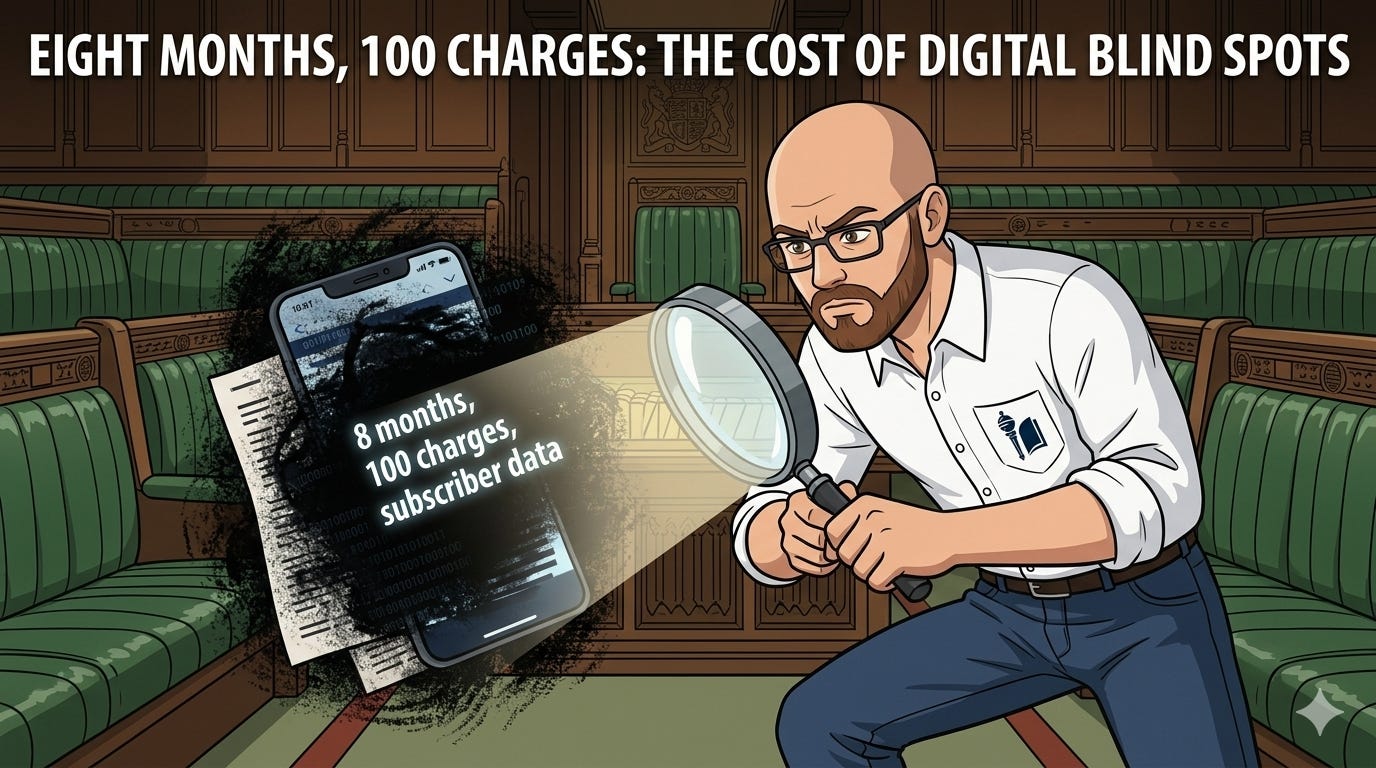
Deputy Chief Nick Milinovich of Peel Regional Police appeared before the Standing Committee on Public Safety and National Security this spring with a concrete example. His force had spent eight months building a case that produced more than one hundred criminal charges tied to extortion. Each step that required subscriber information had demanded a court order. He told members that the powers in Bill C-22, which would allow access on reasonable grounds to suspect rather than higher thresholds, could have compressed that window and kept threats from staying active as long.
The bill would give law enforcement new tools for cases involving extortion, child exploitation, and transnational crime. It would permit access to basic subscriber data on a lower threshold than current law requires and would mandate that service providers retain metadata for up to one year. Supporters argued these changes would let police investigate 2026 digital activity without being limited by statutes written for an earlier era.
The Eight-Month Extortion Case
Milinovich told the committee that his force had watched active threats disappear into digital shadows because existing rules forced investigators to treat sophisticated 2026 communications with outdated analog procedures. The Peel case illustrated the practical effect. Each request for subscriber details required a separate court process. By the time the charges were laid, the investigation had consumed resources and allowed the activity to continue. The deputy chief stated that the powers in Bill C-22 would have let police move earlier and with greater precision.
The committee also heard that the legislation would create a framework for secret ministerial orders compelling companies to provide assistance. Proponents said these orders would be used sparingly and only when necessary to protect investigations. The record showed police forces arguing that without such mechanisms, certain categories of crime would remain effectively untraceable in real time.
“The Bill Does Not Put a Hole in the Wall”
Representatives from Apple, Google, and the Canadian Civil Liberties Association appeared before the same committee and raised a different set of concerns. They warned that the bill’s broad language and the provision for secret orders could require companies to introduce systemic vulnerabilities into encrypted services. Erik Neuenschwander of Apple put the objection in direct terms: the bill does not put a hole in the wall. It merely allows for secret orders to force putting a hole in the wall. The concern, he said, is that at the end of the day there would still be a hole in the wall.
The tech witnesses argued that once such capabilities exist, the pressure to expand their use would be difficult to contain. They described the risk that end-to-end encryption, relied on by millions of Canadians for banking, health, and personal communications, could be undermined not by a single dramatic breach but by cumulative, low-profile demands. The Canadian Civil Liberties Association echoed that the combination of metadata retention and compelled assistance created new points of exposure without clear limits on how the retained data could later be used.
What Remained Unmeasured Elsewhere This Spring
The same committee season produced parallel testimony about information that stayed out of reach or untracked. In the Standing Committee on Citizenship and Immigration, a witness from the Saskatoon West Business Association described how asylum seekers moved through municipal systems without consistent data collection. Karen Kobussen told members that what is not measured becomes invisible, and people simply fall off the system. Saskatoon officials reported their shelter and reception capacity at maximum, with a point-in-time count of 1,931 unhoused individuals. Witnesses contrasted the cost of efficient NGO reception beds at roughly thirty-seven dollars per day with emergency hotel placements that ran two hundred to three hundred dollars per night.
In the Standing Committee on the Status of Women, advocates for shelters described a different form of invisibility. They explained that return-to-shelter rates dropped below five percent when women had access to robust transitional housing and wraparound supports. Yet the absence of sufficient transitional units created a permanent bottleneck. One witness from Muskoka stated that urgency is not empowerment. The pressure on survivors to find housing quickly in a broken market, she said, often left them more exposed rather than less.
The Standing Committee on Access to Information, Privacy and Ethics heard that roughly forty thousand of two hundred thousand Access to Information requests in 2024-25 had missed legislated timelines. The Information Commissioner reported a sixty percent surge in complaints in a single month and called for independent funding mechanisms for Agents of Parliament so that backlogs could be addressed without relying on the very departments subject to the requests.
In the Standing Committee on Industry and Technology, Jennifer Brown of SOCAN addressed a different gap in visibility. She told members that when AI models ingest copyrighted music for training without compensation or transparency, the creators’ work disappears from the economic record. Stealing is not innovation, she said. SOCAN, which collected five hundred eighty-seven million dollars in royalties in 2025, argued that text-and-data-mining exceptions would require explicit transparency obligations so that rights holders could see when and how their work was used.
The Standing Committee on Access to Information, Privacy and Ethics also examined the Prime Minister’s conflict of interest screen. Members were told that one hundred three companies linked to Brookfield fell under the screen out of roughly two thousand in which the Prime Minister holds shares. Opposition members pressed for Privy Council Office documentation showing instances in which the screen had not been applied to relevant decisions.
The Record This Spring
Across these rooms, witnesses returned to the same practical problem. Police described threats that stayed active because data stayed out of reach. Shelter workers described women who cycled back into danger because housing data and supply stayed out of alignment. Immigration and municipal officials described people who fell out of systems because tracking stayed incomplete. Creators described their work entering AI models without leaving a trace in the royalty stream. Ethics committee members described financial interests whose influence on decisions remained difficult to verify from the public record.
The transcripts do not resolve whether Bill C-22’s proposed powers would have prevented the specific harms police described or whether the vulnerabilities tech companies warned about would have materialized. They do show that in spring 2026, multiple committees documented places where the information needed to see a problem clearly, or to act on it in time, was not available under existing rules.
Hansard Files spends weeks in the archives so you don’t have to. If stories like this matter to you, subscribe to keep this work independent.
Related Hansard Files Articles


Source Documents
House of Commons Canada. (2026, May 26 & 28). *Evidence of the Standing Committee on Public Safety and National Security* (SECUEV38-E and SECUEV39-E).
House of Commons Canada. (2026, May 27). *Evidence of the Standing Committee on Citizenship and Immigration* (CIMMEV34-E).
House of Commons Canada. (2026, May 26 & 28). *Evidence of the Standing Committee on the Status of Women* (FEWOEV39-E and FEWOEV40-E).
House of Commons Canada. (2026, May 4, 25 & 28). *Evidence of the Standing Committee on Access to Information, Privacy and Ethics* (ETHIEV40-E, ETHIEV42-E and ETHIEV43-E).
House of Commons Canada. (2026, May 28). *Evidence of the Standing Committee on Industry and Technology* (INDUEV40-E).
"Secret" backdoors do not remain secret. They become zero day exploits allowing persons with little regard for the law to exploit them for their personal benefit and to the detriment of the person owning the device(s). It is bad enough that bad code will let some of these people through. To give them a path is to invite them into your living room.