


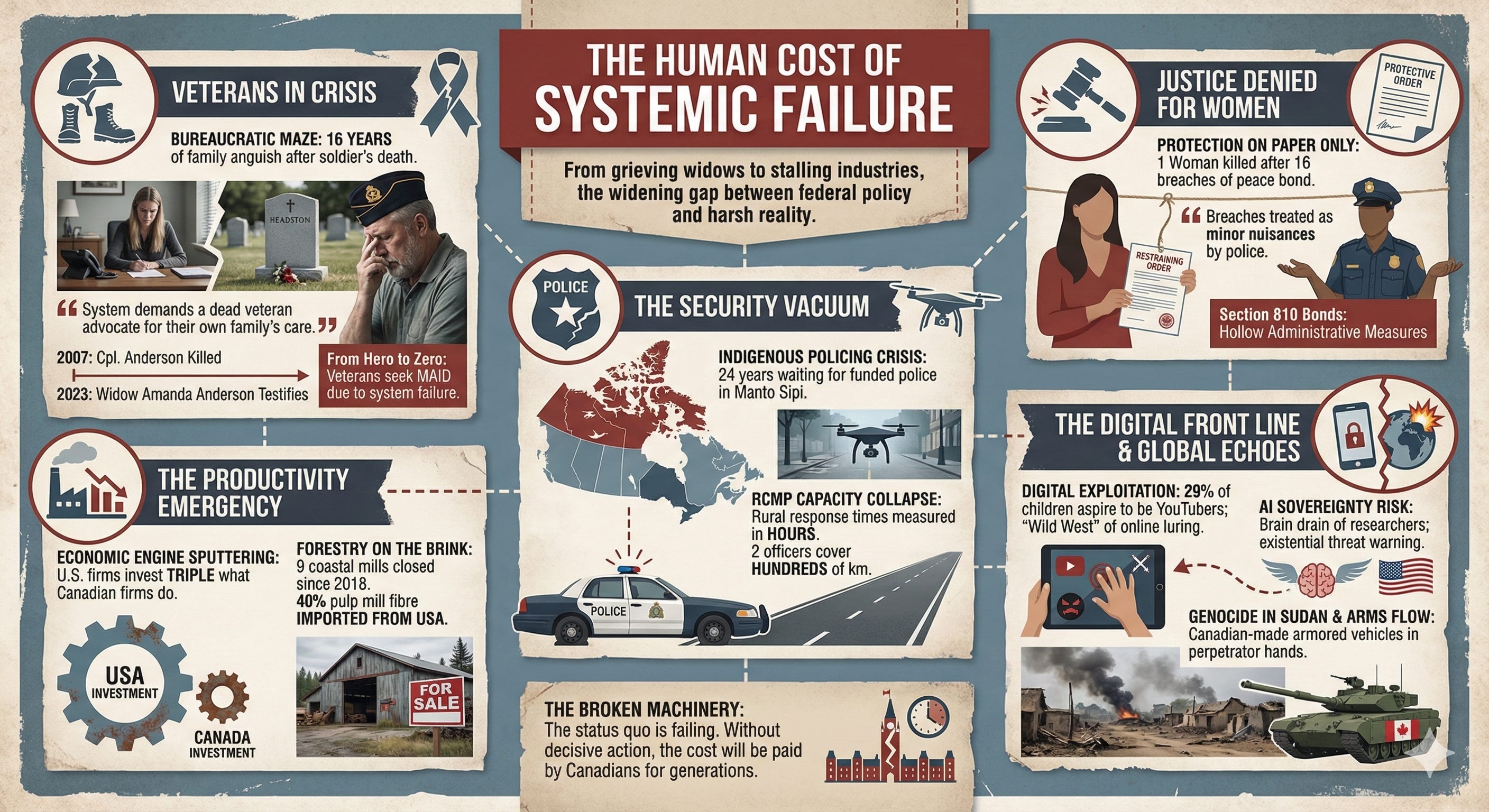
The air in the committee room was heavy with the weight of unaddressed grief as Amanda Anderson took her seat. She was not there to discuss policy in the abstract. She was there to speak about the wreckage left behind when parliamentary accountability fails those it is meant to serve. Her husband, Corporal Jordan Anderson, was killed in Afghanistan in 2007. For sixteen years, she has fielded the late-night phone calls and messages from other survivors—families left to navigate a bureaucratic maze that seems designed to break them. She told the Standing Committee on Veterans Affairs that the mental anguish leading to suicide is not suffered only by the veteran. It is shared by the family. When the system demands a veteran advocate for their own family’s mental health care, and that veteran is dead, the door slams shut.
Beside her sat Michel Marceau, a veteran of the war in Afghanistan. He spoke with the raw intensity of a man who has been pushed to the edge. He described the transition from hero to zero, the red tape, and the indignity of having to fight for basic medical care. He admitted to the room that he had previously requested medical assistance in dying because he felt the system had destroyed his nature. He spoke of yoga and martial arts as his salvation when pills failed him, but his testimony was a searing indictment of a system that leaves its warriors to fight their hardest battles alone on home soil.
Protection on Paper Only
The crisis of care extends far beyond the veteran community. In the Standing Committee on the Status of Women, the testimony painted a grim picture of a justice system that offers protection in theory but abandons victims in practice. Representatives from the Fédération des maisons d’hébergement pour femmes described how Section 810 peace bonds—intended to keep abusers away from their victims—have become hollow administrative measures. They detailed cases where conditions were breached dozens of times without consequence. One woman was killed by her spouse after sixteen breaches of conditions over twenty years. The committee heard that police often treat these breaches not as criminal offences, but as minor nuisances, leaving women to navigate a terrifying gap between the law as it is written and the law as it is enforced.
This failure of enforcement echoes loudly in indigenous communities. In the Standing Committee on Indigenous and Northern Affairs, Chief Michael Yellowback of the Manto Sipi Cree Nation described a public safety crisis that has been ignored for decades. His community, and others in northern Manitoba, have been working for twenty-four years to establish a regional self-administered police service. Yet, despite tripartite agreements dating back to 2001, the funding has never materialized. He described a reality where organized crime infiltrates communities, exploiting the lack of police presence to traffic drugs and recruit youth. Lloyd Yew, a former RCMP officer running a private investigation firm, testified that his team patrols streets twenty-four hours a day with drones and marked vehicles because the police presence is simply insufficient.
The testimony from the National Police Federation in the Public Safety committee reinforced this collapse in capacity. Brian Sauvé, representing RCMP members, bluntly stated that they do not have the resources to adequately enforce peace bonds or monitor offenders. In rural and remote detachments, two members might be responsible for covering hundreds of kilometres. When a breach of a protective order occurs, the response time can be measured in hours, eroding any sense of safety a victim might have. The system, witnesses argued, is operating on a principle of restraint that leaves dangerous individuals on the street and victims living in fear.
The Productivity Emergency
While the social safety net frays, the economic engine of the country is sputtering. The Standing Committee on Finance and the Standing Committee on Industry and Technology heard repeated warnings that Canada is facing a productivity emergency. The Bank of Canada has labelled it as such, and witnesses warned that the standard of living for Canadians is at risk of permanent decline.
Jim Estill, CEO of Danby Appliances, told the committee that productivity is not just about machines. It is about creating conditions where businesses can thrive. He argued that excessive government spending and regulation are dragging down the economy. The committee heard that U.S. firms invest triple what Canadian firms do in productivity-related technologies. This investment gap is widening as capital flees to jurisdictions with more certainty and lower costs.
In the natural resources sector, the situation is dire. Mayor Kermit Dahl of Campbell River described a forestry industry on the brink of collapse. Since 2018, nine coastal mills have closed. The allowable annual cut has plummeted, and 40 percent of coastal pulp mill fibre is now imported from the United States because local capacity has been decimated. He described a community where every business, from restaurants to clothing stores, depends on the forestry sector. When the mills close, the town dies. The committee heard that federal policies, combined with U.S. tariffs, have created an environment where investment is impossible.
The mood in the Committee on International Trade was equally tense. Representatives from the steel and aluminum sectors warned that the industry is facing unprecedented pressure from aggressive U.S. tariffs and global overcapacity driven by China. They called for a “Fortress North America” approach, urging the government to secure a permanent exemption from U.S. tariffs and to align trade remedies to prevent Canada from becoming a backdoor for dumped steel. The fear is palpable: without immediate action to protect these strategic industries, the jobs that sustain middle-class families will vanish.
Behind the Blind Trust
As industries struggle and communities cry out for resources, the machinery of government itself is under scrutiny. In the Standing Committee on Access to Information, Privacy and Ethics, the focus turned to the integrity of the highest office in the land. The committee grilled Michael Sabia, Clerk of the Privy Council, and Marc-André Blanchard, the Prime Minister’s Chief of Staff, regarding the conflict of interest screens set up for Prime Minister Mark Carney.
The tension in the room centered on the Prime Minister’s past role at Brookfield and his continued financial interests. Witnesses questioned how a screen could be effective if the administrators do not know the specific contents of the Prime Minister’s blind trust. The committee heard that while Mr. Sabia divested his own Brookfield assets to avoid any appearance of conflict, the Prime Minister did not. The opposition pressed on whether the Prime Minister’s involvement in decisions regarding clean energy and infrastructure—sectors where Brookfield is a massive player—could inadvertently benefit his financial portfolio.
The testimony revealed a complex web of “ethical walls” and administrative processes designed to shield the Prime Minister from conflicts. However, members of the committee argued that these measures are insufficient to maintain public trust. They pointed to the fact that the Prime Minister is entitled to carried interest payments based on the future performance of funds he helped establish. The committee heard arguments that the only way to truly restore confidence is for leaders to fully divest from controlled assets, rather than relying on screens that critics argue are opaque and unenforceable.
This theme of opacity extended to the Government Operations committee, where members expressed frustration over redacted contracts related to the Stellantis battery plant. The committee had ordered the production of unredacted documents, but the department provided heavily redacted versions, citing commercial confidentiality. The refusal of Stellantis representatives to appear due to “technical difficulties” only deepened the sense that parliamentarians—and by extension, the public—are being kept in the dark about how billions of dollars in taxpayer money are being spent.
The Digital Front Line
While traditional industries fight for survival, a new front has opened in the digital realm. In the Standing Committee on Canadian Heritage, experts sounded the alarm about the exploitation of children on social media. Daniel Clark testified that twenty-nine percent of children aged eight to twelve aspire to be YouTubers, a career path that exposes them to economic exploitation and privacy violations. He described a “wild west” where parents monetize their children’s lives with little oversight, and platforms profit from the data of minors.
Dr. Wanda Polzin Holman of Little Warriors brought a darker reality to the table. She described the rise of online luring and sextortion, where predators use gaming platforms and social media to groom vulnerable children. She testified that sexual offenders are often released with minimal consequences, only to reoffend. The committee heard that the current legislative framework is woefully inadequate to protect children in a digital age where harm can be inflicted from anywhere in the world.
Simultaneously, the Standing Committee on Science and Research grappled with the double-edged sword of artificial intelligence. Witnesses warned that Canada is losing the global race for AI talent and infrastructure. Angela Adam of eStruxture Data Centers testified that without sovereign, high-performance computing capacity, Canada’s best researchers will leave for the U.S. or Europe. The committee heard that Canadian data hosted on foreign infrastructure is subject to foreign laws, compromising national sovereignty.
There was also a stark warning about the existential risks of AI. Malo Bourgon of the Machine Intelligence Research Institute testified that the race to build systems smarter than humans poses a catastrophic threat. He urged the government to lead a global conversation on halting the development of superintelligence until safety can be guaranteed. The contrast between the rush to innovate and the desperate need for guardrails was a recurring theme, with witnesses emphasizing that Canada must define what it means to be sovereign in a digital world before it is too late.
Echoes of Genocide
Perhaps the most harrowing testimony came from the Subcommittee on International Human Rights, where witnesses described the unfolding genocide in Sudan. Sadia Araa, born and raised in El Fasher, described how her city has been erased from the earth. She spoke of hospitals becoming slaughterhouses and families being burned alive in their homes. The committee heard that this is a war on civilians, fueled by external actors supplying weapons and political cover to the warring factions.
Mutasim Ali and Yonah Diamond of the Raoul Wallenberg Centre for Human Rights testified that there is clear evidence of genocide and crimes against humanity. They called on Canada to formally recognize the genocide, impose sanctions on perpetrators and their backers, and enforce an arms embargo. The testimony highlighted a disturbing disconnect: while the government speaks of human rights, Canadian-made armored vehicles have been found in the hands of the perpetrators.
The committee heard that the international community has failed to act on clear warnings, allowing the atrocities to escalate. Witnesses urged Canada to use its diplomatic weight to push for a ceasefire and to support the democratic aspirations of the Sudanese people, rather than legitimizing military rulers. The plea was simple: stop the killing.
The Broken Machinery
Across all these committees, a singular narrative emerges: the machinery of the state is straining under the weight of modern crises. Whether it is the inability of the Canada Border Services Agency to staff its posts and stop the flow of stolen vehicles, or the failure of the military justice system to protect its own members from sexual misconduct, the testimony reveals a system in distress.
In the National Defence committee, the debate over Bill C-11 highlighted the deep mistrust survivors have in the military chain of command. Witnesses argued that transferring jurisdiction for sexual crimes to civilian courts is the only way to ensure justice, yet police chiefs testified that they have no capacity to take on these cases without significant new funding. It is a catch-22 where survivors are caught between a military system they do not trust and a civilian system that is too overwhelmed to help them.
This paralysis is evident in the border security discussions, where the Customs and Immigration Union president described a toxic workplace culture and a reliance on students to staff the front lines. He testified that experienced officers are being pushed out while the agency relies on “self-declaration” kiosks that compromise security. The result is a border that is porous to contraband, stolen vehicles and transnational crime.
From the forests of British Columbia to the war-torn streets of Sudan, from the digital playgrounds of our children to the boardrooms of global finance, the testimony before Parliament paints a portrait of a nation at a crossroads. The challenges are complex, but the message from witnesses is clear: the status quo is failing. Without urgent, decisive action to restore parliamentary accountability, invest in critical infrastructure and protect the most vulnerable, the cost of this systemic failure will be paid by Canadians for generations to come.
Source Documents
Standing Committee on Veterans Affairs. (2025, November 25). Evidence (No. 014).
Standing Joint Committee on the Library of Parliament. (2025, November 24). Evidence (No. 001).
Standing Committee on Canadian Heritage. (2025, November 24). Evidence (No. 015).
Standing Committee on Canadian Heritage. (2025, November 26). Evidence (No. 016).
Standing Committee on International Trade. (2025, November 24). Evidence (No. 015).
Standing Committee on Citizenship and Immigration. (2025, November 25). Evidence (No. 014).
Standing Committee on Environment and Sustainable Development. (2025, November 24). Evidence (No. 016).
Standing Committee on Access to Information, Privacy and Ethics. (2025, November 19). Evidence (No. 016).
Standing Committee on Access to Information, Privacy and Ethics. (2025, November 20). Evidence (No. 017).
Standing Committee on Access to Information, Privacy and Ethics. (2025, November 24). Evidence (No. 018).
Standing Committee on Access to Information, Privacy and Ethics. (2025, November 26). Evidence (No. 019).
Standing Committee on Foreign Affairs and International Development. (2025, November 20). Evidence (No. 014).
Standing Committee on Foreign Affairs and International Development. (2025, November 25). Evidence (No. 015).
Standing Committee on the Status of Women. (2025, November 19). Evidence (No. 015).
Standing Committee on Finance. (2025, November 19). Evidence (No. 014).
Standing Committee on Finance. (2025, November 24). Evidence (No. 015).
Standing Committee on Fisheries and Oceans. (2025, November 25). Evidence (No. 014).
Standing Committee on Fisheries and Oceans. (2025, November 27). Evidence (No. 015).
Standing Committee on Human Resources, Skills and Social Development and the Status of Persons with Disabilities. (2025, November 25). Evidence (No. 017).
Standing Committee on Indigenous and Northern Affairs. (2025, November 24). Evidence (No. 013).
Standing Committee on Indigenous and Northern Affairs. (2025, November 26). Evidence (No. 014).
Standing Committee on Industry and Technology. (2025, November 24). Evidence (No. 016).
Standing Committee on Industry and Technology. (2025, November 26). Evidence (No. 017).
Standing Committee on Industry and Technology. (2025, December 1). Evidence (No. 018).
Standing Committee on Official Languages. (2025, November 18). Evidence (No. 010).
Standing Committee on Official Languages. (2025, November 20). Evidence (No. 011).
Standing Committee on National Defence. (2025, November 20). Evidence (No. 014).
Standing Committee on Government Operations and Estimates. (2025, November 20). Evidence (No. 016).
Standing Committee on Government Operations and Estimates. (2025, November 25). Evidence (No. 017).
Standing Committee on Procedure and House Affairs. (2025, October 30). Evidence (No. 010).
Standing Committee on Procedure and House Affairs. (2025, November 25). Evidence (No. 014).
Standing Committee on Natural Resources. (2025, November 20). Evidence (No. 014).
Standing Committee on Natural Resources. (2025, November 24). Evidence (No. 015).
Subcommittee on International Human Rights of the Standing Committee on Foreign Affairs and International Development. (2025, November 24). Evidence (No. 005).
Standing Committee on Public Safety and National Security. (2025, November 20). Evidence (No. 014).
Standing Committee on Public Safety and National Security. (2025, November 25). Evidence (No. 015).
Standing Committee on Public Safety and National Security. (2025, November 27). Evidence (No. 016).
Standing Committee on Science and Research. (2025, November 24). Evidence (No. 017).
Standing Joint Committee for the Scrutiny of Regulations. (2025, November 17). Evidence (No. 002).