


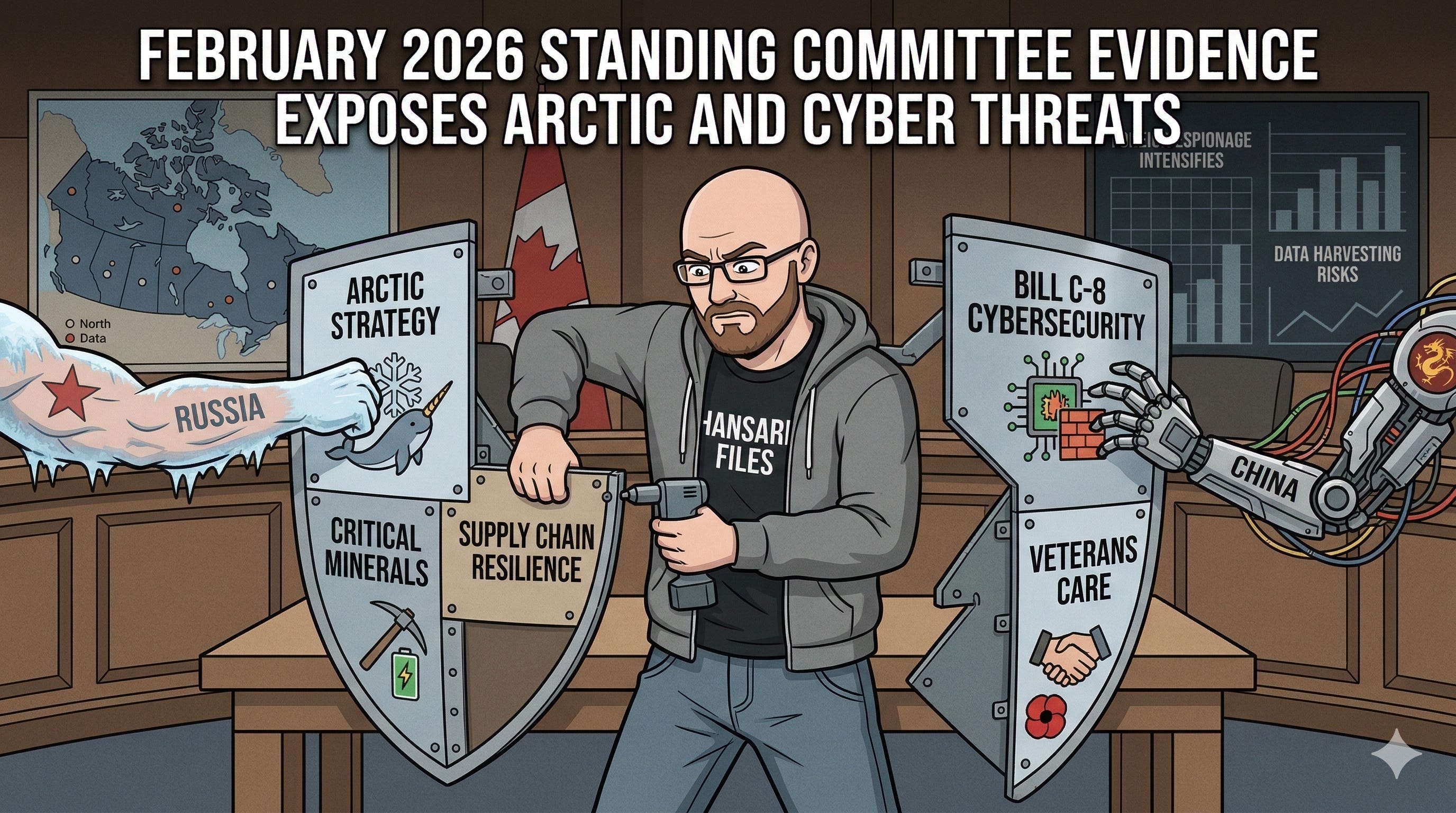
On Thursday, February 12, 2026, in the wood-paneled room of the Standing Committee on Foreign Affairs and International Development, Chair Ahmed Hussein called the meeting to order. The committee had resumed its study of Canada’s Arctic strategy. Two senior officials from the Canadian Security Intelligence Service, Paul Lynd and René Ouellette, sat ready to deliver unvarnished intelligence. Their testimony set the tone for an intense month of parliamentary scrutiny.
Lynd described state actors, chiefly Russia and China, actively seeking footholds in the circumpolar region. China deployed research vessels disguised as scientific missions to gather data and advance economic objectives. Russia maintained heavy conventional military interest. Both pursued intelligence collection through clandestine means. MPs pressed for details. Ziad Aboultaif asked how Russia’s posture had shifted since the Ukraine invasion. Lynd confirmed sustained focus. Shuvaloy Majumdar inquired whether activities undermined Canadian sovereignty. The answer was direct: yes. Alexis Brunelle-Duceppe raised electric-vehicle trade deals linked to Chinese data systems. Lynd noted CSIS continued to flag economic-security risks. Hon. Michael Chong cited the CSIS director’s public statements naming China as a primary strategic competitor for critical minerals and supply chains.
The same day brought parallel sessions. The Standing Committee on Access to Information, Privacy and Ethics, chaired by John Brassard, resumed its study of the state of access to information in Canada. The Standing Committee on Official Languages, under Yvan Baker, held its meeting. The Standing Committee on Natural Resources, chaired by Terry Duguid, examined Bill C-15 and energy regulator amendments. Together these February 2026 standing committee evidence sessions underscored how transparency, language rights and resource policy intersect with northern sovereignty.
Critical Minerals and Defence Intersect in February 2026 Standing Committee Evidence
Two weeks later, on Monday, February 23, the Standing Committee on National Defence, chaired by Charles Sousa, turned its attention to the defence industrial strategy and the critical minerals sector. Witnesses from industry and government stressed that Arctic infrastructure, processing capacity and allied supply chains were essential to counter China’s dominance. Domestic development of northern projects directly bolstered Canada’s Arctic strategy goals of monitoring and presence. The same day the Standing Committee on Finance, chaired by Karina Gould, advanced clause-by-clause study of the budget implementation bill, debating tax credits tied to critical minerals. The Standing Committee on Fisheries and Oceans, under Patrick Weiler, continued its study of marine and coastal protections. The Standing Committee on Science and Research, chaired by Salma Zahid, met. The Standing Committee on Citizenship and Immigration, chaired by Julie Dzerowicz, examined Canada’s immigration system. The Subcommittee on International Human Rights, chaired by Fayçal El-Khoury, studied internally and externally displaced people worldwide. The Standing Committee on Veterans Affairs, chaired by Marie-France Lalonde, heard testimony on the PCVRS rehabilitation contract. Psychologists described bureaucratic delays and gaps in trauma-informed care. Providers called for continuity and better coordination.
These February 2026 standing committee evidence sessions revealed a parliament grappling with the human and strategic costs of delayed infrastructure, fragmented services and global displacement.
Cybersecurity Legislation Takes Centre Stage in February 2026 Standing Committee Evidence
On Tuesday, February 24, the Standing Committee on Public Safety and National Security, chaired by Jean-Yves Duclos, met twice in the same week. The earlier session (Number 025) and the later one (Number 026 on February 26) focused on clause-by-clause consideration of Bill C-8, an act respecting cybersecurity and amending the Telecommunications Act. MPs debated definitions of information, review mechanisms and incident-reporting requirements. Amendments addressed privacy protections already embedded in the Privacy Act. Across the hall the Standing Committee on International Trade, chaired by Judy A. Sgro, passed a motion urging legislation against forced labour in supply chains. The Standing Committee on Indigenous and Northern Affairs, chaired by Terry Sheehan, began study of Bill C-10 to create a commissioner for modern treaty implementation. Nisga’a Nation witnesses offered strong support. Numbered treaty representatives raised cautions. The Standing Committee on the Status of Women, chaired by Marilyn Gladu, examined Bill C-225, an act to amend the Criminal Code.
Rights, Health and Justice Debates Round Out February 2026 Standing Committee Evidence
Wednesday, February 25, saw the Standing Committee on Justice and Human Rights, chaired by James Maloney, continue clause-by-clause study of Bill C-9 on Criminal Code amendments concerning hate propaganda and hate crime. Thursday, February 26, brought the Standing Committee on Health, chaired by Hedy Fry, to clause-by-clause consideration of Bill C-234, establishing a living donor recognition medal and promoting organ, tissue and blood donation awareness. Human stories of donors and recipients underscored the policy stakes.
Across every room the pattern held. Witnesses and MPs returned repeatedly to themes of sovereignty, data security, supply-chain resilience and human impact. Indigenous partners emerged as essential stewards in the North. Critical minerals appeared as both economic prize and vulnerability point. Cybersecurity legislation aimed to harden infrastructure against exactly the foreign interference flagged by CSIS. Veterans care gaps and immigration system reviews reflected the domestic foundation needed to sustain long-term Arctic presence.
No committee operated in isolation. The February 2026 standing committee evidence record shows a parliament connecting dots across defence, foreign affairs, natural resources, public safety, trade, indigenous affairs, health, justice, finance, fisheries, science, citizenship, status of women, official languages, access to information, ethics and human rights. Each session added a piece to the larger picture of Canada navigating great-power competition while strengthening internal resilience.
The evidence leaves little doubt. External pressures on the Arctic are intensifying through espionage, investment leverage and data harvesting. Domestic policy choices on minerals, cyber defences, treaties, veterans support and donor recognition will determine whether Canada can meet those pressures with credible presence and credible care for its people.
Hansard Files digs through dense parliamentary archives to uncover these stories. Subscribe to support independent investigation into Canada’s key national challenges.
Source Documents
House of Commons Canada. (2026, February 12). Evidence from the Standing Committee on Foreign Affairs and International Development (Number 022).
House of Commons Canada. (2026, February 24). Evidence from the Standing Committee on International Trade (Number 024).
House of Commons Canada. (2026, February 23). Evidence from the Standing Committee on Veterans Affairs (Number 022).
House of Commons Canada. (2026, February 26). Evidence from the Standing Committee on Public Safety and National Security (Number 026).
House of Commons Canada. (2026, February 23). Evidence from the Standing Committee on Science and Research (Number 026).
House of Commons Canada. (2026, February 24). Evidence from the Standing Committee on Public Safety and National Security (Number 025).
House of Commons Canada. (2026, February 25). Evidence from the Standing Committee on Justice and Human Rights (Number 019).
House of Commons Canada. (2026, February 26). Evidence from the Standing Committee on Health (Number 023).
House of Commons Canada. (2026, February 24). Evidence from the Standing Committee on Indigenous and Northern Affairs (Number 022).
House of Commons Canada. (2026, February 23). Evidence from the Standing Committee on Citizenship and Immigration (Number 021).
House of Commons Canada. (2026, February 12). Evidence from the Standing Committee on Access to Information, Privacy and Ethics (Number 028).
House of Commons Canada. (2026, February 12). Evidence from the Standing Committee on Official Languages (Number 021).
House of Commons Canada. (2026, February 12). Evidence from the Standing Committee on Natural Resources (Number 024).
House of Commons Canada. (2026, February 23). Evidence from the Standing Committee on Fisheries and Oceans (Number 024).
House of Commons Canada. (2026, February 24). Evidence from the Standing Committee on the Status of Women (Number 026).
House of Commons Canada. (2026, February 23). Evidence from the Standing Committee on National Defence (Number 025).
House of Commons Canada. (2026, February 23). Evidence from the Standing Committee on Finance (Number 027).
House of Commons Canada. (2026, February 23). Evidence from the Subcommittee on International Human Rights of the Standing Committee on Foreign Affairs and International Development (Number 012).
Research vessels disguised as scientific missions, eh? That kind of begs the question... what legitimate scientific mission does China have in Canada's northern territories?
If we had a credible CAF and the ability to project strength to enforce our sovereignty, China would be turned back before they left the Bering Sea, let alone the Beaufort Sea!!
Strengthening internal Canadian resilience is good, connecting the dots. Great article Hansard. Let’s hope no one drops the ball…much.