


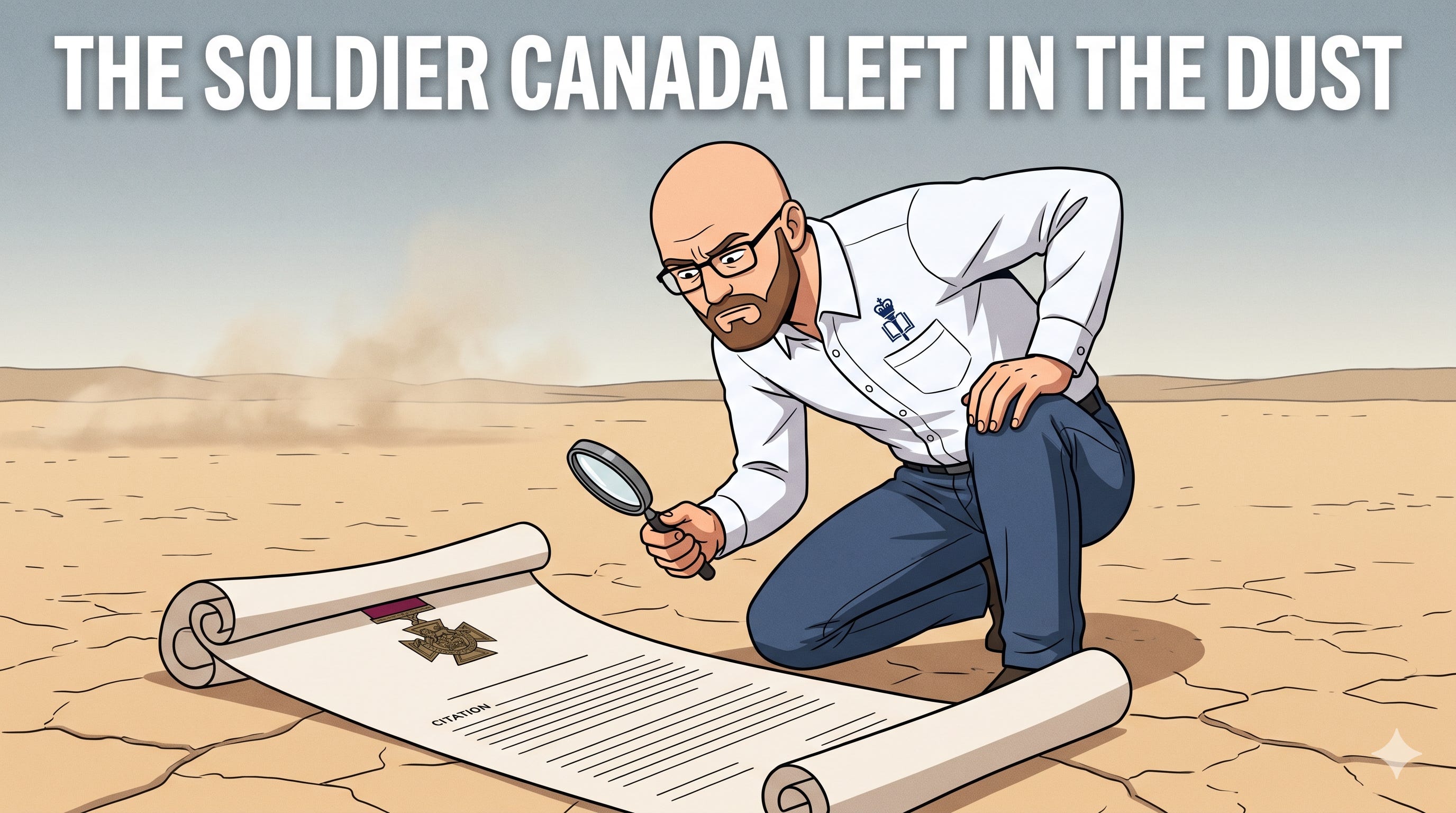
OTTAWA, June 5, 2026 — Bruce Moncur found the story he needed in the Afghan dust.
He had been looking, he told the people who asked, for a reason to keep going. He found it in a young man from Restoule, Ontario, a village tucked into the Nipissing region north of Georgian Bay. A boy who had joined the Canadian Army, shipped out to Kandahar province in 2006, and on October 14 of that year, with a broken back and a detached retina, held off a Taliban attack by himself long enough to save the lives of the soldiers around him.
Moncur’s words, read into the official record of the House of Commons by MP Pauline Rochefort on June 4, 2026, were brief. “If he could do that,” Moncur said, “I could do this.”
What Moncur did was advocate. For years. Through bureaucratic indifference, through failed motions, through the particular institutional silence that greets citizens who believe their government has made a mistake about a dead soldier’s honour. The soldier was Private Jess Larochelle. The mistake, in Moncur’s view and in the view of the 16,000-plus Canadians who signed petition e-6661, was that Larochelle received the Star of Military Valour for what he did that day in Kandahar, and not Canada’s highest military decoration.
The Victoria Cross. The one that has existed in Canadian law since 1993. The one that, in 33 years, has never been awarded to anyone.
A Cross That Has Never Left Its Case
Canada adopted its own national Victoria Cross on February 2, 1993, when Queen Elizabeth II approved the design. It is the country’s highest military honour, reserved for the most conspicuous bravery in the presence of the enemy. The British Victoria Cross, which Canada and other Commonwealth nations had previously used, was last awarded to a Canadian during the Second World War. The Canadian version was created to fill that gap, to give this country its own sovereign instrument for recognizing soldiers who do the kinds of things that are almost impossible to survive.
In the 33 years since that approval, through the Gulf War, through the Balkans missions, through more than a decade of the bloodiest Canadian combat since Korea, the medal has sat unclaimed.
The government’s position, before this week, was that no action in Afghanistan met the standard. The standard is “most conspicuous bravery.” The committee, and eventually the full House, voted unanimously to ask whether someone looked hard enough.
The fifth report of the Standing Committee on Veterans Affairs, concurred in without dissent on June 4, calls on the government to establish an independent military honours review board. The board would be empowered to look again at cases where Canadian soldiers may have been overlooked. At the top of that informal list, never named in the motion itself but impossible to separate from the story of how the petition reached 16,000 signatures, is Jess Larochelle.
Restoule to Kandahar
Larochelle grew up in Restoule, a community of a few hundred people in northeastern Ontario. His maternal grandfather had served in the Korean War as a sergeant in the Royal Canadian Artillery. Larochelle joined the Canadian Army after high school, serving with the 1st Battalion, Royal Canadian Regiment. In 2006, he deployed to Afghanistan as part of Operation Medusa, one of the largest NATO ground offensives since the alliance’s founding.
On October 14, 2006, during the Battle of Pashmul, Larochelle was wounded. According to the record read into the House, his back was broken. His retina was detached. He kept fighting.
He was awarded the Star of Military Valour, Canada’s second-highest military decoration. His family and supporters, including Bruce Moncur, have argued for years that what Larochelle did that day met the standard for the Victoria Cross. The Department of National Defence reviewed the case and concluded it did not.
Larochelle died on August 30, 2023, at the age of 40, in Nipissing, Ontario. He never received the upgrade his supporters sought.
16,000 Signatures and a Question That Wouldn’t Die
Petition e-6661 gathered more than 16,000 signatures calling for an independent honours review board. It was not the first attempt to move this question through Parliament. Previous motions had failed. What changed this time, according to the debate record, was the breadth of support that had built around the issue and the willingness of members from every recognized party to treat the committee recommendation as a matter of national conscience rather than partisan positioning.
The concurrence motion passed unanimously. Not 169 to 164, the margin that had carried time allocation for Bill C-16 the same day. Unanimous. All members present, regardless of party, voting together.
The government has signaled openness to forming the board and is looking at models from NATO allies. No timeline has been established. No legislation has been introduced. The committee report is a recommendation, not a mandate.
What a Board Would Actually Do
The Veterans Affairs committee’s recommendation calls for an independent body with the authority to review past cases, examine whether the evidence presented at the time was complete, and determine whether the standard was applied consistently. The model has precedents in other NATO member nations, where independent review mechanisms exist specifically to address cases where the chain of command may have assessed bravery through the lens of operational context rather than against the decoration’s formal threshold.
The specific question the board would address in the Larochelle case is whether a soldier who continued fighting, alone, with a broken back and detached retina, under active enemy fire, was evaluated against the correct standard or whether administrative factors shaped the outcome.
MP Rochefort, delivering Moncur’s words to the chamber, described Larochelle as a boy from Restoule who lay broken in the Afghan dust and kept fighting. That sentence, from a civilian advocate who spent years carrying a dead soldier’s story through the machinery of government, landed in the official record of Canada’s Parliament on June 4, 2026.
What Comes Next
A concurrence vote is a beginning, not an end. The government must now decide whether to act on the committee’s recommendation, and if so, how quickly. The House record indicates the government is examining international models, but no minister has introduced legislation, and no terms of reference for a review board have been made public.
The Victoria Cross has been waiting 33 years. Jess Larochelle’s family has been waiting since 2006.
Bruce Moncur found his reason to keep going in a story about a young man who would not stop. He has not stopped either. As of June 4, 2026, the House of Commons has, for the first time unanimously, agreed that the question deserves a formal answer.
Hansard Files spends weeks in the official record so you don’t have to. If stories like this matter to you, subscribe to keep this work independent.
Related Hansard Files Articles


Source Documents
Canada, House of Commons. (2026, June 4). Debates of the House of Commons (Hansard), 1st Session, 45th Parliament, Vol. 151, No. 129 [HAN129-E].
Canada, House of Commons. (2026, June 4). Journals of the House of Commons, 1st Session, 45th Parliament, No. 129 [Journal129].
Canada, House of Commons. (2026, June 1). Debates of the House of Commons (Hansard), 1st Session, 45th Parliament, Vol. 151, No. 126 [HAN126-E].
Canada, House of Commons. (2026, June 2). Debates of the House of Commons (Hansard), 1st Session, 45th Parliament, Vol. 151, No. 127 [HAN127-E].
Canada, House of Commons. (2026, June 3). Debates of the House of Commons (Hansard), 1st Session, 45th Parliament, Vol. 151, No. 128 [HAN128-E].
Canada, House of Commons. (2026, June 5). Debates of the House of Commons (Hansard), 1st Session, 45th Parliament, Vol. 151, No. 130 [HAN130-E].
It is about time that the Canadian Victoria Cross was awarded, and Pte. Larochelle seems a fit recipient. Also it is about time that the decisions about senior awards be taken seriously and standards be established. I read yesterday about the first Victoria Cross awarded to a Canadian, for his support of his comrades during the Charge of the Light Brigade. Neither the Canadian nor British Victoria Crosses require that war be declared, only that extreme bravery be involved. I think the Private Larochelle supplied that qualification.
Why have a Canadian Victoria Cross if the threshold for the award ensures never the award given?
The ever-slow gears of government - 20 years in waiting?
All Canadians benefit from the hard work of the Hansard Files! Many thanks.