


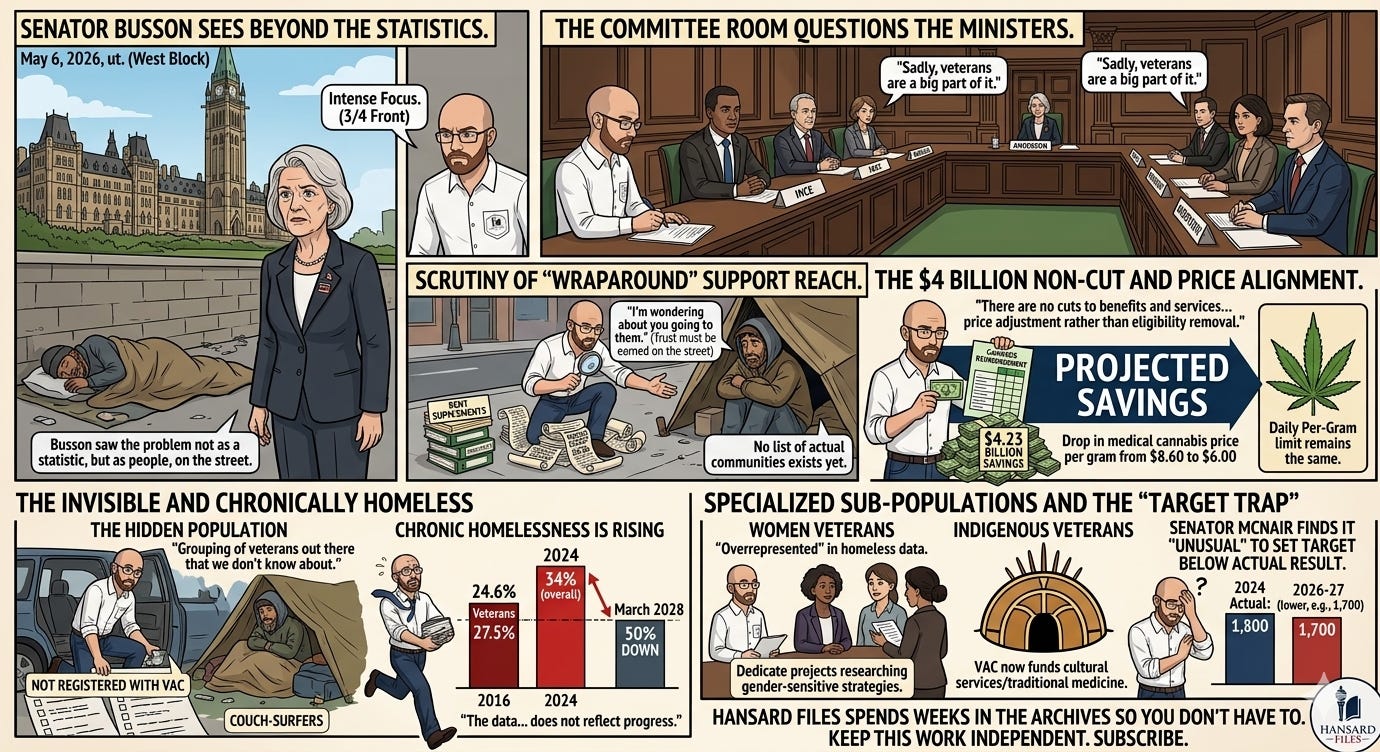
Senator Bev Busson stepped outside the Parliament building on the afternoon of May 6, 2026, and saw the problem. Not as a statistic. Not as a departmental plan target. She saw it the way she’d seen it back home in British Columbia. People, on the street, with nowhere to go.
“You just have to step outside this building to see the problem,” she told the two ministers sitting before her minutes later. “Sadly, veterans are a big part of it.”
Full disclosure, she told the room: she’s a veteran herself.
That moment, brief and quiet as it was, cut through the polished ministerial language filling the committee room all afternoon. It was a reminder of what Canada’s Senate Subcommittee on Veterans Affairs was actually wrestling with: 1,800 Canadians who wore the uniform and now don’t have a roof.
The Numbers They’re Working With
The subcommittee has been studying veteran homelessness for months. On May 6, they brought in the heavy hitters: the Honourable Jill McKnight, Minister of Veterans Affairs and Associate Minister of National Defence, and the Honourable Gregor Robertson, Minister of Housing and Infrastructure.
The headline statistic is genuinely good news, and McKnight led with it. In 2024, approximately 1,800 veterans experienced homelessness in Canada, down from 4,000 a decade ago. A 10 percent drop from 2023 alone. Through the federal Veteran Homelessness Program (VHP), more than 1,400 veterans were served in its first year, and over 200 of those experiencing homelessness secured stable housing.
Progress, yes. But also a reminder that 1,800 people served their country and now sleep somewhere they shouldn’t have to.
“While these numbers are moving in the right direction,” McKnight acknowledged, “they remind us that many veterans are still living in dangerous, unstable and unsuitable conditions. Until that number reaches zero, we can’t stop.”
The VHP runs to March 2028 and operates on $72.9 million through what officials call the Services and Supports Stream, plus an additional $6.2 million for research and data collection through a Capacity Building Stream. As of April 2026, the program had delivered wraparound supports to 2,280 veterans and rent supplements to 397.
What “Wraparound” Actually Means
Robertson, whose Housing, Infrastructure and Communities Canada department runs the operational side of VHP, walked through the suite of services: rent supplements, eviction prevention and credit counselling, mental health and addiction treatment, employment connections, and peer-support workers who are themselves veterans.
The idea is that housing instability rarely has a single cause. A veteran who can’t hold an apartment may be managing PTSD, chronic pain, substance use, financial fragility, and the particular alienation that comes from the military-to-civilian rupture, all at once. Fixing just the rent doesn’t fix the person.
That’s the theory. Senator Tracy Muggli, whose background is in mental health and addictions, pushed the committee to look harder at the practice. She wasn’t questioning the theory. She was questioning the reach.
“I don’t think these veterans are coming to Veterans Affairs,” she said, after Acting Assistant Deputy Minister Mitch Freeman described a trust-building case management model. “I’m wondering about you going to them.”
Her point was specific: people living rough often won’t walk into a government office. Trust has to be earned on the street, sometimes over months. She asked about harm-reduction models, managed alcohol programs, housing where people can be where they are before they can become who they need to be. Assistant Deputy Minister Janet Goulding confirmed that community entities receiving Reaching Home funding can run those kinds of programs. But no one in the room had a list of communities where it was actually happening. McKnight said she didn’t have that information with her.
The $4 Billion Number That Isn’t What It Sounds Like
Chair Dawn Anderson, Senator for the Northwest Territories, stopped the session near the end to press McKnight on something that had been hanging in the room: Budget 2025’s $4 billion in announced savings for Veterans Affairs.
The number is real. And it is specifically, entirely, about one thing: the rate of reimbursement for medical cannabis, dropping from $8.60 per gram to $6.00 per gram. The $4.23 billion figure represents accumulated projected savings over the lifetime of that program.
“There are no cuts to benefits and services for which veterans are eligible,” McKnight said. “The program hasn’t changed in that veterans still have access to the daily per-gram limit that was previously in place.”
Anderson pressed anyway. Doesn’t a reduced reimbursement rate mean veterans pay more out of pocket? Might some reduce usage, change products, or switch to alternatives that don’t work as well for them?
McKnight’s answer: it’s an alignment with market rates, not a benefit cut. She committed to providing a written response.
The exchange is worth flagging because the $4.23 billion figure has circulated publicly with very little context, creating an impression of sweeping cuts that the minister says isn’t accurate. Whether the cannabis reimbursement change is, in practice, painful for veterans using it therapeutically is a separate question. McKnight’s framing, budget savings through price adjustment rather than eligibility removal, is what she’s committed to on the record.
The Corps of Commissionaires and a 1945 Policy
Busson surfaced a separate issue partway through: the federal government’s decision to end the right-of-first-refusal arrangement with the Canadian Corps of Commissionaires, a near-century-old organization that has long provided dignified employment for veterans, including those at risk of homelessness.
The concern was direct. The Corps employs upwards of 2,000 people in Canada, paid just above minimum wage in guard and security roles. The policy giving them preferential access to federal guard contracts dated to 1945 and had never been competitively tendered. Busson also noted, pointedly, that the company expected to take on the work has a substantial relationship with Homeland Security in the United States and works with ICE detention centres.
McKnight offered a clarification: the change isn’t a direct contract switch to a different provider. It’s a shift from a right-of-first-refusal policy to a competitive procurement process. The Commissionaires can bid. The existing policy has been extended by one year during the transition.
Her broader argument was that today’s military veterans are “highly skilled, highly trained in trades which are highly in demand,” and that tethering veteran employment policy to low-wage guard work doesn’t serve that population well. The National Veterans Employment Strategy, she said, will offer a wider range of options.
Busson wasn’t satisfied. “I just feel that because veterans are a part of that, they should have special treatment as part of our members of service.”
It was a sharp disagreement, and neither side resolved it.
What Nobody Knows: The Hidden Homeless
Senator Tony Ince posed the question that may be the hardest to answer in this whole file: how do you find veterans experiencing homelessness who never show up in shelter data? The couch-surfers. The people in vehicles. The ones in encampments who don’t identify themselves to anyone.
McKnight’s answer revealed something she admitted surprised her when she came to this file: veterans aren’t automatically enrolled in Veterans Affairs Canada when they leave military service. They have to choose to register. Which means there is, by definition, a population of former service members who have fallen through that initial gap and are now somewhere the system can’t see.
“There is a grouping of veterans out there that we don’t know about,” McKnight said plainly.
Outreach through community organizations and the Veteran and Family Well-being Fund are the current approaches. Freeman noted that most veteran homelessness happens not in the immediate years after release but five to ten years later. That lag creates a narrow window for early identification that the department is trying to better use through transition-stage data tracking.
It is, candidly, an unsolved problem.
Chronic Homelessness: 34% Up, Target 50% Down
Senator John McNair raised a number that sits awkwardly against the government’s stated goals. According to the National Housing Strategy’s own data, chronic homelessness among shelter users increased 34 percent between 2016 and 2024. Veterans are slightly overrepresented in that group, at 27.5 percent versus 24.6 percent of non-veterans. The government has committed to a 50 percent reduction in chronic homelessness by March 2028.
Robertson didn’t spin it. “The data reflected, since the chronic homelessness commitment was made, does not reflect progress.”
His argument for optimism rests on something not factored into previous commitments: the $13 billion Build Canada Homes program from Budget 2025, with $1 billion specifically earmarked for supportive and transitional housing. The core thesis, shared by government and advocacy groups alike, is that the chronic homelessness crisis has persisted not because of failures in front-line support but because of a structural deficit in a specific category of housing: not emergency shelters, not market-rate apartments, but the intermediate supported spaces that help people stabilize over time.
Robertson said roughly two thousand units are confirmed across six provinces and territories. Negotiations with the remaining jurisdictions are ongoing. He also acknowledged a concern Muggli raised: community organizations delivering homelessness services have been forced to reapply annually for Reaching Home funding, making it nearly impossible to retain experienced staff. The National Housing Strategy has 22 months left. Robertson said the fall budget will clarify what comes next.
“This is a problem you are already aware of,” Muggli told him, “so you can probably plan for it now without having hearings or consultations.”
Women Veterans and the Knowledge Gap
Senator Krista Ross brought the committee’s attention to another overrepresentation: women veterans are overrepresented among homeless veterans relative to their share of the veteran population overall. Goulding confirmed two dedicated research projects funded through VHP’s Capacity Building Stream. The Lawson Research Institute is running a four-year project on gender-sensitive strategies for women veterans experiencing homelessness. An organization called The Pepper Pod is testing referral and transition models for women leaving military service.
Total funding across both projects: slightly over $2 million. It is, as Goulding acknowledged, as much a knowledge-gap project as a service-delivery one. The gap in question: nobody fully understands yet what works specifically for women veterans in housing crisis.
Indigenous Veterans and a Quiet Policy Change
The committee touched, briefly but meaningfully, on services for First Nations, Inuit and Métis veterans. Freeman confirmed that the majority of VAC’s Indigenous veterans team is itself Indigenous. More notably, he described a shift in treatment benefits that moves beyond the traditional Western medicine model. If an Indigenous veteran’s situation is best addressed by an Indigenous organization, including a Sweat Lodge or other cultural service, VAC now has the capacity to fund and facilitate that referral.
It’s a quietly significant policy change. It received very little time in the session.
The Duty That Doesn’t End at Discharge
The phrase “duty to serve” comes up regularly in these committee rooms. McKnight used it in her opening statement. Robertson used it. It has become, at this point, something close to liturgy in parliamentary discussions of military care.
What this testimony makes clear is that the duty is harder to act on than to declare. Veterans don’t automatically connect to the system. Most who become homeless do so years after release, in a window that’s hard to predict. The programs that exist are real and reaching real people, but chronic homelessness is still rising, the hidden homeless are by definition uncounted, and the funding architecture for the organizations doing front-line work is precarious by design.
There are 1,800 known veterans without stable housing in Canada today. There are others the system doesn’t know about. And the government’s own departmental plan for 2026-27 set a homelessness target lower than the result already achieved in 2024-25. Senator McNair noticed.
“It does seem unusual,” he said, “to set a target below the actual.”
McKnight acknowledged it. She called it a reflection of how fluid homelessness can be, day to day.
That may be technically accurate. But it’s also the kind of answer that gets written into the committee record, and stays there, waiting for someone to ask again.
Hansard Files spends weeks in the archives so you don’t have to. If stories like this matter to you, subscribe to keep this work independent.
Related Hansard Files Articles


Source Documents
Senate of Canada, Subcommittee on Veterans Affairs. (2026, May 6). Evidence: Study on Veterans Homelessness, Meeting No. 7. Witnesses: Hon. Jill McKnight, Minister of Veterans Affairs; Hon. Gregor Robertson, Minister of Housing and Infrastructure; Mitch Freeman, Acting ADM, Veterans Affairs Canada; Janet Goulding, ADM, Housing, Infrastructure and Communities Canada.
FWIW, dealing the VAC is a shit-show which almost seems designed to make us veterans throw up our hands and walk away in disgust.