


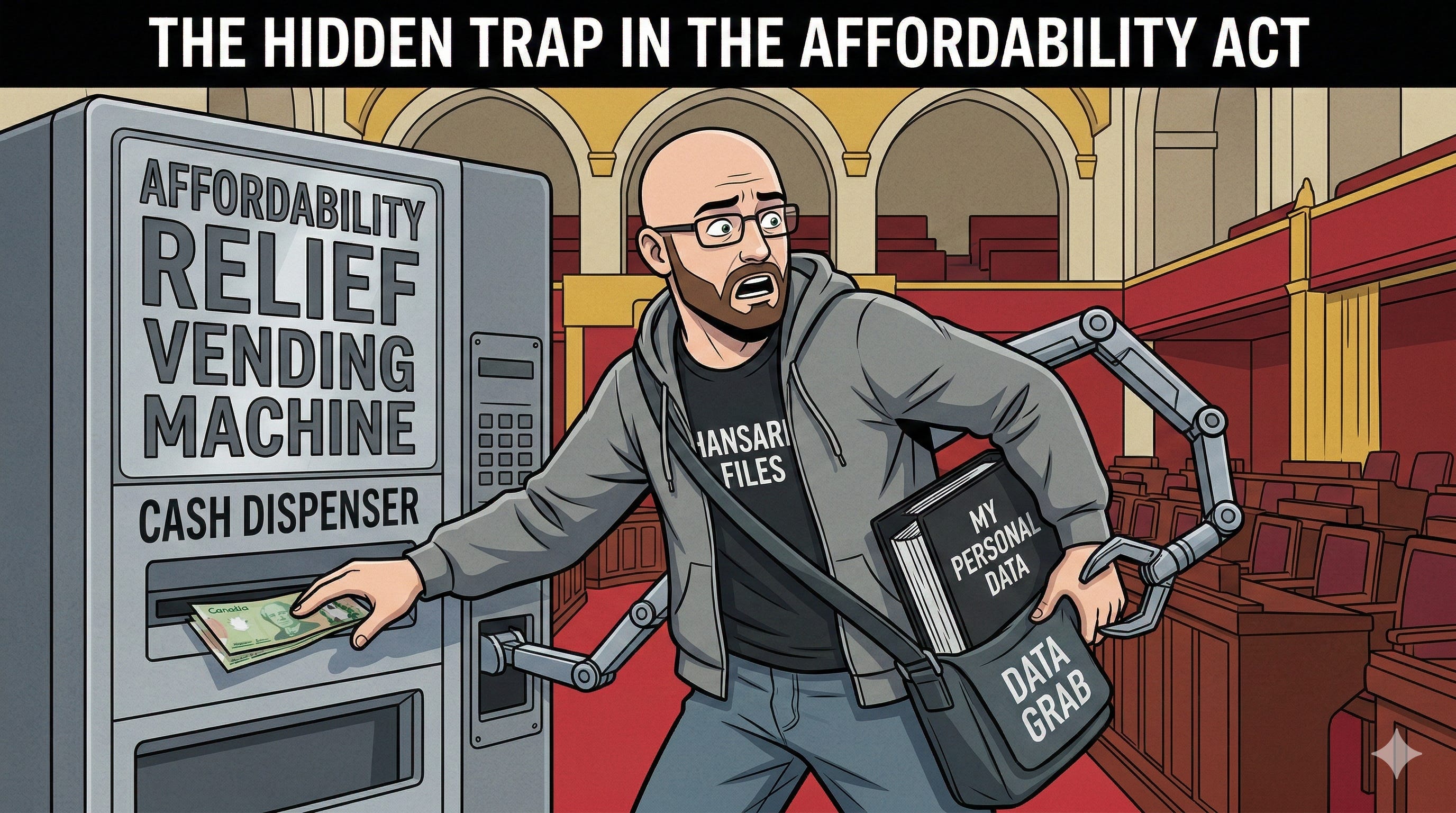
It was a bitter Thursday afternoon in Ottawa on February 26, 2026. Inside the Red Chamber, the debate over Bill C-4 was reaching a boiling point. Officially titled the Making Life More Affordable for Canadians Act, the legislation promised relief for first-time homebuyers and tax cuts for a population strained by a soaring cost of living. But buried deep within its pages was a legislative Trojan horse. The Bill C-4 Privacy Exemption had nothing to do with economics. Instead, it proposed an unprecedented rewrite of the Canada Elections Act, quietly exempting federal political parties from meaningful data privacy oversight.
As political campaigns increasingly rely on harvesting intimate behavioral data to profile and predict voter behavior, the stakes could not be higher. Without a robust framework, the personal lives of Canadians risk becoming unregulated ammunition in perpetual partisan warfare. The battle lines in the Senate were drawn, pitting the unelected chamber of “sober second thought” against the unanimous will of the House of Commons. What unfolded was a dramatic confrontation over the fundamental right to digital privacy.
The Affordability Smokescreen
To understand the sheer audacity of the privacy exemption, one must first look at the vessel chosen to carry it. Canada is in the grips of a profound cost of living crisis. Household debt has surged to a staggering 2.6 trillion dollars, driven by soaring mortgage balances and an unrelenting housing market. In the Senate, the desperation of ordinary citizens was palpable during Question Period. Senator Yonah Martin pressed the Government Representative on the reality that families are increasingly forced to choose between purchasing groceries and paying for housing. Meanwhile, Senator Leo Housakos pointed to devastating reports from UNICEF indicating that over 30,000 additional Canadian children had fallen below the poverty line, pushing the child poverty rate to an alarming 26 percent.
The government’s response to this economic distress was Bill C-4. The legislation promised to cut the Goods and Services Tax for first-time homebuyers and deliver targeted tax relief. These were highly anticipated measures, long demanded by a weary electorate. The sheer urgency of passing financial relief provided the perfect cover for the government to slip in an unrelated, deeply consequential policy change.
This tactic of using an omnibus bill to bury contentious legislation is a long-standing parliamentary sleight of hand. By attaching the privacy exemption to urgent financial relief, the government effectively dared the Senate to delay economic help for struggling families in order to debate data rights. As Senator Krista Ross articulated, tacking a non-financial measure onto an affordability bill prevents parliamentarians from giving complex privacy issues the thorough scrutiny they require. It forces lawmakers into an impossible corner. They must pass flawed legislation, or be accused of holding up vital financial aid.
The Anatomy of the Bill C-4 Privacy Exemption
Modern political campaigning is no longer about simply shaking hands and kissing babies. It is a continuous, data-driven operation where persuasion relies on prediction. When canvassers knock on your door, they are not just asking for your vote. They are gathering intelligence. As Senator Paula Simons pointedly asked her colleagues, imagine what a campaigner can glean without asking a single question. They might note the value of your home, the presence of children’s toys, a pride flag in the window, or a cancer awareness sticker on your car.
Under normal circumstances, organizations collecting this level of sensitive personal data are strictly regulated by laws like the Personal Information Protection and Electronic Documents Act. But federal political parties have long operated in a grey area. The Bill C-4 Privacy Exemption was designed to officially place them beyond the reach of provincial privacy watchdogs. It declared that federal jurisdiction over elections was absolute, while simultaneously failing to establish any baseline behavioral boundaries for the parties themselves.
Senator David M. Arnot pulled no punches in his assessment of the situation. He noted that the Chief Electoral Officer had testified that the bill created a “complete code” but without embedding any minimal privacy standards. Worse still, the legislation was drafted to be retroactive to the year 2000. As Arnot observed, this effectively handed political parties a “get-out-of-jail-free card” for over two decades of unregulated data collection.
The timing of the legislation was hardly coincidental. According to Senator Simons, the urgency behind passing the bill was directly tied to an ongoing court case in British Columbia. In 2024, the B.C. Supreme Court ruled that the Canada Elections Act did not comply with the standards of the province’s privacy laws. Facing the prospect of a rigorous appellate court review, the major federal parties united to pass this legislative workaround. They even filed a letter with the B.C. Court of Appeal registry, citing the imminent passage of Bill C-4 as a reason to halt the proceedings. It was a maneuver that Simons described as reading like an attempt to undermine the independence of the courts and the judicial system.
A $50 Fine for Stealing Your Data
The sheer inadequacy of the proposed regulatory framework became a focal point of the Senate’s outrage. When rules cannot be effectively enforced, they cease to be rules and become mere aspirations. Under the framework proposed by the bill, federal political parties are essentially permitted to define their own privacy policies and regulate themselves.
The penalties for violating these self-imposed rules bordered on the absurd. Senator Simons highlighted that infractions would trigger fines of a mere $50 per person or $300 for an organization. To contextualize this penalty, she noted that the fine for jaywalking in Edmonton is $250. In a political ecosystem where a single party can raise 28 million dollars in just three months, a $300 penalty is not a deterrent. As Senator Colin Deacon observed, the administrative monetary penalties are completely out of alignment with the financial realities of modern campaigning.
This glaring discrepancy drew sharp criticism from international experts. Elizabeth Denham, the former United Kingdom Information Commissioner who investigated the infamous Cambridge Analytica scandal, testified before the Legal and Constitutional Affairs Committee. Denham characterized Part 4 as “unsalvageable”. She reminded the committee that in the U.K., the European Union, New Zealand, South Korea, and Brazil, comprehensive data protection laws extend across the political ecosystem without exemptions. Canada, by contrast, remains an outlier in shielding its political actors from independent oversight.
Senator Krista Ross echoed this frustration, noting the double standard applied to the private sector. When PIPEDA was introduced, small businesses and non-profits adapted and complied, often with significantly fewer resources than federal political parties possess. To demand strict compliance from local retailers while giving a free pass to entities seeking to form a national government struck many senators as fundamentally unjust. As Ross summarized, the bill offers ineffective privacy protection masquerading as election changes.
The Shadow of Foreign Interference
The Senate’s acute anxiety over data privacy did not emerge in a vacuum. On the exact same day that lawmakers debated the affordability bill, the chamber dissolved into a Committee of the Whole to receive Anton Boegman, the newly nominated Foreign Influence Transparency Commissioner. Boegman’s testimony provided a sobering backdrop to the privacy debate, emphasizing that Canada’s institutions are increasingly under threat from malign foreign actors seeking to exert influence through covert means.
Senator Housakos challenged Boegman on the delays in implementing the foreign interference registry, pointing out that Five Eyes security partners have repeatedly identified Canada as vulnerable to transnational repression. Housakos noted that nefarious forces, such as Beijing’s United Front Work Department, spend billions globally to infiltrate democratic institutions. When domestic political parties hold vast, unregulated databases of voter information, the potential for this data to be compromised or weaponized becomes a glaring national security liability.
Senator Yuen Pau Woo also questioned the scope of the new foreign registry, highlighting the complexities of capturing all forms of non-state and state-sponsored influence. In this highly charged environment, the idea of allowing political parties to operate on an honor system for data protection appeared increasingly reckless to many senators. As witness Jason Woywada highlighted, foreign interference often leverages lawfully obtained domestic personal information. A weak privacy framework does not just violate individual rights. It leaves the entire democratic ecosystem exposed to sophisticated disinformation campaigns and targeted manipulation.
The Constitutional Clash of Restraint and Duty
The debate over the privacy exemption inevitably evolved into a broader constitutional clash over the role of the Senate itself. The legislation arrived from the House of Commons with unanimous support from the elected members. For institutionalists within the Red Chamber, this unanimity demanded deference.
Senator Peter Harder delivered a passionate defense of legislative restraint. Quoting the late Senator Ian Shugart, Harder warned that an activist Senate risks triggering a constitutional crisis if it routinely blocks legislation passed by the democratically elected lower house. He reminded his colleagues that the Founders specifically designed an appointed upper chamber to complement, rather than rival, the House of Commons. In Harder’s view, the Senate’s natural bias should always lean toward self-restraint.
Senator Pierre Moreau, the Government Representative in the Senate, reinforced this perspective. He argued that the core objective of Part 4 was simply to establish a uniform federal electoral regime, ensuring that a voter in Nova Scotia is governed by the same rules as a voter in British Columbia. Moreau challenged the chamber, asking why the Senate would reject the unanimous consensus of elected members on legislation that primarily regulates the conduct of those very members. He framed restraint not as a weakness, but as the mature expression of a bicameral democracy respecting institutional balance.
But for the critics of the bill, deference in the face of a fundamental rights violation equated to abdication. Senator Arnot forcefully argued that the Senate’s role is not ornamental, but corrective. He noted that the privacy provisions were tucked into an omnibus affordability bill, bypassing the rigorous, stand-alone scrutiny that such sweeping powers demand. Senator Percy E. Downe reminded the chamber of historical precedents, such as the defeat of restrictive abortion legislation in 1991, where the Senate stood its ground against the government to protect the rights of citizens. The sentiment among the opposition was clear. Political parties should not be trusted to draft their own oversight mechanisms.
The Final Showdown and the Sunset Clause
As the evening wore on, the tension in the chamber culminated in a series of highly charged votes. Senator Simons introduced an amendment that would have imported the robust privacy language from a previous, stalled piece of legislation directly into Bill C-4. While she acknowledged it was not a perfect solution, she argued it was a necessary attempt to put leashes on the foxes and muzzles on the goats. The amendment was defeated, with 19 senators voting in favor and 35 against.
However, the momentum for intervention had not dissipated. Recognizing the profound flaws in the bill but acknowledging the pressure to pass the affordability measures, Senator Dalphond proposed a subsequent amendment. This amendment sought to implement a sunset clause, forcing the government’s hand by putting an expiration date on the privacy exemption. The strategy was clear. Allow the immediate jurisdictional fix to proceed, but compel the House of Commons to return to the drawing board and draft proper, comprehensive privacy legislation for political parties in the near future.
The government strongly opposed the measure. Senator Moreau argued that a sunset clause merely postponed the problem. He contended that if the period expired without new legislation, Canadians would be left in an even more vulnerable position with no system at all.
Despite the government’s objections and the pleas for institutional restraint, the Senate exercised its independence. The bells rang, and the vote was called. In a striking rebuke of the House of Commons’ unanimous position, Senator Dalphond’s amendment passed with 28 votes in favor, 24 against, and 8 abstentions. The amended bill was then read a third time and passed on division.
The passage of the amended legislation sent a resounding message across Parliament Hill. While the Senate recognized the urgent need to deliver economic relief to Canadians, it drew a hard line against the opportunistic erosion of civil liberties. The Great Voter Privacy Heist had been stalled, at least temporarily. The ball is now firmly back in the court of the elected officials. They must decide whether to finally implement the global privacy standards Canadians deserve, or continue fighting for the right to operate in the dark.
Hansard Files digs through dense parliamentary archives to find these stories. Support independent investigative journalism and never miss a critical deep dive by subscribing today.
Source Documents
Senate of Canada. (2026, February 24). Debates of the Senate (Hansard), 1st Session, 45th Parliament, Volume 154, Issue 52.
Senate of Canada. (2026, February 25). Debates of the Senate (Hansard), 1st Session, 45th Parliament, Volume 154, Issue 53.
Senate of Canada. (2026, February 26). Debates of the Senate (Hansard), 1st Session, 45th Parliament, Volume 154, Issue 54.
I wish Canadians would recognize that party caucuses operating within parliament, and the corporate fan-clubs operating outside of parliament, are not the same thing. In fact, the corporations operating outside of parliament should be thought of as the largest sources of corruption of Democratic institutions, or even their own form of "foreign interference".
Given the direct threats to Democratic Institutions, these corporate fan clubs should have even tighter privacy requirements than other corporations which are regulated as lobbyists.
https://www.davidgraham.ca/p/leadership-by-caucus
https://r.flora.ca/p/lets-work-to-fix-parliamentary-flaws
Welcome to the People's Republic of Canuckistan (formerly Canada). You will own nothing, have zero privacy, and you'll be happy... OR ELSE...