


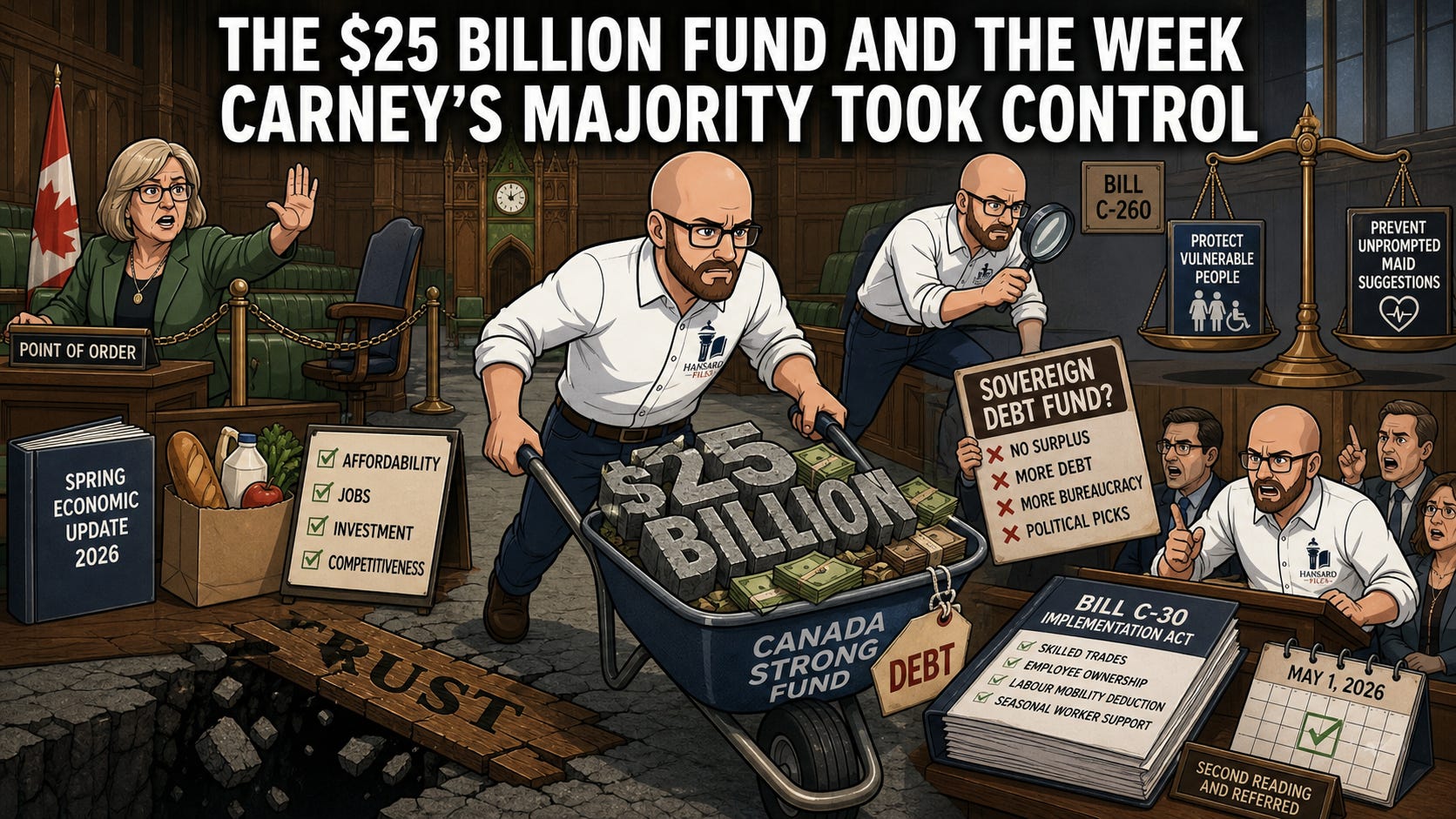
The week’s first warning came from a desk.
On Monday, April 27, 2026, before the fiscal numbers, before the fund, before the accusation that Canada was being asked to borrow its way into wealth, Elizabeth May rose on a point of order in the House of Commons. Or tried to. Her desk had been moved. There was a post. There were chairs. She told the Speaker she could not rise in her place.
It was a small scene, almost absurd in its ordinariness, but debates placed it at the edge of a much larger fight. The government had just moved to stop further adjournment of debate on Government Business No. 9, a motion to change the Standing Orders after the Liberals’ status in the House had changed. Opposition members called it committee stacking. Government House Leader Steven MacKinnon called it the ordinary Westminster principle that a majority in the chamber should be reflected in the institutions of Parliament.
The argument was not really about desks. It was about who gets to stand, who gets to ask, and who gets to stop the questioning.
Andrew Scheer pressed the point first, saying the government was shutting down debate on the very motion that would change committee control. MacKinnon answered that the circumstances were unusual, a government whose seat count had shifted during a mandate, but the principle was old. Committees, he said, should reflect the majority in the House.
By the end of that exchange, the week had its question. If the government now had the votes to move faster, what exactly would speed be used for?
The Update Arrives With A Promise To Build
The next afternoon, Finance Minister François-Philippe Champagne rose under Ways and Means and tabled the spring economic update documents for 2026. He framed the moment as sudden and global: geopolitical shifts, supply chain disruption, artificial intelligence, trade uncertainty. Canada, he said, had to adapt.
Then came the promise that would dominate the rest of the week. The government wanted to build Canada strong, and to build at a speed and scale not seen in generations.
The spring economic update put a long list before the House. The minister cited the second-fastest growing economy in the G7, a projected deficit for 2025-26 reduced by more than $11 billion, a commitment to balance day-to-day operating spending with revenues by 2028-29, and a downward deficit-to-GDP path. He pointed to 15 major projects projected to create more than 60,000 jobs and $126 billion in new investment. He spoke of a defence industrial strategy, automotive strategy, major projects, Arctic renewable energy, the Bay du Nord project, and a Canada investment summit in Toronto.
For households, he named the Canada groceries and essentials benefit for more than 12 million Canadians, the middle-class tax cut, suspended federal fuel excise tax relief, a national school food programme, dental care, and GST relief for first-time buyers on homes priced at $1 million or less.
At the centre sat the Canada Strong fund. Champagne described it as Canada’s first national sovereign wealth fund, a national savings and investment account meant to grow wealth for future generations. Canadians, he said, would be able to invest directly in it.
The opposition heard a different story. Jasraj Hallan answered that the Prime Minister had doubled the deficit, that debt-servicing costs would rise, and that the update meant more debt, more costs, more taxes, and more spending. Gabriel Ste-Marie asked why an update did not account for the U.S. President’s April 2 order imposing a 25% tariff on most goods exported from Quebec and Ontario to the United States.
Champagne’s answer was support for workers and industry. The dispute was no longer whether Canada should build. Everyone claimed that word. The dispute was who would control the machinery.
A Different Kind Of State Power
On Wednesday, the chamber shifted from fiscal statecraft to the power of the state at its most intimate edge.
Garnett Genuis brought forward Bill C-260, aimed at limiting when government employees in positions of authority or trust could propose medical assistance in dying to someone who had not asked for information about it. His speech moved through cases he said showed people seeking help and being met with death as an option: Miriam Lancaster in hospital, David Baltzer calling Veterans Affairs Canada, Heather Hancock living with cerebral palsy, Christine Gauthier fighting for a wheelchair ramp, and Kathrin Mentler seeking mental health support in Vancouver.
The bill was narrow by design. It exempted doctors and nurses. It applied to government employees in authority or trust. Genuis said the goal was not heavy punishment, but a legal standard that would deter the unprompted suggestion of MAID when people were seeking unrelated public services.
Sean Casey, parliamentary secretary to the Minister of Veterans Affairs, challenged the evidentiary basis. He said Veterans Affairs Canada had reviewed more than 400,000 files back to 2016 and found isolated incidents involving one employee, who no longer worked there. MAID, he said, was not and would not be a Veterans Affairs programme or service.
Marie-Hélène Gaudreau answered from Quebec’s experience, and from her father’s 20-year experience with amyotrophic lateral sclerosis. She separated unacceptable pressure from open discussion of care options, warning that the Criminal Code was a blunt instrument if the real problem was malicious or incompetent behaviour around vulnerable people.
Blake Richards pushed back, saying veterans had brought forward concerns and that the government’s account did not settle the matter.
The debate mattered to the week’s larger story because it exposed the same contested premise beneath the fiscal update. What happens when Ottawa builds systems for people, but those people do not trust the systems built for them?
The Fund With No Surplus
By Thursday, the Conservatives used an opposition day to put the Canada Strong fund on trial.
Pierre Poilievre’s motion asked the House to call on the government to abandon what it called a sovereign debt fund. Its case was built on a simple sequence: real sovereign wealth funds require surpluses or resource revenues; the government had run deficits for 11 years; the proposed $25 billion fund would be placed on the national credit card; and political direction of capital would favour the powerful.
Poilievre’s speech made the philosophical fight explicit. He contrasted a political economy, where wealth follows power, with a market economy, where capital follows voluntary exchange. He argued that the government taxed, regulated, delayed, and blocked development, then returned with a fund, office, bank, summit, task force, or subsidy to solve the damage it had caused.
Government members defended the ambition. Liberal speakers said the country needed capital, confidence, major projects, and a stronger independent economy. The Bloc was not persuaded. Gabriel Ste-Marie called the fund a mistake and emphasized that the Bloc’s support for the Conservative motion was itself notable.
The House spent the day circling one problem: the word “sovereign” sounds sturdy, but in the record before MPs, its meaning depended entirely on trust. To the government, it meant national wealth and strategic investment. To critics, it meant borrowed money, new bureaucracy, and public risk attached to private winners.
Bill C-30 And The Bridge To Tomorrow
On Friday morning, the update turned into legislation. Bill C-30, the Spring Economic Update 2026 Implementation Act, was moved at second reading and referred to committee.
Ryan Turnbull opened for the government by returning to the same language used all week: affordability, workers, homes, infrastructure, competitiveness, and a changing world. He described trade conflicts, wars, fragile supply chains, and just-in-time systems that carried vulnerabilities into Canadian households.
The bill’s details were practical, sometimes technical. Team Canada strong would recruit, train, and hire 80,000 to 100,000 new Red Seal skilled trades workers by 2030-31. The employee ownership trust tax exemption would become permanent. The labour mobility deduction for tradespeople would rise from $4,000 to $10,000, indexed to inflation, with the relocation threshold reduced from 150 kilometres to 120 kilometres. Seasonal workers in 13 economic regions would see temporary Employment Insurance support extended to October 2028, with an estimated $356 million over five years.
There it was, the machinery after the rhetoric. Not the whole economy. Not the whole state. Specific levers, written into an implementation bill, after a week in which MPs argued over who could control committees, who could propose death, who could direct capital, and who could define fiscal prudence.
The week did not resolve those questions. Hansard rarely does. It records the pressure around them. A desk that made it hard for one member to stand. A fund that asked Canadians to believe debt could become wealth. A MAID debate that asked whether vulnerable people trust the officials assigned to help them. A bill that promised a bridge to tomorrow.
For readers outside the chamber, the stakes are not procedural. They are personal. Parliament’s language, closure, Ways and Means, opposition supply, second reading, sounds remote until it becomes the rulebook for a benefit, a permit, a home, a job, a pension fund, or a call for help. That was the week’s quiet warning. When a government says it is moving fast, the country has to watch not only what it builds, but who still has room to rise and ask why.
Hansard Files spends weeks in the archives so you don’t have to. If stories like this matter to you, subscribe to keep this work independent.
Related Hansard Files Articles


Source Documents
House of Commons of Canada. (2026, April 27). House of Commons Debates, 45th Parliament, 1st Session, Vol. 152, No. 111.
House of Commons of Canada. (2026, April 28). House of Commons Debates, 45th Parliament, 1st Session, Vol. 152, No. 112.
House of Commons of Canada. (2026, April 29). House of Commons Debates, 45th Parliament, 1st Session, Vol. 152, No. 113.
House of Commons of Canada. (2026, April 30). House of Commons Debates, 45th Parliament, 1st Session, Vol. 152, No. 114.
House of Commons of Canada. (2026, May 1). House of Commons Debates, 45th Parliament, 1st Session, Vol. 152, No. 115.
If our economy is doing so well, why am I finding it difficult to pay my bills where I didn't used to struggle at all? The sovereign debt fund will be a Liberal slush fund; that's how they roll.
If we can assume that economic growth is largely driven by the volume of money creation and credit allocation, then the Canadian economy is presumably growing because more money is being created and spent, which is perhaps reflected in the size of the federal deficit, so it might be better for the federal government to keep running a deficit if it plans on spending money on new public projects.
Likewise, if the private sector’s savings comes from government deficits, then deficit spending and tax cuts do help more people to save more money, which we can then supposedly invest directly in the Canada Strong Fund.
If government spending precedes tax collection then the federal government doesn’t need to worry about collecting or raising taxes to pay for these projects.
As you have noted, public debt charges are projected at $58.7 billion for 2026-27.
If the government plans to borrow from the Bank of Canada then, as you pointed out, the Bank will buy new federal bonds and create corresponding deposits for the government (simply creating new money by making digital accounting entries). The Bank typically remits profits to the federal treasury—but it looks like the Bank didn’t remit any money to the government last year. And it does seem a little odd for the government to pay interest to its own bank so that the bank can then remit some of that money to the government.
But it seems crazy for the government to pay interest to the commercial banks for money that they will also create with the click of a keyboard.
Perhaps the problem isn’t so much who creates the money, but how it is created and for what purpose.
Perhaps it would be preferable and more cost-effective for the Bank of Canada to provide zero-interest financing to the federal government for the entire amount for any productive public projects...but that seems unlikely.