


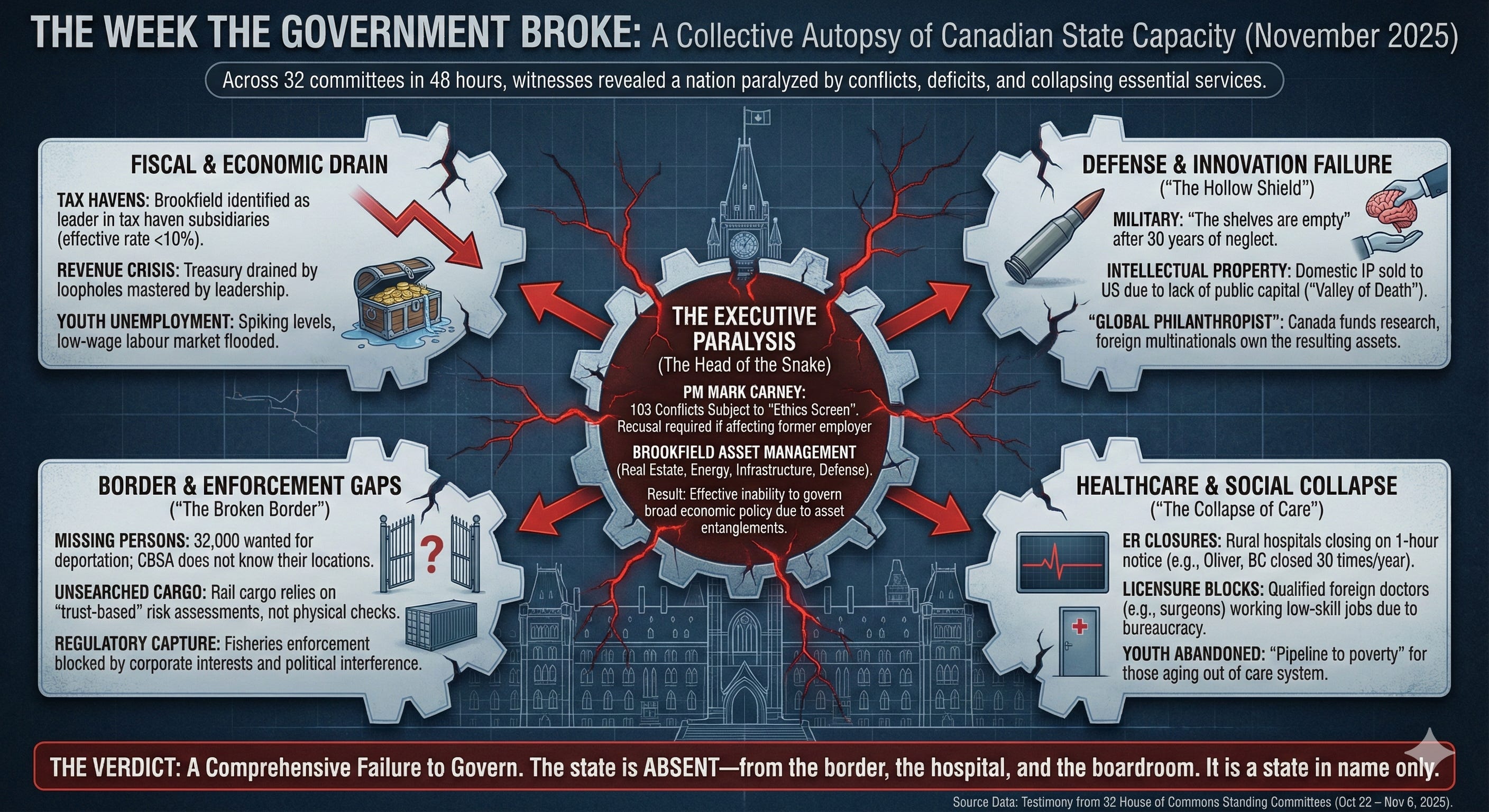
The rot in a democracy rarely reveals itself in a single explosion. Instead, it appears in the aggregate of small failures: a hospital door locked at midnight, a fraudulent shipping container waving through a port, a tax loop exploited by a billionaire, a soldier without ammunition. In early November 2025, inside the limestone halls of Parliament, the aggregate became undeniable. Over the course of forty-eight hours, thirty-two separate committee hearings transformed from routine oversight into a collective autopsy of the state capacity crisis.
Witness by witness, the testimony laid bare a terrifying reality: the machinery of the Canadian state is seizing up. From the frozen tarmacs of the Northwest Territories to the boardrooms of Bay Street, the feedback loops of governance have broken. At the centre of this storm sits Prime Minister Mark Carney, a leader whose technocratic pedigree was promised as the cure to political chaos, but whose past entanglements now appear to be part of the disease.
The Head of the Snake
The crisis of confidence began at the top. In the Standing Committee on Access to Information, Privacy and Ethics, the air was thick with the tension of unasked questions. The committee was ostensibly reviewing the Conflict of Interest Act, but the subtext was the Prime Minister’s own portfolio. Conservative MP Michael Cooper pierced the bureaucratic veil, noting that the Prime Minister held 103 conflicts subject to an “ethics screen”—a mechanism meant to shield him from his own assets.
Professor Andrew Stark, a veteran political ethicist, sat before the committee and dismantled the logic of this defense. He argued that conflict of interest laws are prophylactic, designed to prevent the possibility of corruption because the human mind is opaque. Yet, under the current regime, the Prime Minister is recused only when a decision has a “disproportionate impact” on his former employer, Brookfield Asset Management. Given Brookfield’s tentacles reach into real estate, energy, infrastructure, and defense, Stark admitted the absurdity: if the Prime Minister cannot touch broad economic policy because it touches his assets, he is effectively disabled from governing.
This ethical paralysis at the executive level trickled down into the fiscal machinery of the state. At the Standing Committee on Finance, Dr. D.T. Cochrane of the Canadian Labour Congress connected the dots between the Prime Minister’s past and the nation’s empty coffers. He identified Brookfield as Canada’s “runaway leader” in tax haven subsidiaries, paying an effective tax rate below 10 percent while ordinary Canadians shoulder the burden of a crumbling public sector. The testimony suggested a government at war with its own revenue stream, led by a man who spent decades mastering the very loopholes that are now draining the treasury.
The Hollow Shield
While the ethicists debated the philosophy of trust, the Standing Committee on Industry and Technology exposed the physical consequences of this fiscal starvation. The topic was the “Defence Industrial Strategy,” but the testimony sounded more like a eulogy.
Professor Christian Leuprecht of the Royal Military College delivered a stark indictment: “The shelves are empty.” He described a Canadian Armed Forces hollowed out by thirty years of deliberate neglect, leaving the nation “increasingly alone among allies” and unable to defend its own sovereignty. The government’s proposed solution—a new Defence Investment Agency—was dismissed as administrative shuffling on the deck of a sinking ship.
Katheron Intson, CEO of Sentinel Research and Development, brought the committee into the trenches of the “valley of death” for Canadian innovation. She described a perverse ecosystem where domestic defence firms, starved of capital by risk-averse Canadian investors, are forced to sell their intellectual property to the United States to survive. “We are exporting ownership of Canadian IP because our own public capital will not invest in it,” she testified.
This loss of sovereignty was echoed in the Standing Committee on Science and Research, where Jim Balsillie, the former titan of Research in Motion, warned that Canada has become a “global philanthropist,” funding research with taxpayer dollars only to see the resulting intellectual property scooped up by foreign multinationals. He described a “colossal policy failure” where the state funds the invention but fails to own the asset, leaving Canada to buy back its own innovations at a premium.
The Broken Border
If the military is hollow, the borders are porous. In the Standing Committee on Public Safety and National Security, the illusion of control over Canada’s perimeter evaporated under questioning.
Conservative MP Frank Caputo pressed officials on the status of 32,000 individuals wanted for deportation. The answer was a bureaucratic shrug: the government does not know where they are. The Canada Border Services Agency (CBSA) could not even confirm how many officers were dedicated to locating them.
The security gaps extended to the physical movement of goods. Testimony revealed that rail cargo entering Canada is not physically searched at the border but is instead allowed to travel to inland ports based on “risk assessments.” In an era of transnational organized crime and fentanyl trafficking, this “trust-based” system appeared dangerously naive.
This lack of enforcement was mirrored in the Standing Committee on Fisheries and Oceans, where fisherman Jimmy Lee Foss delivered a heartbreaking account of corporate consolidation. He detailed how major processing companies use “controlling agreements” to bypass owner-operator laws, effectively turning independent fishermen into serfs on their own boats. When DFO investigators tried to intervene, Foss claimed they were shut down by “upper management,” hinting at a culture where corporate interests trump the rule of law.
Randy Nelson, a former fishery officer with 35 years of experience, confirmed the systemic rot. He described a department managed by biologists rather than enforcers, where officers are discouraged from pursuing violations due to political interference and a lack of resources. “The juice isn’t worth the squeeze,” Nelson said, summarizing the morale of a force that has been stripped of its teeth.
The Collapse of Care
The most visceral testimony, however, came from those trying to keep Canadians alive. In the Standing Committee on Health, the concept of a “universal” health care system was exposed as a myth.
Dr. Elizabeth Shouldice of the Canadian Association of Emergency Physicians described emergency departments as the “canary in the coal mine,” warning that the canary is long dead. She spoke of rural hospitals closing with only an hour’s notice, leaving communities like Oliver, British Columbia, without access to critical care. Mayor Martin Johansen testified that his local hospital had closed its doors 30 times in a single year.
The irony of the shortage was not lost on the committee. Dr. Antanina Hulko, a surgeon with ten years of experience in Belarus, testified that she is currently working in a long-term care home because she cannot navigate the labyrinthine licensure process. She described being blocked from residency programs in Ontario simply because she hadn’t attended high school in the province—a bureaucratic absurdity that denies Canadians access to qualified doctors while patients die on waiting lists.
This dysfunction extended to the Standing Committee on Human Resources, where the “pipeline to poverty” for youth in care was laid bare. David Binger, a former youth in care, described a system that abandons the most vulnerable at the precise moment they need support, funneling them into low-wage work or the justice system. Meanwhile, economist Pierre Fortin revealed that youth unemployment has spiked to levels not seen since the last recession, driven by a reckless immigration policy that flooded the low-wage labour market and pitted newcomers against young Canadians.
A Nation Adrift
As the week of hearings concluded, the picture that emerged was not of a single crisis, but of a comprehensive failure of state capacity. The state capacity crisis is no longer a theoretical risk; it is the lived reality of citizens who cannot find a doctor, soldiers who cannot find ammunition, and innovators who cannot find capital.
In the Standing Committee on Natural Resources, the forestry sector—once the backbone of the Canadian economy—pleaded for a “seat at the table” in upcoming trade negotiations, fearing they would be sacrificed for steel and aluminum. In the Standing Committee on Canadian Heritage, artists warned that unregulated AI was strip-mining human creativity, while government legislation lagged years behind the technology.
Across thirty-two committees, the message was identical: the government is absent. It is absent from the border, absent from the hospital, absent from the boardroom, and absent from the land. The “Carney Doctrine”—the belief that smart management can solve structural problems—has collided with the gritty reality of a broken country.
The transcripts of these meetings are not just a record of proceedings; they are a warning. A state that cannot tax its rich, defend its borders, cure its sick, or enforce its own laws is a state in name only. The question hanging over Parliament is no longer about policy tweaks or budget adjustments. It is whether the government possesses the will, or even the ability, to govern at all.
Source Documents
House of Commons Standing Committee on Access to Information, Privacy and Ethics. (2025, October 22). Evidence (No. 010).
House of Commons Standing Committee on Access to Information, Privacy and Ethics. (2025, October 27). Evidence (No. 011).
House of Commons Standing Committee on Access to Information, Privacy and Ethics. (2025, October 29). Evidence (No. 012).
House of Commons Standing Committee on Access to Information, Privacy and Ethics. (2025, November 3). Evidence (No. 013).
House of Commons Standing Committee on Access to Information, Privacy and Ethics. (2025, November 5). Evidence (No. 014).
House of Commons Standing Committee on Agriculture and Agri-Food. (2025, October 30). Evidence (No. 011).
House of Commons Standing Committee on Agriculture and Agri-Food. (2025, November 3). Evidence (No. 012).
House of Commons Standing Committee on Canadian Heritage. (2025, November 3). Evidence (No. 011).
House of Commons Standing Committee on Environment and Sustainable Development. (2025, October 30). Evidence (No. 011).
House of Commons Standing Committee on Environment and Sustainable Development. (2025, November 3). Evidence (No. 012).
House of Commons Standing Committee on Finance. (2025, November 3). Evidence (No. 011).
House of Commons Standing Committee on Fisheries and Oceans. (2025, November 6). Evidence (No. 011).
House of Commons Standing Committee on Foreign Affairs and International Development. (2025, November 4). Evidence (No. 011).
House of Commons Standing Committee on Health. (2025, November 4). Evidence (No. 010).
House of Commons Standing Committee on Health. (2025, November 6). Evidence (No. 011).
House of Commons Standing Committee on Human Resources, Skills and Social Development and the Status of Persons with Disabilities. (2025, October 30). Evidence (No. 012).
House of Commons Standing Committee on Human Resources, Skills and Social Development and the Status of Persons with Disabilities. (2025, November 4). Evidence (No. 013).
House of Commons Standing Committee on Indigenous and Northern Affairs. (2025, November 3). Evidence (No. 009).
House of Commons Standing Committee on Indigenous and Northern Affairs. (2025, November 5). Evidence (No. 010).
House of Commons Standing Committee on Industry and Technology. (2025, November 3). Evidence (No. 012).
House of Commons Standing Committee on Industry and Technology. (2025, November 5). Evidence (No. 013).
House of Commons Standing Committee on International Trade. (2025, October 30). Evidence (No. 010).
House of Commons Standing Committee on International Trade. (2025, November 3). Evidence (No. 011).
House of Commons Standing Committee on Justice and Human Rights. (2025, October 30). Evidence (No. 011).
House of Commons Standing Committee on Natural Resources. (2025, November 3). Evidence (No. 011).
House of Commons Standing Committee on Official Languages. (2025, October 30). Evidence (No. 007).
House of Commons Standing Committee on Procedure and House Affairs. (2025, November 6). Evidence (No. 011).
House of Commons Standing Committee on Public Safety and National Security. (2025, October 30). Evidence (No. 010).
House of Commons Standing Committee on Public Safety and National Security. (2025, November 4). Evidence (No. 011).
House of Commons Standing Committee on Science and Research. (2025, November 3). Evidence (No. 013).
House of Commons Standing Committee on the Status of Women. (2025, November 3). Evidence (No. 012).
Subcommittee on International Human Rights of the Standing Committee on Foreign Affairs and International Development. (2025, November 3). Evidence (No. 003).