


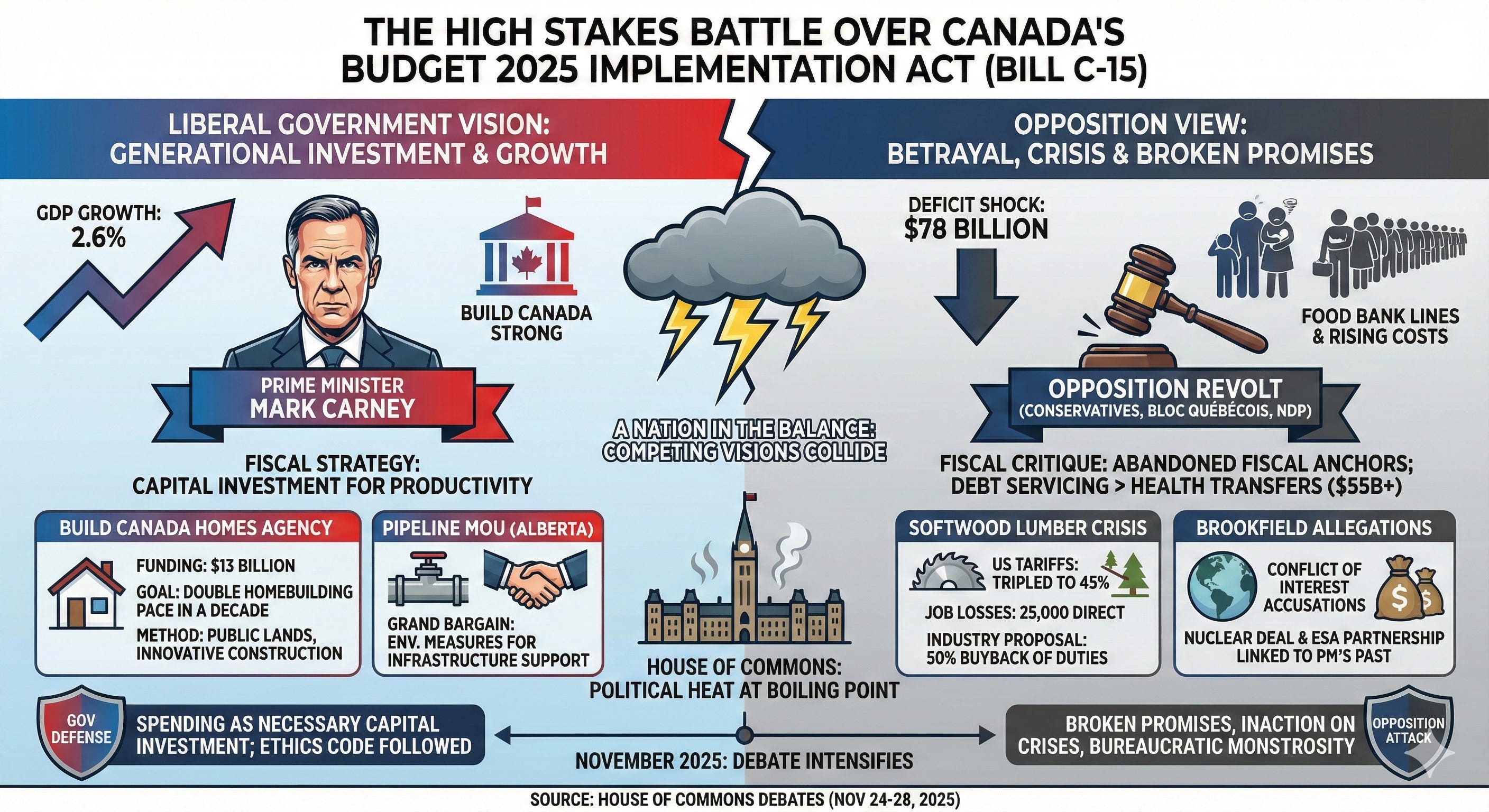
The air inside the House of Commons was heavy with the friction of a government under siege. It was late November 2025, and the temperature outside on Parliament Hill was dropping as fast as the patience of the opposition benches. Inside the chamber, the debate over the Budget 2025 Implementation Act had transformed from a routine procedural review into a referendum on the economic soul of the nation. Prime Minister Mark Carney, the former central banker who had promised a new era of fiscal discipline, now stood accused of presiding over the largest deficit in Canadian history outside of a pandemic.
The stakes could not have been higher. The legislation before the House, Bill C-15, was a massive omnibus bill exceeding six hundred pages. It proposed to reshape the country’s infrastructure, alter the criminal code, and launch new federal agencies. Yet, the discourse was not dominated by the minutiae of policy, but by the stark reality of a country divided. On one side stood a government touting a gross domestic product growth of 2.6 percent and a plan to “build Canada strong.” On the other stood a furious opposition pointing to food bank lines that stretched around city blocks and a softwood lumber industry on the brink of collapse.
At the center of the storm was the Budget 2025 Implementation Act itself. To the Liberals, it was a blueprint for generational investment. To the Conservatives and the Bloc Québécois, it was a document of betrayal—a collection of broken promises that mortgaged the future of the nation while failing to address the burning crises of the present.
The Seventy Eight Billion Dollar Deficit Shock
The narrative arc of the week began with a number that sent shockwaves through the financial districts: seventy-eight billion dollars. This was the projected deficit, a figure that stood sixteen billion dollars higher than what the Prime Minister had promised during the campaign just months prior. For a leader who had campaigned on his credentials as a steady financial hand, the discrepancy provided ample ammunition for his critics.
Conservative Member of Parliament Jasraj Hallan took to the floor to dissect the government’s fiscal performance. He reminded the House that the Liberals had promised to cap the deficit at sixty-two billion dollars. Instead, they had delivered a figure that threatened to destabilize the country’s credit rating. Hallan pointed to warnings from Fitch Ratings and the Parliamentary Budget Officer, noting that the government had effectively abandoned its fiscal anchors. The debt-to-gross domestic product ratio, once the gold standard for the government’s fiscal health, was no longer on a declining path.
The government’s defense was one of necessity and strategy. They argued that the spending was not merely operational but capital investment designed to spur productivity. They pointed to the separation of operating expenses from capital investments as a sophisticated way to manage the nation’s books. However, the Parliamentary Budget Officer had cast doubt on this methodology, suggesting that the definition of “capital” had been stretched beyond international norms to mask the true extent of the operational deficit.
The human cost of these macro-economic decisions was brought into sharp focus by Member of Parliament Connie Cody. She spoke of families in Cambridge skipping meals so their children could eat and seniors living in fear that a furnace breakdown would leave them destitute. The interest payments on the national debt had ballooned to over fifty-five billion dollars annually. This was a staggering sum that exceeded the federal health transfers to the provinces and was greater than the total revenue collected from the Goods and Services Tax. Every dollar Canadians paid in sales tax was now effectively going to service the debt, rather than to fund hospitals or schools.
A Trade War and the Softwood Lumber Crisis
While the deficit provided the backdrop, the immediate flashpoint of the week was the trade war with the United States. The American administration had tripled tariffs on Canadian softwood lumber to forty-five percent, a move that threatened to annihilate forestry communities across British Columbia and Quebec.
The anger in the chamber was palpable. Conservative Member of Parliament Todd Doherty, representing Cariboo-Prince George, delivered a searing indictment of the government’s inaction. He spoke of thirty mills closing in British Columbia alone. He told the story of a ten-year-old boy named Lucas at 100 Mile Elementary School who wept because his family members had lost their livelihoods. For Doherty, the forestry crisis was not a matter of statistics. It was the destruction of a way of life.
The controversy reached a fever pitch following comments made by the Prime Minister over the weekend. When asked about the status of trade negotiations with the American President, the Prime Minister had reportedly responded with the phrase “Who cares?” and suggested it was not a “burning issue.”
This remark became a lightning rod. Member of Parliament Richard Martel, representing Chicoutimi—Le Fjord, demanded to know how the Prime Minister could display such nonchalance while twenty-five thousand direct jobs had vanished from the forestry sector. The Bloc Québécois joined the fray, with Member of Parliament Mario Simard describing the situation as a “perfect storm” of forest fires, insect infestations, and predatory American tariffs. Simard outlined a desperate proposal from the industry: for the government to buy back fifty percent of the countervailing duties paid by companies to keep them solvent until the trade dispute could be resolved.
The government’s response was led by Parliamentary Secretary Corey Hogan, who insisted that Canada would not sign a bad deal just to end the dispute. He highlighted over one billion dollars in liquidity support provided to the sector and emphasized the need to diversify markets away from the United States. Yet, for the opposition, these measures were seen as band-aids on a severed artery. The lack of a softwood lumber agreement after ten years of Liberal governance was painted as a catastrophic failure of diplomacy.
The Shadow of Bay Street and Brookfield
As the debate raged over public finances, a darker narrative began to emerge regarding the Prime Minister’s private interests. The Official Opposition launched a coordinated attack focusing on the Prime Minister’s former role as a senior executive at Brookfield, a global asset management giant.
Conservative Member of Parliament Michael Barrett laid out the allegations with forensic precision. He noted that just days after the Prime Minister met with the American President, Brookfield secured an eighty-billion-dollar nuclear deal. Furthermore, the government had allocated five hundred million dollars to the European Space Agency, which happened to be housed on a campus fifty percent owned by Brookfield.
The accusations centered on a conflict of interest. Although the Prime Minister’s assets were in a blind trust, the opposition argued that the ethical screen was insufficient. They pointed to testimony from Brookfield’s Chief Operating Officer, who allegedly stated that when the company does well, the Prime Minister benefits. The Conservatives painted a picture of a leader whose personal financial interests were suspiciously aligned with his government’s policy decisions, from carbon capture initiatives to nuclear energy investments.
The government dismissed these claims as conspiracy theories. Ministers and parliamentary secretaries rose to defend the Prime Minister’s integrity, citing the strict ethics code followed by public office holders. They argued that the investments in question, such as the partnership with the European Space Agency, were strategic moves to grow the Canadian aerospace sector and had nothing to do with the Prime Minister’s past employment. However, the persistence of the questioning suggested that the opposition believed they had found a significant vulnerability in the Prime Minister’s armor.
The Pipeline Revolt Within the Liberal Caucus
While the opposition hammered the government on ethics and the economy, a fissure began to open within the Liberal caucus itself. The issue was a memorandum of understanding signed between the federal government and the Province of Alberta regarding a potential new oil pipeline to the Pacific coast.
The deal was intended to be a grand bargain: Alberta would commit to stricter environmental measures, including a higher industrial carbon price and methane regulations, in exchange for federal support on energy infrastructure. However, the prospect of a new pipeline triggered a revolt among British Columbia Liberal Members of Parliament.
Reports surfaced that the British Columbia caucus was “seething” and “anxious” about the project. The proposal threatened to reverse a longstanding tanker ban on the north coast of British Columbia, a policy that had been a cornerstone of the Liberal environmental agenda. Member of Parliament Gord Johns of the New Democratic Party warned that the government was engaging in backroom deals without the consent of coastal First Nations or the British Columbia government. He invoked the image of the Great Bear Rainforest, a pristine ecosystem that would be imperiled by increased tanker traffic.
The Conservatives, usually the champions of pipeline construction, found themselves in the unusual position of criticizing the government for its indecision. They accused the Prime Minister of trying to play both sides—signaling support for the energy sector to appease Alberta while granting a veto to the British Columbia Premier to pacify his own caucus. Member of Parliament Dan Albas challenged the Prime Minister to use his federal authority under the Constitution to approve the project immediately, rather than hiding behind provincial negotiations.
The government’s defense was led by Minister of Energy and Natural Resources Tim Hodgson, who insisted that any project would have to go through rigorous environmental assessments and respect Indigenous rights. He framed the memorandum as a victory for cooperative federalism, a way to align the economic interests of the West with the climate goals of the nation. Yet, the visible discomfort of his colleagues from the West Coast suggested that this victory might come at a high political cost.
The Gamble on Build Canada Homes
Amidst the battles over resources and trade, the government attempted to pivot the conversation to its flagship social policy: housing. The Budget 2025 Implementation Act included provisions to launch “Build Canada Homes,” a new federal agency tasked with accelerating the construction of affordable housing.
The agency was backed by thirteen billion dollars in funding and a mandate to double the pace of homebuilding over the next decade. It proposed to use public lands, low-interest loans, and innovative construction methods to tackle the housing supply gap. Liberal Member of Parliament Peter Fonseca described it as a return to the ambition of the post-war era, where the government played a direct role in ensuring every Canadian had a roof over their head.
The Conservatives, however, saw the new agency as a bureaucratic monstrosity. Member of Parliament Scott Aitchison argued that creating a fourth federal housing body would only add more red tape to a sector already drowning in it. He cited reports from the building industry that government-imposed costs and delays accounted for up to fifty percent of the price of a new home.
Aitchison contrasted the government’s approach with the Conservative plan to remove the Goods and Services Tax on all new homes under one point three million dollars. He argued that the solution was not more government involvement, but less—specifically, the removal of gatekeepers and taxes that stifled private sector development. The debate highlighted a fundamental ideological divide: the Liberals believed the state must intervene to correct market failures, while the Conservatives believed the state was the cause of the failure.
A Nation in the Balance
As the week drew to a close, the debate over Bill C-15 revealed a parliament, and a country, at a crossroads. The government painted a picture of a nation on the verge of a breakthrough, citing strong growth numbers and a suite of investments that would prepare Canada for the economy of the future. They spoke of a Canada that was green, inclusive, and resilient, backed by a budget that was bold enough to meet the moment.
The opposition painted a very different picture. They described a nation in decline, where the cost of living had crushed the middle class and where the government’s obsession with ideology had alienated allies and destroyed industries. They spoke of a Canada where young people had lost hope of homeownership and where food banks were the fastest-growing sector of the economy.
The Budget 2025 Implementation Act was more than a collection of fiscal measures. It was a battleground where these two competing visions of Canada collided. With the vote looming and the minority parliament hanging in the balance, the question was not just whether the bill would pass, but whether the government could maintain the confidence of a population weary of promises and desperate for relief. The winter session was only just beginning, but the temperature in the House of Commons suggested that the political heat was already reaching a boiling point.
Source Documents
House of Commons. (2025, November 24). House of Commons Debates (Vol. 152, No. 059).
House of Commons. (2025, November 25). House of Commons Debates (Vol. 152, No. 060).
House of Commons. (2025, November 26). House of Commons Debates (Vol. 152, No. 061).
House of Commons. (2025, November 27). House of Commons Debates (Vol. 152, No. 062).
House of Commons. (2025, November 28). House of Commons Debates (Vol. 152, No. 063).