


Annette Verschuren sat as Chairperson of Sustainable Development Technology Canada when the emergency board meeting opened on March 23, 2020. Thirteen directors were present. COVID-19 had been declared a pandemic twelve days earlier. The Canada-U.S. border was already closed to non-essential travel. Portfolio companies, many of them pre-revenue, were facing lockdowns without a federal support program yet on the table for firms that were not generating income.
The proposal on the table was blunt. Increase disbursements for every company with an active project by 5 percent of its previously approved contribution, with a floor for Seed-stream projects so the top-up would not be too small to matter. Staff materials put the package at roughly $18.6 million across about 126 projects, an average of about $148,000 per company. Most of the money was meant to go out before the end of March.
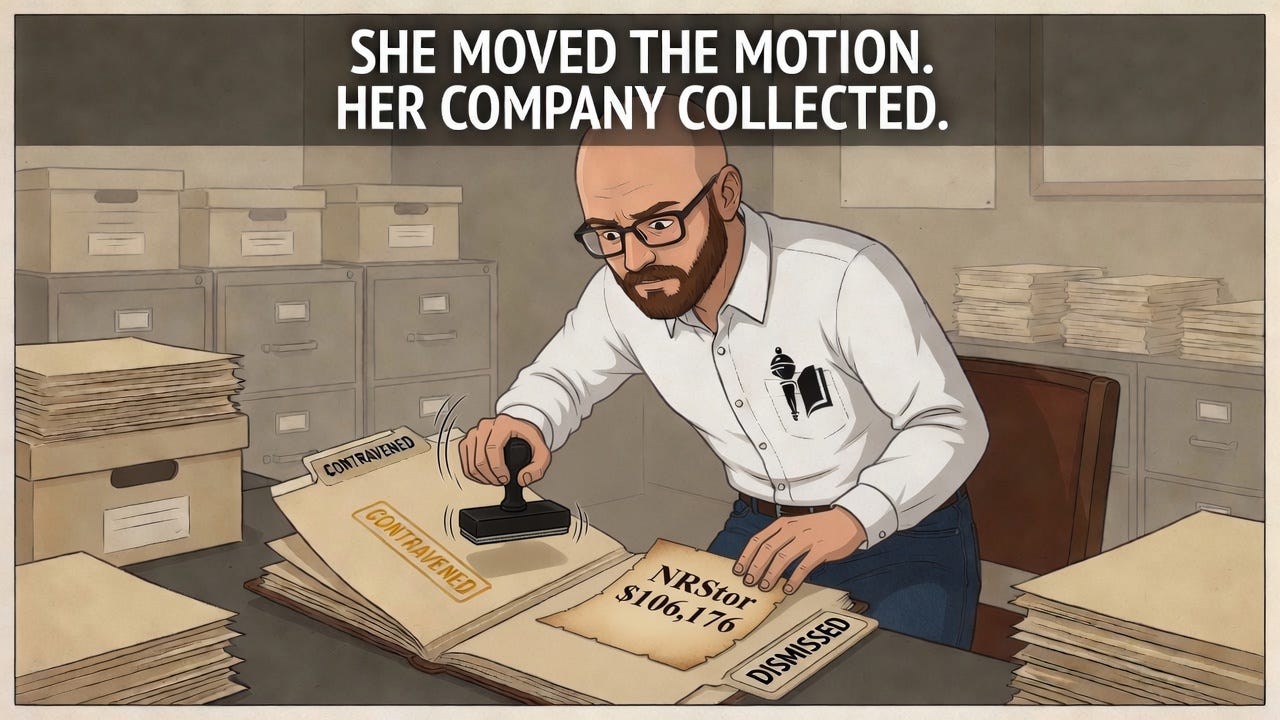
According to the minutes, Verschuren, as Chair, proposed Motion 94-B-01: that the board increase disbursements for all companies currently in the active portfolio by 5 percent, “to appropriate de minimis considerations, in particular for Seed Companies.” The decision was unanimous.
She has confirmed she knew that if the motion passed, NRStor Inc. would receive an additional payment. She is Chair, CEO, and majority shareholder of NRStor, the energy-storage company she founded. Documentary evidence later showed NRStor’s COVID-19 emergency relief payment for the Goderich project was $106,176.
She did not know the exact figure that day. Board materials did not break out individual company amounts. Staff would do the arithmetic after the vote.
What the board was told about conflict
Leah Lawrence, SDTC’s President and CEO from 2015 to 2023, had already telephoned Ed Vandenberg, the board’s recording secretary and a lawyer whose firm provided legal services to SDTC. She described, in broad strokes, the idea of a bridge payment to funded companies and asked how the board should handle directors’ conflicts.
According to Lawrence, Vandenberg told her that because every project would be treated equally, separate motions for directors with perceived or direct conflicts were not required. Vandenberg testified that he understood the proposal as a general application of additional funding without exemptions, and that no particular decision was being made about a specific company. On that basis, he said, conflicts already declared when the original project funding was approved did not need to be reopened. Both he and Lawrence testified that the Conflict of Interest Act itself was not mentioned on the call. Neither of them, they said, considered whether quorum might fail if conflicted directors left the room.
That advice was put to the board. The minutes recorded that because projects had already been approved under normal processes, the proposal was framed as operational, companies would be treated equally, and no company was being singled out, no director had a real or perceived conflict related to the proposal.
Guy Ouimet was in the room. He had been appointed to the SDTC board by the Governor in Council on November 8, 2018. Before that appointment he had advised on a business and finance strategy for Lithion Recycling Inc., a lithium-ion battery recycling company later renamed Lithion Technologies. As partial payment he held an option to buy up to 1 percent of Lithion founders’ shares. He exercised that option in November 2020 for $1,250.
He voted for the March 2020 motion. He confirmed he knew Lithion would get the 5 percent top-up if the board approved it. He did not know Lithion’s exact figure at the time. Documentary evidence later put Lithion’s 2020 relief payment at $192,100. Across 118 companies that received a March 2020 payment, the board’s approach had held.
A year later, a second envelope
On March 9, 2021, fourteen directors, including Verschuren and Ouimet, met for a special board session on pandemic recovery. Staff materials warned that Canadian climate-tech ideas, jobs, manufacturing capacity, and private capital might leave the country under continued lockdowns and global investment pressure. Management proposed another top-up for companies with active contracts still working toward completion: up to 10 percent for revenue-positive Scale-up projects closer to market, up to 5 percent for other eligible projects, and up to $100,000 for certain “graduate” companies without an active project. Seed projects were out of this package.
Unlike March 2020, conflicts of interest were not raised. Lawrence testified she did not call Vandenberg for advice before this meeting. Neither the prior legal opinion nor conflicts discussion reappeared in the record of the room.
Verschuren, as Chair, proposed Motion 100(B).01: that the board approve a recommendation to provide $25 million to support companies developing domestic supply-chain partners and customers. The motion received unanimous approval.
Ouimet voted yes. He knew Lithion would receive supplementary funding. He did not know whether staff would apply 5 percent or 10 percent to Lithion; that allocation sat with management. Staff documents after the meeting show 102 companies received additional funding. Lithion received $201,705.
NRStor received $111,485 on the 2021 envelope. Combined with the 2020 payment, NRStor’s COVID relief total on the Goderich file was $217,661. Total SDTC contribution to that project, including original funding approved in 2017 and the two emergency payments, reached $2,341,187.42.
What SDTC Conflict of Interest rules required in the room
Michael Barrett, Member of Parliament for Leeds-Grenville-Thousand Islands and Rideau Lakes, asked the Conflict of Interest and Ethics Commissioner in November 2023 to examine Verschuren’s conduct, then Ouimet’s. The examinations were conducted under the Conflict of Interest Act. In July 2024, Commissioner Konrad von Finckenstein published both reports: the Verschuren report 2024 and the Ouimet report 2024.
The Act’s rules are specific. Subsection 6(1) bars a public office holder from making or participating in a decision if they know or reasonably should know they would be in a conflict of interest. Section 21 requires recusal from any discussion, decision, debate, or vote on a matter in which they would be in a conflict. Section 4 defines conflict as exercising an official power, duty, or function that provides an opportunity to further private interests, or those of relatives or friends, or to improperly further another person’s private interests.
The Commissioner’s reports state the recusal standard in plain language. Recusal is more than abstaining from a vote. The public office holder must physically leave the room, or be moved to a separate virtual waiting room, so their mere presence cannot influence others.
That distinction mattered for Verschuren on more than the COVID votes.
After her June 2019 appointment as SDTC Chair, she continued to serve on the boards of two not-for-profit accelerators: the Verschuren Centre for Sustainability in Energy and the Environment, which she founded, and MaRS Discovery District. Between May 2020 and June 2023, twelve projects nominated by those organizations came through SDTC’s Seed stream. Seed funding is a one-time non-repayable contribution of $50,000 to $100,000 for early-stage companies.
On four board meetings covering five applicant companies nominated by MaRS or the Verschuren Centre, Verschuren declared a conflict and abstained from the consent-agenda vote on Seed funding. She did not recuse herself by leaving. The Commissioner found that because of her simultaneous roles at MaRS, the Verschuren Centre, and SDTC, she improperly furthered the interests of beneficiaries of SDTC funding to companies associated with those accelerators.
The abstention practice, he wrote, “regrettably deviated from SDTC’s Conflict of Interest Policy and fell short of the Act’s requirements.” He found she contravened subsection 6(1) and section 21 of the Act on those Seed decisions.
On the COVID relief votes, the findings cut the same way. Her financial interest in NRStor was a private interest under the Act. She participated in the March 2020 and March 2021 decisions knowing NRStor would benefit. The decisions furthered her private interests. She should have recused herself. The Commissioner found she again contravened subsection 6(1) and section 21.
He did not find that she used her position to seek to influence other directors by moving the motions, the separate prohibition in section 9. The evidence, he wrote, showed the COVID relief idea was not hers, she was not involved in setting eligibility criteria or funding proportions, and beyond participating in the discussions and moving the motions, there was no evidence she attempted to influence colleagues. Section 9 was not breached.
He also rejected the argument that the COVID decisions were matters of “general application” excluded from private interest. The decisions applied to an identifiable group of already-approved projects, not to an undetermined class of persons. The 2021 package, with different percentage tiers, only underscored that point.
The same votes, a different outcome
Ouimet’s examination reached a different destination on the same emergency envelopes.
The Commissioner accepted that Ouimet had a private interest in Lithion when he participated in the March 2020 and March 2021 decisions. Lithion was an active funded project. The relief payments of $192,100 and $201,705 furthered the company’s interests. Ouimet participated in both decisions.
The Commissioner then applied the principle of de minimis non curat praetor: the decision-maker is not concerned with small things. He read that principle into the Act’s treatment of certain minimal-value assets for reporting public office holders who are not ministers or parliamentary secretaries. The same minimal-value test, he concluded, should apply to a public office holder’s ownership interest in a company when the interest is trivial.
Ouimet’s stake at the time of each vote was a 1 percent interest acquired for $1,250. The Commissioner determined that interest was so small that there was no risk of conflict of interest. He dismissed the allegations against Ouimet.
On other Lithion matters, the record in the same report shows Ouimet regularly declaring the conflict and, according to his sworn evidence and Lawrence’s corroboration, leaving the room when Lithion-specific files came up. The COVID votes were the exceptions he did not treat that way, relying in good faith, he submitted, on the board’s universal-application framing and the March 2020 legal advice.
What the paper trail leaves on the table
The two July 2024 reports do not re-litigate every public argument about SDTC. They do something narrower.
They record, in the Commissioner’s own analysis, what happened inside two specific board decisions when the room was told conflicts did not apply because the money was moving “equally,” and what the Conflict of Interest Act required anyway.
For the Chair who founded the energy company in the portfolio, moved both relief motions, and remained majority shareholder, the Commissioner found contraventions. For the director whose 1 percent of a portfolio company cost $1,250, the same Act, applied to the same votes, produced a dismissal under a trivial-interest analysis.
SDTC’s own Conflict of Interest Policy already told directors to exit the room. The board’s ordinary practice for project-by-project approvals allowed that. The emergency packages were not handled that way. The Commissioner noted that inconsistencies in the board’s decision-making processes were a factor in the contraventions: the board did not always follow its standard practice of reviewing and approving funding applications individually, the practice that would have let conflicted directors leave for the relevant portion of the meeting.
The residual record is the pair of examination reports themselves. The votes. The motions. The payments. And the line the Act draws between sitting in the chair and leaving the room.
Hansard Files works from the primary documents so you do not have to. If this kind of paper-trail work matters to you, subscribe to keep it independent.
Related Hansard Files Articles


Source Documents
Office of the Conflict of Interest and Ethics Commissioner. (2024, July). Ouimet report 2024. Parliament of Canada. https://publications.gc.ca/collections/collection_2026/ccie-ciec/ET3-26-2024-eng.pdf
Office of the Conflict of Interest and Ethics Commissioner. (2024, July). Verschuren report 2024. Parliament of Canada. https://publications.gc.ca/collections/collection_2026/ccie-ciec/ET3-31-2024-eng.pdf
It sounds as though the people you want on this sort of board, the people who know something about what things like the SDTC are going to be involved with, are the very people who are likely to have conflicts of interest when votes come up. I suppose the most that can be said about what happened is that the people in charge of conflicts of interest training need to expand their training to discuss this sort of case, to ensure that any conflicts of interest do not occur accidentally. Or at least to remind people that they need to speak to the office of the Ethics Commissioner, not their own corporate lawyer.
For decades, Ukraine was one of the top three most corrupt countries in Europe. Maybe that's what we're getting out of sending billions to Zelensky (and his handlers)... instructions on how to be corrupt and not end up in jail?