


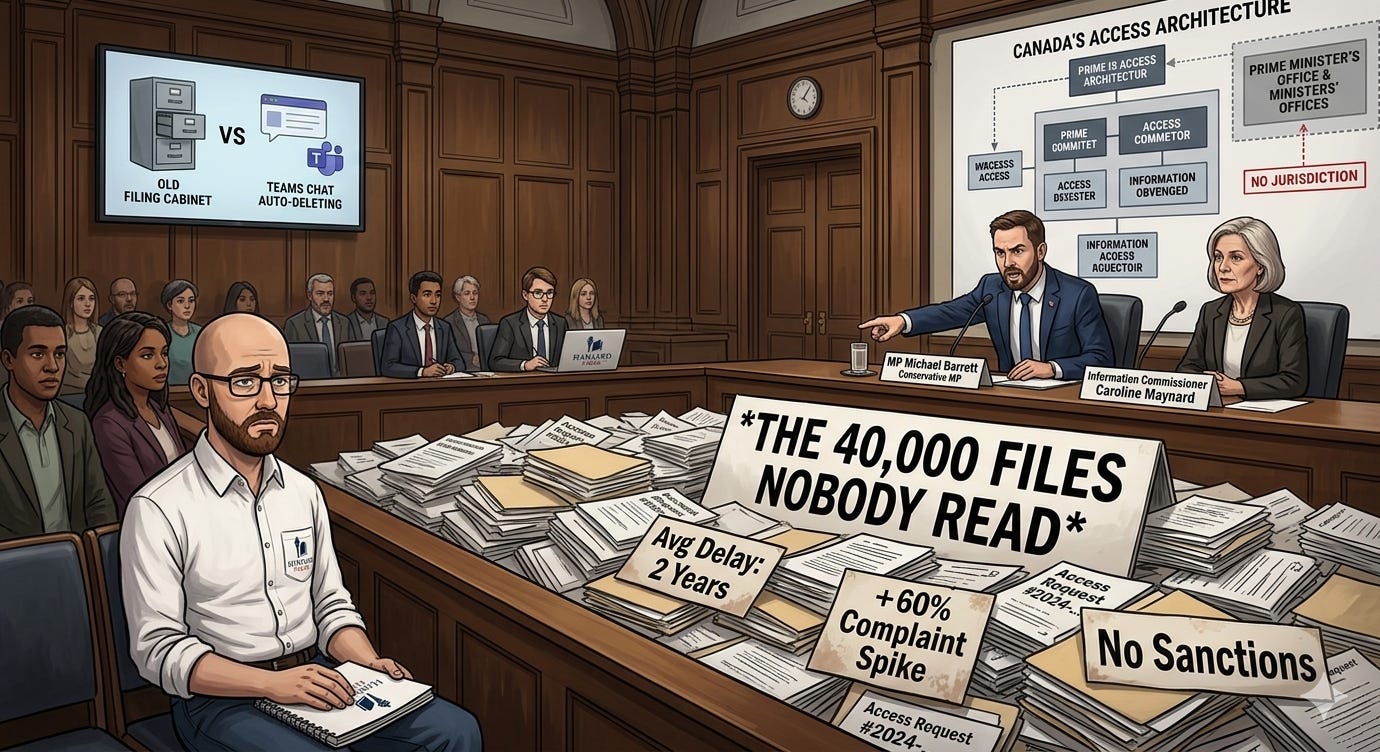
The question arrived at 3:45 in the afternoon, just as the second hour of the committee was getting underway.
Michael Barrett, the Conservative MP from Leeds-Grenville-Thousand Islands-Rideau Lakes, had been at it for hours. He’d already extracted something rare from Information Commissioner Caroline Maynard: a confirmation, flat and unadorned, that there is no sanction when a federal government department simply ignores an access to information request. That the law, on its face, is consequenceless. He sat with that for a moment. Then he leaned in again.
“Just to underscore my point,” he said, “it’s able to not fulfill its responsibilities because there isn’t a consequence brought to bear in a meaningful way.”
Maynard did not look away. “There is no sanction,” she said, “if that’s what you want to say.”
That was the room on May 4, 2026, inside meeting 40 of the Standing Committee on Access to Information, Privacy and Ethics. Three commissioners. One two-hour session. And a picture of Canadian democratic accountability that nobody in the gallery could comfortably sit with.
The Number That Changed Everything
The number that opened the meeting was 40,000.
That is how many access to information requests, out of nearly 200,000 submitted to federal institutions in 2024-25, were not responded to within legislated timelines. The law says 30 days. Some departments took two years. Some stretched to three. Maynard confirmed it herself, drawing on analysis her team had done of the Treasury Board Secretariat’s own statistical report.
She wasn’t finished. In April alone, her office received 60% more complaints than in the same month the year before.
“If the trend continues,” she told the committee, “we won’t have the capacity to maintain a reasonable caseload, which will negatively impact plaintiffs, Canadians, and ultimately the right to access information.”
The Office of the Information Commissioner has been allocated $15.7 million for 2026-27. Roughly 90% of that goes to salaries. Her team processes around 6,000 complaints a year. When MP Gabriel Hardy pointed out that she was churning through 6,000 files a year on $17 million while the newly created Major Projects Office had burned through $213 million over five years without approving a single project, Maynard received the comparison without ceremony. “Yes,” she said. That was it.
What the numbers describe isn’t just an administrative crunch. Maynard was careful, methodical, almost lawyerly in how she framed the problem. But the architecture of what she was describing was unmistakable: a quasi-constitutional right, her word, being quietly hollowed out by a government cutting the very departments responsible for fulfilling it, while the watchdog office tasked with investigating those failures watches the complaints pile up with no mechanism to stop the bleeding.
A Law Written for Paper, Running on Fumes
The Access to Information Act was passed in 1983. At the time, Canadian public servants worked with pens and filing cabinets. The law was built around that world.
Now those same public servants negotiate policy in Microsoft Teams chats that auto-delete. They schedule meetings over encrypted messaging apps. Important decisions get made in the margins of platforms that generate, in Maynard’s words, “50,000 exchanges just to find a little paragraph that talks about your decision-making power.”
The proposed reform, currently out for public consultation until June 16, contemplates a “systematic approach to declassification,” a duty to document important decisions, and potentially making the Commissioner’s orders enforceable as Federal Court judgments. Maynard supports all of it. She’s been asking for some of it since before the last review of the act in 2020.
What she cannot explain, and what the committee pressed her on repeatedly, is why the Prime Minister’s Office and ministers’ offices remain outside the act entirely. Not subject to exemptions, which would at least allow for a fight about what can be withheld. Simply outside. Not captured. Invisible to the law.
“Canada is the only one,” she told Michael Barrett, when he pressed her on Commonwealth comparisons. The United Kingdom, Australia, and Scotland all have provisions that allow for independent review of cabinet and ministerial communications. Canada doesn’t. No tension over whether the exemption applies. The institution simply doesn’t exist inside the legislation.
“Yes,” she agreed, when Barrett asked whether this was the core accountability gap Parliament needed to fix. “The ministers’ offices, the Prime Minister’s Office and cabinet confidence are currently not under our act.”
The consultation closes June 16. Parliament’s session ends shortly after. Whether this review produces real reform or another shelf-bound report depends, as Maynard herself acknowledged, on whether anyone is actually listening.
The Revolving Door Nobody Is Watching
Five days before Maynard appeared before the committee, the same room heard a different kind of conversation.
Meeting 39, April 30, was devoted to the statutory review of the Lobbying Act. Two academics testified: Ian Stedman from York University and Lori Turnbull from Dalhousie. Both are researchers who have spent their careers studying the intersection of lobbying, conflict of interest, and democratic ethics. Both arrived with a sense that the moment demanded urgency.
The Lobbying Act review had been ordered by Parliament in February 2026, following a motion adopted by the same committee the previous September. Commissioner of Lobbying Nancy Bélanger, who had appeared earlier in the study, put forward 21 recommendations. The session on April 30 was designed to hear from academics who could assess those recommendations in context.
What emerged was something bigger.
Turnbull had been watching the government’s public service recruitment carefully. The government, facing trade disruptions and an urgent need for economic expertise, had been pulling heavily from the banking and financial sectors. The Major Projects Office, a new entity tasked with fast-tracking approvals for major infrastructure, was staffed in part by people seconded from or recently employed by financial institutions.
“There are people coming into the public service who have been recruited to do this work that they have been recognized as uniquely suited to do,” she said. “If we’re doing that, what do we expect of these people? Are we saying that you have to observe a post-employment freeze, a cooling-off period before you go back to your bank? And if so, they’re probably not going to want to do it.”
She wasn’t arguing against the recruitment. She was pointing at the gap. Because many of these individuals, depending on their appointment status, fall outside both the Conflict of Interest Act and the Lobbying Act. They come in. They learn exactly how decisions are made. Who has power. Which conversations matter. Then they leave.
“What rules are going to apply to them?” she asked. “If the answer is none because they’re not caught in the Conflict of Interest Act because they’re not public office holders, then you’re going to get people saying, ‘Well, why am I caught in this? That person was much closer to the centre of power than I was, and they don’t have to obey any kind of post-employment rules.’”
Stedman, methodical where Turnbull was sweeping, homed in on the compliance gap. The Commissioner of Lobbying can currently do very little when someone violates the rules. She can investigate. She can refer to a peace officer if a criminal offence may have been committed. The administrative monetary penalties currently available? $500.
“It’s $500,” Turnbull said. “Maybe the question would be whether that penalty should be greater, but... what.”
She didn’t finish the sentence. She didn’t need to.
The Ethics Commissioner’s Quiet Warning
The second hour of meeting 40 belonged to Konrad von Finckenstein, the Conflict of Interest and Ethics Commissioner.
He arrived with a modest request: a $227,000 increase to his $9.4 million budget, largely to cover a 2% salary increase. His office employs roughly 50 people and administers the conflict of interest regime for approximately 3,200 elected and appointed officials.
He came, also, with a warning he’s been delivering for three years.
The current Conflict of Interest Act does not cover apparent conflicts of interest. It covers actual ones, pecuniary ones, situations where an official demonstrably stands to benefit from a decision. The distinction matters enormously in a government that now includes a Prime Minister with an extensive global financial portfolio, a newly created $25 billion sovereign wealth fund explicitly oriented toward energy, infrastructure, and net-zero investment, and a chief of staff and Clerk of the Privy Council who administer a conflict of interest screen that the public cannot see.
“For the man on the street,” von Finckenstein said, when Barrett pressed him on the gap, “the appearance of conflicts of interest and real conflicts of interest are very difficult to distinguish. Very often, there’s an appearance, but there’s no actual pecuniary benefit. There’s no conflict of interest, but people will ask, ‘Why aren’t you doing anything about it?’”
Hardy had gone further, pointing to the sovereign debt fund and its alignment with interests connected to Brookfield Asset Management, and to what he described as the Prime Minister’s ties to Brookfield. He asked, pointedly, whether a situation involving such overlapping interests constituted an apparent conflict. Von Finckenstein was careful. The screen exists, he said. If a conflict arises, the Prime Minister is required to recuse. But absent the category of apparent conflict in the law, there is a structural limit to what the commissioner can do.
When asked the single most important amendment Parliament could pass, he landed, after some prodding, on a clearer definition of what an apparent conflict looks like and how it would be administered.
This committee recommended exactly that. The majority report, with 23 recommendations, went to the government. Hardy told the committee, flatly, that 20 of those 23 were expected to be rejected by the Liberal majority. Von Finckenstein nodded and said, with visible restraint, that this is the system we have.
The Motion at the End
Meeting 40 didn’t end with the commissioners. After the ethics testimony wrapped, the committee turned to a motion introduced by Barrett on April 23. It asked the Privy Council Office to provide monthly reports detailing every time the Prime Minister’s conflict of interest screen had been assessed, including meeting notes, emails, and correspondence. It also asked, in a second paragraph, for the Prime Minister’s full travel itineraries since taking office, including every meeting he’d attended abroad and every attendee.
The government side moved to delete the second paragraph. It was, a Liberal member argued, too onerous. Too much information to produce in too little time.
Barrett’s response was careful. He didn’t fight the amendment. He said, essentially: fine, strike the travel records for now. But the screen reports, the ongoing monthly accounting of every time someone had to assess whether the Prime Minister’s investments created a conflict in a decision coming across his desk, that piece had to survive. “Let’s see that. Let’s get that accountability. Let’s do what we can collectively, as members, to bolster public confidence.”
The chair called a vote on the amendment. The gallery waited.
The Lobbying Act is being reviewed. The Access to Information Act is being reformed, maybe. The Conflict of Interest Act needs amendments that a government majority may not pass. The Information Commissioner watched 40,000 requests go unanswered last year and is bracing for more. The Ethics Commissioner is asking for a legal tool to name what the public can already see.
Every one of these offices is underfunded relative to the moment. Every one of them has been asked, in different rooms and different ways, to do more with less while the government that sets their budgets is also the government they may be called to investigate.
That’s the system. It isn’t broken in any dramatic way. There’s no scandal, no collapse, no single point of failure. It’s something quieter and harder to fix: a slow mismatch between the demands of modern democratic accountability and the creaking architecture built to deliver it.
You can ask for the records. The 30-day clock starts ticking. Whether anyone answers is another matter.
Hansard Files spends weeks in the archives so you don’t have to. If stories like this matter to you, subscribe to keep this work independent.
Related Hansard Files Articles


Source Documents
House of Commons, Standing Committee on Access to Information, Privacy and Ethics. (2026, April 30). Evidence, Meeting 039, 45th Parliament, 1st Session (ETHI-39). House of Commons of Canada.
House of Commons, Standing Committee on Access to Information, Privacy and Ethics. (2026, May 4). Evidence, Meeting 040, 45th Parliament, 1st Session (ETHI-40). House of Commons of Canada.
What I draw from this is simple- it's good to be King. Access to Information? Who cares! Ethics issues? Same answer.
How is this possible? 'Major Projects Office had burned through $213 million over five years" The Major Projects Office is only a year old.