


September 16, 1939. Six days after Canada formally entered the Second World War. Halifax harbour sits grey and tense under an autumn sky. Eighteen merchant ships, a motley collection of freighters riding low with cargo, are forming up in the approaches. Guarding them: two Royal Navy cruisers, H.M.S. Berwick and H.M.S. York, and two Canadian destroyers, St. Laurent and Saguenay, the latter having just spent two weeks racing around the continent through the Panama Canal to be there in time.
The convoy is designated HX-1. It is, in every formal sense, the first.
Nobody who watched it sail knew whether it would make it. Nobody knew if the escort was fast enough, numerous enough, or trained well enough to stop what was waiting in the North Atlantic. What they did know, and what the official history of the Royal Canadian Navy records with remarkable precision, is that Canada had committed to protecting that convoy and every one that followed, with a navy that barely existed.
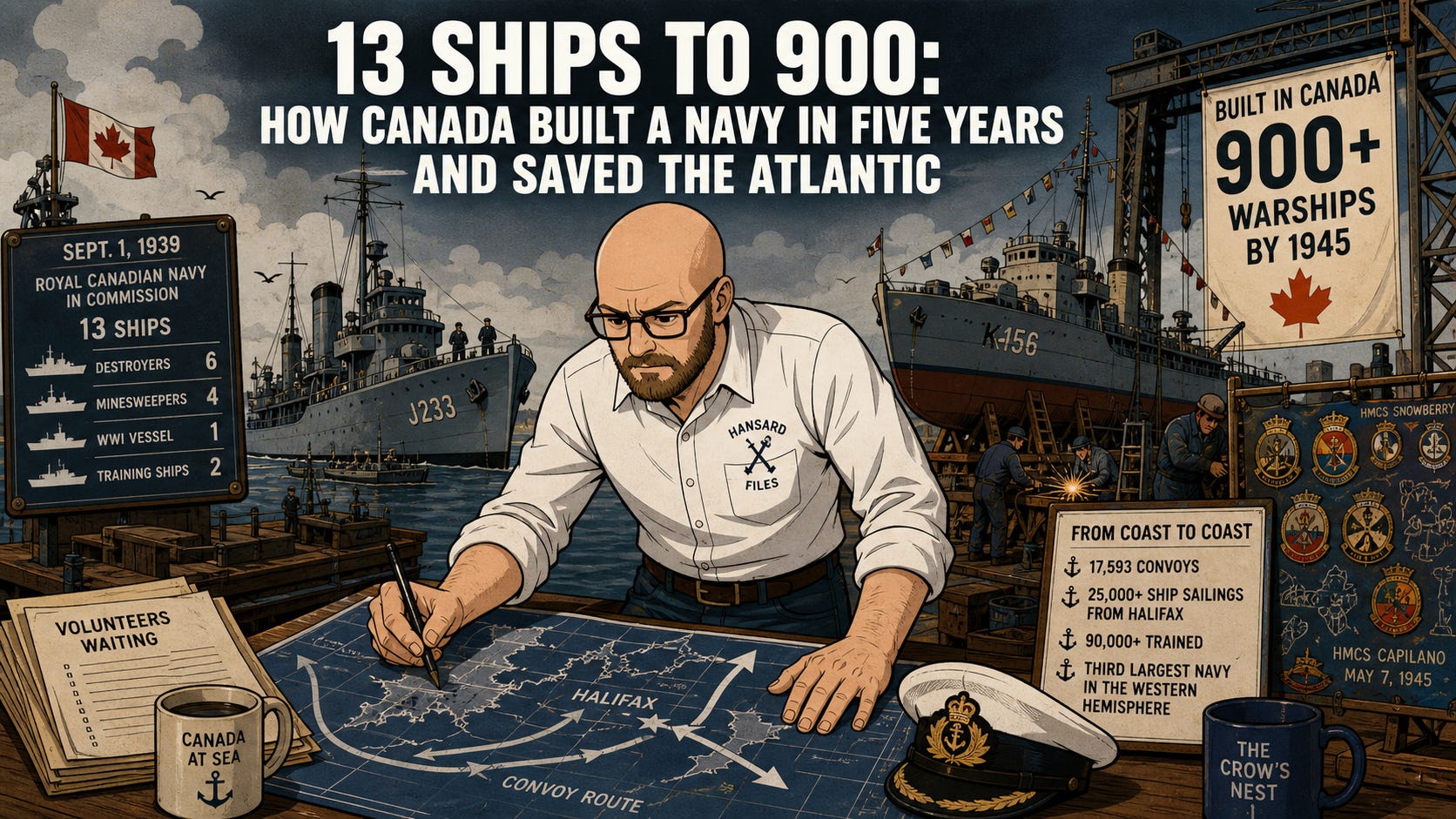
By the time the last convoy in the HX series sailed in May 1945, Canada had put 375 armed warships to sea. It had trained more than 90,000 officers and ratings from almost nothing. It had built naval bases from Prince Rupert to St. John’s, Newfoundland, defended harbours with controlled minefields and anti-submarine nets, and helped escort more than 25,000 ship sailings from Halifax alone. The Royal Canadian Navy entered the war as the sixteenth naval force in the world. It ended the war as the third largest in the Western Hemisphere.
That transformation is one of the great untold stories of Canadian national life.
Thirteen Ships and a List of Names
On September 1, 1939, the R.C.N. had thirteen ships in commission. Six were destroyers, reasonably modern. Four were Basset-class trawlers converted to minesweepers, launched in 1938. One dated from the First World War. Two were training vessels. Of the destroyers, four were on the West Coast and had to be ordered immediately to Halifax, sailing via Panama.
The navy’s personnel, as of September 23, 1939, stood at 2,673 officers and ratings across all three components: the permanent Royal Canadian Navy, the Naval Reserve, and the Volunteer Reserve. Ten weeks later, that number had nearly doubled to 5,042, almost entirely men who had enlisted for the duration of hostilities only.
The demand for men came faster than anyone could absorb them. Naval Service Headquarters was receiving applications by the hundreds from individuals and organizations across the country. Yacht clubs, fishing communities, merchant sailors, office workers with no sea experience at all. The only category where Ottawa had to advertise was wireless operators. Every other trade had more applicants than the navy could train, house, or equip.
“In general, due to the immediate lack of instructors, training establishments, and ships,” Tucker writes in the official history, “it was impossible to absorb the would-be seafarers as fast as they presented themselves.”
So the navy kept a list. Thousands of names, waiting.
The Convoy Problem
What those volunteers were signing up for was a particular, gruelling, and statistically dangerous job. Convoy escort. By September 7, 1939, four days after Britain’s declaration of war, the Admiralty had already informed Ottawa that convoys would begin sailing from Halifax “as soon as possible,” with approximately thirty ships per sailing, making a minimum average speed of eight knots across the Atlantic.
The Royal Canadian Navy was being handed responsibility for the assembly and departure of those convoys, the most critical supply lifeline in the Western world.
Halifax, the logical hub, had almost nothing ready. Its harbour defences were incomplete. A net to block submarines from entering the anchorage, essential before a single warship could safely berth, was not finished until November 18. A controlled minefield, approved after the sinking of HMS Royal Oak at Scapa Flow in October 1939, was not in operation until June 1941. The radar station built by the National Research Council was not turned over to the Naval Service until early 1942.
Improvisation was the operating principle. An old Staten Island ferry, the S.S. Sankaty, was acquired and converted into a minelayer and loop-layer. She was, by all accounts, a poor choice: “H.M.C.S. Sankaty with over 80 tons of cable in her hold, would proceed to sea in the calmest weather only, bows down and well-nigh unmanageable.” She served throughout the war anyway, because there was nothing else.
Meanwhile, the first fourteen HX convoys sailed. Four hundred and ten ships crossed the Atlantic by the end of 1939, with only three losses. One sunk by submarine while in convoy. Two destroyed by mines after dispersal. In the context of what U-boat commanders would achieve in 1942 and 1943, those numbers were almost incomprehensible good fortune. But they established something vital: the system worked.
The Corvette and the Canadian Shipyard
The question of where the ships would come from occupied the Naval Staff almost from the first week of the war. Six destroyers could not escort hundreds of convoys. The math was impossible. What Canada needed was a vessel it could build fast, in large numbers, in yards that had never built warships.
The answer was the corvette, a British design based on a whale-catcher hull, cheap to produce and designed for anti-submarine work in coastal waters. It was not ideal. It was small, it rolled viciously in Atlantic swells, and it had been intended for short-range patrol, not mid-ocean escort. But it could be built.
The first corvette joined the R.C.N. in the fall of 1940. H.M.C.S. Collingwood arrived at Halifax in December of that year, one of the earliest to commission. By the summer of 1941, seven corvettes were operating as the Halifax Local Defence Force. By the middle of the war, Canadian shipyards from Quebec to British Columbia were producing frigates, Bangor minesweepers, motor torpedo boats, and landing craft alongside corvettes, at a pace that had outstripped all pre-war estimates.
On September 1, 1939, there had been thirteen ships. By the end of the European war, there were more than nine hundred, of which over 375 were armed for offensive action.
Most were built in Canada, by workers who had never built a warship in their lives.
What Halifax Became
To understand how thoroughly the war transformed Canada, you have to understand what happened to Halifax.
In 1939, Halifax was a modest, faded port city. Its harbour was commodious, its dockyard Victorian. By 1942, it had become one of the most strategically vital ports on earth. The statistics in Tucker’s history are staggering. In August 1942, 7,169,567 tons of merchant shipping passed through the Halifax gate in a single month. The total number of ships sailing in convoy from Halifax across the entire war reached 17,593.
The base itself, H.M.C.S. Stadacona, grew from a small establishment to a complex that included barracks, repair facilities, a degaussing range in Bedford Basin where ships were demagnetized against mine attacks, a controlled minefield across the harbour entrance, harbour-defence asdics, shore radar stations, and a firing range at Osborne Head. The R.C.N. worked alongside scientists from Dalhousie University on degaussing technology. The National Research Council built Canada’s first coast-defence radar station in Halifax, the first of its kind outside the United Kingdom.
The organizational load on the Naval Control Service Officer at Halifax was enormous. Every convoy conference, every sailing order, every liaison with Allied authorities passed through that office. Tucker credits Capt. R.H. Oland, who died in 1941, with much of the early system’s success: “the inauguration of a successful convoy system as early as September 16, 1939, was due in large part to the foresight and fine organizing ability of the late Capt. R.H. Oland.”
A man now largely forgotten. His work, still visible in the record.
Training a Navy from a Nation of Landlubbers
The human dimension of this story is where it gets most extraordinary.
Canada in 1939 was not a maritime nation in any meaningful sense. The Great Lakes and the St. Lawrence carried commerce, but the ocean-going navy was tiny, its culture barely developed. The men who flooded into recruitment offices in September 1939 were farmers, clerks, students, mill workers. Very few had ever been to sea.
They had to be turned into navigators, gunnery officers, asdic operators, signalmen, and engine-room artificers. Fast.
The training network the R.C.N. constructed to do this was, by any measure, one of Canada’s remarkable wartime achievements. H.M.C.S. Cornwallis, built from scratch at Deep Brook, Nova Scotia, became the main ratings training establishment. H.M.C.S. Kings in Halifax trained executive officers. H.M.C.S. St. Hyacinthe in Quebec trained communications specialists. Royal Roads in British Columbia trained the first classes of naval cadets for the permanent force.
The system trained roughly 3,800 executive officers for the R.C.N.V.R. alone, at a time when the peak strength of that component alone was around 4,000 officers. By the close of the war, H.M.C.S. Cornwallis had become one of the largest training establishments in the Commonwealth.
At Halifax, Captain (D)’s staff invented something entirely new: the night escort teacher. An 360-degree simulated ship’s bridge, inside a building, where entire crew teams could be drilled in night-action procedure. Water was thrown on the men. Radar signals, asdic contacts, visual signals, and depth-charge runs were all simulated simultaneously. It was developed by Canadian officers using components that already existed. Before the end of the war, the Royal Navy had built versions of the same device at Liverpool and Londonderry, and was planning others at Malta, Gibraltar, and Australia.
A Canadian invention, exported to the world’s greatest navy, barely remembered now.
The Wrens and the Crow’s Nest
Two details from the official history deserve to stand on their own.
The Women’s Royal Canadian Naval Service was established in July 1942 with a minimum complement of 150 officers and 2,700 ratings. By the end of the war, it encompassed thirty-nine service branches. Wrens operated loran shore stations in remote coastal locations, maintained operational plots of the war at sea, manned signal towers, and worked in the operational training centres at Halifax and St. John’s. The concentration of Wrens at Halifax was, Tucker notes, “possibly the largest in the Commonwealth.” Their reputation for efficiency was, he writes, one that “can scarcely be exaggerated.” They did work that had never before been done by women in the Canadian navy, in conditions that had not been designed with them in mind, and they were not simply tolerated. They were indispensable.
And then there is the Crow’s Nest.
In January 1942, Captain (D), Newfoundland, converted the top floor of a St. John’s warehouse into a club for sea-going officers. Known as the Crow’s Nest, it became one of the most famous gathering places in the North Atlantic war. Each ship whose officers visited was allotted four square feet of wall to decorate however they wished. Over three years, those walls filled with badges, crests, trophies, and designs from almost every ship that had ever sailed out of St. John’s into the worst sea-lanes in the world.
The last ship to present her badge was H.M.C.S. Capilano. The ceremony took place on May 7, 1945. The day before Germany surrendered.
What the Record Shows
Gilbert Norman Tucker’s official history was published in 1952 by the King’s Printer. It runs to nearly 600 pages. It was compiled from the files of the Central Registry at Naval Service Headquarters in Ottawa, from Admiralty records, from war diaries, memoranda, minutes, signals, and dozens of interviews with participants. Tucker himself acknowledged the difficulty of the work: the source material was “exceedingly raw, and its mass is mountainous.”
The book was written four years after the war ended, when the memories were still sharp and the documents were still accessible. It was intended as the permanent institutional record of how Canada’s navy functioned on shore during the Second World War.
Most Canadians have never heard of it.
What it documents, in meticulous and sometimes moving detail, is a nation that built something extraordinary under extreme pressure, largely without precedent, and with most of the foundational decisions being made by people who had no template to follow. The night escort teacher. The degaussing range at Bedford Basin. The corvette fleet. The Wrens in the signal towers. The Crow’s Nest with its four square feet of wall.
Canada in 1939 had thirteen ships. By 1945, it had the third-largest naval force in the Western Hemisphere.
The question the archive asks, quietly, is what a country is capable of when the stakes are clear, the need is real, and the record is kept.
The answer, for this country at least, is a great deal more than anyone expected.
Hansard Files spends weeks in the archives so you don’t have to. If stories like this matter to you, subscribe to keep this work independent.
Related Hansard Files Articles


Source Documents
Tucker, Gilbert Norman. (1952). The Naval Service of Canada: Its Official History. Volume II, Activities on Shore During the Second World War. King’s Printer, Ottawa.
thank you for this reminder that when set out to do something we can do great things. We will do so again.
Thanks for an excellent article, as Mr. Williams said a reminder for what Canada can achieve. I wished I had asked one of my uncles more about his experiences on RCN corvettes during WW2.