


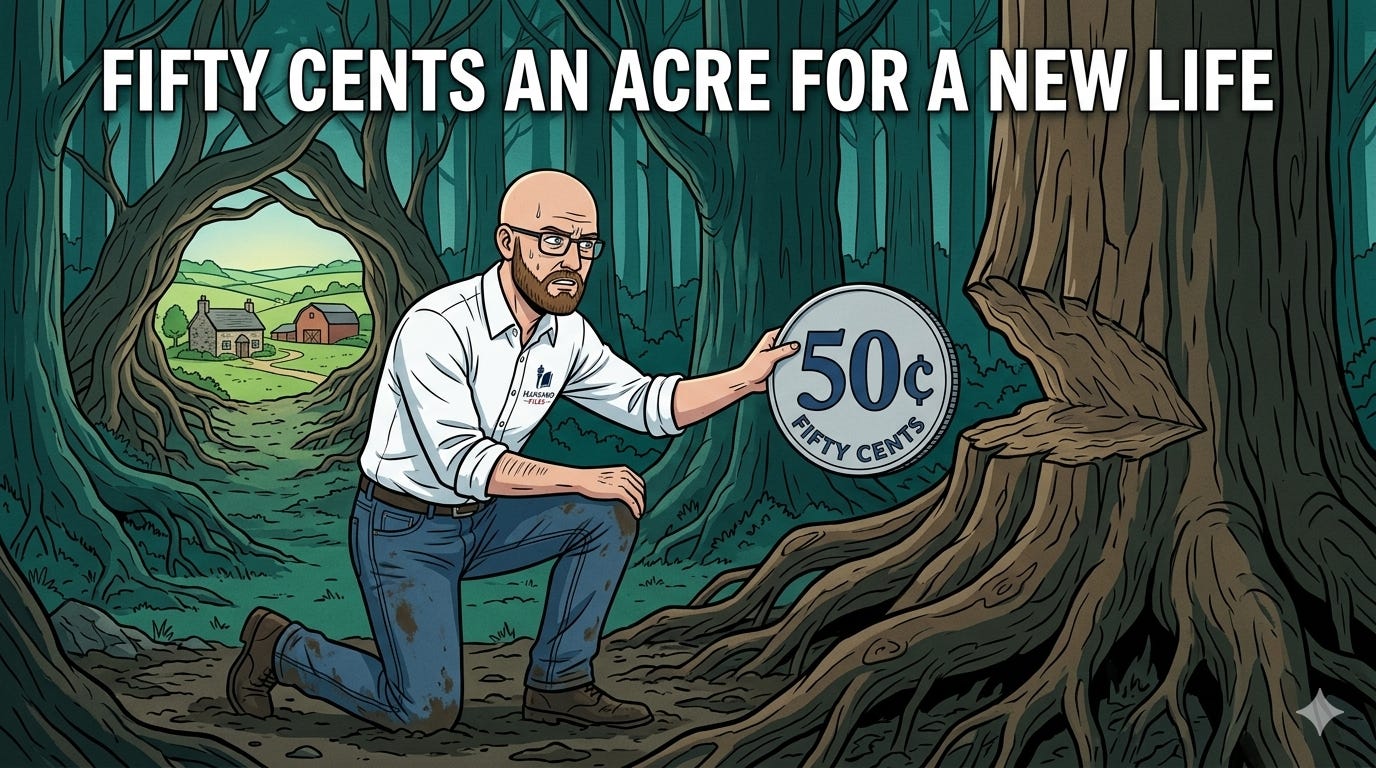
The pamphlet likely landed on a kitchen table in Manchester or Leeds with a thud of promise that defied the surrounding industrial gray. It was 1928. The Great Depression had not yet paralyzed the global economy, but for the working-class families of the British Isles, the post-war recovery was a grinding, soot-stained struggle. Then came this booklet, emblazoned with a simple, hypnotic title: A Farm Home in Ontario.
It did not offer a job. It offered a kingdom.
The cover alone was a masterpiece of psychological marketing, featuring a pastoral idyll that seemed light-years away from the cramped row houses of England. Inside, the government of Ontario laid out a proposition so audacious it reads today like fiction: for fifty cents an acre, a man could claim his own slice of the Empire. This was the peak of the Ontario land settlement scheme, a final, desperate push to colonize the “New Ontario” of the north with “sturdy families from the British Isles” before the world changed forever.
The Garden of the Empire
To understand the allure of this document, one must first understand the geography it invented. The booklet, issued by the authority of John S. Martin, Minister of Agriculture, divides the province into two distinct worlds, both painted in the hues of paradise.
There was “Old Ontario,” the established south, described as a land of “vine-lands” and “orchards and vineyards that rival the richest on earth.” The writers went to great lengths to reorient the British reader’s internal map. They argued that Ontario was not a frozen wasteland but a southern sanctuary, noting that the province extended to the “geographic level of Rome.” The text urged the reader to forget the latitude of London; agricultural Ontario, it insisted, lay south of the fiftieth parallel, basking in a summer “warm beyond the belief.”
But the true target of the campaign was not the expensive, settled south. It was the “Great Clay Belt” of Northern Ontario. Here, the government needed bodies. To sell this rugged, mosquito-infested frontier to a Londoner, the booklet deployed poetic sleight of hand. It described the north not as a wilderness, but as a “rich earth that beckons to the pioneer,” geographically level with “Herefordshire, Essex, Berkshire.”
The imagery was relentless. It promised a landscape of “white roads” reaching away into the distance, “red brick dwellings” sheltered by trees, and “golden harvest heydays.” It was a vision of England, transplanted and perfected.
The Fifty-Cent Contract
The financial hook was buried in the fine print, but it was the engine of the entire enterprise. In the settled districts, land was expensive. But in the District of Temiskaming and Cochrane—the “New Ontario”—the Crown was practically giving it away.
The terms were explicit: “Crown lands... may be purchased for 50c an acre.”
A head of a family could claim 80 acres in the north. The math was intoxicating. For forty dollars—roughly the monthly wage of a farmhand—a man could own an estate that would be the envy of a baron back home. The government required only one-quarter of the payment down, with the balance spread over three annual installments at six percent interest.
But the currency of this transaction wasn’t just cash; it was sweat. The government required the settler to erect a “habitable house not less than 16x20 feet” and reside on the land for three consecutive years. During this time, the settler had to clear and cultivate at least fifteen acres. This was the “sweat equity” of 1928—hewing a home out of the boreal forest with little more than an axe and a horse.
To sweeten the deal, the Northern Development Branch offered loans of up to $500 to assist with “erecting buildings, purchasing live stock and implements.” The government wasn’t just the seller; it was the banker, the advisor, and the architect of the settler’s future.
Social Engineering and the “British Stock”
The document makes no secret of its demographic intentions. This was not an open invitation to the world; it was a targeted recruitment of British citizens to bolster the “Empire.” The text proudly declares that Ontario was “originally settled by sturdy families from the British Isles” and assures the potential immigrant that they will find themselves “among friends.”
“More than likely,” the booklet seduces, “you will know families in the new community who, like yourself, have come right from your own countryside.”
This racial and cultural reassurance was central to the pitch. The government promised that the social pattern of Ontario was “much the same as that of infinitely older countries.” It highlighted the existence of separate schools for Roman Catholics and public schools for Protestants, ensuring that the sectarian divides of the Old World could be comfortably maintained in the New.
There was even a specific track for youth. The “Boy Settlement” plan allowed young men from sixteen years of age to be placed with farmers for three years of apprenticeship. It was a cradle-to-grave vision of population management, designed to transplant the British working class into the Canadian shield.
The Techno-Pastoral Dream
Perhaps the most striking aspect of the 1928 pitch is its obsession with modernity. While asking settlers to clear forests like medieval pioneers, the booklet simultaneously dazzled them with the wonders of the 20th century.
“Hydro-Electric Power” is capitalized like a deity throughout the text. The authors knew that the drudgery of farm life—particularly for women—was the greatest deterrent to settlement. To counter this, they presented a vision of the electrified farm that was advanced even for city dwellers of the era.
“Cooking, washing, ironing and sewing can be done by electric power,” the text promises, claiming this has relieved the “drudgery that in the past has made farm life a burden to the womenfolk.” Photographs showed women using electric washing machines and families dining under electric lights, a sharp contrast to the oil lamps and scrub boards common in rural Europe.
The “isolation” of the farm was dismissed as a myth. The text boasted that “nearly every farm is equipped with a telephone” and that “the radio is being very largely installed.” The automobile, too, was presented as a universal standard, with the claim that “there is scarcely a farm in Ontario that lacks a motor car or light lorry.”
The Reality Between the Lines
For all its optimism, the booklet contains hints of the brutal reality awaiting the 50-cent settlers. The requirement to clear fifteen acres of northern forest in three years was a herculean task. The “Great Clay Belt,” while fertile, was notoriously difficult to drain and prone to short growing seasons.
The text vaguely alludes to this struggle, noting that the pioneer must be a man of “courage and resource.” It mentions that while Old Ontario offers opportunities for a man with capital, New Ontario is for the man willing to perform “splendid service... hewing an empire out of a wilderness.”
The booklet ends with a barrage of statistics designed to overwhelm skepticism—millions of pounds of butter, vast herds of “Yorkshire” hogs, and charts showing Ontario’s dominance over the other provinces. It was a “hard sell” backed by the full weight of the Crown.
Reading it today, with the hindsight of the Great Depression that would crash down just months later, the booklet feels like a ghost story. It captures the final moment of the “Roaring Twenties” optimism, where a government believed it could conquer the northern climate with brochures, loans, and the desperate hope of British families seeking a home.
Hansard Files digs through the archives to find the stories that shaped our world. Subscribe below to support independent investigative history.
Source Documents
Ontario Department of Agriculture. (1928). A Farm Home in Ontario. Province of Ontario.
I've always found the Empire Ontario and clay belt expansion interesting. I would like to see parts of the clay belt protected as a provincial park locking in North South corridors and something like 40% of the land.
But I would like to see a real push to bring the region into agricultural production. I think we should have a big marketing campaigns in the US Midwest for farmers (I'd also like to see Dutch farmers but aimed more at other regions). It might be something some Mennonite communities are interested in as well. Beef North looks like a good concept to me.