


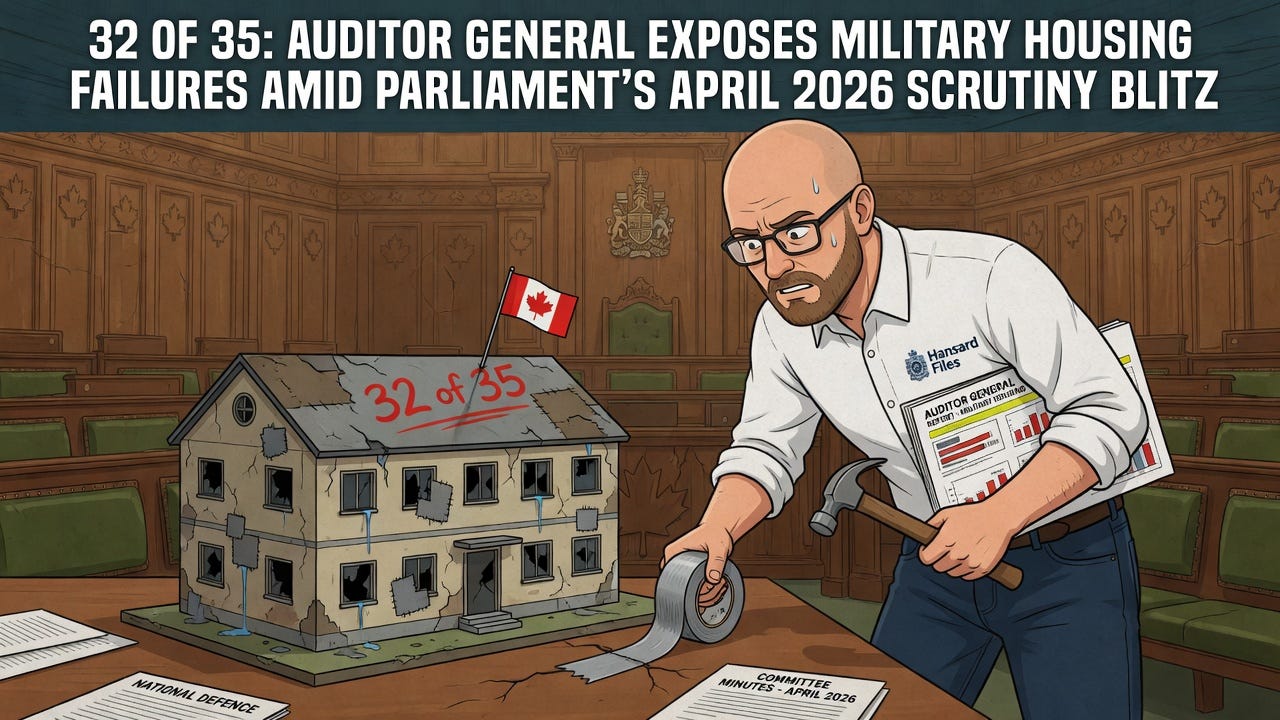
In the wood-paneled room on Parliament Hill where the Standing Committee on Public Accounts met on the morning of April 13, 2026, the air carried the quiet weight of accountability. Chair John Williamson called meeting number 30 to order. Members sat in person and on Zoom. The witness list included Auditor General Karen Hogan and her director, Stuart Smith.
Hogan began with the required land acknowledgment. Then she turned to the fall 2025 Auditor General report on housing for Canadian Armed Forces members.
“Overall, National Defence did not manage living accommodations in a manner that would meet its operational needs and be responsive to the needs of Canadian Armed Forces members and their families,” she stated. “This is particularly important because the Canadian Armed Forces are planning to add additional members in the future.”
The details that followed were precise and damning. National Defence lacked reliable data on furnished housing, or quarters. There was no accurate count or location map of beds intended for members in training, on short-term assignments or in transit. The audit team had visited three bases. Many quarters were in poor condition. Some lacked safe drinking water. Others had no working toilets. Of the 35 buildings examined, 32 needed at least one high-priority repair to meet minimum standards for size, amenities and physical condition.
The Canadian Forces Housing Agency had not planned enough new units to close the gap. On March 31, 2025, more than 3,700 members held outstanding applications for residential housing units. Only 205 units were available. Planning documents still relied on 2019 data and did not factor in the force’s expansion to authorized full strength.
“Canadian Armed Forces members can be required to move frequently,” Hogan continued. “It is important for their morale and well-being that they can access affordable housing in good condition to meet their needs, as well as those of their families.”
The testimony landed with force. These were not abstract policy failures. They were the living conditions of the people who serve the country and the families who support them.
Families Under Financial Strain
That same afternoon, in the Standing Committee on Finance, meeting number 32, Vice-Chair Jasraj Hallan opened a study on household debt. Shereen Benzvy Miller, Commissioner of the Financial Consumer Agency of Canada, sat with her deputies. She described a population under real strain.
“According to our monthly financial well-being survey, 40% of Canadians reported their debt had increased in 2025, up from 35% in 2020,” she said. “Nearly two-thirds say they are carrying non-mortgage debt, with parents and those aged 35 to 54 being the most indebted.”
The agency had already moved on earlier signals. In 2023 it issued a supervisory guideline requiring banks to proactively contact mortgage holders showing signs of distress. By December 2025, more than 165,000 at-risk accounts had been reached. Canadians had avoided over $7.85 million in late payment penalties and fees. Clear disclosure rules for credit cards, mortgages and lines of credit remained a core part of the consumer protection mandate. Yet the underlying pressure on household balance sheets had not eased.
Canada’s AI Edge Is Slipping
A short distance away, the Standing Committee on Industry and Technology continued its study on artificial intelligence, meeting number 31. Chair Ben Carr welcomed new Liberal faces and noted the insightful testimony already received. Witnesses joined online: Alan Veerman, Chief Operations and Finance Officer at the Vector Institute, and Jessica Blackman, director and chief data officer, alongside Jayson Myers of Next Generation Manufacturing Canada.
Veerman described Vector’s mission: taking cutting-edge AI research and enabling Canadian organizations to adopt and deploy it faster. The institute, one of three national AI institutes founded in 2017, counted more than 960 affiliated researchers and produced over 1,000 AI master’s graduates annually, more than 90% of whom stayed in Ontario. It had more than 300 partners, second globally only to MIT in industry engagement.
Yet Veerman delivered a sobering assessment. In 2019 Canada ranked fourth globally in AI thanks to its early strategy. By 2024 it had fallen to eighth. Research strength remained third in the world, but infrastructure ranked 16th and operating environment 18th. Private and public adoption rates still lagged international peers. “Canada has successfully built a world-class AI research base,” he said. “The nation’s private and public AI adoption rates still lag behind those of international peers.”
Veterans Building Businesses Against the Odds
In the Standing Committee on Veterans Affairs, meeting number 28, Chair Marie-France Lalonde opened a study on barriers to entrepreneurship among veterans. The room followed hybrid rules. Witnesses included Nicholas Stroesser, founder of Corporal4Life Apparel, joining by video conference, along with Heather Vanderveer of Alberta Recoil Inc. and Duncan McSporran of Vimy Forge.
Stroesser spoke first. A veteran-owned and veteran-operated apparel company out of Windsor, Ontario, Corporal4Life had grown since 2015 into a brand sold across Canada and the United States, with shipments to Europe and Mexico. It had operated three bricks-and-mortar stores and was now available in two national museums, two regimental kit shops and one independent store in British Columbia. Collaborations included a line of craft spirits with a veteran-owned distillery. The company sponsored fighters, race-car drivers and a youth hockey team. A portion of sales had funded tens of thousands of dollars in donations to veteran, first responder and local charities.
The barriers he named were clear: hiring, mentorship and capital. “I still have big goals for this company, which will be accomplished,” he told the committee. “But how much longer will it take?”
The pride in service and in the business was unmistakable. So was the friction.
Defending Democracy on the Global Stage
The Subcommittee on International Human Rights of the Standing Committee on Foreign Affairs and International Development held its 15th meeting the same day. Chair Fayçal El-Khoury welcomed witnesses including Gabrielle Bardall, assistant professor and Canada Research Chair at Université Sainte-Anne; Leslie Campbell; Professor Miriam Cohen; Kevin Deveaux; Monika Le Roy; and, by video conference, the Honourable Sviatlana Tsikhanouskaya, head and president-elect of Belarus from the United Transitional Cabinet.
Bardall, with more than 20 years of democracy assistance experience across more than 60 countries, delivered the central message: supporting resilient democracy internationally requires a shift from technical support to protecting people, power and participation. Canada is uniquely positioned to lead by setting the normative agenda, establishing a special representative and mobilizing Canadian expertise.
“We are living through a rupture in the international order,” she said. “The rules-based system is under strain. In this context, support for democracy is not only a values issue; it’s really a preventative security and economic policy, the essence of national strategic interests.”
The nature of democratic erosion had changed. It was no longer only the dismantling of institutions but also their manipulation and the shrinking of participation, including through violence against women in politics.
Powering the Economy: Energy Exports Under the Microscope
On April 14 the Standing Committee on Natural Resources met for its 31st meeting. Chair Terry Duguid acknowledged the unceded territory of the Algonquin Anishinabe nation. Witnesses included Gurpreet Lail, President and CEO of Enserva, by video conference, and Stephen Buffalo, President and CEO of the Indian Resource Council.
Lail described an energy services sector that supports hundreds of thousands of jobs and enables all upstream production. In 2024 energy products were Canada’s largest domestic export category at $195 billion, roughly 27% of all domestic exports. Canada already exported over 80% of its crude oil production and 40% of its natural gas production. Yet the country had become one of the least attractive energy investment destinations in the developed world. “What we don’t have is a policy framework that consistently lets us win,” Lail said. “The consequences of this are being felt in communities, at the dinner table and throughout all provincial budgets.”
Keeping Goods Moving: Ports and Labor Stability
Also on April 13 the Standing Committee on Transport, Infrastructure and Communities held its 28th meeting. Chair Peter Schiefke welcomed witnesses including Derrick Hynes, interim president and CEO of the National Maritime Group; Eric Harvey, president and CEO of the Railway Association of Canada; and Atul Sharma of the Toronto Port Authority by video conference.
Hynes delivered a blunt assessment. The National Maritime Group represents nearly 100 private sector maritime employers handling over a quarter of Canada’s total traded goods. “The status quo is no longer an option,” he said. “Canada faces an economic crisis. We need to act with a sense of urgency to improve the performance of our transportation infrastructure.”
In the past two years the transportation network had endured 60 work stoppages. The Industrial Inquiry Commission on West Coast Ports had released its report a year earlier with no action yet. Two recommendations stood out: geographic certification of unions along west coast ports to allow one employer and one union, and measures to bring greater stability to collective bargaining.
The Efficient Machinery of Private Members’ Business
On April 14 the Subcommittee on Private Members’ Business of the Standing Committee on Procedure and House Affairs held its fourth meeting. Chair Élisabeth Brière noted 18 items for consideration. Two had received comments. No questions arose. The subcommittee adopted three motions by unanimous consent: that all items placed on the order of precedence on March 10, 12, 19 and 26, 2026 remain votable; that the subcommittee present a report listing items it determined should not be designated non-votable; and that the Chair report the findings to the Standing Committee on Procedure and House Affairs as soon as possible. The meeting adjourned after minutes.
Setting the Rules for Major Projects
That same evening the Special Joint Committee on the Exercise of Powers Under the Building Canada Act held its second meeting. Joint Chairs Dean Allison and Senator Patti LaBoucane-Benson presided over a hybrid session. Members adopted an amended motion setting witness opening statements at five minutes with 72-hour advance submission where possible, and detailed question rotation rules for three-hour and 90-minute panels. A second motion on tie votes was withdrawn; the original text, giving joint chairs full participation rights including moving motions and voting, with tie votes resulting in the item being negatived, was adopted. The committee then turned to a motion on its mandate and first guests.
What These Hearings Reveal
Across two days and nine committee rooms, Parliament Hill functioned as a national diagnostic center. One room revealed that 32 of 35 examined military buildings required urgent repairs and that 3,700 members waited for housing while only 205 units sat ready. Another showed 40% of Canadians reporting rising debt. A third documented Canada’s drop from fourth to eighth in global AI rankings despite third-place research strength. A fourth captured a veteran entrepreneur asking how much longer he could sustain a business that had already given back tens of thousands to charity. A fifth heard calls to protect democracy defenders amid a rupture in the international order. A sixth stressed that energy exports worth $195 billion needed a winning policy framework. A seventh warned of 60 work stoppages in two years threatening supply chains. An eighth moved 18 private members’ items forward in minutes. A ninth settled procedural rules for a new joint committee on major projects.
These were not isolated proceedings. They were the daily work of accountability. The transcripts capture specific human moments, concrete numbers and direct testimony that together form a clearer picture of where policy meets reality in Canada in the spring of 2026. The mechanisms exist. The questions are being asked. What happens next depends on whether the answers are heard and acted upon.
Hansard Files spends weeks in the archives so you don’t have to. If stories like this matter to you, subscribe — it keeps this work independent.
Related Hansard Files Articles


Source Documents
House of Commons. (2026, April 13). *Standing Committee on Public Accounts, Evidence* (Number 030).
House of Commons. (2026, April 13). *Standing Committee on Finance, Evidence* (Number 032).
House of Commons. (2026, April 13). *Standing Committee on Industry and Technology, Evidence* (Number 031).
House of Commons. (2026, April 13). *Standing Committee on Veterans Affairs, Evidence* (Number 028).
House of Commons. (2026, April 13). *Subcommittee on International Human Rights of the Standing Committee on Foreign Affairs and International Development, Evidence* (Number 015).
House of Commons. (2026, April 14). *Standing Committee on Natural Resources, Evidence* (Number 031).
House of Commons. (2026, April 14). *Subcommittee on Private Members’ Business of the Standing Committee on Procedure and House Affairs, Evidence* (Number 004).
House of Commons. (2026, April 14). *Special Joint Committee on the Exercise of Powers Under the Building Canada Act, Evidence* (Number 002).
House of Commons. (2026, April 13). *Standing Committee on Transport, Infrastructure and Communities, Evidence* (Number 028).
In the mid 90's I was visiting our offices in Edmonton. The young woman I was working with invited me to her home for dinner with herself and her husband, who was a member of the CAF. I recall walking into that CAF owned home and thinking that it hadn't been updated since it was built shortly after WW2 and was badly in need of it. On the other hand they were happy to have it since there was shortage of CAF homes available and rents in Edmonton were daunting for a young couple.
My son is living in barracks at CFB Esquimalt. He grew up with me doing renovations on the house so when he told me about some of the issues, I asked if he could fix things himself. He said when he suggested doing so, the Powers That BE said no way, no how, don't even think about it.
It's remarkable to me that during a time of RECORD DEFICIT SPENDING, there is so many very basic issues which are being neglected. But hey... we're sure committed to Ukraine and Zelenskyy needs a new Bentley (Kyiv is currently the third biggest customer of luxury Bentley autos).