


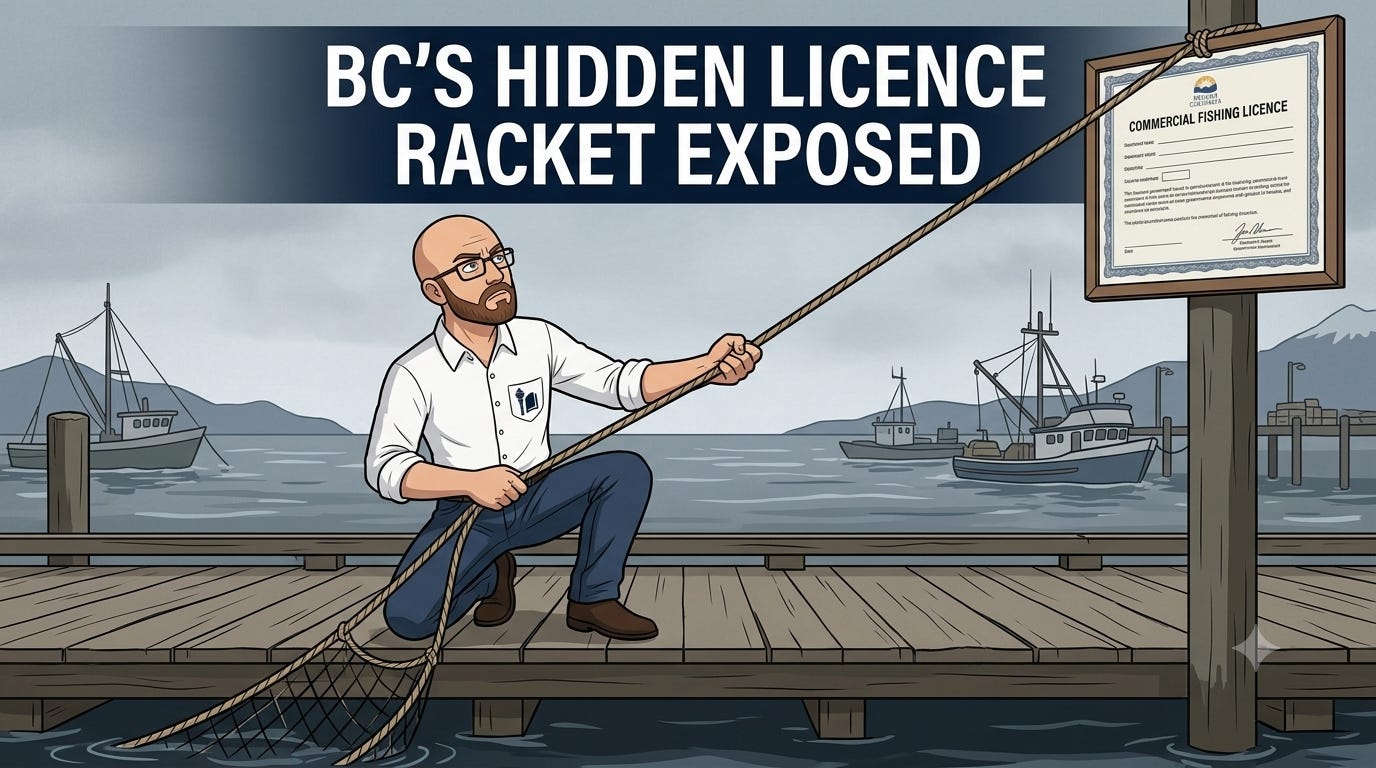
There’s a detail buried in the Senate Fisheries Committee evidence from the 45th Parliament that stops you cold once you understand what it means. In British Columbia, a person can hold a commercial fishing licence, never leave the dock, never get their hands wet, never catch a single fish, and still pocket a tidy profit every season. They do it by renting the licence out to an actual fisher who does all the work, takes all the risk, and then hands over a substantial cut of everything they land just for the privilege of going to sea.
Rick Williams put it directly when he testified before the Standing Senate Committee on Fisheries and Oceans.
“In Atlantic Canada,” he told senators, “a fishing licence is a licence to catch fish. In British Columbia, it’s a licence to control fish prices and to make big profits, renting out the privilege at exorbitant rates to the people who do the fishing.”
That sentence is not hyperbole. It’s a description of how the Pacific Coast commercial fisheries licensing regime actually functions.
Hansard Files spends weeks in the archives so you don’t have to. If stories like this matter to you, subscribe to keep this work independent.
A Tale of Two Coasts
On the Atlantic side, the owner-operator model is federal policy. If you hold a licence, you fish it. You can’t park it in a portfolio and collect rent from someone who actually works the water. Fleet separation rules reinforce this by keeping processing companies out of the harvesting side. The protections aren’t perfect, and enforcement has its own problems, but the principle is clear: the licence belongs to the person doing the fishing.
British Columbia never had those rules. What it got instead was a system where licences became tradable financial assets, decoupled from the act of fishing itself. Over decades, the committee heard, those licences concentrated in the hands of processing conglomerates, corporate buyers, and investors with no operational connection to the fishery. The people who actually fish in BC now routinely lease those licences back from the owners, often paying between 50 and 80 percent of their landed value before they’ve covered fuel, gear, or crew.
The average fishing income in BC was $23,000 to $24,000 in 2019. A fishery that’s been part of the provincial economy for over a century, that stocks Canadian tables and export markets, where the person doing the work brings home less than $24,000 a year.
The employment numbers follow the money. Since 1990, the fishing fleet on the Pacific has dropped by 60 percent. Employment in the commercial fishery has dropped alongside it. Communities along BC’s coast that built themselves around the fishery have watched it hollow out not because the fish disappeared, but because the economics of who controls the right to fish made actual fishing unviable for anyone without outside capital.
Who the Fishery Is Actually For
Williams wasn’t the only voice the committee heard. The evidence session drew testimony from multiple perspectives on the Pacific licensing regime, and they converged on the same structural diagnosis. The current system doesn’t just disadvantage active fishers. It systematically transfers wealth from coastal communities, where the fishing actually happens, to outside investors, where the financial returns actually accumulate.
The committee heard that this isn’t an accident of history, exactly. It’s the downstream consequence of a policy architecture that treated fishing licences as property to be owned rather than a public resource right to be exercised. Once that happened, market forces took over. Licences became expensive. Expensive licences became attractive investments. Investment money pushed licence values higher, pricing out working fishers who might otherwise buy their way into the industry. The result is a class structure inside the fishery: people who own the right to fish, and people who pay for the right to use that right.
For young people trying to enter the industry, the committee heard, the economics are simply prohibitive. You can’t build a fishing operation from scratch when your first obligation every season is a lease payment that consumes the majority of your revenue before expenses.
The Atlantic Model as the Counterargument
The comparison Williams drew to Atlantic Canada isn’t incidental. The Senate committee is studying the Pacific regime partly because the contrast with Atlantic policy is so stark, and partly because what happened in Atlantic Canada’s owner-operator fishery offers a working example of how different rules produce different outcomes.
Atlantic inshore fishing communities have their own pressures. Enforcement of fleet separation rules has been criticized as inconsistent. Corporate consolidation in the processing sector continues to squeeze harvester incomes. But the underlying principle, that a licence is an entitlement to fish, not an investment vehicle, has kept income flowing to active harvesters in a way the BC regime has not replicated.
The question the committee left hanging is what it would take to reorient the Pacific system. Williams framed it as a policy choice, not an inevitability. The rules that allow BC licences to be held and leased by non-fishing entities exist because no one changed them. Atlantic Canada made different choices. The Pacific didn’t.
What the Numbers Say
The income figure is worth sitting with. Twenty-three to twenty-four thousand dollars a year is what the average BC commercial fisher brought home in 2019. That’s before the full weight of the pandemic, before the supply chain disruptions of subsequent years, before whatever the current season looks like. It’s a number that puts the policy question into human terms quickly.
A 60 percent decline in fleet size since 1990 means the people still fishing in BC are the survivors of a decades-long economic squeeze that has driven thousands of their predecessors out of the industry. It means coastal communities that once supported thriving independent fishing operations are now supporting far fewer of them, with far less money circulating locally.
The committee also heard testimony about what the concentration of licence ownership looks like when you follow it through the supply chain. Because processing companies and corporate investors control significant licence holdings, they have structural leverage over the harvesters who lease from them. In some cases, lease agreements come with conditions that effectively direct harvesters to sell their catch through a specific processor, compounding the income pressure.
None of that is illegal under the current regime. That’s the point Williams was making, and that the committee’s study is positioned around. The problem isn’t that someone broke the rules. The problem is that the rules produce these outcomes by design.
An Answer the Record Doesn’t Have Yet
The Senate Fisheries Committee is still in the study phase on Pacific commercial licensing. No recommendations have been tabled. No legislative changes are on the table. What the committee has done, through sessions like this one, is build a detailed record of how the system works and who it works for.
That record matters. It’s the foundation for any future policy response, and it makes the problem hard to deny. The income numbers, the fleet decline figures, the direct comparison to Atlantic policy, the structural description of how lease arrangements function, all of it is now formally in the parliamentary record.
Whether the study produces a report that moves federal policy on Pacific fishing licences, or whether it joins the long archive of Senate studies that document a problem without changing it, is not something the current evidence can answer. What the evidence does answer is the question Rick Williams put to the committee in plain language: in BC, the people who fish the Pacific are not, in any meaningful sense, the people who own the right to do it.
That’s the problem. The committee heard it. The record has it. What comes next is the government’s choice.
Hansard Files spends weeks in the archives so you don’t have to. If stories like this matter to you, subscribe to keep this work independent.
Related Hansard Files Articles


Source Documents
Senate of Canada, Standing Senate Committee on Fisheries and Oceans. (2026). Evidence (33ev-57776.pdf). 45th Parliament, 1st Session.
The Atlantic model is neither simple nor ideal. My father (RIP) was a commercial fisherman.
Mi'kmaw (local first nations) decided fishing for food & ceremonial fishing wasn't enough so they pushed to feds to give them "communal licences" to be used by any member of the band. I'm not sure I understand the difference between that and a food & ceremonial licence but I digress.
My family has native heritage but my father objected to this as he figured it would cause more problems than it solved. And he was right. The gubbermint gave them what they wanted.
Then the FN asked for commercial fishing licences. And, of course, the gubbermint capitulated without giving it a moment of thought. When the commercial fishermen pointed out licencing was done to protect the fish stocks, the gubbermint stopped issuing new licences and created for existing commercial fishermen who wanted to sell their licences back to the gubbermint for the purposes of conversion to native commercial fishing licences.
Now comes the bitter truth part... most of those FNs pushing for commercial fishing licences lacked the equipment and skills to do commercial fishing. So the gubbermint paid for boats and gear. One cannot however buy skills.
So most of the FN commercial licence holders "lease" their licence to non-FN commerical fishermen to do the actual work.
If that sounds much like the west coast fisheries, go figure.
Now for the capper... a coalition of Mi'kmaw bands and BC based Premium Brand Holdings spent $1billion to buy up Clearwater Seafoods Inc, a multinational vertically integrated fish buyer & processing company. I'm not sure whether Premium Brand Holdings got their half but the local FNs laughed about how the gubbermint gave them $250m for the up front cost and the rest is a long term loan being paid by revenues of the company being operated by Premium.
If that sounds like a great deal for the taxpayers to you, I'd like to offer you a special deal on ocean front property in Saskatchewan.
Why the hell do we have 2 license regimes? The Atlantic model, for all it's problems, makes more sense to me. This is worse than taxi licenses in Toronto being held by a few corporate owners.