


During three days of farewells to independent senators, the chamber transferred jurisdiction over Criminal Code sexual offences by Canadian Armed Forces members to civilian courts, defeated an amendment that would have let victims choose their forum, and heard blunt testimony about capacity gaps that already produce stays in one in seven civilian sexual assault cases.
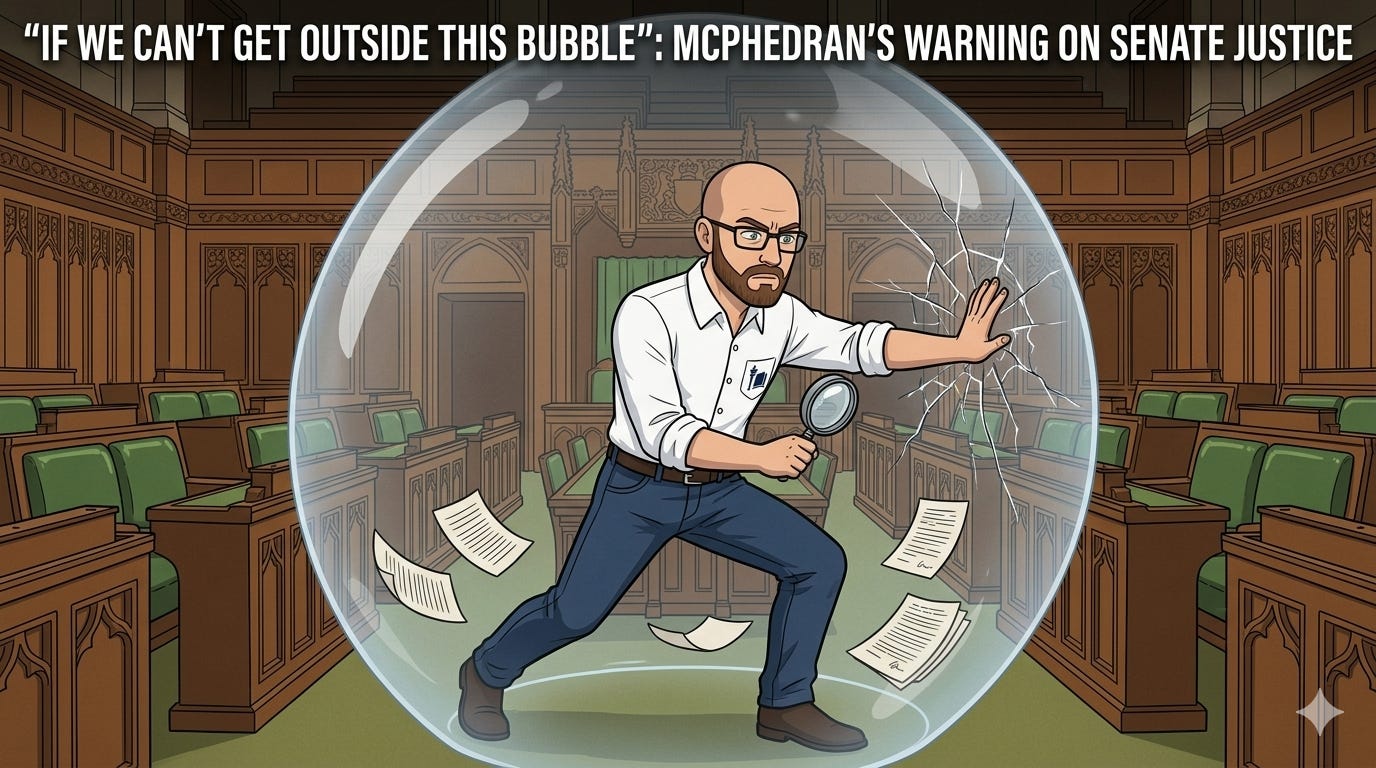
On June 10, Senator Marilou McPhedran stood to deliver her farewell. She described fighting secret complaints inside the Standing Committee on Internal Economy, Budgets and Administration. The process had cost her approximately $100,000 over 42 months before the Senate Ethics Officer exonerated her. There was no appeal.
“What if we were to choose, as a standard, fairness? What if we were to choose, as a standard in our decision making, transparency and accountability? If we can’t get outside this bubble, there is no court that can touch this place. De facto, we have no Charter rights as senators inside of self-governance...”
Two days later the Senate passed Bill C-11 at third reading on division. The legislation transfers the investigation and prosecution of Criminal Code sexual offences committed by CAF members in Canada from the military justice system to the civilian system. It codifies Recommendation 5 of the 2022 Arbour report.
The Amendment That Did Not Pass
In committee, an amendment to preserve victim choice between military and civilian forums was defeated on a 7-7 tie. A different amendment survived. It requires a statutory review of the jurisdictional transfer three years after the bill comes into force.
Former Supreme Court Justice Marie Deschamps had argued that victims should retain the right to decide where their case is heard. The Canadian Association of Chiefs of Police warned that local forces lack the resources and specialized capacity for these complex files.
One witness, Major (Ret’d) Donna Ven Leusden, put the stakes directly: “Jurisdictional reform without cultural reform will not deliver outcomes. We do not need another report. We do not need another study.”
A separate concern was recorded in the record. Transferring these cases means CAF members charged with Criminal Code sexual offences will no longer have the right to receive legal representation at no cost. In the civilian system, approximately one in seven sexual assault cases is already stayed or withdrawn because of unreasonable delay under the Jordan decision. More than 268 such cases have been documented to date.
The Same Week, Other Justice Files
On June 9 the Senate had taken up Bill C-225, known as Bailey’s Law. It creates a specific first-degree murder offence when an intimate partner killing occurs in the context of coercive or controlling conduct. The bill extends the retention period for seized evidence from 90 to 180 days and strengthens reverse onus bail provisions for those with prior intimate partner violence convictions or active peace bonds. Committee amendments were made to protect victims who act in self-defence from being swept into automatic first-degree charges.
Senators heard the scale: 128,175 police-reported cases of intimate partner violence in 2024. Women and girls experience IPV at a rate 3.5 times higher than men and boys and account for 79 percent of IPV-related homicides.
“Every 48 hours in this country, a woman is killed by her intimate partner,” Senator Fabian Manning told the chamber.
On June 11, alongside the final debate on Bill C-11, the Senate also considered Bills S-223 and S-224. The proposed changes would amend the RCMP Act and the Director of Public Prosecutions Act to compel enforcement and prosecution of First Nations laws and bylaws. Currently, police sometimes decline to enforce measures such as banishments for drug trafficking, citing jurisdictional uncertainty. Provincial models in Saskatchewan and Manitoba were cited as working examples that integrate First Nations bylaws into existing ticketing and court systems. The 2024 Supreme Court of Canada decision in Dickson v. Vuntut Gwitchin First Nation had already affirmed that the Charter applies to First Nations laws while Section 25 shields collective rights.
Three Farewells, One Institution
The legislative activity unfolded against three retirement tributes. On June 9 senators honoured Donna Dasko for her polling work, her advocacy for Ukraine, and her role in achieving gender parity in the Senate, now at 55 percent women. She spoke of the independent appointment process allowing the chamber to take the views of Canadians into account without direction from a partisan caucus. Nanos polling from March 2026 showed 79 percent of Canadians prefer that model over the old partisan system.
On June 11 the chamber paid tribute to Mohammad Al Zaibak, the first Syrian-born Arab Canadian senator and founder of Lifeline Syria, which resettled thousands of refugees.
He closed with a simple charge: “Make good deeds and cast them into the sea... Give without condition or expectation of return, and the universe takes care of the rest.”
Between those bookends, McPhedran’s accounting of secret complaints, personal cost, and the absence of natural justice inside the Senate’s own administrative body remained on the record.
The Senate rose for the summer having passed Bill C-11, advanced Bailey’s Law, and debated new mechanisms to enforce First Nations laws. It had also heard, from one of its own retiring members, a detailed description of how its internal economy committee functions without the procedural protections it routinely debates for others.
Hansard Files spends weeks in the archives so you don’t have to. If stories like this matter to you, subscribe to keep this work independent.
Source Documents
Senate of Canada. (2026, June 9). Debates of the Senate [080db_2026-06-09-e.pdf].
Senate of Canada. (2026, June 10). Debates of the Senate [081db_2026-06-10-e.pdf].
Senate of Canada. (2026, June 11). Debates of the Senate [082db_2026-06-11-e.pdf]]