


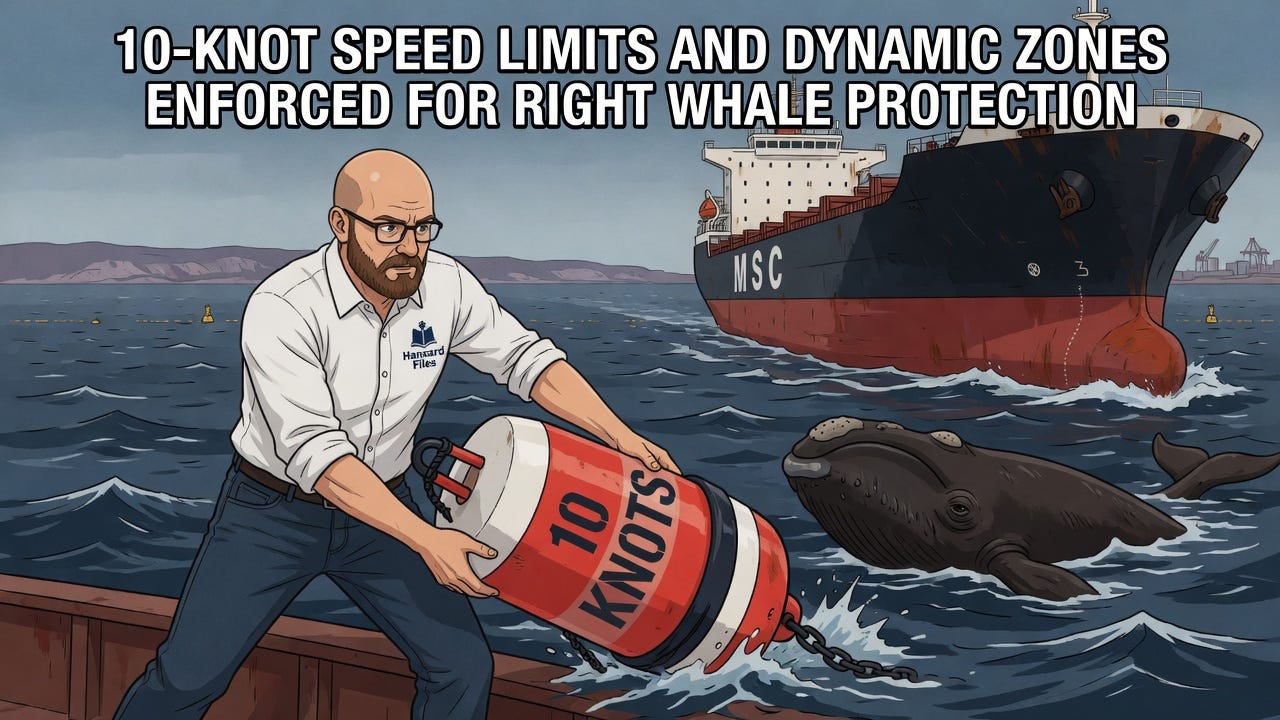
On April 14, 2026, Transport Minister Steven MacKinnon reviewed the latest detection data and signed the order. Eight days later, on April 22, the rules snapped into effect across one of Canada’s busiest shipping corridors. For every vessel longer than 13 metres, the Gulf of St. Lawrence suddenly became a carefully choreographed zone of caution. The Interim Order for the Protection of North Atlantic Right Whales (Eubalaena glacialis) in the Gulf of St. Lawrence, 2026, will run until November 15. It is not a blanket slowdown. It is a living system, triggered by the whales themselves.
The order rests on the Canada Shipping Act, 2001. Its stated purpose is direct: deal with “a direct or indirect risk to marine safety or to the marine environment.” What that means in practice is a layered network of speed limits, detection-triggered alerts, and one tightly controlled restricted area, all enforced through navigational warnings broadcast by the Canadian Coast Guard.
Static Zones Form the Foundation
Two permanent static zones now carry a mandatory 10-knot speed limit over ground. The northern static zone begins at 50°20’N, 65°00’W, runs south and east along a precise polygon that hugs the Gaspé Peninsula, and closes back on itself. The southern static zone sits below it, stretching from 48°40’N, 65°00’W eastward to 48°03’N, 61°07.5’W and south to 47°10’N. Both exclude the dynamic shipping zones nested inside them, but the 10-knot rule applies everywhere else inside the lines.
Commercial fishing vessels in waters no deeper than 36.57 metres were initially exempt. So were federal air-cushion vessels clearing ice. That exemption, however, is conditional. The moment the Minister detects a right whale in those shallows, the Coast Guard issues a navigational warning and the speed limit returns for the fishing fleet. The rule stays in force until 15 full days pass without another detection.
Dynamic Shipping Zones Respond to Live Sightings
Five dynamic shipping zones sit inside the larger static areas, each with its own five-nautical-mile buffer to the south and 2.5-nautical-mile buffers east and west. Zone A runs near 49°41’N, 65°00’W. Zone B sits farther east. Zone C continues the chain. Zone D lies northward near the 50th parallel. Zone E completes the pattern closer to the southern edge. When a right whale is spotted inside any zone or its buffer, the Minister directs the Coast Guard to publish or broadcast a navigational warning. From that instant, every vessel over 13 metres must slow to 10 knots. The restriction lifts automatically after 15 days without further sightings, or when whale-detection operations resume following any seven-day outage.
The system is deliberately agile. No fixed calendar dictates the rules. The whales write the schedule.
Seasonal Management Areas Tighten Through Peak Season
Until June 30, 2026, two seasonal management areas operate under the same 10-knot ceiling. After July 1 the rules shift to detection-based, exactly like the dynamic zones. Seasonal Management Area 1 lies east of the main shipping channel; Seasonal Management Area 2 sits farther south. Both are defined by the same coordinate grid that threads through the entire order.
Restricted Area Imposes the Strictest Controls
Inside the southern static zone lies a smaller, high-risk pocket now subject to outright prohibition. The Minister can activate the restricted area when right-whale presence spikes or when reports of deaths or injuries arrive from the Gulf. Once the navigational warning issues, no vessel may enter. The ban ends only when conditions ease.
Exceptions are narrowly drawn. Commercial fishing vessels, those operating under Aboriginal communal fishing licences, federal employees or peace officers on duty, government-funded right-whale research teams, Department of Fisheries and Oceans marine-mammal response crews, pollution responders, cable-maintenance vessels, and ships avoiding immediate danger are allowed inside. Even these vessels must not exceed eight knots while the prohibition remains active.
Broader Triggers and the Weather Safety Valve
Any confirmed death or injury of a right whale anywhere in the Gulf can trigger 10-knot limits across the affected dynamic zones and, after July 1, the seasonal areas. The same 15-day clearance period applies.
Weather provides the only built-in relief. If current or forecast conditions threaten marine safety, the Minister can suspend a speed limit or prohibition by another navigational warning. The suspension ends the moment conditions improve. For greater certainty, the order states that any such suspension does not extend the underlying duration of a speed limit.
What the Rules Mean for Mariners on the Water
Every master of a vessel over 13 metres must now monitor Coast Guard navigational warnings before entering the Gulf. A single confirmed sighting can rewrite transit plans across hundreds of square nautical miles. The full set of coordinates, zone definitions, and buffer descriptions is published verbatim in the Canada Gazette so operators can plot them with precision.
The order draws clear lines between essential operations and protected waters. Fishing vessels retain access under defined conditions. Research vessels supporting right-whale science continue their work. Emergency response remains unimpeded. Yet the default for large commercial traffic is now slower, more watchful passage.
The measure ends on November 15, 2026. Until then, the Gulf operates under this living framework: static zones for the baseline, dynamic zones for real-time response, seasonal areas for the summer peak, and one tightly controlled restricted pocket for the highest-risk moments. Every decision flows from the presence, or absence, of the whales themselves.
Hansard Files spends weeks in the archives so you don’t have to. If stories like this matter to you, subscribe — it keeps this work independent.
Related Hansard Files Articles


Source Documents
Government of Canada. (2026, April 25). Canada Gazette Part I, Vol. 160, No. 17.