


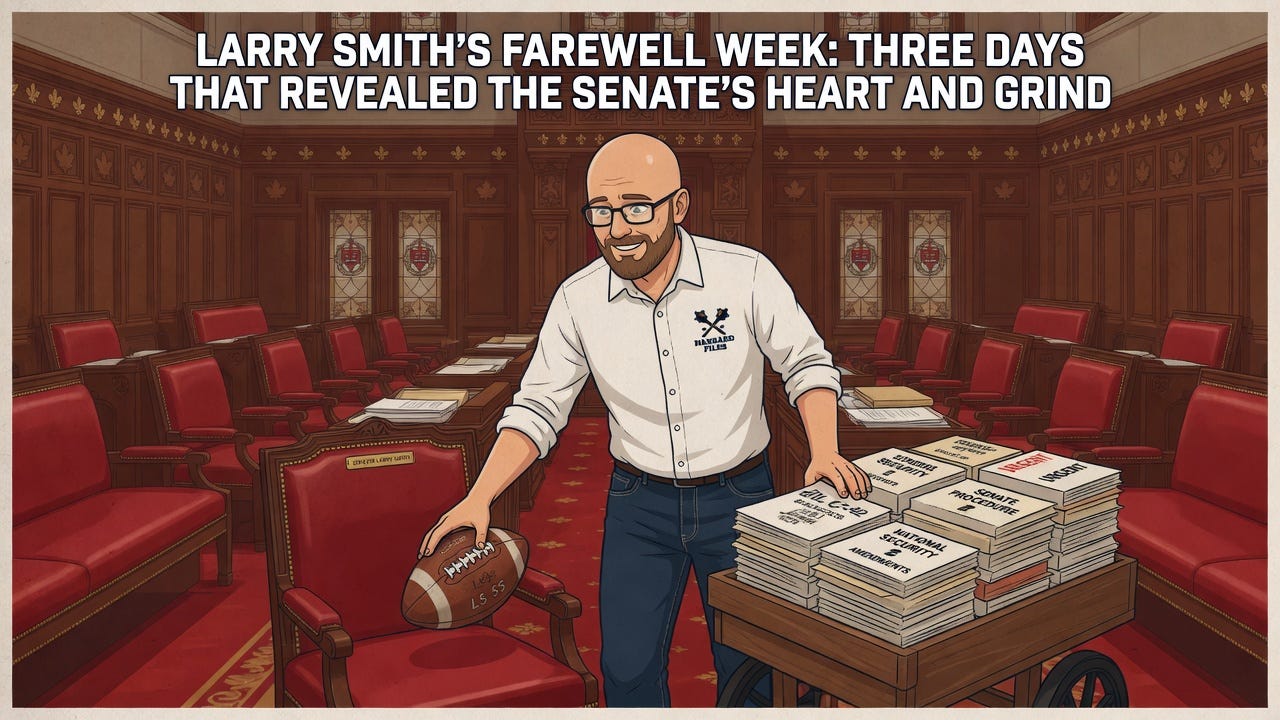
On Thursday, April 23, 2026, at 1:30 p.m., Speaker Raymonde Gagné did something the Journals of the Senate rarely record. She extended Senators’ Statements at the request of the Leader of the Opposition so the chamber could properly say goodbye. The Honourable Larry W. Smith, who would leave the Senate five days later, sat in his place while colleagues from every group rose one by one. What unfolded was not routine. It was the human counterpoint to a week of hard legislative work.
The tribute did not erase the other business. It framed it. Across three consecutive sitting days the Senate had moved cyber-security legislation, received observations on a major trade deal, welcomed a new private member’s bill on living donors, and listened to statements that ranged from Taiwan’s survival under shadow to the quiet crisis of Canadian topsoil. The Journals captured the procedural skeleton. The Debates captured the voices. Together they showed an institution still capable of both grind and grace.
Tuesday, April 21: Purpose and Postponement
The week opened with the usual bilingual formality. The Journals listed 78 senators present in the chamber and another handful attending to business under the Senators Attendance Policy. Prayers. Then statements.
Senator Leo Housakos, Leader of the Opposition, delivered one of the week’s most urgent interventions. He had just led a Senate delegation to Taiwan. “Taiwan is not only a partner,” he told colleagues. “They are also an indispensable democratic anchor in the Indo-Pacific.” He described an island of 23 million people that had surpassed the United Kingdom as the world’s seventh-largest stock market and commanded nearly 80 percent of the global foundry market. “Every AI chip, every EV component and every advanced defence system we rely on starts there in Taiwan,” he said, while living under the constant shadow of Chinese Communist Party aggression. The message was clear: Canada’s partnership with Taiwan was not optional.
Senator Bernadette Clement rose next on behalf of the African Canadian Senate Group. She thanked founding chair Rosemary Moodie and listed the group’s members, including Senators Wanda Thomas Bernard, Amina Gerba, Mohamed Ravalia, Sharon Burey, Tony Ince, Paulette Senior, Suze Youance, and herself. “We stand against anti-Black racism,” she said. “We speak for communities that are too often underserved and unheard.” She spoke of dancing briefly and joyfully at her oath-taking alongside her godmother, Senator Bernard.
Senator Robert Black, the soils advocate, reminded the chamber that National Soil Conservation Week had just begun. One gram of soil can contain up to 10 billion organisms. Yet the world loses the equivalent of 30 football pitches of fertile soil every minute, and topsoil disappears 10 to 40 times faster than it forms. Agriculture and Agri-Food Canada was now working with the Soil Conservation Council on a national agricultural soil health strategy born from Bill S-230, which had passed the Senate only weeks earlier.
Senator Danièle Henkel closed the statements with a personal story. At a citizenship ceremony the day before, 92 new Canadians had taken the oath, including her own Director of Parliamentary Affairs, Dimitri, and his husband Thomas, along with their twin girls. “They embody what Canada truly stands for,” she said.
The Journals that day also recorded the deposit of the second report of the Human Rights Committee on antisemitism and the adoption of a motion by Senator LaBoucane-Benson extending Wednesday sittings past 4 p.m. when government business remained unfinished. Bill C-8, the cyber-security legislation, received second-reading debate but was adjourned on a motion by Senator Martin. The procedural machinery kept turning even as individual senators spoke from the heart.
Wednesday, April 22: Reports from the Road and Early Adjournment
The Journals for April 22 showed 75 senators present. The day began with tabling. Senator MacDonald deposited three reports from the Canada–United States Inter-Parliamentary Group: the 77th Annual Meeting of the Council of State Governments Western Legislative Conference in Portland, the Republican National Convention in Milwaukee, and the 78th Annual Meeting of the Midwestern Legislative Conference in Columbus. These were not ceremonial filings. They documented real parliamentary diplomacy conducted in the previous year.
Question Period followed. Then government business. Debate resumed on Bill C-9, the hate-propaganda legislation. After further discussion, Senator Housakos moved to adjourn the debate until the next sitting. The motion carried. An inquiry on the nation-building value of tourism, sponsored by Senator Sorensen, was also adjourned on a motion by Senator White.
At 3:28 p.m. the sitting was suspended. At 3:30 p.m. it resumed. Then, with leave, Senator LaBoucane-Benson moved that the Senate do now adjourn. The motion passed. At 3:29 p.m. the Senate rose until 1:30 p.m. the following day. The Journals recorded the early adjournment without fanfare. The Debates showed a chamber that had completed its immediate business and chosen to end the day early, perhaps sensing the weight of what Thursday would bring.
Thursday, April 23: The Tribute and the Division
By Thursday the Journals listed 70 senators present and several more attending to business. The Speaker’s extension of statements turned the afternoon into something the procedural record could not fully capture.
Senator Housakos spoke first, calling Smith “a giant of Quebec and our hometown of Montreal, a titan of the Canadian Football League.” He traced the arc from Alouettes player to CFL Commissioner to Gazette publisher to senator summoned in 2011, Conservative caucus leader, brief sojourn with the Canadian Senators Group, and return to the Conservative fold the previous June. “It was just good to have our powerful fullback back in the huddle where he belonged,” Housakos said.
Senator Pierre Moreau, visibly moved, remembered Smith as the idol of his youth and a francophile who always tried to speak both languages. “When I see you, Senator Smith, what I see is a gentleman,” Moreau said, defining the word as courteous to all, restrained in power, respectful of every status, and possessed of moral elegance. Senator Lucie Moncion, on behalf of the Independent Senators Group, called Smith “a player at heart — and, may I say, a very good one.” She compared the Senate itself to a football field where long-game vision and team protection mattered most.
Smith’s reply was brief: “Thank you.”
The chamber then returned to the legislative agenda. Senator Boehm presented the Foreign Affairs Committee’s third report on Bill C-13, the United Kingdom’s accession to the CPTPP, without amendment but with observations urging adequate resourcing of the foreign service and trade commissioner service. Senator Petten moved that the bill be placed for third reading at the next sitting. The motion carried.
A message arrived from the House of Commons with Bill C-234, An Act respecting the establishment and award of a Living Donor Recognition Medal. Senator Carignan moved that it be placed for second reading in two days. That motion also carried.
Then came the moment the Journals would record simply as “the question being put on the motion, it was adopted, on division.” Senator McNair’s motion for second reading of Bill C-8, the cyber-security bill, passed with some dissent. The bill was read a second time and referred to the Standing Senate Committee on National Security, Defence and Veterans Affairs on a motion by Senator McNair seconded by Senator Youance.
Other orders were postponed. The Senate had done its business. But the day belonged to the man who had carried the discipline of the locker room into every subsequent arena.
The Record and the Reality
The three Journals and three volumes of Debates together paint a precise picture. Attendance fluctuated modestly. Procedural motions were adopted or postponed with mechanical regularity. Reports were tabled. Bills advanced or stalled. Yet threaded through the official record were the human moments that give the institution its pulse: warnings about disinformation and measles, celebrations of new citizens, alarms about soil loss measured in football pitches per minute, urgent appeals for Taiwan, and a final, collective bow to a colleague whose career had already spanned Grey Cups, newsprint, and the red benches.
On April 25, 2026, two days after the tribute, the Senate would sit again. Larry Smith would no longer be among them. The legislative files would continue. But the week of April 21–23 had shown something the dry procedural language could not: that even in a chamber often accused of distance, colleagues still knew how to stop, stand, and speak from the heart when one of their own was leaving the huddle for the last time.
Hansard Files spends weeks in the archives so you don’t have to. If stories like this matter to you, subscribe — it keeps this work independent.
Related Hansard Files Articles


Source Documents
Senate of Canada. (2026, April 21). *Journals of the Senate*, No. 65.
Senate of Canada. (2026, April 21). *Debates of the Senate* (Official Report, Hansard), 1st Session, 45th Parliament, Volume 154, Number 65.
Senate of Canada. (2026, April 22). *Journals of the Senate*, No. 66.
Senate of Canada. (2026, April 22). *Debates of the Senate* (Official Report, Hansard), 1st Session, 45th Parliament, Volume 154, Number 66.
Senate of Canada. (2026, April 23). *Journals of the Senate*, No. 67.
Senate of Canada. (2026, April 23). *Debates of the Senate* (Official Report, Hansard), 1st Session, 45th Parliament, Volume 154, Number 67.
Thank you for another informative update, excellent read. And I was touched by the Senate members tributes to Senator Smith.
I wish the Senate was fit to purpose instead of often being a reward for partisan hacks and activists. At this point, the Senate is a structural impediment to a proper functioning federal government with the numeric distribution guaranteeing dominance of Quebec and Ontario.