


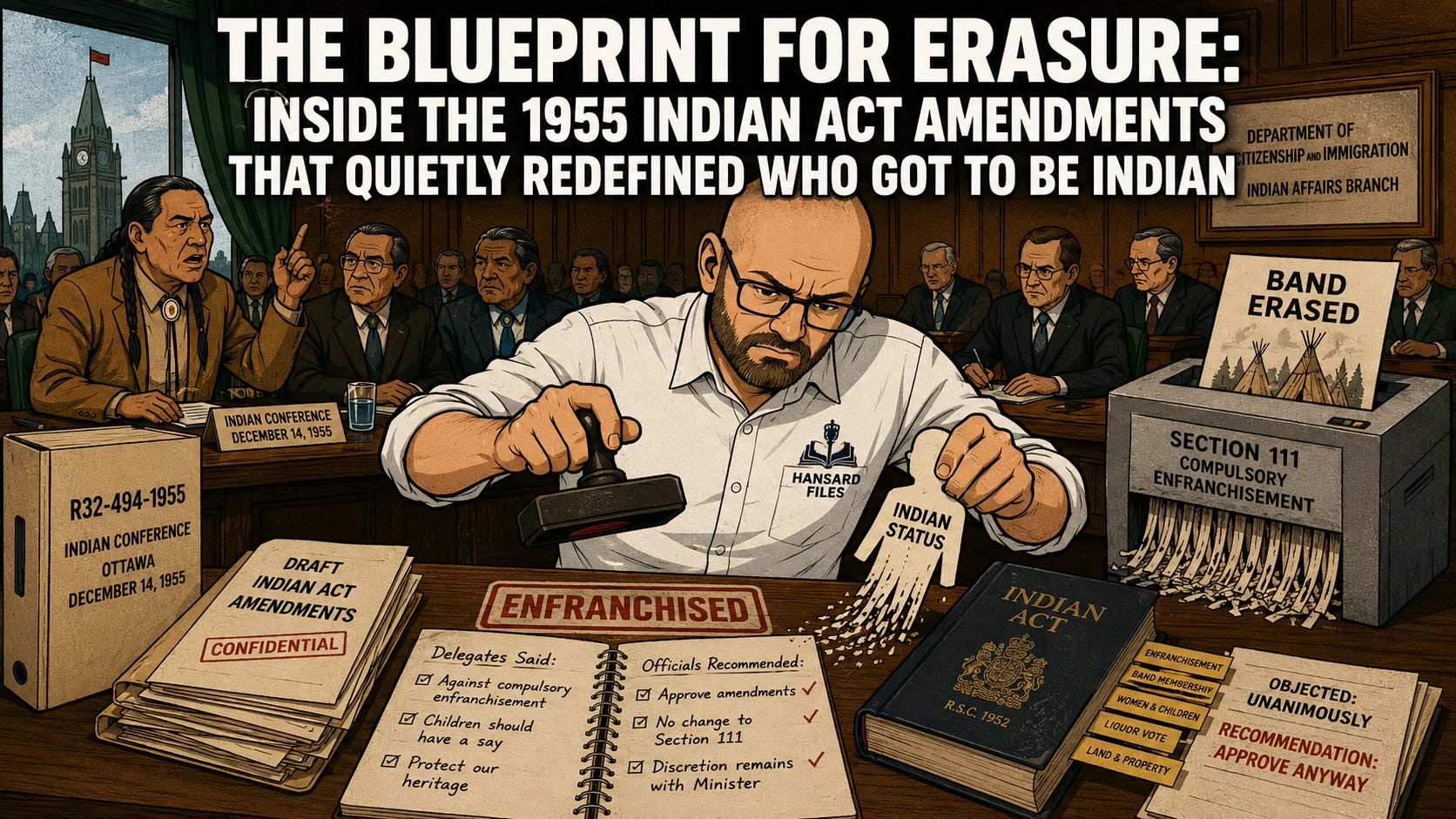
In December 1955, somewhere in Ottawa, a man named Andy Pauli stood up and said that children should not be stripped of their Indigenous heritage without having any say in the matter.
He was not the only one who felt that way. According to the minutes of the Indian Conference held December 14, 1955, recorded in the Department of Citizenship and Immigration’s internal archive that forms the core of this document, delegate after delegate rose to speak against compulsory enfranchisement. The delegates were unanimously against it. Councillors from Alberta and British Columbia said the same thing. A note-taker dutifully recorded their objections. And then the officials wrote back to the minister recommending the amendments be approved anyway.
This is how the Indian Act gets made.
A Document Nobody Was Supposed to Read in Sequence
The file catalogued as R32-494-1955 is a 139-page assembly of draft bills, interdepartmental memos, conference minutes, and legal opinions that circulated between the Department of Citizenship and Immigration, the Department of Justice, and the Indian Affairs Branch between November and December 1955. It was digitized by Library and Archives Canada in 2017. It is not presented as a narrative. There is no summary at the front. Most people who encounter it would spend hours trying to assemble the chronology.
Read in sequence, though, it tells a particular story: the story of how a government decides what an Indian is, who stays one, and what happens to those who fall outside the definitions it has crafted for them.
The amendments under consideration that winter would touch almost every dimension of Indigenous life under the Act: band membership, reserve lands, property inheritance, liquor rights, school attendance, and the procedure by which a person could be legally erased from their community’s rolls through enfranchisement. That last category, above all else, was where the document’s tensions became sharpest, and where the gap between what the delegates said and what the officials recommended was widest.
The Machinery of Membership
Before you can follow the debate, you need to understand what was at stake.
Under the Indian Act, enfranchisement was the legal process by which a person lost Indian status. Once enfranchised, Section 109 of the Act was blunt: the person “shall, from the date thereof, be deemed not to be an Indian within the meaning of this Act or any other statute or law.” Not diminished. Not reclassified. Gone, in law, from the category of Indian entirely.
Enfranchisement could happen voluntarily, but it could also happen automatically. An Indian woman who married a non-Indian man was enfranchised. Her children could be enfranchised with her. And under the provision the delegates in December 1955 most strenuously opposed, entire bands could be compulsorily enfranchised under Section 111 if the government decided the community had sufficiently “advanced.”
The legal opinions circulating in the file tried to be precise about all of this. A November 28, 1955 memorandum from H.M. Jones, Director, to the Deputy Minister of Justice walks through the practical difficulties with real clarity. Jones was not opposed to enfranchisement as a policy goal. He was concerned, practically, that the existing provisions were not working efficiently enough to achieve what he described as the long-range federal objective: “to gradually integrate Indians with the non-Indian population.”
He identified the problem plainly. By 1955, Indians were already receiving most of the social benefits that enfranchisement had once offered as an incentive. They had access to welfare, limited liquor rights in some areas, and in some provinces the provincial vote. If enfranchisement no longer conferred material advantages, Jones wrote, “it is difficult to see why any Indian would apply for enfranchisement.” The solution he recommended was to make it easier for an enfranchised Indian to receive title to reserve land immediately, so the land itself could be sold. The carrot, in other words, was to be made of property.
What the Delegates Actually Said
The Indian Conference convened on December 14, 1955. The file preserves two documents from that day: a summary of main points discussed and a separate record of points arising during the discussion of proposed amendments.
Chief Crowe requested that all individual applications for enfranchisement be brought to band councils for their approval before proceeding. He was told this would happen, though the language in the draft bill preserved no such formal requirement.
A number of delegates spoke against compulsory enfranchisement under Section 111. The note records: “The delegates were unanimously against the provisions of this section.” Councillor Herkimer went further, suggesting the section should simply be dropped from the Act altogether, and if the government later decided it was needed, it could always be re-enacted. Councillors from Alberta raised the question of children being enfranchised alongside their parents without any choice in the matter, describing it as unjust to deprive Indian children of their heritage without some say themselves.
The section on education also produced friction. Mr. Pauli objected to proposed amendments affecting Section 12, which dealt with band list registration, citing potential hardship to certain Indians. He raised the question of whether Indians living on reserves and earning income off-reserve could legally be taxed, and whether band funds could be used for a test case. He was told his concern would be brought to the minister’s attention.
There was considerable discussion, the minutes record, on hunting, trapping, and fishing. Local problems were noted. No further detail was provided.
The Memorandum That Followed
Four days before the conference, on December 10, a lengthy memorandum was sent from the branch to the Deputy Minister recommending approval of the amendments. After the conference, a follow-up memo worked through the results of the December 14 meeting, noting where the Indians had agreed to provisions and where they had objected.
On the question of Section 111, the compulsory enfranchisement provision the delegates had unanimously opposed, the memo noted “there was general opposition to this section on various grounds” before recommending no change. The minister was informed of the delegates’ views. The memo moved on.
On the question of women and children, the file captures a particular administrative anxiety. If an Indian woman married a non-Indian, she was automatically enfranchised. But what about her children? The draft amendment to Section 108 gave the Governor in Council discretion to enfranchise the children as well, as of the date of their mother’s marriage. Jones and the Department of Justice exchanged several letters about whether this discretion was broad enough, whether the drafting accomplished what was intended, and whether children who had been adopted by Indians should be treated differently from those living on reserve.
The memo from Jones dated November 28 is particularly candid on this point. He wanted the minister to have clear discretion to decide, case by case, whether a child should follow the mother into enfranchisement or not. His rationale was partly practical and partly, in the language of the era, welfare-oriented: if a mother had neglected her children and they were living with relatives on the reserve, Jones wrote, “I do not think that they should be enfranchised on account of their mother’s marriage.” If they were following the mother, they should be. The children were, in this framework, variables in a legal equation rather than persons with rights of their own.
Councillor McDougal in Alberta had raised a related scenario at the conference: an Indian woman who is enfranchised with her children, then later marries an Indian and thereby regains status herself. Her children, under the law as written, remained non-Indian. He had asked whether there could be a provision allowing such children to re-enter the band. The minister indicated the point might be covered by another amendment and suggested McDougal raise it again when that section came up for discussion. McDougal did not raise it again. The note records the omission without comment.
The Liquor Provisions and the Mechanics of a Vote
The intoxicant sections of the Indian Act occupied a significant portion of both the conference discussions and the internal memoranda. The 1955 amendments proposed to give bands the right to vote on whether liquor laws would apply to their reserves. Before that, intoxicants on reserves were prohibited under criminal penalty.
The debate in the files about how to implement the voting procedure reveals something about the government’s general approach to Indigenous consent. The question of whether to allow all bands to vote, or only those with treaties referencing liquor, generated back-and-forth between officials. There were also concerns about “nomadic Indians” living on Crown land with no reserve, and whether they should have a vote too. The departmental legal adviser concluded that if reserve Indians had the right to decide, the same right should be extended to those living on Crown lands off-reserve.
But there was a more fundamental concern buried in the memos. The minister had indicated at the conference that he was not, “for the time being,” in favour of liquor outlets being established on reserves at all, even if bands voted to allow possession. The question of what exactly a yes vote would permit was therefore left unclear. The vote was real. The effect of the vote was contingent on subsequent ministerial discretion.
This structure, the formal consultation with a preserved ministerial override, appears throughout the document. Band councils were consulted on leases, then the minister approved them. Councils were consulted on the use of reserve lands for schools, administration, and health projects. But the amendment eventually adopted added “burial grounds” to the list on the initiative of branch officials, not delegates, because, as the December memorandum explained, certain majority groups might otherwise refuse to permit minority church groups to use reserve land for cemeteries. The protection was real. The process that produced it was not the conference.
The Legibility of Illegitimacy
One of the most procedurally detailed debates in the file concerns Section 11(e), which dealt with the registration of illegitimate children. An illegitimate child of an Indian woman was entitled to be registered as an Indian. An illegitimate child of an Indian father by a non-Indian mother was in a more ambiguous category. The 1955 amendments proposed to address this by allowing band councils or a sufficient number of electors to protest the inclusion of a child on a band list within twelve months of registration, if they had grounds to believe the father was not Indian.
The vote taken at the conference on this provision was recorded: 17 in favour of the proposed amendment, 5 in favour of the Act as it stood. Chief Barker, the notes specify without further explanation, voted twice for both positions.
Pauli requested retroactivity. He claimed there were, he believed he mentioned, approximately 200 illegitimate children on his reserve. The branch countered that since 1951 only 17 illegitimate children had been registered as Indians nationally. This figure apparently settled the question, and the amendment was recommended not to be retroactive.
H.M. Jones, reviewing all of this from the Department of Justice perspective, flagged a drafting problem. If names could only be added to band lists automatically, not deleted, then there was no logical basis for allowing a protest against a deletion. Allowing such a protest would, as he put it, open the door to a double protest. His November 30 memo recommended removing the word “deletion” from the protest provision. This correction did not appear to have been transmitted to Justice in the initial draft. The file preserves the back-and-forth as the error was caught and corrected, a small mechanical example of how the law is actually written.
What Happened to Newfoundland
The first section of the document deals with a different question entirely, one that predates the December conference by several years: the federal position on native people in Newfoundland and Labrador after Confederation in 1949.
The summary is administrative and chronological. When Newfoundland entered Confederation, the federal government’s jurisdiction over and responsibility for native people in the new province was deliberately left aside. No special mention of native people was made in the Terms of Union. The province’s position was that its Indigenous and mixed-blood communities were integrated, and it wished to maintain that character. The federal government’s position, for most of the decade that followed, was that it bore no constitutional obligation.
Between 1950 and 1954, a temporary ad hoc arrangement provided some relief and health funding. The federal deputy minister of Justice provided a legal opinion confirming that the federal government did have exclusive legislative authority over Indians, but that whether to exercise it was a policy choice, not a legal obligation. A subsequent legal opinion in 1964 confirmed this interpretation.
Premier Smallwood wrote to Prime Minister Pearson in March 1964 asking the federal government to either assume full responsibility or provide per capita payments equivalent to what other provinces received for their Indian and Inuit populations. Pearson responded by confirming continuing financial support while expressing a preference for provincial administration. The memoranda from that period describe the arrangement as placing Newfoundland “at the terminus” of a process of increasing provincial responsibility that was “just beginning” in other provinces.
The Labrador Inuit communities of Hopedale, Postville, Nain, Makkovik, and eventually Rigolet and Black Tickle are named in successive orders-in-council as the agreements were renewed, amended, and eventually formalized in 1981. The Indian community of Conne River on the island of Newfoundland was added in 1973. The agreement split the Indian and Inuit communities for cost-sharing purposes, owing to what the files describe as the “mixed population” of the Inuit settlements.
At no point in the Newfoundland section does the file record any consultation with the native communities themselves about the arrangements being made on their behalf.
The Estates Section and the Private Memorandum
Buried near the back of the file is a partially illegible handwritten note and a series of internal memos dealing with the administration of Indian estates. The concern was procedural: the branch had in practice been paying minor children’s enfranchisement funds to provincial public trustees or official guardians, but legal advisers had concluded they no longer had clear authority to do so under the revised 1951 Act.
The case motivating the urgency was the pending enfranchisement of the Michel Band. The per capita share was approximately $1,000 per person. There were a large number of minor children in the band. Jones’s memo is direct: “Once we have enfranchised Indians I do not believe we should be holding moneys for them.” The solution was an amendment to Section 15, authorizing payment to provincial public trustees. The amendment was recommended and approved.
The Michel Band is named only in this context, as an administrative problem to be solved before the enfranchisement proceeded. Their collective disappearance from the Indian Act register is treated, in this file, as a background fact.
The Persistent Shape of the Law
The 1955 amendments were ultimately introduced in Parliament the following year. Many of the provisions discussed in this file, including the liquor vote mechanism, the band council composition rules, the surrender and referendum provisions, and the registration protest procedures, became part of the Indian Act’s architecture for years afterward.
The second-generation cut-off, the mechanism by which status degrades over generations of marriage outside the community, is a direct descendant of the logic visible throughout this file: that Indian status is a legal category requiring active maintenance against dilution, and that the protections of the Act are contingent on meeting criteria that the government defines and the government can revise.
Andy Pauli said the children should have a say. The delegates said compulsory enfranchisement should be dropped. The minutes recorded both statements. The recommendations proceeded as planned.
The files were digitized in 2017 and made available through Library and Archives Canada. Very few people have read all 139 pages in sequence.
They are worth reading. Not because the law they shaped is now historical, but because the reasoning used to craft it has never fully left the building.
Hansard Files spends weeks in the archives so you don’t have to. If stories like this matter to you, subscribe to keep this work independent.
Related Hansard Files Articles


Source Documents
Department of Citizenship and Immigration, Indian Affairs Branch. (1955, November to December). Summary of Indian Treaties: Discussion of Amendments to Indian Act [Archival record R32-494-1955]. Library and Archives Canada.
I was a judge for the Canadian National Newspaper Awards again this year, and this story submitted and reported by the National Post (it’s US hedge fund owner is said to have $2 billion of Chinese funding) was one of the three finalists in my category. I volunteer to do this judging every year, and it takes hours and hours to read over 75 submissions carefully. If you read my whole piece right here, you will see how it could link to China. Take the cookie, Canada, and get rich. Then all of the country will gain, and Canada will have more power in the world, which would be a good thing.
This year, I was less inclined for this story to be a finalist— As there were many excellent pieces— until the other judges explained to me more carefully and emphatically that it should be a finalist. I decided to agree to this story as one of the three finalists with the other judges, but not because I was enraged by the issue, but because I worry that perhaps it may be used by rogue interests, looking to gain Canadian land rights or division that divides Canadians, and it’s worth having a conversation about.
I was very curious about how the story would be used by parties that perhaps don’t have the best interests of any Canadians at heart.
The question that I think is at the heart of this story, before we get to the emotional history of the terrible things that happened to the First Nations people, is the logic of today:
At what point is someone integrated into Canada as a Canadian tax-paying citizen without any additional indigenous rights or government payments?
We all belong to some culture from the past that at one point lost land, whether that is Celtic, Anglo, Syrian, or Roman. It’s very sad. War is very sad, and we also progress as nations and build anew through that diversity. Being one population of a nation—Canada, America, and Great Britain—has a lot of strength. So the question that I would like to ask, and I think should be the real debate:
Again, at what point is someone integrated into Canada as a Canadian tax-paying citizen without any additional indigenous rights or government payments?
Once you’re 1/4 First Nation or Inuit, 1/8 First Nation or Inuit, 1/16 First Nation or Inuit?
I think that’s a real question. It seems logical that if you are half, you still have a lot of rights, maybe even 1/4 — but then what?
As many people start to use status as a way to hold up or control mining, hydro deals (note NFLD shout out in this piece), Etc. Any land deals that they need and want to counter… I become a bit suspicious. Especially when the action prevents Canada from gaining. It would be very convenient for an opposition country like China to stir up these issues so that It remains the world's largest mining power and can therefore hold that over the heads of Western nations.
We may want to ask who is really pushing these stories for gain, when it is not that of the Canadians or the First Nations people who prosper. Canada, which should be one of the richest nations in the world, continues to be very poor. Natural resource growth is an incredible opportunity for Canada to gain vast amounts of wealth for all Canadian people.